Author: Sandi Sadar Šoba
Photos: Aleš Podbrežnik
Location: Ljubljana / Dallas Records / Slovenia
Interview date: 05.02.2014
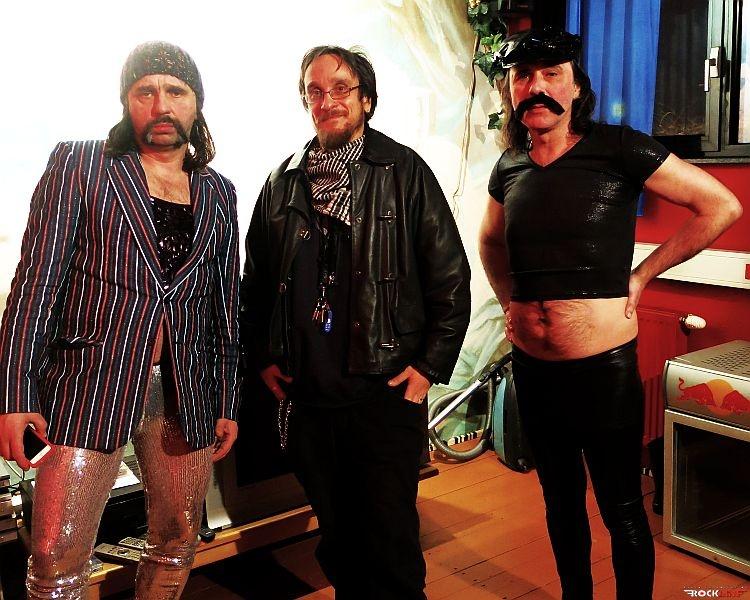
Eccentricity and shock – those are the two words many a casual music fan will blurt out as synonyms for a band that has been redefining what’s allowed in rock since 1986. They’re rockers, they’re punks, they’re a new wave attraction, they’re theatrics freaks, and those mustachioed uncles with a phallic obsession have plenty more to offer beneath the vulgar and provocative surface – sweeter stuff, but of course everyone has to dig their way down to it on their own. After a four-year absence from Slovenian stages (at least when it comes to headline shows), the Rijeka elders of differently-sounding rock in opposition decided on a systematic revival of memories of the past, but with fresh scepters in the fire. Last year brought the heavily spiced record Kurcem do vjere – Thank You Lord, which, along with the anthology-style document of the primordial Let 2 era, the album Punjeta, makes a great jumping-off point for another reckoning with the audience’s expectations. A month before their announced occupation of the innards of Cvetličarna, they made time to talk to us at the offices of their home label Dallas Records. Dressed in eccentric outfits straight out of the disco era and spiced with aesthetic extremity, the band’s two founding fathers Zoran Prodanović – Prlja and Damir Martinović – Mrle sat down in front of the mic, and the journey into the unknown could begin without the usual safe anchor points that some see as bulwarks of security – for the unpredictable founders of the Rijeka alternative, they’d only get in the way of a total release of tension and the fullness of the moment’s inspiration.
Rockline: First off, I’d like to say we’re delighted to be presenting you in depth on our site too, where, enchanted by your albums, we did everything in our power to get to the bottom of things properly. The first question is about the fact that after four years away from your last headline show in Slovenia, you’re coming back to Ljubljana’s Cvetličarna. What are the expectations, and what’s the idea, the story you plan to shock the audience with this time?
Prlja: The expectations are the same as always – lots of stuff happening. As you say, four years have gone by since our last headline show in Ljubljana (which surprises me, I was sure it had been less time than that), and we heard that Cvetličarna has been renovated in the meantime …
Rockline: They’ve got, among other things, a bigger stage …
Prlja: It’s nice to hear stuff like that too, and … The show will be an explosion of Let 3 in color and in sound, and we plan to give it everything, the very best we’ve got, and …
Mrle: Pathlessness … It’ll be a total excursion into the pathless, where there’s no beginning and no end – just pathlessness.
Rockline: We live in times of pathlessness that follows us day after day …
Mrle: It’s not about that kind of pathlessness and aimlessness, but about a positive pathlessness, where there are no limits. It’s a spiritual pathlessness, a release, where you get one deep inhale and one long exhale.
Rockline: What will the central thread be, the focus of this musical marathon? Will it mainly present stuff from the latest record Kurcem do vjere, followed by the old creations, or is there a special dramaturgical thread with its own kind of storytelling that you plan to use to challenge the audience in your own way this time?
Prlja: It’s a cross-section of our entire career, or careers, which might sound like some kind of The best of. Of course we’ll play material from our latest work, but we won’t skip or leave out the standards that people who know us expect. We’ve been playing them for years, so there’s no reason to cut them. You’ll get a Let 3 concert in all its charm, and the fun will suit above all those who’ve been following us for years – everyone will get what they want and what they need.
Mrle: I won’t tie myself directly to that question. Our last two records aren’t conceptual wholes with some rigid narrative. In essence they’re conceptual albums built out of lots of smaller bits, scraps. Why did that happen? Because about four years ago we were working on loads of projects, like theater productions, films, releasing video clips that were very topical because of their political engagement. Meanwhile, in our rehearsal space we jammed through our two records, so we collected those recordings too. Then we gathered this period of truly excessive work into one pile, compiled it, but we weren’t making music with the aim of creating a Let 3 album. That was a period in which we threw ourselves into all kinds of pursuits that fall within the field of numerous arts – film, theater, music and video production, as I said. Our Ljubljana show will be calibrated in a similarly compilation-minded way, covering the entire period and all the epochs of Let 3.
Rockline: I’m glad that with Punjeta you also closed a long period of waiting and essential vacuum in a special way, and honored the memory of the Let 2 era, that primordial period that made the Let 3 form possible in the first place. Why did it take so long? Why did you put off releasing these first pearls of your creativity for so long?
Prlja: When we recorded this material in the eighties, there was simply no chance of releasing it, because nobody wanted to put it out, so the material lay in the archives in our bunker for ages. Then we worked on new things that shifted our priorities, and the old stuff just never came up. Last year we decided the time was ripe and that it was time to put all those archive moments into one shared form for the audience’s ears, and the initiative came from the top man at Dallas, Fox (Goran Lisica Fox is the owner, music producer and director of the Croatian label Dallas Records, which was founded in Ljubljana in 1987 – editor’s note). Before that they had already released a whole range of important Rijeka punk anthologies – they put out Termite, the compilation titled Riječki novi val, then came Krč, Mrtvi kanal, and Let 2 fits naturally into the concept of the label’s editorial policy. On the other hand, we’re glad we could release something that, despite the time lag, is still just as topical in sound as in content. I have to admit, sadly, that some lyrics we wrote three decades ago are tailored in a way that describes today’s picture too. An example is the song Punjeta, which is a new, previously unreleased song on this material, and we gave it the lyrics of Gomile, a song written in the Let 2 era.
Rockline: Were those fragments, a split-up mosaic, or a complete form?
Prlja: In the Let 2 days we had some great lyrics in our catalog, which weren’t called Punjeta but Gomile umiru glasno. We borrowed that text and wrote a completely new musical bed for it, and on the textures of 2013 music, the text from 1984 sounds very topical …
Rockline: Except that instead of socialism you’re now settling scores with capitalist oligarchs and the times?
Mrle: With them too. If thirty years ago Tito and the Party were fucking us over, and we couldn’t wait to get rid of all that, now it’s the church that’s working us over nicely, fucking us up so concretely, at least here in Croatia. They’ve got very similar grips, and they harass us in exactly the same way …
https://www.youtube.com/watch?v=oxfIjYwab94
Rockline: Only the colors and the ideology have changed … During the Punjeta period, with the album Kurcem dovjere, hand in hand with reviving old memories you were also writing, in the new era, material that’s thoroughly topical. The red thread of this current period is?
Mrle: Like I just said. The stance against the church is only one of the moments. We have to admit that people today are still very manipulated and everything’s pretty bad. I hate seeing this nation harassed and exploited, and we felt the need to articulate things because the situation has stayed unchanged, the same. Societies have changed, only the ones doing the harassing have swapped places (or at least the name of the system has). The people themselves are oppressed and manipulated in exactly the same way.
Rockline: Aesthetic shock has been what drew attention to you since day one of Let 3, but I get the feeling you’ve moved theater from the stage into all of life too – to borrow Shakespeare’s line »All the world is the stage and people merely players …« If the world is theater, we all play our social roles in it, and Let 3, besides being a show on stage, is also an honest critique of society both on the stage and off it?
Mrle: Absolutely! It’s a stance and a reaction to the state we live in. Some say we’re big provocateurs, but that’s our recognizable expression, our authenticity and originality. We were given it in our artistic cradle to react to every fucking thing that happens, it outrages us and drives us to have to give our take on it. That can sometimes be ill-mannered, tasteless and shameless.
Rockline: When something happens and you see it for the first time, the shock is there, but any later stagings can only be repeats, repetitions. After so many aesthetic shocks, how do you plan to upgrade the moment of shock and the ideology of Let 3 itself on the new tour?
Prlja: We don’t burden ourselves with having to raise the bar in the manner of Sergey Bubka. We’ll see, something like that comes up and gets set in motion in the course of the work and the action itself, and then it can become a kind of overarching concept. Things show themselves to be important over time, during the happening itself, and things become clear through their smell, their aroma. We don’t strive to come up with some bigger shock out of necessity. Then it’d probably be best to cut our dicks off on stage – that would probably shock people, but we don’t go to such extremes and that doesn’t suit us … We don’t always think there has to be a shock here.
Mrle: A thing can be extreme, but it’s not a must. Shock for shock’s sake is completely pointless to us. At some moment shock is fine, but having it as your consistent form …
Prlja: We don’t feel any obligation, commitment or necessity, even though pretty much anything can be expected of us, and we won’t be breaking any rules, so to speak, if we decide at some moment to deliberately let the shock loose.
Rockline: The release of the record Jedina was a shock of its own kind. You recorded it in extremely good production, and it was supposed to come out at first in just one copy on just one medium. Then the original idea got distorted and now Jedina is on three records with 22 different songs. How do you see the fact that at some point the label itself managed to pervert you?
Mrle: We got angry at them at first, and then we decided to release three different records. »If you cunts put out two, you’ll have to put out two more, otherwise we’ll sue you.« So now you’ve got three different records available.
Rockline: Before our interview I took the time to talk to the other three members of Let 3 (the lineup is completed by drummer and percussionist Branko Kovačić – Husta and guitarists Dražen Baljak – Baljak and Matej Zec – Knki, with Ivan Šarar – Faf occasionally on keys – editor’s note), and a good idea, one that would keep Jedina from losing its form, would be a box set of three albums in one package. How do you two see that?
Mrle: Re-releasing it all over again?
Rockline: If we look at the whole period, the band’s millennial epoch, it would be a restorative opportunity to pay tribute to the record in a way we could calmly and happily agree on.
Mrle: Then it’d look nicer on vinyl.
Prlja: Given the amount of material, it would have to be a double vinyl, say, which would put out all three versions, since a single vinyl couldn’t cover all three albums time-wise. One record is too short in minutes.
Mrle: Then why not make three records?
Prlja: Okay, a triple record can be done too.
Mrle: That way we could repeat the principle of all three records in the same way, and it’s simpler.
Rockline: If I’m not mistaken, you’ve been in this lineup since 1997? How did this crew come together, one that’s stuck together so long and works so well?
Prlja: At one point some old structures and former members dropped out of the story, both because of their private lives and because over time some of them just weren’t interested in doing this stuff anymore. On the other hand, Rijeka in those days was marked by a very compact scene, everything gravitated toward the club Palah, and we also had good festivals, like the rock kitarijade and such. It was completely normal that we old musicians hung out with younger ones, and those then-young guys we knew, we invited into the band, and they accepted the invitation. Things turned out good and the energy flows between us ran nicely and worked great. This lineup has been together for quite a while now and it works, most importantly, smoothly and punchily.
Rockline: Since you’ve just touched on the Rijeka scene – it has always been an important factor and the epicenter of music-making in Croatia. What’s the situation in musical Rijeka today? Lots of bands simply died out after a very promising start …
Prlja: Rijeka has always had its own spirit and it’ll keep having it. Now such times and cycles of change have come, and back in the day we also saw periods of idling on the scene, and then creative generations happened again, or at least individuals who pull things forward. Things get pulled along by some clubs or spaces that become relevant … I can’t claim I follow and know everyone who’s in Rijeka’s garages right now … I wouldn’t say this dying-off is symptomatic only of Rijeka, if it’s even a problem, since young people can be creative with something else. In our years, in our time, we understood that being in a band was something completely natural. Everybody rushed to start bands – those who could play, as well as those who had no clue about it but were in a band anyway. Now these, let’s call them, herds and packs of young generations form up a bit differently. On the other hand, there’ll always be a percentage of youth who love music and who play not just well but superbly. Better than we did when we started out. The question of creative calls and infections, the question of strong individual authors with their own thing, who are also stubborn enough and have the balls and defiance built into them to break through the frames of a small, closed scene like Rijeka’s, is another matter.
Rockline: What would the response be, say, to a call to all young Rijeka musicians, offering them your material to do anything of their own with, anything creative, so that we’d get a Tribute To Let3 seen through the eyes of young musicians? Would you dare to do something like that?
Mrle: Who’d bother with them?
Prlja: Personally I think it’d be interesting to see how someone hears and understands us and what they see as content-wise interesting to rework in us, but that’s not my preoccupation.
Mrle: You do it and put it into the form of yet another album of ours … Come to Rijeka, you’re invited to test your creativity …
Rockline: The quality probably wouldn’t be as high as yours, since a few years back I had bands that broke up in the name of quality. It was the only fair thing to do by the audience … (laughs) But for the big finale of the interview I’d rather leave that last message to you, so you can address our readers completely without brakes.
Prlja: I’d call on them to come to the show at Cvetličarna on March 6, because it’ll be a unique chance to spend a few hours together in great atmosphere and energy. On the other hand, I’d tell them we’re thinking of them, that we’re working a lot and intensely, and that we’re working on new material that they can rightfully look forward to.
Rockline: Mrle, one more for the finishing touch.
Mrle: Strong spurts of ejaculate into eyes that can’t see yet. (or am I jerking off into your blind eyes – editor’s note)
interview conducted and edited by: Sandi Sadar Šoba
Photo gallery