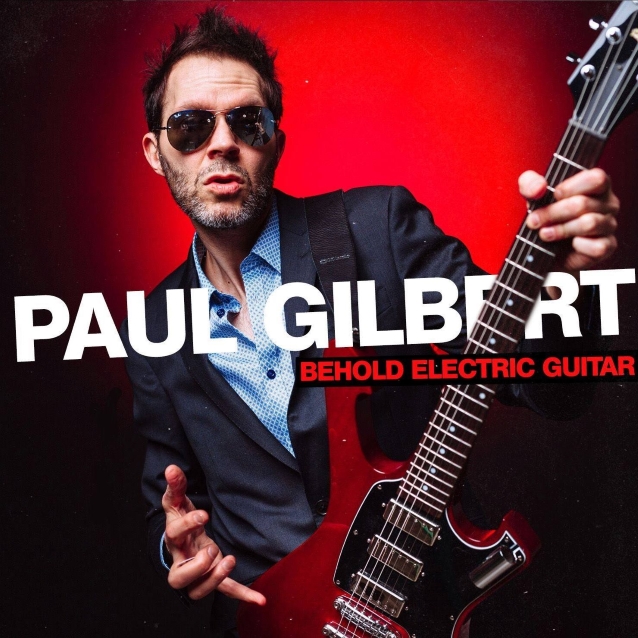
Label: Mascot Label Group / Music Theories Recordings
Release date: May 17, 2019
Production: John Cuniberti
Album length: 58.36 min
Genre: Art Rock
Rating: 9.5 / 10
Paul Gilbert came back in the middle of May with his 15th solo studio album, titled “Behold Electric Guitar”! The tireless guitarist, surely one of the most dazzling, let’s just say brilliant, guitar greats of his generation and beyond, and one of the hardest-working and most dedicated musical artists out there. Insightful, forever bursting with flashes of ideas, with a lush creative imagination, which feeds his huge charisma as a guitar player, or rather the wizardry of enormous manual dexterity in mastering the six-string theory. Not just on this planet, but probably in the whole galaxy.
Lately it feels like Paul is mellowing out a touch. Not literally. It’s hard to say Gilbert can mellow out at all. He’s exploring new horizons, and so, slowly, through an ever-growing flirtation with the blues, he’s found a new love. Jazz. Don’t worry, “Behold Electric Guitar” is Paul Gilbert, not jazz. In fact, judging by what its successor brings, it’s now even easier to label “I Can Destroy” as the record that closed one era of Paul Gilbert’s career as a solo guitar artist, because with “Behold Electric Guitar” he opens entirely new chapters in his artistic growth.
What fascinates me about Gilbert is the way he composes. His approach to the process of creating a song. He first writes the lyrics and then derives a vocal melody from them, which is then arranged to be played on guitar. The guitar fully takes over the role of the vocals. It’s no surprise he put out a compilation of covers in a strictly instrumental version of works by some of his favorite artists, “Stone Pushing Uphill Man” (2014), and no surprise that at least a third of what he plays at his gigs is covers. Even back then Gilbert pointed out, that his biggest challenge was to carry over, as authentically as possible, all the emotion radiating from the vocals of Mike Reno (Loverboy), Paul McCartney, Elton John, Sting… into the language of expression of his guitar playing on the aforementioned covers album.
On the new album Gilbert once again proves to be a guarantee of grand eclecticism. For this record Gilbert teamed up with John Cuniberti, who’s best known for his work with Joe Satriani in particular. Not because Gilbert happens to be a Satriani fan, but because he’d come across the single-microphone recording technique Cuniberti practices, which delivers the most authentic transfer possible of what’s played in the studio onto the recording and into the ears of the listener. When Gilbert moved from Los Angeles to Portland, where Cuniberti is also based, he met a whole bunch of eminent local musicians. Alex Fulero and bassist Roland Guerin joined the recording process of the new album, while the drumming duties were split among three drummers. Gilbert was thrilled with Cuniberti’s method, and the band set up in front of a single (stereo) microphone, live-gig style, to play and record all the compositions in one take. Since Gilbert’s guitar kept coming out too loud, they eventually agreed that each player would get their own mic, and they simply repeated the recording with multiple microphones.
“Behold Electric Guitar” is of course a Gilbert product, but perhaps more than ever before in his solo career, in terms of cohesiveness it comes across as an album made by a band. The playful Havin’ It already signals that, wrapped in the warm embrace of good old Hammond sound, and yes. Especially thanks to the cheeky Fulero, the “jazz” label fits nicely right from the start. Gilbert remains a big joker. The song titles give that away, and it would be interesting to read the original lyrics too, which Gilbert mumbles before he “shouts them out” on the guitar. The blues “shuffle” in Blues For Rabbit (a blues for Johnny Hodgesa, whose nickname is “the Rabbit”) still sounds thoroughly “Gilbertesque” and exceptionally special, backed by the strong aural and performing charisma of all the players. I Own A Building comes from a story about how the owner of a giant building showed the members of Mr. Big every last corner of his private property, while A Herd Of Turtles is a bit of a humoresque, an experiment in narration crossed with sudden jumps into fast funk, and the narration move recalls The Police’s trick in Be My Girl, Sally. In the “burlesque” Sir, You Need To Calm Down, Gilbert wove in a story about missing a flight. Every Snare Drum carries the story of Gilbert’s visit to Hawaii, where he found that every restaurant plays the same music, which started to drive him extremely nuts. It’s hard to put up with, after all, when every snare drum in everything you hear sounds (rings out) exactly the same. In Love is the Saddest Thing we run into anything but a “dirge,” instead it’s a wound-up boogie rock stampede, while in the relaxing I Love My Lawnmower Gilbert devotes himself to mowing his little patch of lawn in Portland. A Snake Just Bit My Toe is another excellent highlight, where Gilbert goes full bluesman (“his own kind,” of course). Things Can Walk To You is a playful closing garnish to an album of superb blues and jazz fusion, with a proper rock grip, of course. A truly theatrical finale.
The use of the slide thimble is interesting too. It hangs on a magnet built into the body of Gilbert’s guitar. Gilbert puts it on his middle finger, and it’s incredibly interesting how deftly he alternates between “normal” playing and playing with the thimble (Things Can Walk To You, I Owe A Building).
With “Behold Electric Guitar” we can say it’s Gilbert’s most defined and accomplished work to date, in the sense that everything on it feels like there’s a band behind him and not a solo artist. Fulero’s integration is hugely important. He’s such a penetrating keyboardist that Gilbert often lets him loose on improvisations, and through the course of the evolving song structures it’s not hard to tell that it’s Fulero’s playing (his fills) that often fires Gilbert up, pushing him into resolving situations paved by the sparkling, inspired keyboardist with insightful moves, something Gilbert hasn’t experienced before. And the chemistry is outstanding. The chemistry of a quartet. The fusion is no less outstanding. A level of fusion that culminates in utterly unusual musical extravagance and an adventure full of eclecticism. No. Gilbert approaches his improvisations in a noticeably tamer, more considered way than you’d expect. Still, he thrills with his trademark ultrasonic madness of string-skipping between arpeggios and all the tricks of the extreme comedy of guitar-shred slapstick we’re used to from him. But like I said. “Behold Electric Guitar” is a great step toward new dimensions, and it wouldn’t be surprising if, in these fusion adventures, Gilbert is also growing into an exceptionally refined arranger.
Behold Electric Guitar is at the same time an incredibly musical and infectious record, a work of rock fusion, and when you add all of Gilbert’s uniqueness, you call it “art rock fusion.” A brilliant blend of classic rock (The Beatles remain the compositional platform), jazz and blues, which of course only a genius of Paul Gilbert’s caliber can create. Just the right measure of everything. An unpretentious and superbly balanced record. Mature! Gilbert will clearly keep maturing in this direction, and given the pedigree of his technical perfection and flawless execution, it’s a dimension in which the musician freely develops and keeps moving forward by challenging himself!
author: Aleš Podbrežnik
Tracklist:
1. Havin’ It
2. I Own A Building
3. Everywhere That Mary Went
4. Love Is The Saddest Thing
5. Sir You Need To Calm Down
6. Let That Battery Die
7. Blues For Rabbit
8. Every Snare Drum
9. A Snake Just Bit My Toe
10. I Love My Lawnmower
11. A Herd Of Turtles
12. Things Can Walk To You
Line-up:
Paul Gilbert – guitar
Roland Guerin – bass guitar
Asher Fulero – keyboards
Brian Foxworth – drums
Bill Ray – drums
Reinhard Melz – drums