Label: EMI Records
Release date: 14.04.1980
Producer: Wil Malone
Album length: 40.25 min
Genre: Heavy Metal / N.W.O.B.H.M.
Rating: 8.5 / 10
On April 14, 1980, music history changed forever in the blink of an eye. A history that had started being written five years before the debut of the heavy metal monster Iron Maiden. Santa was generous indeed on Christmas Day, way back in 1975, or maybe the name Steve Harris was sitting at the top of his “nice list”. Cookies and milk were always waiting for the ever-jolly man in red on Harris’s table, and in return he left a package under Steve’s Christmas tree, wrapped in shiny paper and tied with a big red bow, but bearing the ominous name of a medieval torture device: Iron Maiden.
A fair bit of water went under the bridge before Iron Maiden mastermind Steve Harris gathered a stable lineup around him and, after almost five years of playing, managed to release a self-titled debut on EMI. But the runaway train called Iron Maiden was already unstoppable before that release. The best way to sum it up is with the words of the notorious Soundhouse DJ Neil Kay, who played an important part in Maiden’s early breakthrough: “Every once in a while, a very special band rises out of the mass of hopeful, unknown names filling the streets of the rock world. One of those bands is Iron Maiden, who with their birth brought a style of rock music so powerful, bold and honest that only success can justify their effort.”
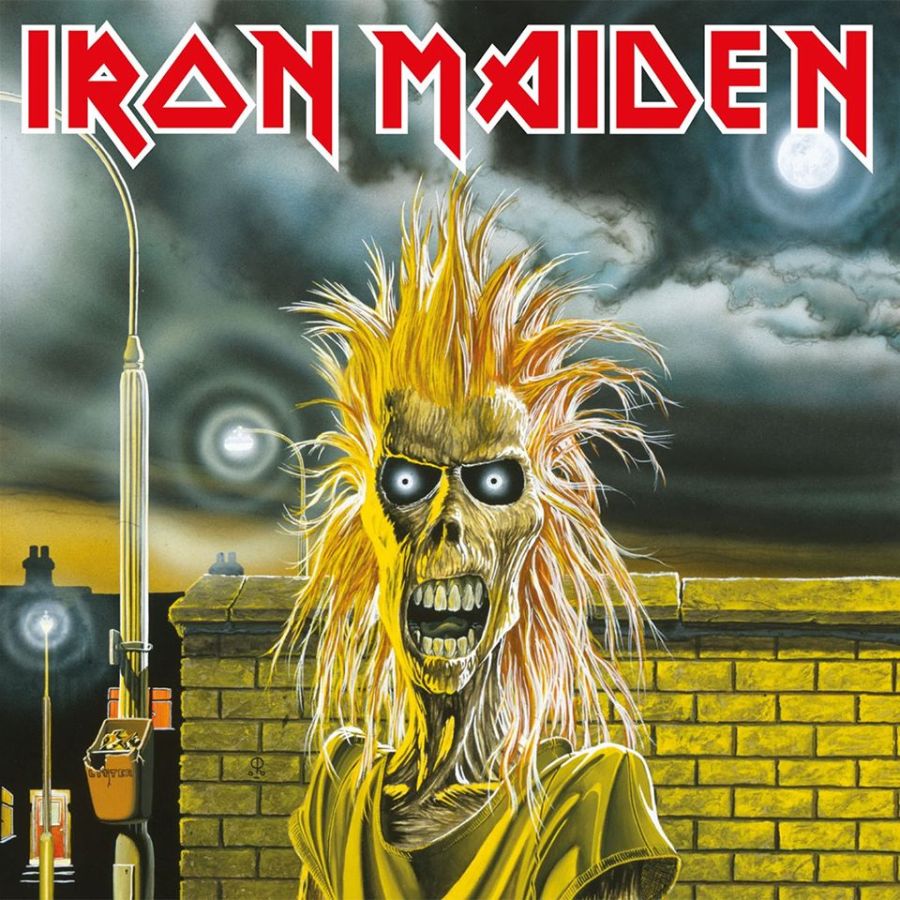
Iron Maiden delivers a sound you won’t be used to if you only know the Bruce Dickinson era. What defines the debut is above all a raw, primal, almost primitive “punky” sound, which will shock anyone used to the typical Iron Maiden melodies of the Dickinson era. That quality comes mostly from the raspy voice of Paul Di’Anno. Sure, Di’Anno is miles behind Dickinson in quality, but I personally think he was never appreciated enough. He fit the raw sound of early Iron Maiden like a glove, since the Maiden’s beginnings are defined by an unpolished, dirty sound, both in the material itself and in the production. The band themselves, or rather ‘Arry, are mostly “to blame” for the “dirty” production of the first record, since even though Will Malone is listed as producer, they did most of the production work themselves. Even though Harris has said more than once that he’s not exactly proud of the album’s production, plenty of fans still count the first two records among the best Maiden ever recorded. No wonder, since with their raw energy and power they get you hooked fast. Iron Maiden also brings the signature rattle of the bass of the fast-fingered Harris, which has always been the central driving force of the dynamic songs and over a thirty-year career became Harris’s trademark sound. For most people, one of the first associations with the words Iron Maiden is the charismatic “mascot”, drummer Nicko McBrain. We’ll get to know Nicko well later, but on Iron Maiden it’s Clive Burr who steps up, forming an extremely tight rhythm section with Harris. Last but not least, there are the excellent guitarists Dave Murray and Dennis Stratton (Iron Maiden is the only record he played on), who point to another trait that became inseparable from Maiden: the triple-guitar harmonies. Murray especially shines with some truly excellent solos that became an important part of the band’s unforgettable repertoire. I have a feeling I’m forgetting something… Ah, of course, Iron Maiden doesn’t just bring the sound that defined heavy metal, the cover introduces us to the character who became the band’s most recognizable symbol, and the symbol of heavy metal, and turned into a full-on brand: Eddie, aka Edward the ‘Ead, Edward the Head, or Edward the Great. Whatever you want to call him, he glares menacingly at us from the cover, the first in a series of fantastic illustrations by Derek Riggs. Maybe I should quickly mention the story of how Eddie got his name: “Eddie the Head was born without a body, without arms or legs. All he had was a head. Despite this flaw, his parents loved him dearly. For Eddie’s sixteenth birthday, his dad and mom found a doctor who was able to give Eddie a body. When the parents got home, they could hardly wait to tell Eddie that he’d get a body and become like all normal people. They said to Eddie: ‘You won’t believe the surprise we have for you! You’ll never get a better present than this!’ And Eddie replied: ‘Oh no, not another bloody hat!'”
If any metal band deserves a closer, track-by-track breakdown of their albums, it’s Iron Maiden, of course. If you don’t know the record in front of us yet, I recommend you stop right here, run to the nearest record shop and add Iron Maiden to your collection, where it really should have been already! Why am I telling you this? I don’t want to spoil the joy of hearing this excellent debut for the first time. Give the record a spin and then come back here. True fans already own it, of course, and won’t be in for any big surprises, but maybe I’ll reveal a detail or two you don’t know yet. So, let’s get started!
The record opens with the hard-hitting Prowler, which wins you over and hooks you from the very first bars of its infectious melody. The thrilling up-tempo of the song perfectly captures what’s going on in the head of the flasher the lyrics describe. Thanks to its great melody and raw power, Prowler became one of the band’s most popular songs and a live favorite. Even though its pretty shallow lyrics, about a pervert who likes to open his coat in front of unsuspecting ladies and show off his goods, don’t reach the band’s later lyrical masterpieces, it earned its place in the hearts of all the band’s fans with raw energy. Prowler had first appeared on the band’s first official recordings, The Soundhouse Tapes, but the faster version on Iron Maiden completely overshadows the older one. Murray sets it on fire with the solo and the punchy “wah wah” riffs! Sanctuary was the band’s second single, and it only made it onto the American release of the album, reaching the European version only with the 1998 reissue. Sanctuary continues in the same fast, punchy vein as Prowler, and it’s about a fugitive from the law who was driven to madness by all the awful things he witnessed. A simple, energetic song that doesn’t reach Maiden standards, but thanks to good riffs and Murray’s solo, followed by a realistic police siren (imagine listening to it in the car), it earned a place among the band’s better-known tracks. As a curiosity, let me also mention the dust kicked up by Riggs’s single cover, which shows Eddie having just stabbed the Iron Lady Margaret Thatcher. Remember Tomorrow is definitely the song that set Maiden apart and lifted them high above the punk scene of the eighties. A dynamic track that swaps calm and heavy parts, it became one of the band’s evergreens. One of Di’Anno’s better vocal performances, as he trades high screams with an equally screaming guitar. Running Free was the band’s first single and still stays one of their best-known early songs. Sadly, it’s also one of the weaker tracks on the record, since with its repetitive chorus and simple structure it waters down next to the rest of the songs. The lyrics are also a simple story, about a runaway teenager who hitchhikes across the USA, and Di’Anno claims the story describes his own troubled teenage years. Pointing to the band’s later genius is without a doubt the best song on the record, the first of Harris’s “epics”, Phantom of the Opera. It’s of course based on the 1910 novel of the same name by French writer Gaston Leroux, about the disfigured phantom Erik, who terrorizes the Paris Opera House and falls in love with opera singer Christine Daae, leading to an inevitably tragic end. Instrumentally it’s one of the best Iron Maiden songs, since eight brilliant minutes don’t allow a single boring moment. From the opening guitar motif, through several complicated solo sections with guitar duels between Murray and Stratton, the excellent fit of Di’Anno’s vocals and the dynamic rhythm section driven by Harris’s typical gallop, it’s pure Maiden perfection. One of the most brilliant instrumental parts can compete without shame with the one in the epic Seventh Son of a Seventh Son. Harris’s progressive rock influences show in the first of the band’s four instrumentals, the fantastic Transylvania, in which every single member of the band goes wild and races like a buffalo stampede. Once again the excellent Murray and Stratton trade solos, while the rhythm section, undoubtedly the best of its time, destroys everything in its path. The song originally had lyrics, but they were dropped because of the excellent instrumentation. Would they have been about vampires and Vlad the Impaler? Transylvania quietly slides into the wistful, melancholy Strange World, which introduces a gentler, more melodic Di’Anno that fits superbly with the song’s calm, slow tempo. One of the better lyrics on the record offers no direct explanation and leaves room for your own interpretations, ranging from drug references to the theme intertwining with the vampire theme of Transylvania. Personally I read the lyrics as a description of a utopian future, reminiscent of Huxley’s Brave New World. Next comes another band classic and, together with Phantom of the Opera, the best song on the record, the first of four parts about the prostitute Charlotte, Charlotte the Harlot. The lyrics, about the troubled love for a prostitute and the pain that comes with it, are matched by an instrumentally excellent song, in which Murray, who wrote it, shines above all, while Di’Anno proves himself in the calmer section, which provides great variety and dynamics. The record closes with the song Iron Maiden, which became the band’s anthem and the only song they’ve played from their beginnings to this day. A shame, you could say, since it’s a completely average song, with no solo whatsoever and strange lyrics. It’s hard to understand how such an average song became a mandatory part of the Iron Maiden repertoire.
Iron Maiden is a record that belongs in every metal collection, even though it only hints at the band’s later brilliant work. Despite the fact that the guitars, bass, vocals and shallow lyrics are far from what Maiden gave us from The Number of the Beast onward, Iron Maiden is the best record of the New Wave of British Heavy Metal (NWOBHM), even though Iron Maiden moved quite far from that sound before long. Iron Maiden is a superb showcase of the evolution of the Iron Maiden sound and a historically important release, for the band, for the genre and for music history as a whole. Up the Irons!
author: Rok Klemše
Tracklist:
1. Prowler (03:56)
2. Sanctuary (03:16) – 1998 remastered version only
3. Remember Tomorrow (05:28)
4. Running Free (03:18)
5. Phantom Of The Opera (07:08)
6. Transylvania (04:19)
7. Strange World (05:32)
8. Charlotte The Harlot (04:13)
9. Iron Maiden (03:36)
Lineup:
Paul Di’Anno – vocals
Dave Murray – lead and rhythm guitar
Dennis Stratton – lead and rhythm guitar, vocals
Steve Harris – bass guitar, vocals
Clive Burr – drums