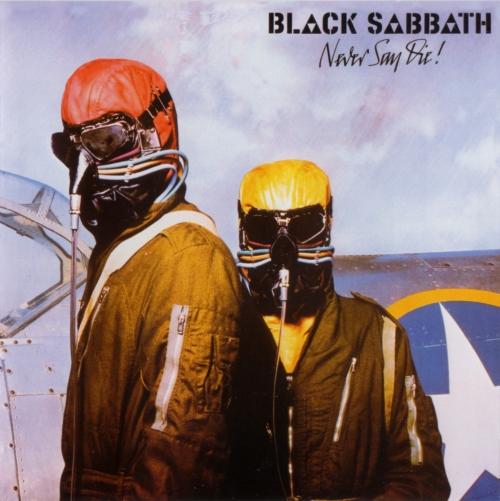
Label: Vertigo Records
Release date: 28.09.1978
Production: Black Sabbath
Album length: 45.41 min
Genre: Heavy Metal
Rating: 7.0 / 10
“Never Say Die” was the farewell album of the classic Ozzy-era Black Sabbath and their least convincing effort of that period. Thanks to some unusual sonic detours away from the familiar ‘doom & gloom’ metal vocabulary, it’s anything but a favorite among the traditional fan base. You could say it marks the decline of the most beloved lineup, caught in a classic identity crisis, when the label of godfathers of heavy metal suddenly started to chafe. So they unexpectedly went back to their blues roots while also trying to experiment with various sonic shades from the prog rock world, with a “whatever happens, happens” attitude. Several different factors were to blame, led by the notorious singer Ozzy Osbourne, whose problems with intoxicating substances peaked around this time, to the point where he was so wasted that he made a habit of skipping live shows.
Before the recording of “Never Say Die”, the follow-up to the excellent “Technical Ecstasy” (1976), he decided to leave the band of his own accord. So guitar innovator Tony Iommi, bass oddball Geezer Butler and drum wizard Bill Ward found his replacement in Dave Walker, former singer of Savoy Brown and Fleetwood Mac. With Walker in the lineup they even played live once, at a promo appearance for the BBC, where they performed an early version of “Junior’s Eyes”. Well, Ozzy, the sly old fox, changed his mind at the last minute, just before the rest of the band headed into the studio, and managed to talk his old buddies into taking him back, on the condition that they rewrite the songs Walker had worked on.
Under such strange circumstances they made an album that, with its mostly playful vibe and unconventional sonic adventures, is practically the polar opposite of the usual dark Sabbath ‘doom & gloom’ standards and has little to do with heavy metal. They went back to their blues rock roots and also experimented with symphonic touches and even jazz. At best you could call it classic hard rock with experimental art rock elements.
None of that would be wrong in itself, but through certain compositions “Never Say Die” chronically suffers from uninspired arrangements, and above all its momentum is sapped by Ozzy’s at times downright apathetic vocal approach. He later voiced his dissatisfaction with “Never Say Die” in interviews many times. It was recorded in Toronto, Canada. The album is by no means without virtues, and here and there you even get flashes of the expected Sabbath brilliance, where the instrumental finesse of the individual members impresses. Ozzy, who was already half-minded toward a solo career, still shows signs of ‘life’ in places, too. The orchestral arrangements by longtime collaborator Will Malone are also put to good use, while the legendary Don Airey (now with Deep Purple) shines on keyboards. Ozzy would invite him into his solo band a few years later.
Among the better “Never Say Die” moments is certainly the solid title track, the last Sabbath single written with Ozzy (until the album “Reunion”, 1998) and the best-known cut from this album. It has a repetitive chorus, fueled by a ‘rabid’ guitar riff and laid over a sleepy bluesy rhythm, yet the end result is a surprisingly intense atmosphere. The lyrics are pretty ironic, referring to the previous ten years of their existence and the idea that you should never throw in the towel, even though Ozzy left them for the second time after the album came out. “Johnny Blade” has a sacral synth intro and, with its fatalistic guitar riff, repetitive rhythm and lyrics about a crazed killer, it’s the only moment on the album that somewhat recalls the legacy of the dark and chilling Sabbath. Iommi is as ever superb at weaving innovative guitar phrases and solos, and he saves the day where Ozzy fails to deliver convincing emotion.
The mighty hard rocker “Junior’s Eyes” is convincingly the best thing on the whole album, and you can easily feel that more effort and emotion went into it than into the rest of the “Never Say Die” songs. Geezer’s melodic bass lines nicely build up the melodramatic mood, while resolute guitar passages run over them and synth effects wander through in between. Even Ozzy’s vocal sounds more convincing here, as he sings the tale of a tragic family story, than on most of the other tracks. The complex instrumental section, led by a mouthwatering guitar solo, is a nice showcase of the technical chops of his three instrumental bandmates.
The blues rocker “A Hard Road”, the album’s second single, is notable for being the only song in the Sabbath story so far where all the band members sing backing vocal harmonies, including Iommi, for whom it remains the only vocal outing of his career. Sadly, it’s still one of the weakest, or least inspired, pieces in their history. Ozzy’s vocal moaning, thrown over a repetitive rhythm and a spicy guitar phrase, sounds more like the groaning of the village drunk than one of the most ‘evil’ vocalists of all time. Well, at least Iommi’s guitar finesse comes off as fascinating here too.
“Shock Wave” is a solid hard rocker with a playful vibe and an unusually sped-up rhythm, which goes especially for Ward’s drum fills. Despite the good ideas, though, it never quite manages to develop its atmosphere fully. The prog rock surprise “Air Dance”, another of the rare “Never Say Die” gems, has an epic guitar sound and lovely arrangements on acoustic guitar and piano, which somewhat revives the memory of their best days, while Ozzy once again sings emotionally however it comes out. The closing complex instrumental section with gorgeous symphonic arrangements is a proper art rock treat. The end result is an intense, distinctly ethereal atmosphere, the kind that’s sadly missing from “Never Say Die” far too often.
“Over To You” is yet another interesting experiment, a fairly successful hybrid of hard rock and symphonic music with orchestral arrangements and a resolute guitar riff, nicely complemented by rhythmic finesse led by the dynamic sound of the cymbals. By the end of the sessions Ozzy was obviously so fed up with everything that he couldn’t be bothered to sing on the last two songs on the album. They’re more interesting to prog rock fans than to metalheads, meaning traditional Sabbath devotees. The short jazz rock fusion instrumental “Breakout” is one of the most unusual, you could even say daring, experiments of their career, where Iommi’s guitar finesse keeps company with agitated wind arrangements directed by Will Malone and together they create a repeating melody. On the closing blues rock hybrid “Swinging the Chain” Ozzy doesn’t sing at all anymore. Instead Ward jumped in front of the microphone at the last moment, having already proved himself excellent as a vocalist on the “Technical Ecstasy” classic “It’s All Right”. This time Ward’s vocal sounds made for the blues, like a raging bandit in the middle of a cowboy saloon, with harmonica sounds echoing in the background. A rather uninspired ending to the classic Black Sabbath era, and one that tells you exactly where things stood back then.
With its schizophrenic nature and its digging through dead blues roots with a busted compass in hand, “Never Say Die” was the herald of the classic Black Sabbath lineup’s demise. Even though nearly every Sabbath traditionalist still turns their back on it today, anyone whose musical horizons stretch beyond strict heavy metal boundaries can appreciate its experimental nature and rare brilliant moments. As a whole it’s still a decent effort, and its main curse is that its strengths fade fast next to the rest of the Ozzy era’s legacy. As most heavy rock fans have known since ‘time immemorial’, after Ozzy’s departure for a solo career and the arrival of his replacement, the legendary Ronnie James Dio (1942-2010), a little man with a big voice, Black Sabbath quickly bounced back and stepped into a short but one of the most successful periods of their long career. “Never Say Die” then remained the last release of the classic Black Sabbath for a long time, all the way until November 2011, when it was announced that the original lineup planned to record a new album. As it looks, though, it will manage to hold onto that status, since in 2012 Ozzy, Tony and Geezer headed into the studio without the shafted Bill Ward in the lineup, and thus provided yet another inglorious chapter in their magnificent career, marked by ups and downs.
author: Peter Podbrežnik
Track list:
1. Never Say Die
2. Johnny Blade
3. Junior’s Eyes
4. A Hard Road
5. Shock Wave
6. Air Dance
7. Over to You
8. Breakout
9. Swinging the Chain
Lineup:
Ozzy Osbourne – vocals
Tony Iommi – guitar, backing vocals on “A Hard Road”
Geezer Butler – bass, backing vocals on “A Hard Road”
Bill Ward – drums, vocals on “Swinging the Chain”, backing vocals on “A Hard Road”
Guest musicians:
Don Airey – keyboards
John Elstar – harmonica
Will Malone – wind arrangements