Label: EMI Records
Release date: June 13, 1969
Production: Pink Floyd
Album length: 44.57 min
Rating: 8.0/10
Genre: Psychadelic Rock/Progressive Rock
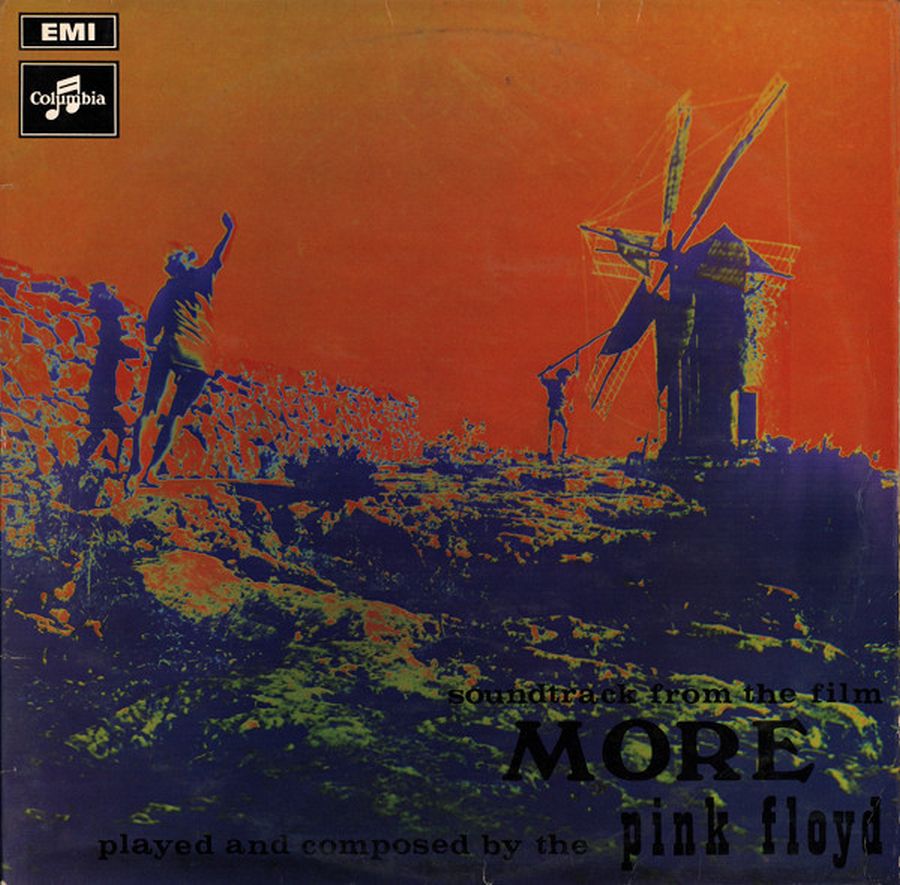
In the period after the departure of the “crazy diamond” Syd Barrett and the release of their second album “A Saucerful Of Secrets” (1968), Pink Floyd recorded the music for the film “More” at the instigation of the well-known German director Barbet Schroeder. At the label’s urging, it was then reworked and some sections changed, and came out as their third album. In the wider collective consciousness it’s perhaps best known as their first record without Syd in the lineup, though its musical content is nothing to sneeze at either, and it offers plenty of what made Pink Floyd one of the most innovative and unique rock bands of the second half of the 60s from the very start.
The first important change in the next evolutionary step of their sound, which came with this album, was undoubtedly the successful integration of the then still wet-behind-the-ears guitarist/singer David Gilmour. Here he got a completely free hand for his own musical ideas and started developing into one of the best guitarists in the history of rock music. As a guitarist he had already demonstrated his exceptional potential on the predecessor, but as a singer he only really came into his own here. On “More”, bassist/singer Roger Waters actually let him sing all the lead vocals, which was completely unthinkable before and, for a good while, after. Waters, who a year earlier had managed to pull the band back from the brink of existential collapse, where Syd’s eccentricities during their live shows had driven it, even went out of his way to give the young guitarist a somewhat bigger role in the band’s expression than he’d had when he first arrived. Considering that over the years the two became the best of “friends”, that’s hard to believe today. Perhaps the most important thing the creative process of this album brought is that, after the traumatic departure of the “crazy diamond”, the band came alive as a successful and equal collective and, for the first time, tried its hand at producing too.
“More” is a stylistically quite diverse album, with an almost equal number of instrumentals and vocal numbers. You’ll find all sorts of musical elements here, some of them atypical for the band, like folk and hard rock, alongside the more characteristic experimental avant-garde creations with loads of effects and that signature space rock vibe. The best-known (and, according to most, the best) pieces on “More” are “The Nile Song”, “Green Is The Colour” and “Cymbaline”. The latter two were played live regularly at the time. I don’t know the film, so I can’t comment in detail on the differences between the film versions and the ones on the album, but I’m convinced they were noticeably improved for the studio release. As for the film’s plot, it’s supposedly a pretty bleak existentialist drama about a couple, two hard drug addicts, who come to a sad end. That fits rather well with the end of the psychedelic era in music and society, a fact the members of Pink Floyd were aware of too, as they slowly but visibly started shaking off their psychedelic rock legacy from the Syd years. Thanks to its music, the film of course achieved cult status over the years, but that only happened many years after its release, when Pink Floyd had already become a worldwide phenomenon.
The opening “Cirrus Minor” is steeped in a surreal pastoral atmosphere. After the opening effects of chirping birds, Gilmour’s calm, hypnotic vocal drifts in along with a gentle acoustic guitar accompaniment, and together they create a special, mysterious mood. The central position in the rest of the piece is taken by the deep sound of Wright’s keyboards, especially the booming organ, which carries a slightly eerie undertone. The complete absence of Mason’s drums and the unusual metric structure surely add to the surreal atmosphere too. “The Nile Song”, which also came out as a single and is undoubtedly one of the heaviest things in the band’s history, confirms right away that this is an album with a varied mix of moods. You could call it one of the few hard rock pieces in their catalog, or even a kind of proto-metal creation. It’s marked by a punchy guitar riff and Gilmour’s atypically fired-up, raw vocal, solid, hard-hitting drum fills and a complete absence of keyboards. Gilmour also deftly worked in a short, bluesy solo, typical of him, though it can’t yet compete with his later masterpieces. Alongside The Beatles classic “Helter Skelter”, “The Nile Song” can be counted as one of the first “metal” tracks in history. The heated mood is calmed in the next moment by the dreamy pastoral ballad “Crying Song”, suffused with the gentle sounds of Wright’s vibraphone and the rattle of Waters’ melodic bass. Once again Gilmour’s dreamy vocal and gentle acoustic guitar melody take the lead role, creating a pleasantly romantic atmosphere. A fairly simple but thoroughly lovely folk ballad.
On the instrumental “Up The Kyber”, Pink Floyd also show a feel for jazzy improvisation. It’s mostly a pairing of Mason’s drum solo with Wright’s experiments on a crazed piano, dissonant organ and a whole lot of quirky effects. “Green Is The Colour” is another beautiful folk ballad, with Gilmour’s gentle vocal and a melodic accompaniment on acoustic guitar and piano. Witty flute sounds in the background heighten its ethereal Celtic touch. Next comes “Cymbaline”, which in my view, at least in terms of arrangements and its outstanding romantic atmosphere, is the best piece on the album. The arrangements combining acoustic guitar, piano, organ, drums and bass are wonderful and testify to the band’s exceptional compositional talent. Gilmour’s romantic, dreamy vocal rides on an exceptionally beautiful piano and guitar melody. The track is also distinguished by Wright’s use of numerous special effects and brilliant organ passages. The lyrics deal with a nightmare, which is actually a metaphor for the first of Waters’ cynical reckonings with the music industry. The short instrumental “Party Sequence” is a bundle of Mason’s shamanic percussion accompanied by flute played by his wife Lynette. It’s one of the few pieces in their history with an ethnic touch.
“Main Theme”, where their space rock side comes to life more prominently again, has a pretty eerie mood that matches the bleak atmosphere of the film itself, and that’s probably why it was picked as its central theme. After the rather annoying, droning sound of a gong comes a creepy organ sound. That sound, combined with unusual rhythmic patterns on bass and drums, dictates the course of the composition. Plenty of unusual effects from Wright’s synthesizer also contribute to the gloomy vibe. There are also some fairly nondescript embellishments on Gilmour’s slide guitar. The hard-hitting hard rocker “Ibiza Bar” has a central motif quite similar to “The Nile Song”, except that here they’ve worked in Wright’s keyboards as well. Gilmour’s atypical fired-up vocal and his punchy guitar shredding come across as fairly funny, especially compared with some of their better-known and more ambitious creations. A solid piece, and another of their rare adventures in hard rock. The short instrumental “More Blues” is one of their even rarer ventures into blues, and accordingly it’s nothing special. Gilmour shows off a few of his typical blues passages here, which he’s built up quite a lot over the years and put in a completely different context. “Quicksilver” is the longest and by far the most avant-garde piece on the album, with lots of wacky synth effects, sounds typical of musique concrete and a not insignificant use of vibraphone. The whole thing again strongly recalls some psychedelic horror flick. They’d push this kind of avant-garde creation to practically the extreme on their next album. “A Spanish Piece” is another very short instrumental, featuring a typical Spanish or Latin guitar riff and Gilmour’s obscurely oriented vocal accompaniment in the background. Here Gilmour appears in a completely solo role, without help from the other band members. The closing “Dramatic Theme” is yet another short instrumental with an identical motif to “The Main Theme”, except that its focus lies mainly on Gilmour’s guitar.
I’d say that, even though it’s not a typical studio album, “More” is one of that handful of rock albums that originally started out as film music and deserve attention even from people who’ve never seen or even heard of the film the soundtrack comes from. Its place in the Pink Floyd legacy isn’t exactly a prestigious one, which is somewhat justified when you compare it with most of their later work, but still, even though not all the experiments land and you can’t yet detect that later transcendental Floyd magic, I can’t find a bad piece on it. Even among their fans there are a few people who don’t like this album and see it only as a bunch of half-baked ideas, and what bothers them most is that the band showed some elements atypical for them, closer to folk and hard rock/blues rock than to space rock. That’s entirely their problem, because in my eyes this is a more-than-solid record from a band that was still searching for its sonic identity at the time and recorded as many as three albums within a few months, which certainly was no small feat. If “More” had been conceived as a concept album, it would be a pretty weak bunch of unconnected pieces and would rightly deserve criticism. As it is, it’s yet another completely unique album, seasoned with diverse musical ideas, which presented David Gilmour as an equal member of the band and pulled him out of Syd’s shadow. In my opinion “More” is even a slightly overlooked record, but for a band that created such a large number of excellent albums, you just have to live with that. The first years without Syd were undoubtedly pretty grueling for all the band members, as they searched for some recognizable, unique sound that would separate them for good from the psychedelic phase and the constant experimentation with diverse sound patterns that came with it. Even though in this period, that is, until the end of the 60s, they didn’t manage to create any record that would establish a new, recognizable, lasting sound and also bring them significant commercial success, Pink Floyd of that time were one of the main driving forces of the then freshly formed progressive rock. Among the albums of that era with which they explored, often in avant-garde ways, the new frontiers of popular music, this more-than-solid collection of film music undoubtedly belongs too.
Author: Peter “Dr. ProgRock” Podbrežnik
Tracklist:
1. Cirrus Minor (5:18)
2. Nile Song (3:26)
3. Crying Song (3:33)
4. Up the Khyber (2:12)
5. Green Is the Colour (2:58)
6. Cymbaline (4:50)
7. Party Sequence (1:07)
8. Main Theme (5:28)
9. Ibiza Bar (3:19)
10. More Blues (2:12)
11. Quicksilver (7:13)
12. Spanish Piece (1:05)
13. Dramatic Theme (2:15)
Lineup:
David Gilmour – vocals, guitar
Roger Waters – bass guitar, vocals
Richard Wright – organ, piano, vocals
Nick Mason – drums