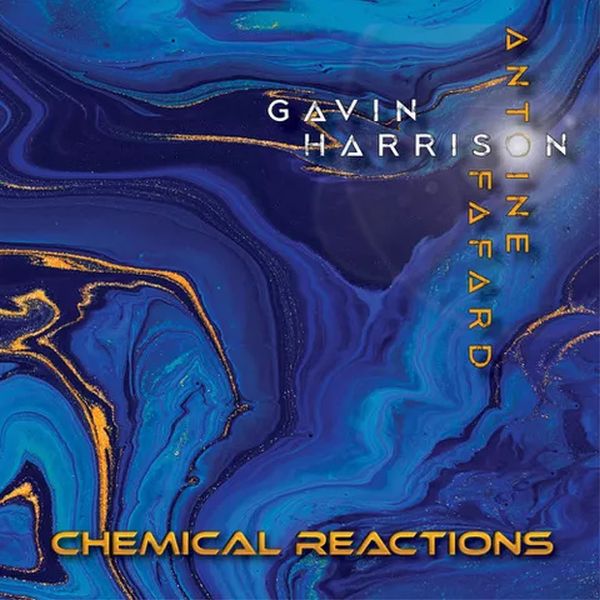
Label: Amplified Distribution
Release date: 11. 12. 2020
Production: Antoine Fafard
Album length: 50.15 min
Genre: Jazz Fusion
Rating: 9.5/10
This is jazz! And real jazz, the kind with no pegged-down templates, is always “weird.” Which, in the end, is the whole point. “Chemical Reactions,” which came out just before the new year, is actually mostly the work of French bassist, arranger and composer Antoine Fafard, who invited King Crimson and The Pineapple Thief drummer Gavin Harrison to join in. So, one of the hottest names in the galaxy and on today’s drumming scene – let’s just call him a drumming superman. Fafard has plenty of experience working with top-tier drummers. Just a few names: Simon Phillips, Dave Weckl, Terry Bozzio. Enough said.
“Chemical Reactions” is an all-instrumental album, and jazz fusion is the most fitting genre tag for it. Fans of experimental mischief, or of the constantly provocative collision and interplay of countless rhythmic structures that entertain and surprise at every turn, and that, for all their complexity, coexist within a constant guarantee of high reconcilability, will get a full dose of artistic catharsis from this charmingly shocking album.
This is an album that stands on its own. Anyone who knows Fafard and his earlier work won’t be all that surprised by the basic musical direction of “Chemical Reactions.” Still, that’s not the heart of the thing – as the title itself says, it’s the chemical sparks flying between the musicians. Reactions between players, first and foremost between Fafard and Harrison. The latter is without a doubt a top-class guarantee who brings a streak of eclecticism and uniqueness to every project he touches, because right now there’s only one Harrison. Nobody comes close to him (stylistically), and his approach is what gives this release so much of its appeal. It adds a touch of adventurousness, oddness and progressiveness, even though at its core this is a jazz fusion album.
Gavin gets total artistic freedom on this album. In musical circles like these, that’s no surprise – it’s practically a requirement. Much like John McLaughlin got long ago, when he came over from Great Britain to New York to record “In A Silent Way” with Miles Davis, and Miles gave him just one basic instruction: “Play the guitar like you don’t know how to play it.” That said it all. Expect the unexpected. McLaughlin, of course, had no idea beforehand what Miles was planning to record. Miles didn’t know either. And it’s exactly in an atmosphere like that that the most beautiful musical miracles tend to be born.
In short: at times “Chemical Reactions” feels like gorgeous film-score music, firmly built on polyrhythms, cheekily riding the springboards of jazz avant-garde, neo-classical elements and progressive rock. The core lineup is Antoine Fafard, Gavin Harisson, cellist Jonathan Gerstner and violinist Maria Grig. The first four tracks on the album are played in a quartet format. Already the opener, “Transmutation Circle,” greets you with an experience that conjures up associations with The Mahavishnu Orchestra, Frank Zappa, King Crimson … Right in this track, Fafard and Harrison show a few moments of superb mutual awareness as they toss short improvised bits back and forth (there are quite a few of these stunts on the album). Next, “Atonic Water” is the track where Harrison first really loosens up and stretches out with his recognizable moves, a one-of-a-kind thing in the drumming universe. The track is showered with atonal violin lines, but what’s especially interesting is the contrast with the cello, which (alongside the bass guitar) builds the bulk of the lower tones, stepping into a phrasing role and adding a dark undertone to the piece. Harrison adds a pile of extra sonic colors on percussion, marimba included. He turns to these tricks later in the album too, including the excellent “Vision of Lost Orbit,” where Harrison’s dazzling genius is especially vivid and layered with playfulness. The fourth track – “Pair of Perfect Four” – doesn’t stop entertaining either, with the atonal figures of the lead melodies and the sheer theater of the polyrhythms edging toward the musical philosophy of Robert Fripp and King Crimson. On “Singular Quartz,” the legendary violinist Jerry Goodman jumps in as a special guest, and his brilliant solo reinforces the sense that “Chemical Reactions” will thrill fans of The Mahavishnu Orchestra most of all.
The last two tracks are a special story, featuring the 65-piece Czech philharmonic orchestra Janacek Philharmonic Orchestra. The pomp of the release – that is, the grip of the atmospheres it creates – leaps up to a more theatrical level in an instant. These are really suites. The first is “Holding Black The Clock,” where the contrast between calm sections and slick seismic jolts is especially pronounced, creating an extraordinary blend of gentle, fragile motivic pastels that coexist in a superb climax. The second suite, which closes the album, is the title track, where Fafard steps into a more central position with his bass guitar. This very track is an especially brilliant composition, tailor-made for use as the backing music for some adventure film. Fafard, who is, as noted, the main composer of everything here and a sort of conductor-producer, also shows off some astonishing bass tricks in this track. He’s not starting a revolution with them, since there’s a whole bunch of similar masters on the planet, but the title track is a first-rate example of the perfect collision of all the building blocks the musical vision of this album rests on. Harrison doesn’t forget to weave in some double bass pedal here either, boosting the drama and theater of how things unfold.
An album of constant ebb and flow and outstanding dynamics. An album that is tightly conceived and executed at every step, yet one that keeps impressing with its fragmented, loosened-up feel. At every turn, the album sparkles with a heavy collision of top-level technically complex execution and free-spirited drifting through wide-open improvisational stretches. The construction of the pieces is basically concise and compact, and this jazz-fused album also carries a clear motivic character of classical music, as well as a cheeky progressiveness and avant-garde streak. As such, it sinks in slowly and demands several spins. The chemistry between Fafard and Harrison works to the full and spoils the listener. The pairing of two top musicians gives the compositions and the album a clear eclectic edge. It’s a musical one-of-a-kind that music gourmets will instantly claim as their own. Fafard’s composing isn’t even a surprise, but it’s Harrison’s contribution that gives this album so much more of its stamp of ever-alluring musical adventurousness.
Author: Aleš Podbrežnik
Tracklist:
1. Transmutation Circle
2. Atonic Water
3. Vision. Of A Lost Orbit
4. Pair Of A Perfect Four
5. Proto Mundi
6. Singular Quartz
7. Holding Back The Clock
8. Chemical Reactions
Lineup:
Antoine Fafard – bass guitar
Gavin Harrison – drums, percussion
Contributing and guest musicians:
Maria Grig – violin
Jonathan Gerstner – cello
Jerry Goodman – violin on track no. 5
Janacek Philharmonic Orchestra – tracks 7 and 8