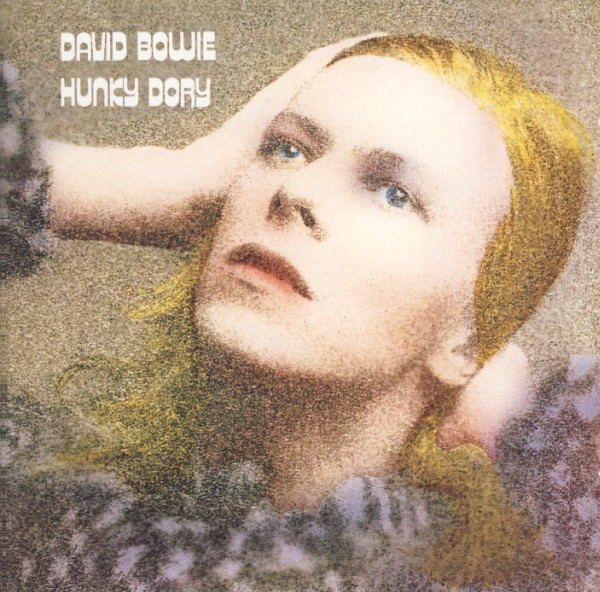
Label: RCA
Release date: December 17, 1971
Production: Ken Scott & David Bowie
Album length: 41.50 min
Genre: Art pop / Pop rock
Rating: 9.0/10
The art-rock gem “Hunky Dory” may well be the most important achievement in the career of English music legend David Bowie. It gave him his first masterpiece and, for the first time, a regular, loyal audience, confirming that his constant musical evolution was heading in the right direction. The striking shift in style compared with its hard-rocking predecessor “The Man Who Sold the World” (1970), which had already hinted at Bowie’s near future as a great musical innovator, owed the most to the (temporary) departure of producer/bassist Tony Visconti. Ken Scott stepped in as the new producer and went on to work with Bowie through the entire glam rock era, while the new bassist was Trevor Bolder (later of Uriah Heep and, briefly, Wishbone Ash). With him on board, Bowie completed his classic backing band, which would become known the following year as the Spiders From Mars and deliver some of the biggest hits of David’s enormously rich career.
On “Hunky Dory,” Bowie suddenly broke with the hard rock that ruled “The Man Who Sold the World” and woke his artistic side back up. He blended art rock, glam rock, pop and folk rock with remarkable sophistication into a distinctive mix that’s easiest to call art pop. Part of that was surely down to working again with keyboard wizard Rick Wakeman (still a member of folk prog rockers Strawbs at the time, though he’d move over to the symphonic proggers Yes the very next year), who played most of the lavish piano arrangements. Meanwhile, Bowie pushed his melodic side so far on “Hunky Dory” that the wider public finally took notice. On three tracks, Bowie, who supposedly imitated a similar photo of Marlene Dietrich for the album cover, tipped his hat to some of his key artistic influences, while the often convoluted lyrics ranged from artistic (self-)renewal, Nietzsche’s “superman” and the occult to Dalí-esque surrealism. Quite a few people are convinced that Hunky Dory, an English phrase for feeling great, was also the first of Bowie’s many alter egos, before Ziggy Stardust arrived on the scene, though the music legend never confirmed it.
The best-known piece on “Hunky Dory” is undoubtedly the evergreen opener “Changes,” which only reached its cult status two years later, when Bowie was already a glam rock star and people were getting more and more curious about the early stretch of his career. This legendary ode to constant artistic (self-)renewal and chameleon-like transformations was the last song Bowie ever played live, in 2006, at the final performance of his career. The central motif is built around David’s saxophone line, Wakeman’s piano arrangement and a distinctive guitar phrase from Mick Ronson, while the unforgettable chorus walks away with total victory. “Changes” became such a beloved song in Bowie’s career that audiences regularly demanded it at most of his shows. It’s also worth mentioning the fun fact that more than three decades later Bowie sang “Changes” in the popular animated movie “Shrek 2,” bringing his music to some younger generations too.
The glam rock treat “Oh! You Pretty Things,” with its playful piano motif before the hypnotic chorus kicks in, touches in its lyrics on Bowie’s favorite dystopian theme, the imminent arrival of Nietzsche’s “superman” (“homo superior”), with some references to the occultist Aleister Crowley. It also foretells a triumphant partnership between aliens and the younger generations who will replace the “old order.” “Eight Line Poem,” with its piano melody, bluesy guitar groove and sarcastic vocal delivery, is one of the few “Hunky Dory” cuts that never reached cult status, though it makes a good contrast before the next masterpiece. The classic “Life On Mars?”, one of the best pieces of Bowie’s career and a perfect fusion of glam rock extravagance and art rock polish, boasts a brilliant Wakeman piano arrangement, a phenomenal Ronson guitar melody and an epic chorus. It was inspired by Dalí-esque surrealism, an unhappy love affair and the artist’s fascination with space. “Life On Mars?” was another evergreen that only hit cult status when it was reissued in 1973, with Ziggy Stardust mania at its peak.
“Kooks,” with its colorful harmonies, mischievous piano arrangement and playful melody, was dedicated to Bowie’s newborn son, whom he and his wife Angie named Zowie Bowie. After reaching adulthood, Zowie (for perfectly understandable reasons) became known as Duncan Jones, and today he’s an acclaimed producer and film director. The nostalgic “Quicksand,” with its romantic acoustic guitar and piano arrangement and numerous references to the “superman,” Buddhism, the occult and famous historical figures, is the prime candidate for the most overlooked track on the album. A gorgeous guitar motif is paired with David’s ethereal singing, while a mysterious yet nostalgic atmosphere hangs over it all the way through. The cabaret-style “Fill Your Heart,” built around a saxophone arrangement and laid over a dance rhythm, is the only song on the album not written by David, but by Biff Rose and Paul Williams.
“Andy Warhol” was Bowie’s tribute to the American pop art icon Andy Warhol, whom he counted among his main artistic influences. The song is built around Ronson’s acoustic guitar melody, led by Bowie’s vocals. Warhol reportedly wasn’t too thrilled when Bowie decided to play it in his presence, apparently bothered by the lyrics, which used clever metaphors to describe some of the painter’s eccentricities. The frustration-ridden visual artist, who never publicly acknowledged his homosexuality, allegedly just said an apathetic “well, yeah… okay” after hearing it, then briskly excused himself, saying he had other things to do. With the folk rock “Song For Bob Dylan,” David paid homage to Bob Dylan, another one of his idols, though it’s also a parody of Dylan’s “Song to Woody,” which was dedicated to Woody Guthrie. Bowie also skillfully, and without being nasty, poked fun at Dylan’s peculiar way of singing in the lyrics.
The glam rock and proto-punk experiment “Queen Bitch” is Bowie’s dedication to The Velvet Underground and Lou Reed. David had a rather complicated relationship with Reed because of the American’s difficult personality, even though Reed’s solo career took off thanks in part to Bowie and Ronson producing the album “Transformer” (1972). Bowie’s vocal approach here is already in the glam rock style that dominated his next studio effort. The folk rock ballad “The Bewlay Brothers,” wrapped in a message that still hasn’t been fully unraveled to this day, features a romantic acoustic guitar arrangement and exceptionally heartfelt singing that creates a thoroughly pleasant, nostalgic atmosphere. In the final minute, with the help of sped-up vocalizations, that mood unexpectedly turns into a dark, chilling thriller.
With “Hunky Dory,” and its enviable stylistic range, David Bowie created a timeless classic and finally stepped into the elite of the most exciting rock performers. The following year the album did great on home turf, while across the Atlantic, too, people began to appreciate Bowie more and more as a fast-rising musical star. But none of his increasingly loyal followers was surely ready for Bowie’s next sonic and visual metamorphosis, since nobody expected the triumphant arrival of the glam rock alien in the shape of Bowie’s most beloved alter ego, Ziggy Stardust.
Author: Peter “Dr. ProgRock” Podbrežnik
This review is dedicated to the memory of David Bowie (1947-2016).
Track list:
1. Changes (3:37)
2. Oh! You Pretty Things (3:12)
3. Eight Line Poem (2:55)
4. Life on Mars? (3:43)
5. Kooks (2:53)
6. Quicksand (5:08)
7. Fill Your Heart (3:07)
8. Andy Warhol (3:56)
9. Song for Bob Dylan (4:12)
10. Queen Bitch (3:18)
11. The Bewlay Brothers (5:22)
Lineup:
David Bowie – vocals, guitar, alto saxophone, tenor saxophone, piano (“Oh! You Pretty Things”, “Eight Line Poem”)
Mick Ronson – guitar, backing vocals, Mellotron, arrangements
Trevor Bolder – bass guitar, trumpet
Mick Woodmansey – drums
Rick Wakeman – piano