Label: Mercury Records
Release date: November 4, 1970 (US) / April 10, 1971 (UK)
Producer: Tony Visconti
Album length: 40:29 min
Genre: Hard Rock / Folk Rock / Glam Rock
Rating: 8.5/10
This review is dedicated to the memory of David Bowie (1947-2016).
On his third studio outing, »The Man Who Sold the World«, the great musical genius David Bowie did what he’d do so many times over his magnificent career: he changed his sound like a chameleon, waving goodbye to the acoustic-leaning prog folk rock and psychedelia that defined his previous album »David Bowie«, aka »Space Oddity« (1969). Part of the shift came from the fact that his friend and occasional musical rival Marc Bolan (T. Rrex) had just then morphed from an acoustic-psychedelic dreamer into a fiery glam rocker. Bowie had no intention of being left behind, but he pulled off his next sonic evolution in a thoroughly his-own-way fashion. He kept a sharp eye on the music trends of the day and kneaded them into something to his own recipe. In 1970, what had everyone’s attention among rock fans was hard rock, led by acts like Black Sabbath, Deep Purple and Led Zeppelin, and that left a decisive mark on David’s new direction.
»The Man Who Sold the World« is an important album above all because it’s where Bowie first started working properly with his backing band The Spider from Mars, led by the immensely talented guitarist Mick Ronson. That shaped the album’s style in a big way: it was an almost total about-face into electric-guitar hard rock with hints of blues, glam and art rock, and next to the dreamy psychedelic/folk-rock »Space Oddity« it was one hell of a sonic shake-up. The band was rounded out by drummer Mick Woodmansey and producer/bassist Tony Visconti. Soon after the album came out, Visconti was replaced on bass by Trevor Bolder, who later built himself a fine musical career as a member of the legendary Uriah Heep.
Ronson’s energetic, dynamic electric guitar lines are so dominant on »The Man Who Sold the World« that some people have even called it a prime example of early heavy metal, although hard rock would be the more fitting label. Ronson and Visconti teamed up with David, who had his hands full at the time with his newlywed wife Angie, and they were the key players when it came to writing the arrangements.
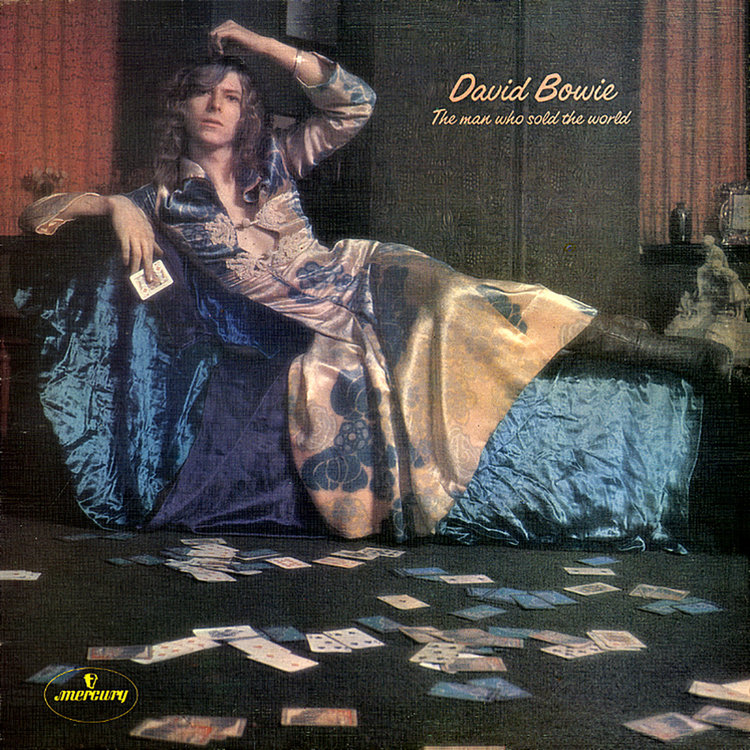
The album also drew attention for its cover, where Bowie, who kept changing his look along with his sound and was starting to open the door to his later glam rock era, is dressed in women’s clothes. For the time that was a pretty provocative move, and it riled up America’s self-appointed guardians of public morals in particular. For the US market the cover was swapped out for some second-rate botch job. So »The Man Who Sold the World« is where Bowie’s teasing about his sexual orientation began, a game the androgynous-looking man would go on to play especially during his glam rock era, giving the conservative public of the day plenty of gray hairs, although years later he revealed he was heterosexual and indirectly regretted making such a ‘circus’ out of it in the seventies.
»The Man Who Sold The World« has a much gloomier ambient tone than its predecessor, which matched the punchier nature of the individual arrangements, while the lyrics lean even harder into dystopian themes like paranoia, alienation, schizophrenia and the dangers of excessive scientific progress. Four tracks stand out for quality: »The Width of a Cricle«, »All the Madmen«, the title track and »The Supermen«. The new, hard-hitting style shines through right on the opener, a cross between hard rock and rhythm and blues, »The Width of a Circle«, which features Ronson’s fiery electric guitar artistry, topped off with a superb solo, while the enigmatic lyrics revolve around a sexual encounter with an angelic or demonic woman somewhere between heaven and hell. »All the Madmen«, crowned with a gothic atmosphere, has stood the test of time even better. It’s one of Bowie’s early masterpieces and at the same time one of the heaviest things of his career, built on uncompromising guitar lines, Ralph Mace’s moog modular synth and Woodmansey’s massive drum fills. The shifts into three-part harmonies work especially well, deepening the dramatic message about the depths of human madness.
»Black Country Rock« is an upbeat blues rocker that stands in sharp contrast to the dark mood running through the album, and stylistically it’s quite close to certain T. Rex exploits, mostly thanks to Bowie’s altered, unusual way of singing, which here sounds a lot like Marc Bolan’s usual vocal habits. The gloomy »After All«, where Bowie again toys with Nietzsche’s ‘superman’ alongside occult undertones, may well be the strangest experiment on the whole album and one of the few tracks on it with a psychedelic nature. »Running Gun Blues«, which obviously pokes fun at American gun ‘culture’, is a sharp-tongued blues rocker with a punchy guitar riff, harmonica and a nearly goofy vocal approach from David.
On the dramatic prog/hard rocker »Saviour Machine«, interwoven with hard-hitting guitar lines and futuristic moog modular sounds, Bowie touches on yet another dystopian idea, in which computer artificial intelligence takes over humanity in the near future. It’s one of the rare tracks of David’s career where he moved close to Genesis-style progressive rock. »She Shook Me Cold« is another hard rocker in the vein of Led Zeppelin, packed with sexual references in the lyrics and quite obviously structured around a group instrumental jam. That less inspired moment is followed by the unforgettable title track, which stands out for its ‘spacey’ vibe, backed by a distinctive guitar riff and a romantic central arrangement. Here Bowie beautifully weaves together elements of glam rock, psychedelia and art rock and creates an exceptionally intense atmosphere, while the lyrics deal with schizophrenia, or a split personality, including an imaginary double, yet another of Bowie’s favorite themes.
The hard rock classic »The Supermen« is deservedly the best-known track on the album, even though it only got a bigger response a few years later, when it was re-recorded at the height of David’s success in the middle of the glam rock era. Its lyrics draw inspiration from H.P. Lovecraft’s work on the ‘Great Old Ones’ (a special breed of eerie beings from another dimension), further heightened by dramatic backing vocal harmonies, while the mighty chorus pushes the all-around dystopian atmosphere to the extreme. According to Bowie, the main guitar riff for »The Supermen« was a gift from Jimmy Page.
With »The Man Who Sold the World«, the heaviest record of his career, Bowie, who was already eyeing his next sonic change, took the first big step toward the glam rock era and at the same time shaped the core of his most successful backing band. With the new, ‘electrified’ sound he also made huge progress compared to »Space Oddity«, kicking off his classic period, the one most cherished by a great many fans. On home turf in Britain, »The Man Who Sold the World« didn’t achieve any big commercial breakthrough, but it did become Bowie’s first album to get noticed on the American charts. Just a year later David made his first studio masterpiece and wrote his name in gold letters among the greatest music icons of the 20th and 21st centuries.
This review is dedicated to the memory of David Bowie (1947-2016).
Author: Peter “Dr. ProgRock” Podbrežnik
Tracklist:
1. The Width of a Circle
2. All the Madmen
3. Black Country Rock
4. After All
5. Running Gun Blues
6. Saviour Machine
7. She Shook Me Cold
8. The Man Who Sold the World
9. The Supermen
Lineup:
David Bowie – vocals, guitar, stylophone, saxophone, organ
Mick Ronson – guitar, backing vocals
Tony Visconti – bass guitar, backing vocals
Mick “Woody” Woodmansey – drums
Ralph Mace – Moog