Label: Parlophone Records / BMG
Release date: September 4, 2015
Production: Kevin Shirley
Album length: 92.11 min (2CD)
Genre: Heavy Metal / N.W.O.B.H.M.
Rating: 8.0/10
“The Book of Souls” is the sixteenth studio album from heavy metal institution Iron Maiden, and it had already set a few major milestones in their career before it even came out. “The Book of Souls”, easily the most anticipated metal album of 2015, is their first double album, arriving five years after its predecessor “The Final Frontier” (2010). That’s also the longest gap between two Iron Maiden studio albums to date, while the 18-minute epic “Empire of the Clouds”, written by singer Bruce Dickinson, is the longest composition in their history, knocking the “Powerslave” (1984) classic “Rime of the Ancient Mariner” off the top spot.
At 92 minutes it’s also their longest album ever, and if the main yardsticks of quality in music were the length of individual tracks and the ambition of the project, “The Book of Souls” would be the undisputed champion of their discography. Besides “Empire of the Clouds”, it features two more marathon epics: the just-over-13-minute “The Red and the Black” and a solid ten-minute title track.
Longtime collaborator Kevin Shirley is back behind the desk for a solid production, while the release was pushed back by several months because doctors found a cancerous tumor on Dickinson’s tongue, so everybody had to wait for him to recover first. Luckily, Bruce came through the intensive treatment well and handles his vocal duties on “The Book of Souls” pretty decently, even if you can often hear that his vocal power is slowly but steadily fading with age. To be honest, that’s perfectly normal at his age, and nobody expects him to sing like he did when he was, say, thirty.
The band’s chieftain, bassist Steve Harris, who also played keyboards on the album, started mulling over how to bring Iron Maiden back closer to the sound of their “golden era” and to what most people today call progressive metal, many years after the concept masterpiece “Seventh Son of a Seventh Son” (1988). That was especially obvious on the records they released over the last fifteen years, led by “The Final Frontier” (2010). The latter already came very close to the desired direction, so it was fair to expect “The Book of Souls” to be the next step on that ambitious path.
As you’d expect, there are no shocking musical surprises from a band that peaked creatively in the eighties. Truth be told, the only track on the album with any convincing link to prog metal/rock is the superb “Empire of the Clouds”, which I’ll get to in the last part of the review. Dave Murray and especially Adrian Smith once again shine with their distinctive, well-placed guitar solos and trademark dual harmonies, which will delight all the longtime fans, while the band’s “weak link” is once again Janick Gers, whose hard-rock-style guitar “weaving” occasionally grates a little, even if it doesn’t do any major damage to individual tracks. Still, credit where it’s due: he co-wrote the title track with Harris, and it’s among the best things on “The Book of Souls”. Drumming joker Nicko McBrain is his usual solid self throughout the album and stays in rhythmically predictable waters, which means no special solo experiments this time around.
Despite all that ambition, “The Book of Souls” isn’t a concept album, so “Seventh Son of a Seventh Son” remains their only one, even though most of the lyrics on the new record revolve around souls, immortality, questions of life and death and other themes that are pretty typical for Iron Maiden, most noticeably on the title track.
The opening energy catalyst “If Eternity Should Fall”, originally intended for Dickinson’s future solo album, has a slow, dramatic intro (this time with an oriental motif) of the kind you quietly expect from Iron Maiden, followed by the inevitable punchy shift into an epic section ruled by triple-guitar harmonies. This tried-and-true recipe that still works is backed by a mighty, well-executed chorus, so on that front too it keeps up Iron Maiden’s long tradition of strong opening tracks, a streak that has rarely been broken in the past. The only surprise is the short narrative closing bit where Eddie’s “cousin” Necropolis speaks, as Iron Maiden last indulged in a similar “cinematic” monologue on “Rime Of The Ancient Mariner”.
“Speed of Light”, whose opening riff slightly recalls “Futureal”, came out as the single and is one of the few compactly built songs on “The Book of Souls”, which is otherwise dominated by tracks of enviable length. At its core the new single is nothing special, and that goes for its unspectacular chorus too. By Iron Maiden standards it’s almost a hard rock effort, and it works a lot better in the context of the whole album, where it sits in just the right spot, than on its own. It’s one of those tracks meant as a radio hit to compete with past classics like “Two Minutes to Midnight”, “Wasted Years” and “Can I Play With Madness”, but it doesn’t come close, though it’s far better than past single flops like “Wildest Dreams” and “Holy Smoke”. “Speed of Light” will be remembered in the collective consciousness less for the music than for its very interesting video, inspired by the history of video games.
“The Great Unknown” has a promising setup with a slow intro, where Dickinson’s vocals in particular slowly but successfully build a tense atmosphere. The rest is a lot less thrilling: despite some good ideas and tasteful guitar harmonies, it never heads in the right direction to earn a place among the “eternal” Iron Maiden standards. A rather nondescript, quickly forgotten chorus contributes to the failure too.
The epic “The Red an the Black”, Harris’s 13-plus-minute pride and joy, opens with a short bass solo before moving into an ominous rhythm and a main riff that slightly recalls the central theme of the old instrumental classic “Genghis Khan”. The melodic motif is well done, but the poorly thought-out weaving in of the “oh-oh-oh-oh-o” chorus we’ve heard many times before, a transparent attempt to rile up the live crowd, comes off as seriously cheap and drags down the value and quality of this ambitiously conceived epic. On the other hand, the instrumental sections with their epic arrangements, Murray’s and Smith’s guitar ideas and Dickinson’s singing deserve praise (except, of course, where that aforementioned cheap chorus kicks in, the Achilles’ heel of an otherwise very solid epic).
“When The River Runs Deep” is pretty average by Iron Maiden standards. It leaves no deeper emotional mark and at times sounds like a bunch of hastily glued-together arrangement ideas, where the song’s core message never flows to its full potential. The only truly interesting thing about this forgettable track is the good guitar passages, delivered as effectively as ever by Murray and Smith.
The bad impression left by the previous track is firmly corrected by the title epic, which is without doubt one of the highlights of “The Book of Souls” and one of the few songs on the album that deserves future Iron Maiden classic status. The possessed, dark opening section with its sharpened riffs and a furious-sounding Bruce fits nicely with the tense lyrics about Mayan occultism, while epic harmonies create a grandiose atmosphere. The mighty chorus, backed by solemn keyboard arrangements in the background, is truly excellent this time and deserves sincere congratulations. The overall vibe is a lot like something made in the middle of Iron Maiden’s golden era, so this time they actually did hit the target they’ve been aiming for. The brilliant transition into the instrumental section more than obviously recalls the “Powerslave” instrumental evergreen “Losfer Words (Big ‘Orra)”, while the epic guitar harmonies deepen the successfully recreated nostalgia and magic of a long-gone, romantic era.
“Death Or Glory” is another of the few compactly built tracks on the album, with guitar phrases once again drawing on a hard rock foundation. Again, it’s not all that spectacular, but thanks in part to its fighting chorus it’s still more interesting than “Speed of Light” and might have been a better choice for the album’s lead single. Murray’s and especially Smith’s guitar ideas are once again top-notch, while Dickinson’s bravura singing isn’t shaken even by the rather below-average lyrics.
“Shadows of the Valley” is yet another example of a composition with an ambitious, promising setup that promises a lot in the intro but ends up falling short of expectations, despite a nostalgic “Sea of Madness” reference in the lyrics. In atmosphere and structure it at times recalls the “Dance of Death” (2003) standard “Paschendale”, and its lyrics likewise deal with the suffering of soldiers in World War I. The epic ending is again slightly spoiled by “oh-oh-oh-oh-o” vocal harmonies, though this time they don’t come off as too tasteless. It’s also an example of a stretched-out Iron Maiden track that would probably have had a better effect if it had been at least a little shorter.
One of the better pieces on the album is definitely “Tears of a Clown”, with lyrics inspired by the depression and tragic death of popular American actor Robin Williams. It has a fairly atypical, unpredictable structure, and the effectively placed keyboards in the background add a lot to the melancholic mood. The lyrics are among the best on the album, and with Dickinson’s heartfelt singing and melancholic arrangements they convincingly paint a picture of a tragic comedian on the brink of fatal suicide. Of the shorter tracks on “The Book of Souls”, it’s certainly the closest to future classic status.
“The Man of Sorrows” of course has nothing in common with Dickinson’s solo track of a similar name, except that the intro features a melancholic, ballad-like passage. That doesn’t last long, as it quickly moves into a punchy section with sharpened guitar passages and a clever use of keyboard backing. The chorus is once again very well done, while the guitar harmonies again sound nostalgic at times. It’s another good track that confirms the second half of “The Book of Souls” is a bit better than the first.
The most ambitious composition on the album, “Empire of the Clouds”, is Dickinson’s “baby” and the first to feature Bruce on piano, while its lyrics were inspired by the crash of the R101 airship in 1930. Bruce’s piano and the orchestral arrangements with violin, which come from Harris’s keyboards, aren’t anything staggeringly exciting, though they sound innovative in the Iron Maiden context so far and deserve praise on that count. Despite some very good and fresh ideas, though, this ambitious “super-epic”, which more than obviously flirts with prog rock elements, leaves somewhat mixed feelings in the end. The epic, symphonic intro is, truth be told, a bit drawn out and has a fairly repetitive motif, and things only get a bit livelier and more interesting somewhere after the five-minute mark. The triple harmonies are, as expected, brilliant, while an interesting ambient twist marks the move into a longer instrumental section, which definitely ranks among the finest moments on this album, with individual band members, led by the Murray-Smith duo, showing off a generous helping of instrumental creativity. The ambitious “super-epic” is equally convincing in its instrumental moments as in Dickinson’s lyrical attempt to dramatically portray the historical event of the airship crash. The ending of the epic is, as you’d expect, excellent and just emotional enough to leave a very good impression. Any comparison with “Rime of the Ancient Mariner” would be ill-considered and, like a few other epics from the “golden years”, pretty out of place in the context of modern Iron Maiden, but the band deserves special credit for the extra effort on “Empire of the Clouds” and for creating one of their best achievements since the end of the eighties.
Contrary to the overly pompous announcements that popped up even before the album’s release (the daftest being Murray’s claim that it’s the best Iron Maiden album in their entire history), “The Book of Souls” is no towering achievement for the long-lived and hugely successful heavy metal champions, since the results are rather mixed in quality. It’s certainly their most ambitiously conceived album since the end of the eighties, one that a few times genuinely wows with unexpected ideas and conjures up the “good old days”, but it can’t possibly stand next to their best work, from when the band was in much better shape.
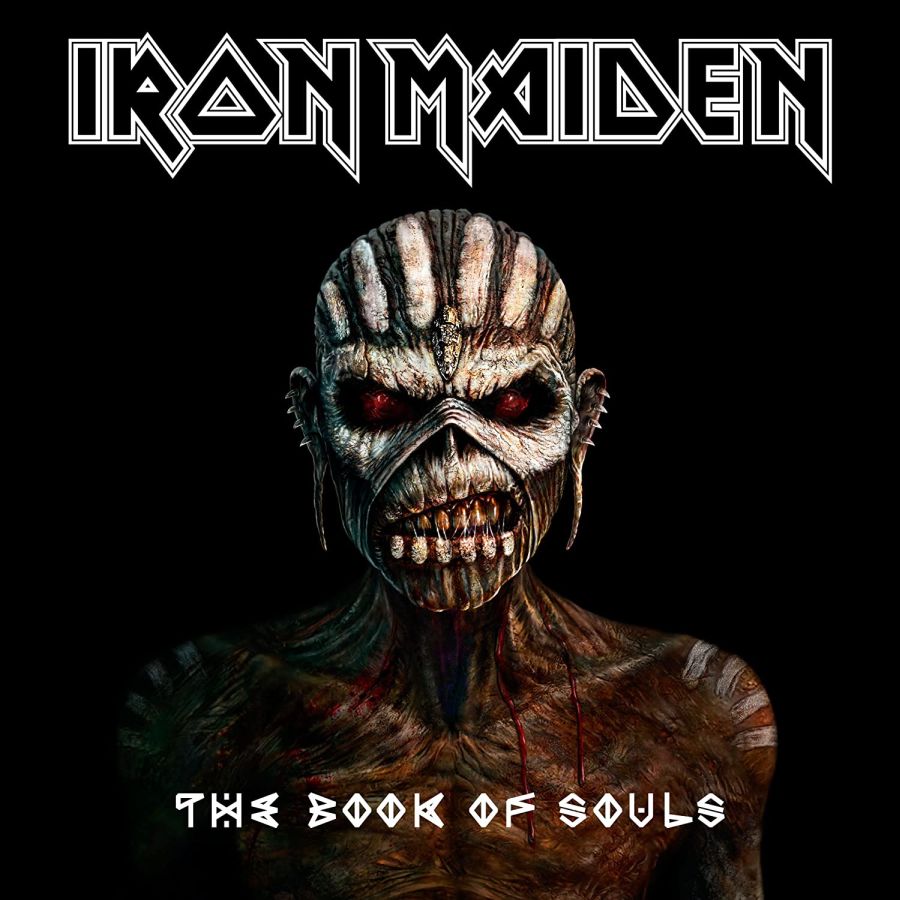
We hardly need to mention one of the dullest covers in Iron Maiden history, where Eddie (for the first time without any background at all) looks like the undead cousin of Dhalsim from Street Fighter, courtesy of renowned graphic designer Mark Wilkinson, who in his day was known for excellent, imagination-packed covers for Marillion. The only things worth praising about the cover are that Eddie finally looks like Eddie again, and the return of the original Iron Maiden logo, last used on “The X Factor” (1995).
Iron Maiden are known for their incredibly loyal fans, who in recent years have forgiven their darlings plenty of mistakes, exaggerated claims and corporate-minded, you could even say lazy, moves. Still, not all of them will fall for the artificially created, over-the-top “The Book of Souls” euphoria that took over among unrealistic expectations long before the album came out. The rest will judge the new album more realistically: as a very solid record that can stand shoulder to shoulder with most of their albums released since Dickinson’s and Smith’s return. That’s still a very nice achievement for the long-lived English outfit, who’ve had plenty of ups and downs since the end of the eighties and haven’t needed to prove in the studio for a long time that they’re not ready for the “scrap heap”, yet still make good music and remain a unique live attraction.
Author: Peter “Dr. ProgRock” Podbrežnik
Tracklist:
CD1: (49:58)
1. If Eternity Should Fail (8:28)
2. Speed of Light (5:01)
3. The Great Unknown (6:37)
4. The Red and the Black (13:33)
5. When the River Runs Deep (5:52)
6. The Book of Souls (10:27)
CD2: (42:13)
7. Death or Glory (5:13)
8. Shadows of the Valley (7:32)
9. Tears of a Clown (4:59)
10. The Man of Sorrows (6:28)
11. Empire of the Clouds (18:01)
Lineup:
Bruce Dickinson – vocals, piano on “Empire of the Clouds”
Dave Murray – guitar
Adrian Smith – guitar
Janick Gers – guitar
Steve Harris – bass guitar, keyboards
Nicko McBrain – drums