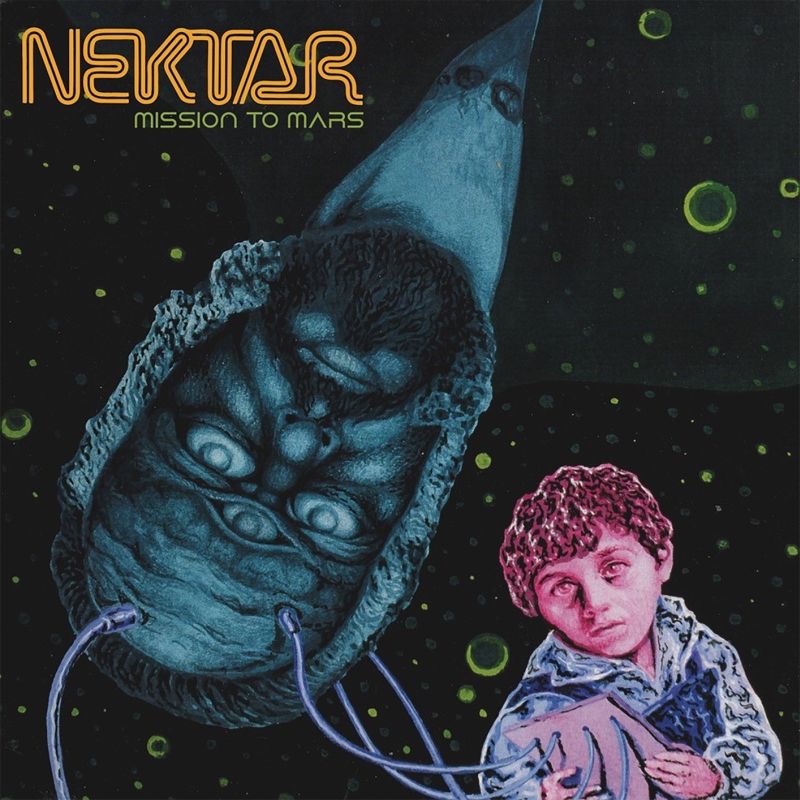
Release date: 6/30/2024
Label: Deko Entertainment
Production: Nektar
Album length: 32.26 min
Genre: Progressive Rock / Space Rock
Rating: 8.0/10
Nektar, the indestructible veterans of the prog rock scene, who keep going even after the death
of their key member, founding guitarist/vocalist Roye Albrighton, and the split of this legendary
band into two factions – one American, one German – are back with a new studio album with a fittingly
space-rock title: “Mission to Mars”. Following “The Other Side” (2020), it’s the second album from the American
branch of Nektar, which counts as the ‘real’ version of this legendary band, since after Albrighton’s death it was
built by founding Nektar members – bassist/keyboardist Derek ‘Mo’ Moore, drummer Ron Howden and stage
lighting wizard Mick Brockett.
Sadly, Howden has been gone since September 29, 2023, having joined Albrighton ‘on the other side’,
along with founding keyboardist Allan ‘Taff’ Freeman, who also left us far too soon in 2021. Brockett, the non-musician of the
bunch, is thankfully still alive, but he’s recently left the ranks of the
American version of Nektar. Bassist Randy Dembo is gone from the band too. Of the founding Nektar members,
only Moore is still around on “Mission to Mars”, and he’s the main reason the American version of Nektar is
more authentic than the German one, called New Nektar and led by keyboardist Klaus Henatsch.
Ryche Chlanda has been filling in for Albrighton since 2018, Kendall Scott is a kind of modern-day stand-in for
Freeman, while Jay Dittamo recently took over from Howden on drums. There’s also a fresh face in
backing vocalist Maryann Castello, who has become the first woman in the history of this cult
band.
One of the key reasons this version of Nektar sounds more authentic and closer to the
classic Nektar right off the bat is how much Chlanda’s voice resembles Albrighton’s. Alexander Hoffmeister,
the singer of the German New Nektar, can’t hold a candle to Chlanda. The American
Nektar are also, mostly thanks to Moore, somewhat better songwriters and arrangers, so on
“Mission to Mars”, a very good follow-up to “The Other Side”, they manage to catch at least a bit of the magic of
the classic Nektar of the seventies, though, to be honest, it can’t possibly be compared with their
greatest masterpieces.
The biggest knock against “Mission to Mars” is that it’s by far the shortest studio album in Nektar
history, with only 32 minutes of music, which is downright laughable these days. For comparison, “The
Other Side” ran twice as long. The opening title track
doesn’t sound all that ambitious either, since it’s not some complex space-rock
adventure like most Nektar fans would expect, but a somewhat drawn-out hard
rocker with a strong Deep Purple stamp. Bluesy guitar passages, barroom piano arrangements and a cheeky
multi-voice chorus aren’t something you’d usually associate with Nektar’s signature sound. If this had been
a track by present-day Deep Purple, it would’ve come off as plenty of fun, with its playful
atmosphere and tongue-in-cheek lyrics, but the average Nektar fan expects a bit more adventure,
complexity and ethereal vibes. Things do start getting more interesting and closer to the classic Nektar
space-rock approach somewhere past the five-minute mark, when Scott starts experimenting with electronic textures on the keyboards and the multi-part guitar-and-keyboard harmonies finally come to life.
From there on, the sound of “Mission to Mars” improves rapidly, as the excellent “Long Lost Sunday”, on
which Chlanda nails Albrighton’s voice so well that it’s almost uncanny at times,
sounds like an almost-classic Nektar piece from somewhere in the first half of the seventies. Chlanda isn’t just
a superb singer but also a great guitarist, which he shows this time with an ethereal guitar solo that
Albrighton would probably have praised too, were he still alive. “One Day Hi One Day Lo”, definitely the best
moment on “Mission to Mars”, keeps the quality of this album high, and thanks to its
unpromising opening, the record gets better by the minute. This time it’s thanks to an epic chorus, one of the
best in the entire Nektar history, while a melodramatic atmosphere dominates and the whole thing climbs
up another level. Here the band, despite my initial grumbling, really deserves all the congratulations and proves that they’re
worthy of the legendary Nektar legacy.
The closing track “I’ll Let You In” opens as a melancholic ballad that, mostly thanks to its ethereal
harmonies, ‘weeping’ guitar passages and subtle organ lines, is a pretty good reminder of some moments
from the ‘good old days’. Sadly, it’s over far too soon, just when things get most interesting.
At the end, at least one more epic piece would have fit in, even though nobody expects anything like the
unforgettable masterpieces such as “Desolation Valley”, “King of Twilight”, the “Remember the Future” suite
or the “Recycled” suite anymore.
After listening to “Mission to Mars”, you’re left with a bittersweet aftertaste, since the band, apart from an intro that’s a little too ‘bland’
hard-rock-wise by their usual standards, is in top form all the way through, until the barely half-hour album
is over in the blink of an eye. That leaves a sense of something unfinished, as if they
were in a hurry to get the album out as soon as possible, especially after Howden’s death, even though they could
have beefed it up with extra tracks of similar quality. The end result could have been
the best Nektar album since the end of the ‘golden’ seventies, but as it is, it’s ‘only’ a very good follow-up to its
predecessor “The Other Side”, which, when it comes to length, at a little over an hour could serve as a model for the
laughably short “Mission to Mars”.
Author: Peter “Dr. ProgRock” Podbrežnik
Track list:
1. Mission to Mars (8:58)
2. Long Lost Sunday (7:12)
3. One Day Hi One Day Lo (10:11)
4. I’ll Let You In (6:05)
Line-up:
Derek “Mo” Moore – bass guitar, vocals
Jay Dittamo – drums
Maryann Castill – backing vocals
Ryche Chlanda – guitar, vocals
Kendall Scott – keyboards