Author: Rok Klemše
Interview date: 09.11.2007
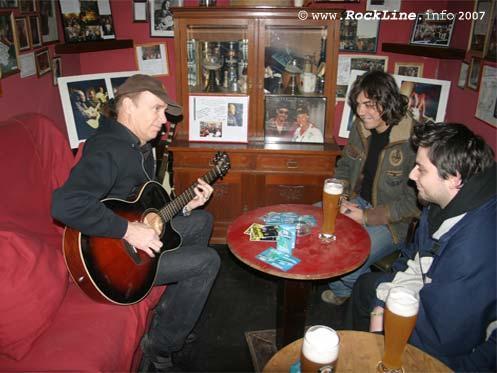
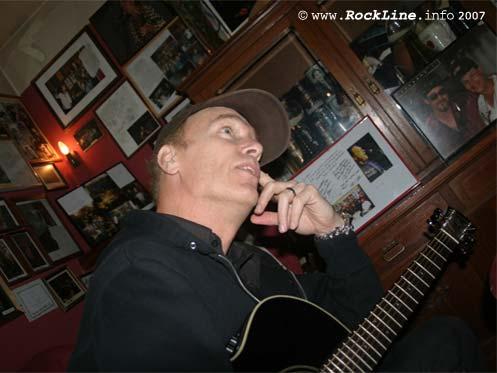
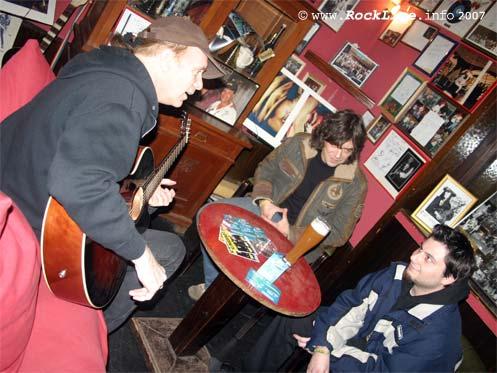
We sat down with a music legend, one of the best bass players on the planet, before the Devil’s Slingshot show at the Bluesiana club in Vrba, Carinthia. Billy Sheehan is a name that commands awe, but the icon of bands like Talas, Niacin, Mr.Big and Steve Vai is really a razor-sharp middle-aged gentleman, an incredibly funny and humble guy you could happily talk to deep into the night. Billy marched into the interview with a guitar and, right between questions, played us a few proper licks. Ladies and gentlemen, Billy Sheehan!
RockLine: You’re nearing the end of the Devil’s Slingshot tour. How’s it gone so far?
Billy: Great, we’re having a blast, but we’re also working hard. We’ve played a ton of shows, I think fourteen in a row. But it’s excellent, we’ve got a great crew, a comfy bus, and people have welcomed us warmly everywhere. It’s fantastic! (the waitress has just brought us fresh beer) Just look at this gorgeous waitress who just served you a great, big, cold beer. Can’t beat that, right?
RockLine: Where did you enjoy playing the most? Do you prefer bigger halls or smaller, more intimate gigs like tonight’s?
Billy: Yeah, definitely. I’ve played some of the biggest venues in the world, Tokyo Dome, Osaka Dome, Madison Square Garde, the Forum in Los Angeles, Royal Albert Hall… Countless huge halls. You play those shows totally relaxed, under zero pressure, because you can’t actually see the people, the place is so big. I played with the Rolling Stones at Tokyo Dome and couldn’t make out a single face. Here, people are literally breathing on me, and I really love that kind of closeness. Yesterday we played in Rome and people were practically on the stage, there wasn’t even a barrier, which I loved, because a barrier just creates distance. At the end I like to hold my bass out to people so they can play a few notes. I like smaller clubs, I grew up playing in places like this and it’s part of my heritage. Makes sense, right?
RockLine: Of course!
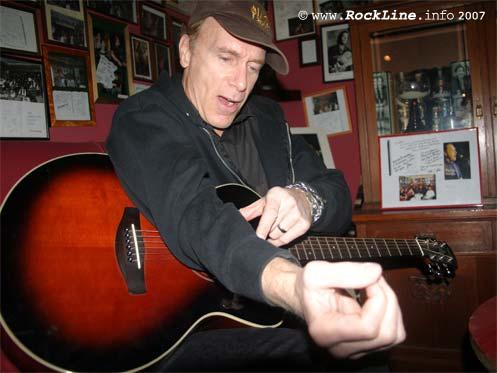
Billy: It’s great to play in halls that hold 80 thousand heads and make thousands of dollars, but a musician’s real satisfaction comes from right here (plays guitar). That’s where 99% of my happiness comes from, being able to sit in peace with a guitar or a bass, with friends, and sing together. If you named any real song right now, Bowie, the Stones, the Beatles, Zeppelin, I’d happily play it. If you want to test me, go ahead.
RockLine: Hm… Let’s say something by Led Zeppelin.
Billy: (already playing)… I could do this all night (laughs). It’s such a big part of my life, and this place tonight is ideal!
RockLine: Since you just played some Zeppelin, what do you think about the reunion show?
Billy: As long as John Paul Jones is involved, I’m happy. When they did a few things without him, I was pretty upset. To me he’s one of the most important members of the band and one of the best bass players in the world. Plus, his Mellotron and B3 are fantastic. One of the best rock musicians, period.
RockLine: Who else do you count among your role models or favorite musicians?
Billy: Ugh, millions of them.
RockLine: What if you could only name three?
Billy: Impossible! (laughs) Let’s say Paco de Lucia, Oscar Peterson and Jimi Hendrix.
RockLine: How do you manage to juggle all the projects you play in – Niacin, Devil’s Slingshot, plus Steve Vai?
Billy: It’s not hard, it’s just sometimes tough to remember all the songs. Last year I played seven different tours with seven completely different sets of musicians. That was pretty demanding, since I had to memorize so many songs. Now it’s easier for me to hold it all in my head, and juggling a bunch of different things isn’t so hard. Devil’s Slingshot is quite different from my other projects, I usually sing too, and that’s a pretty big rhythmic challenge.
RockLine: Have you known Tony for a long time?
Billy: Yeah, since 1985, when I joined David Lee Roth, and I also played on Tony’s first record, I think we’d just recorded David’s album Eat ‘Em and Smile, I don’t remember exactly. But I do remember Tony’s album, it’s one of my favorites and today we’ll play a few songs from it too.
RockLine: How big a challenge is it to play a Hammond B3 in Niacin or guitar in Devil’s Slingshot?
Billy: For me it’s almost the same, because I grew up at a time when the Hammond B3 was almost as important as the guitar, maybe even more so. There was a time in music when you could play without a guitar, but not without a Hammond B3. Simply every band had to have a Hammond B3, they wouldn’t even exist without it. Especially in the ’60s and the ’70s too, like Led Zeppelin, Deep Purple, even Hendrix on Electric Ladyland, Traffic, Jethro Tull. So for me there’s no big difference, I think the B3 is pretty “guitar-like”. The B3 influenced the guitar, and the guitar influenced the B3.
RockLine: So how did you end up working with Tony MacAlpine and Virgil Donati in Devil’s Slingshot?
Billy: It’s mostly their band, they play a ton together in other bands too, they invited me on this tour and I gladly said yes. Otherwise it’s mainly their thing, from the name to the songs.
RockLine: Actually, my next question is about the album title Clinophobia (fear of sleeping, author’s note). Why that title?
Billy: No idea (laughs). All I know is it means fear of sleeping.
RockLine: You’re currently working on your new record for next year…
Billy: Yeah, I just finished recording the drums, guitar, bass and vocals are next, and there’ll be a few special guests too.
RockLine: Can’t you reveal who (laughs)?
Billy: Sure, sure. The drummer is Ray Luzier, who played on my last record, Cosmic Troubadour, and he also plays in Army of Anyone with the guys from Stone Temple Pilots. I mean, I don’t know if it’s been announced yet, but he’s Korn’s new drummer. Great drummer! When I get back home I’ll keep going, I hope the album will be done by Christmas, and it’ll come out early next year. I don’t have a title yet, but it won’t be Clinophobia, Tony already used that one (laughs).
RockLine: Ten days ago Ritchie Kotzen played here, your Mr. Big bandmate. Are you still in touch?
Billy: Yeah, of course, we talk very often, he lives really close to me.
RockLine: Can you tell us what the difference is between gigs back when you first stepped onto the big stages and gigs today?
Billy: When I left Talas, David Lee Roth called me, I left Buffalo and landed straight in the middle of platinum sales and music videos. The original guitarist was Steve Stevens, but it didn’t work out and I suggested Steve Vai. Everyone thinks it was Steve first and then me, but it was the other way around. Then I founded Mr. Big. The biggest difference on big stages is the small differences. On a big stage you can’t hear a thing, and when the drummer counts “one, two, three” you can’t hear him at all, so every song starts with a drum lick. We learned that with Talas when we played before Van Halen. You pick up stuff like that fast on stage. When I was still in Talas we played with quite a few big bands, UFO, Aerosmith, Blue Oyster Cult… Once we played before Pat Travers and they cut our power (laughs). We were playing in some small town and Travers had no idea who we were, the locals already knew us and were cheering for us, and then they pulled the plug on us (laughs).
RockLine: You once got a best bassist award, one of many, and said at the ceremony that right at that moment some kid was surely playing in a garage who was even better than you. So what would your advice be to young guitarists and bassists, after a long and enviable career?
Billy: Start playing in a band! That’s what I did and what all the good musicians did, Hendrix, the Beatles, Zeppelin. That’s it. So many people learn notes and scales at home, standing in front of a mirror. That’s nonsense! Get up on stage and start playing. Learn a million songs and just play. That’s the most important thing.
RockLine: Could you describe your gear a bit for all the tech freaks?
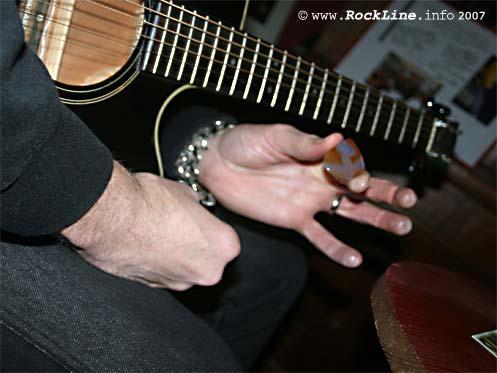
Billy: I use Ampeg SVT-4Pro amps. When I play with a pick, I use a stone pick. They’re fast and they don’t wear down. I play a Yamaha Attitude bass, and a new version, the third one, comes out next year. I use DiMarzio pickups and RotoSound strings, Hendrix played those. Some company just put Jimi Hendrix strings on the market. It’s called Dean Markley, which didn’t even exist in Hendrix’s time. They make otherwise great strings, but they totally blew it with that one. And a few other things I can’t remember, but not a lot of effects, just distortion.
RockLine: What are your plans for the future? What else would you like to achieve musically?
Billy: I’d like to buy a hurdy-gurdy. Incredible instrument.
RockLine: (laughs) I think you should try Switzerland. I don’t know if you know the band Eluveitie, they play Celtic folk metal and use a hurdy-gurdy.
Billy: Really? Crazy! I still learn something every day, I’m still discovering new things. I never get to the point where I think I’m even any good. I only know about the stuff I still can’t play, what I can play doesn’t interest me at all. Yesterday I played so hard that I got cramps while signing autographs. I’m always looking for new things, I just invented a bass you play with your feet. It’s a MIDI board that you play with your feet. A guy from Los Angeles built me a prototype, now I’ll take it to a few companies and we’ll see.
RockLine: Billy, thanks a lot for the interview, it was an honor. Have a great show.
Billy: Thanks, enjoy!
Interviewed by: Aleš Podbrežnik and Rok Klemše
Photos: Jani Lah
Photo Gallery