Author: Peter Podbrežnik
Interview date: October 26, 2009
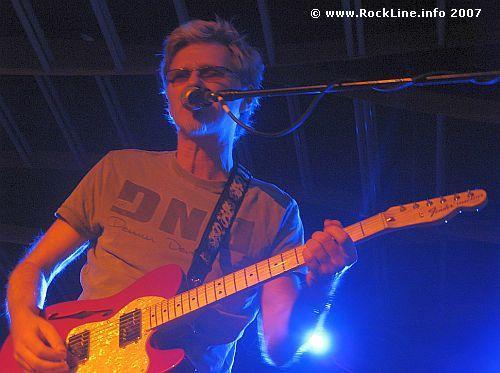
Roine Stolt is the central figure in the story of Swedish progressive rock. The world-renowned guitarist, singer and composer rose to fame as the leader of the two most successful Swedish prog rock bands: his original band Kaipa in the seventies and The Flower Kings from the nineties onward. His recognizable guitar style is a blend of countless influences, but he drew his inspiration mostly from guitar grandmasters like David Gilmour, Steve Howe and Frank Zappa. His positive vision of a world ruled by beauty (similar to the one nurtured by Yes singer Jon Anderson) gives his music an aura that resonates with plenty of prog rock fans. With The Flower Kings, Stolt achieved international fame, as his band, together with the Americans Spock’s Beard, became the most successful prog rock outfit of the nineties. On top of that, over the course of his career he has been a steady member of or contributor to a range of prog rock projects such as Transatlantic, The Tangent, Karmakanic and Agents Of Mercy. Alongside all that, he also keeps up a successful solo career, so he can rightfully be called a true musical workaholic. Lately Roine has been active again with the international prog rock supergroup Transatlantic, which, besides him, features Neal Morse (ex-Spock’s Beard), Pete Trewavas (Marillion) and Mike Portnoy (Dream Theater). Their latest release, “The Whirlwind”, was also the main topic of our interview.
Rockline: To start off, could you tell us a bit more about the recording process while the new Transatlantic album was coming together?
Roine: Not long after the new year I got an email from Neal Morse asking what we thought about the possibility of tackling a new Transatlantic album. There’s obviously no need to guess about my answer anymore. We got together in April 2009 and laid out some demo recordings that we’d been sending to a shared address. Then we started building a new album around those demos.
The recording took place in Tennessee (USA), in a small studio owned by Neal Morse. We were trying to catch that real chemistry between us. I wanted to feel as much excitement as possible, so I worked my butt off to make that kind of magic happen. We were all in the same room, recording the new album piece by piece and gradually adding new sections inside it.
As much as I can, I always try to put as much detail and high-level playing as possible into my recordings. Some of the tracks were of course given extra studio treatment later on (in my case in Sweden). I’m really happy with this album and I’m convinced it’ll stand the test of time and only gain more weight in the coming years. We all put our heart and soul into it, along with our collective experience in music. We’re thrilled with the quality of the result, and the same goes for the sound engineers and mixers.
Rockline: Can you tell us something about the lyrics on The Whirlwind?
Roine: Neal’s lyrical contribution probably comes from a more religious point of view, with biblical references to the whirlwind, but we tried to make the lyrics as cohesive as possible with the help of what Pete Trewavas and I wrote. In the end it all came out really well. The idea of the “whirlwind” is an allegory for how our lives are sometimes turbulent and without any real meaning, but in the end we always land on our feet, and behind the dark clouds the sun is always hiding. God has a plan, but we can’t always see the reason for the turbulence in our lives.
Rockline: Why did so many years pass between the last Transatlantic album and the new one?
Roine: I think the main reason was that Neal wanted to take a break from non-religious music, but after all those years I’m convinced he saw the power and the chemistry that binds our foursome together when we make music. I’m sure the Lord is smiling down on us and agrees that there’s no evil to be found in Transatlantic’s music.
Rockline: What does it feel like to work with such special, talented and diverse musicians?
Roine: They’re simply very special people with exceptional talent and a high level of creativity. This time I was especially blown away by Mike Portnoy’s excellent drumming. I think he’s gotten even better than he was ten years ago.
Rockline: Over your career you’ve worked with many different bands and projects. Which of those experiences has been the most valuable to you as a musician?
Roine: It’s actually hard to say, because they were all good. Working with The Flower Kings was of course one big journey, but the current collaboration with Agents Of Mercy has been a really nice experience too. There I got the chance to play again with King Crimson drummer Pat Mastelotto, and also with newcomer Nad Sylvan, a fantastic singer with an exceptional character. And of course I can’t overlook all three Transatlantic albums, though the newest one is my favorite.
Rockline: What are your future plans with The Flower Kings?
Roine: Well, for now, to rest and start writing new material for an album that should be ready next year. I’m not touring with The Flower Kings at the moment, but I’m playing live with Agents Of Mercy, Transatlantic and Karmakanic, so I’m very happy right now. I also contributed to a new release called “3rd World Electric”, a jazz fusion album where we worked, among others, with drum icon Dave Weckl from the Chick Corea band.
Rockline: By any chance, is there a possibility of working together again with your first band, Kaipa?
Roine: No, I think that chapter is closed for me, but we recently reissued all of the first three Kaipa albums from the seventies as Japanese mini LP replicas with some interesting bonus material.
Rockline: Can we expect a new solo album in the future?
Roine: I’m currently getting ready to make a guitar-oriented album. It’ll be partly prog rock, but more in the direction of what Jeff Beck and Dave Gilmour usually do, meaning with an emphasis on melody and drama. On top of that, we’re about to start recording the second Agents Of Mercy album.
Rockline: If we walk through your whole body of work, can you pick your favorite albums, or the ones that were most important for your career?
Roine: My favorite The Flower Kings albums are “Stardust We Are” and “Unfold The Future”, with Transatlantic it’s “The Whirlwind” and “Bridge Across Forever”, while with Kaipa I’d pick “Inget Nytt Under Solen” and “Keyholder”. Of course I have to add the Agents Of Mercy debut “The Fading Ghosts Of Twilight”. I think “Stardust We Are” and the Transatlantic debut “SMPTe” were the most important for my career.
Rockline: What do you think of the modern prog rock scene?
Roine: Oh, there’s plenty of good stuff, but a lot of it sinks into obscurity because of the flood of second-rate prog. My personal favorites among the newer bands are Opeth, Ritual, Spiraling and Muse.
Rockline: What are the main differences you notice when you compare the music scene of the seventies, when you started playing with Kaipa, and today? Do you think things have gotten worse?
Roine: Today anyone can record an album on their computer, which means a ton of stuff comes out that would never have come out in the seventies, because back then you needed a band that could actually play, and play live too. So I can say that when it comes to originality and musicianship, those qualities were definitely at a higher level in the seventies.
Rockline: Could you list your main guitar influences?
Roine: My first influences were Robin Trower, Jimi Hendrix, Peter Green and Duane Allman, and when the early seventies rolled around, Allan Holdsworth, Steve Hackett and Bill Connors. Lately I like listening to guitarists such as Derek Trucks, The Edge, Pat Metheny, Guthrie Govan and Mike Landau.
Rockline: If you got the chance to travel back in time, would you change anything about your past?
Roine: Oh, that’d be too personal (laughs), but when it comes to music, I’d definitely take control of my business and career much, much earlier. My advice to young musicians is this: don’t let record labels steal your money and profit off your hard work. If you’ve got talent, don’t waste it by signing some ten-year deal with a label just so you can have a recording contract. Those are Stone Age ideas.
Rockline: Mr. Stolt, thank you so much for your answers. It was a real honor to talk with you. I wish you as many magical moments as possible.
Roine: Best regards, and thanks for being willing to talk with me.
Photo Gallery