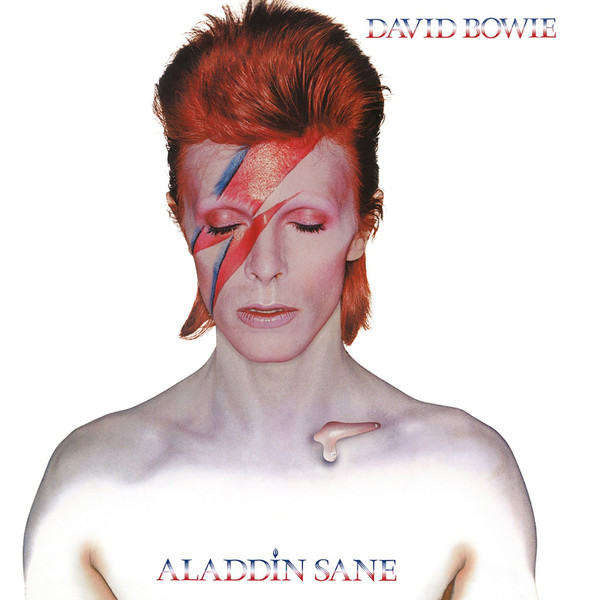
Label: RCA
Release date: April 13, 1973
Production: Ken Scott & David Bowie
Album length: 40.47 min
Genre: Glam Rock / Hard Rock
Rating: 9.0/10
After the phenomenal success of the cult concept album “The Rise and Fall of Ziggy Stardust and the Spiders From Mars” (1972), which turned him into a global star, David Bowie, then at the peak of his glam rock era, decided it was time to gradually say goodbye to his beloved alter ego, the androgynous alien Ziggy Stardust. Still, on his next studio album, “Aladdin Sane”, which unlike its predecessor was not a concept record, David didn’t bury Ziggy completely. Instead, he cleverly turned him into a new character called Aladdin Sane, an odd bit of wordplay on “A Lad Insane”. Bowie got part of the idea after his brother Terry was diagnosed with schizophrenia. Unlike Ziggy, Aladdin was supposedly a little more mentally balanced, while the lightning bolt painted across half of David’s face symbolized the split between his true self and his “spacey” alter ego.
Bowie simply described his new character and the album “Aladdin Sane” as “Ziggy goes to America”, since most of the material was written during the American leg of the “Ziggy Stardust” tour, which is obvious from the title of the song “Panic in Detroit” alone. “Aladdin Sane” was also David’s last album with the classic lineup of his backing band The Spiders From Mars, who got a brilliant helping hand from guest keyboardist Mike Garson, who laid down some fantastic piano improvisations. Compared to its more famous predecessor, “Aladdin Sane” was a noticeably harder-hitting record, with more rock’n’roll riffs and colorful, occasionally female backing vocals, while some of the piano arrangements got even more sophisticated and, here and there, stamped an important experimental mark on the glam rock look of most of the compositions.
It was becoming clearer and clearer that Bowie’s glam rock phase wouldn’t last long, which was more than noticeable on some of the tracks. Of the Spiders From Mars, guitar virtuoso Mick Ronson once again shone, and he earned co-credit on some of the arrangements too. The rhythm section of bassist Trevor Bolder and drummer Mick “Woody” Woodmansey, who was replaced by Aynsley Dunbar soon after “Aladdin Sane” came out, had become thoroughly eclectic and well-oiled by this point.
According to Bowie, the somewhat “dirtier” style of the album was also shaped in part by the drug-soaked, decadent American tour and his hanging out with The Rolling Stones, led by Mick Jagger. Their influence can be heard on the opener “Watch That Man”, where David’s vocals are deliberately pushed into the background of the mix while bluesy guitar lines, energetic female backing vocals and a piano-driven dance groove take the lead. Even though it’s one of the simplest, most party-minded tracks Bowie made in the seventies, it’s a hugely effective introduction to a stylistically very diverse album.
The title track, “Aladdin Sane (1913-1938-197?)”, is a chapter all its own, with its mysterious, enigmatic atmosphere and Garson’s many avant-garde jazz-fusion piano improvisations, the kind that even Soft Machine in their mature period wouldn’t have been ashamed of. In the lyrics Bowie wonders whether anyone will even be able to love Aladdin Sane (after the huge popularity of his predecessor Ziggy Stardust), while the first two years mark the time before the outbreak of the two world wars. The unfinished year was supposed to signal that Bowie quietly believed a third world war was getting closer and was something inevitable, especially after witnessing so many decadent depths of Western capitalism on the American tour. You could say this was the key piece of the whole album when it comes to foreshadowing David’s near musical future, since the most experimental works of his career were still to come.
“Drive-In Saturday”, steeped in doo-wop influences, which also came out as a single, makes for an interesting atmospheric contrast with its nostalgic vibe and colorful saxophone bits. The lyrics are about a completely sterile, dehumanized society in the distant future that has forgotten what sex is and wants to learn “how it’s done” by watching old porn films. “Panic in Detroit”, drenched in energetic female backing vocals, features an authoritative hard rock guitar phrase, while the lyrics are inspired by the phenomenon of all sorts of revolutionary utopians, led by Che Guevara, whom many Westerners in the middle of capitalist society viewed quite romantically at the time.
The cunning glam/hard rock hybrid “Cracked Actor” is another one of the harder “Aladdin Sane” tracks, ruled by Ronson’s sharp guitar lines. Meanwhile, Bowie plays in the lyrics with a story about an encounter between an aging film actor and a prostitute, with plenty of references to drug abuse. “Time”, which has a shattering atmosphere and was also released as a single, features piano-driven elements of cabaret music and avant-garde jazz, while the melodramatic chorus, one of the best on the album, steals the “victory”.
“The Prettiest Star” is a song that first came out back in 1970 in its original version, as a single with special guest Marc Bolan. The 1972 version sounded much more glam rock, while Ronson took care of a perfect imitation of Bolan’s guitar lines. “The Prettiest Star” is said to be dedicated to Bowie’s then-wife Angela “Angie” Barnett. Of all the tracks on the album, by far the most superfluous, despite being very neatly pulled off, is the cover of The Rolling Stones hit “Let’s Spend the Night Together”, which David’s crew dressed up in a glam rock outfit and played in a much punchier way.
One of the most beloved “Aladdin Sane” tracks to this day is the hit “The Jean Genie”, the album’s lead single, where Bowie, within his own particular glam rock mix, brings in elements of blues and proto-punk, while the lyrics contain an allusion to the French writer Jean Genet. The album closes in a majestic and extremely melodramatic way with the shattering love confession “Lady Grinning Soul”, which, with its enigmatic-romantic pulse, is strongly reminiscent of the musical backdrop typical of films about secret agent James Bond. This hugely overlooked song is a complete chapter in itself and can’t be compared to anything Bowie made before or after it. It undoubtedly lifts the artistic side of the album at least one notch higher right at the very end and confirms David’s boundless sonic vision.
“Aladdin Sane”, the next phase of the glam rock saga of Ziggy Stardust, is usually one of Bowie’s more critically overlooked albums, even though with it Bowie proved that his newly acquired stardom hadn’t lulled him to sleep artistically, since he managed to create another unforgettable masterpiece in a relatively short time. Even though “Aladdin Sane” outdoes its more famous studio predecessor in many ways, being yet another important step forward in Bowie’s constant sonic chameleonism, the reactions of critics at the time were reportedly rather mixed, since most of them expected a complete stylistic continuation of the conceptual masterpiece. Bowie, who never intended to rest on his laurels, had meanwhile already grown tired of glam rock. After releasing the covers album “Pin Ups” in the fall of 1973, his last record with the members of The Spiders From Mars, he set about shaping his next studio project, on which he finally buried Ziggy, or rather Aladdin, and presented some completely unexpected stylistic experiments with an even bigger emphasis on futuristic-dystopian concepts.
Author: Peter “Dr. ProgRock” Podbrežnik
This review is dedicated to the memory of David Bowie (1947-2016).