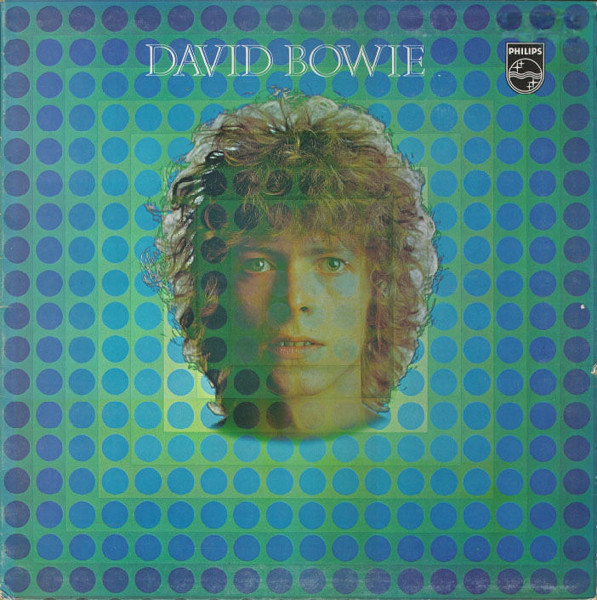
Label: Philips
Release date: 11/14/1969
Production: Tony Visconti & Gus Dudgeon (Space Oddity)
Album length: 45.13 min
Genre: Psychadelic Rock / Folk Rock
Rating: 8.0/10
Bowie’s self-titled second solo album, reissued in 1972 for the international market under the better-known name “Space Oddity,” is without a doubt one of the most important records of his extraordinarily rich musical career. It catapulted him from a London-provincial, almost street-level artist into the ranks of the most promising British musical names of the late sixties, even though a few more years still stood between him and stardom and bigger commercial success. Thanks to the legendary title track, which was inspired by Stanley Kubrick’s film ‘2001: A Space Odyssey’ and played on British TV stations during the first human landing on the Moon, David tasted his first commercial success, even outside the UK.
In the less than a year since his historically interesting but, compared to what came later, naively simple debut, David thoroughly overhauled his musical and visual image. Under the influence of the trends of the day, he headed into progressive rock and folk waters with a not-insignificant dash of psychedelia. Key to this change in sound was his collaboration with the then little-known keyboardist Rick Wakeman, who later reached legendary status as a member of Yes, and (even more importantly) with bassist/producer Tony Visconti. The latter, as producer and occasional musician, worked on some of the best achievements of David’s career. Visconti stayed loyal to Bowie as producer right up to the final creative years. Bowie sparked no small amount of confusion among audiences and critics at the time with the album’s title: it was initially named the same as his debut, while in the US it came out as “Man of Words/Man of Music.” Only later, in the seventies, when Bowie was already a worldwide star, did it come out as “Space Oddity,” and most people still call it that today.
The title evergreen, inspired by the human landing on the moon in 1969, is a clear example of Bowie flirting with space rock, even though at its core it’s a prog/psychedelic rock song with lush orchestral arrangements and Wakeman’s waves of Mellotron. Bowie masterfully fused the main acoustic guitar melody with his unique vocals and a lyric about a fictional British astronaut, Major Tom, who ends up cut off forever from the space center on Earth and is lost for good somewhere in the depths of space in his spaceship. With this unforgettable evergreen, Bowie wanted to satirize the British space program, which hadn’t exactly racked up any noticeable successes when it came to conquering the Moon.
The lyrics supposedly also hide an allusion to taking psychedelic, hallucinogenic substances, while Tom’s space trip is more or less a metaphor for his ‘being high’ and social alienation. Bowie’s fascination with science fiction, unexplored space and aliens was far from over, as he’d go on to prove many times over with songs like “Life On Mars?”, “Moonage Daydream”, “Starman”, “Loving the Alien”, “Halo Spaceboy” and “Dancing Out in Space,” to name just a few. And he returned to Major Tom once more in 1980 on the classic “Ashes to Ashes.”
The rest of the songs on the album weren’t as interesting as the opening hit, as they didn’t reach its artistic depth, but you can’t say any of them lacked a certain specific artistic value, which became pretty much standard practice for Bowie throughout his career. “Letter To Hermione,” which Bowie dedicated to his ex-girlfriend, is a lovely example of a tasteful folk ballad with a love lyric that radiates Bowie’s extraordinary romanticism. The prog-folk experiment “Cygnus Committe” also deserves a mention. At almost ten minutes, it’s one of the longest songs in Bowie’s career. Here Bowie once again touches in the lyrics on one of his favorite (dystopian) themes: a self-proclaimed ‘superman’ or ‘messiah,’ with his rise and fall included, which he’d go on to push to truly epic and glamorous proportions later in his career. “An Occasional Dream” is a fun demonstration of folk-rock wit on flute with plenty of vocal improvisation, while most of the harmonies are built on acoustic guitar. The whole album was markedly acoustic-driven, with minimal electric guitar bits played by Tim Reinwick, which changed radically already the following year of Bowie’s career.
Other compositions worth a look include the orchestral “Wild Eyed Boy From Freecloud” and the closing folk-psychedelic-rock dirge “Memory of a Free Festival,” which was David’s somewhat cynical tribute to one of the hippie music festivals he’d played as a musician. The lyrics, in which you can’t miss the sarcasm and disappointment with the increasingly overhyped hippie scene of the time, are paired with a pleasant, ethereal melody. The later single version is a lot punchier and more interesting, with lead guitar played by a special guest, the future glam rock icon Marc Bolan (T. Rex), with whom Bowie had a kind of friendly-rival relationship at the time. This version of “Memory of a Free Festival” already featured two members of Bowie’s future (and most famous) backing band, The Spiders From Mars: guitarist Mick Ronson, who played rhythm guitar, and drummer Mick ‘Woody’ Woodmansey.
With “Space Oddity” (the album and the title track), Bowie, who was positively bubbling over with innovative musical ideas, proved that he’d very much be a force to reckon with in the future. Roughly half the songs on the album were still firmly rooted in the sixties, while the rest already hinted at a far more ambitious direction ahead. David was, after all, already reaching for the next step in his constant sonic evolution. Before long he started looking for a serious band with which he could develop a much heavier, electric-guitar-based sound, while waving goodbye to the acoustic-psychedelic direction that dominated “Space Oddity.” Once he started building a new lineup around Visconti, guitar maestro Ronson and drummer Woodmansey, the first cornerstone was laid for Bowie’s classic backing band and for the later art rock/glam rock innovations and big successes.
Author: Peter “Dr. ProgRock” Podbrežnik
This review is dedicated to the memory of David Bowie (1947-2016).
Tracklist:
1. Space Oddity (5:16)
2. Unwashed and Somewhat Slightly Dazed (6:55)
3. Letter to Hermione (2:33)
4. Cygnet Committee (9:35)
5. Janine (3:25)
6. An Occasional Dream (3:01)
7. Wild Eyed Boy from Freecloud (4:52)
8. God Knows I’m Good (3:21)
9. Memory of a Free Festival (7:09)
Lineup:
David Bowie – vocals, acoustic guitar, stylophone (“Space Oddity”), organ (“Memory of a Free Festival”), kalimba
Tim Renwick – electric guitar, flute
Keith Christmas – acoustic guitar
Mick Wayne – guitar
Rick Wakeman – Mellotron, electric harpsichord
Tony Visconti – bass guitar, flute
Herbie Flowers – bass guitar
John “Honk” Lodge – bass guitar
John Cambridge – drums
Terry Cox – drums
Benny Marshall (and friends) – harmonica, backing vocals (“Memory of a Free Festival”)
Paul Buckmaster – cello