Today, 28.03.2020, marks exactly 40 years since the release of Genesis’ album “Duke”. This is the record that loudly announced Genesis had entered the eighties too, riding a gradual storm of stylistic changes, just like plenty of their prog rock contemporaries. They started reaching for radical musical shifts that slowly reshaped them into an iconic and commercially huge art pop rock outfit of the eighties. Many of their peers, who like Genesis got through the seventies as prog rock bands, didn’t pull off this transition so well, but Genesis went on to become one of the most commercially successful bands on the planet in the eighties. Slowly, though. First came “Duke”, which, as mentioned, came out on 28.03.1980 on Charisma Records!
You can read RockLine’s review of the album “Duke”, written by Peter Podbrežnik, HERE!
In 1978, Genesis became a trio. They had survived the departure of two hard-to-replace musicians: first Peter Gabriel, then Steve Hackett. The album “…And Then There Were Three…” hinted in many ways that Genesis were on the verge of stylistic and sonic change, even though it’s still seen as the record that more or less closes the classic era of Genesis as a (pure-blooded) prog rock band. For “Duke” the band took a somewhat longer break before getting down to new material. Rutherford, Collins and Banks didn’t really have many ideas or sketches ready beforehand, but unlike on the previous album, they wrote most of it together. All three of them.
Around then, Collins was put up against the wall by his wife Andrea, who basically said that if he planned to keep touring the world this intensely, he wouldn’t find her at home when he got back to England. Collins, who unlike Ozzy had obviously heard of parental responsibility, urgently called a meeting where he, Rutherford, Banks and the band’s manager Tony Smith put their heads together, and he got a two-month postponement of all Genesis activities. This was after the “….And Then There Were Three…” tour wrapped up. Collins, who felt at the time that Genesis were at a turning point, right on the doorstep of big commercial success, actually had to head off after his Andrea and their two kids, not to England but all the way to Vancouver, Canada, and sadly, all his effort to keep the family together didn’t work out. The break ran a little longer, and while Banks and Rutherford were hoping Collins would manage to save his family, each of them recorded a solo debut at Polar studio in Stockholm, Sweden. Rutherford “Smallcreep’s Day”, Banks “A Curious Feeling”. In April 1979 Collins came back to England and started playing local clubs with the jazz rock fusion outfit Brand X, and the first demos for his solo debut “Face Value” took shape at his home in Shalford (Surrey). At that time Collins was getting excited not only about playing piano and synthesizers, but above all about the first drum machines, especially Roland, and he started thinking about how to bring all these new sonic trends into his own music.
In the fall of that year, Banks and Rutherford headed to Collins’ home, and the band started trying out jamming on new material, much like during the recording of “…And There Were Three…”. By then Collins had already written a hefty bunch of new songs, but felt they didn’t suit the Genesis style, while Rutherford and Banks arrived in Shalford with very few new ideas, having spent everything on their solo debuts. The guys agreed that each of them would contribute two songs of their own to the new Genesis album. Banks brought Heathaze and Cul-de-Sac, Rutherford brought Man of Our Times and Alone Tonight. Collins had Misunderstanding (which later became a hit) and Please Don’t Ask up his sleeve. The rest of the songs on “Duke” were created by the band together while jamming in Collins’ studio. As it happened, Banks later regretted turning down In The Air Tonight, which was Collins’ song and which he later put out on his debut (it became Collins’ big hit), while Cul-de-Sac (Banks’ track) was a problem for Collins, since that style of songwriting, lyrically too, no longer interested him, and Banks realized it would have been better to release it on his own solo debut.
The writing and composing process was a lot more relaxed and the band enjoyed it far more than the writing phase for the previous album, where the contributions were strictly individual. Rutherford remembers that while “Duke” was coming together, the band found again that formula from the old days when they wrote material together, while Banks put the newfound freshness down to the fact that Genesis took a longer break, and some really good ideas came out of that time. Collins was thrilled that, compared to the previous album, the band had come together not just as composers but especially as performers. Unlike the material on previous Genesis albums, “Duke” had more shorter songs, with the exception of the closing ten-minute suite Duke’s Travels / Duke’s End.
The first to get its final arrangement for “Duke” was Behind the Lines, followed by Duchess, which is built on Collins’ rhythm played through electronic drums. The songs Behind the Lines, Duchess, Guide Vocal, Turn It On Again, Duke’s Travels and Duke’s End were originally joined into one thirty-minute composition, since they’re tied together by a concept, a story about a fictional character named Albert. The working title of Behind the Lines was Duke. The band chose it because of the fanfare sound used in Behind the Lines and Duke’s End, which ties into the symbol of “royalty”. Later the band decided to cut the composition into several shorter pieces, partly so it wouldn’t recall Supper’s Ready, the “Foxtrot” classic that runs over 23 minutes. The decision also turned out useful because it made it easier for the band to pick and release singles, such as “Duchess” and “Turn It On Again” from the album. The band also played the six songs tied to this concept live on stage, with Collins introducing them to the crowd as “the story of Albert”. Turn It On Again was originally short, sitting in the middle of this medley, but the band enjoyed playing it so much that they decided to double its running time and give it more of a spotlight. Turn it On Again originally came from two unfinished musical ideas that Banks and Rutherford hadn’t used on their solo debuts, and which they then merged into one track. Genesis decided to put all the songs they had written together for “Duke” on side A, and the remaining individually written songs on B.
The band headed off to Sweden, where on 12.11.1979 they started recording the new album in Stockholm (Polar studio), with sessions running until the end of the year. As on previous albums, Genesis worked with co-producer David Hentschel on the production. “Duke” was the last Genesis album they made with Hentschel. It was also the first time Genesis used a drum machine on one of their songs. A Roland CR-78. For the song Duchess (whose working title was “drum machine”).
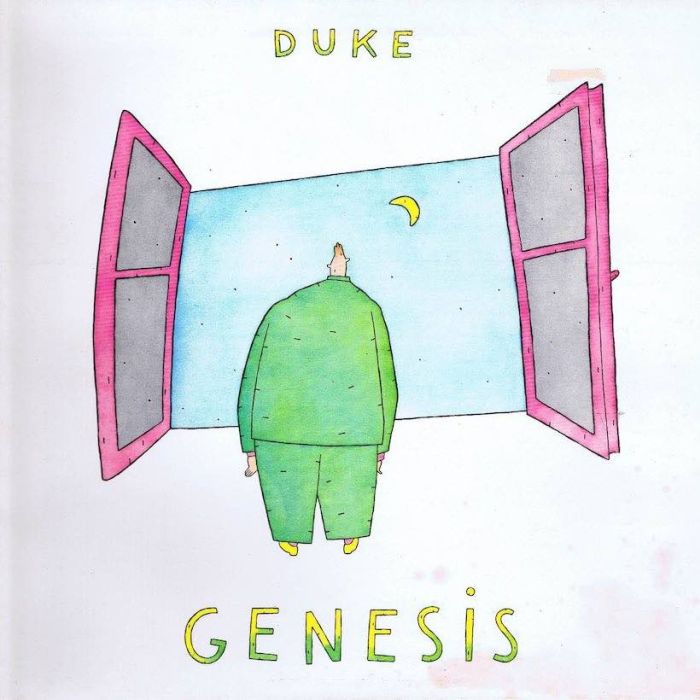
The album cover was created by French artist Lionel Koechlin and is taken from the book “L’Alphabet d’Albert”, published in 1979, though Collins insisted that the character on the cover isn’t the album’s title character and isn’t tied to any of the album’s songs, even though, when you follow the story of Albert on this record, meaningful associations with the cover motif practically rain down.
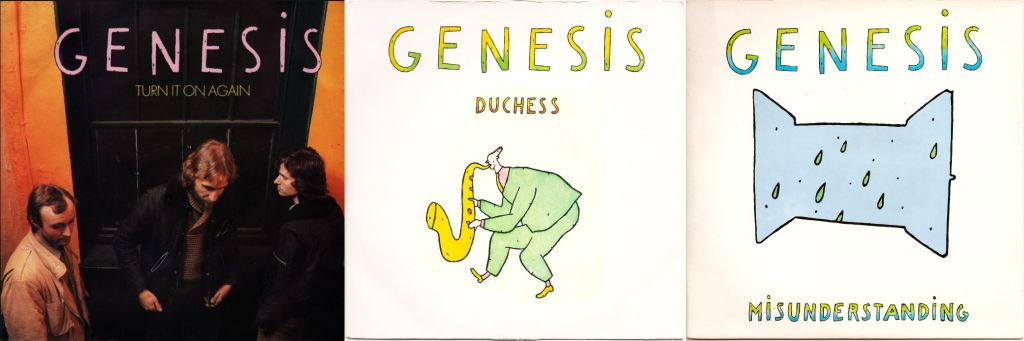
“Duke” came out in the US on 24.03.1980, and in Europe and the United Kingdom on 28.03.1980. For the band it was the biggest commercial success up to that day, since on release it spent two weeks at number one on the UK albums chart, while in the US it climbed to number 11 on the Billboard 200. The band released three singles from “Duke”: Turn it on Again, which hit number 8 on the UK chart and number 58 in the US, then Duchess, which reached number 46 on the UK chart (it didn’t chart in the US), and Misunderstanding, which reached number 42 on the UK chart and number 14 in the US. “Duke” went platinum in the UK on 03.07.1980, and in the US on 11.03.1988.
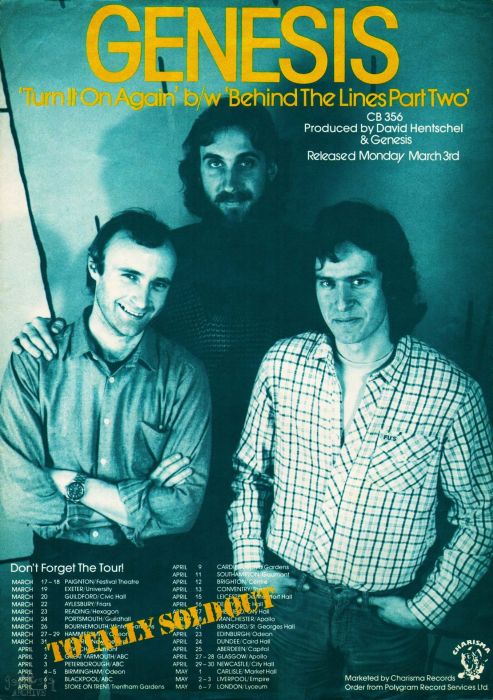
To support the album the band hit the road on a tour of 103 shows at various venues, stretching from Europe to North America, kicking off in Paignton, England on 17.03.1980, with the last show played on 30.06.1980 in Saratoga (USA). A recording of the London show was released later, for the album’s 30th anniversary, as “Genesis – Live in London: The Lyceum Tapes”.
author: Aleš Podbrežnik