Label: Charisma Records
Release date: 28.03.1980
Production: Genesis & David Hentschel
Album length: 55.06 min
Genre: Progressive Rock / Art Pop Rock
Rating: 8.0 / 10
“Duke” is an interesting and unique record for Genesis in more ways than one, since it’s a bridge of sorts between the band’s two musical identities. On it, Genesis took the big step from progressive rock to pop, or rather 80s new wave, and overnight became a global pop attraction that started filling stadiums like it was nothing. But it came at the price of musical creativity and the loss of most of their old fans.
After the huge hit “Follow You Follow Me” from the previous record “…And Then There Were Three…” (1978), it was hardly surprising that they decided to leave behind their past as one of the best and most important prog rock bands of the 70s and adapt to the new times. Their music started to rest on shorter songs, more or less based on new wave and rhythm ‘n’ blues motifs. In other words, something you couldn’t find in their music until then. “Duke” is thus a kind of in-between hybrid of prog and pop. And that’s exactly what makes this album so singular, because combining the two styles produced some really interesting results. On top of that, this album was reportedly a blueprint for numerous newborn prog bands of the 80s, who went on to create a new genre, neo-prog (Marillion, IQ, Pendragon, Pallas, Twelfth Night…).
With this album, Phil Collins became the leading force of the band, mostly thanks to his lyrics about love and social issues and the charisma of a born stage entertainer. With this album he became the writer of most of the band’s lyrics and music. Still, his influence over the band isn’t quite so strong here, since he started his solo career a bit later, after this album came out. Unhappy breakups had apparently become one of Collins’ main lyrical themes, and the concept of “Duke” is based on his traumatic split from his first wife. The lyrics got much more personal, and were practically nothing but that, at the expense of the intelligent and surreal themes of the previous albums. Despite the dominance of the new wave/pop sound, Collins’ programmed drums (a first on a band album) in some parts of the songs and Tony Banks’ modern keyboards, most of the songs on the album are very likeable, and most fans of classic Genesis should like them too. Collins’ vocals had improved considerably by this album, and almost all comparisons with his predecessor had disappeared. On the other hand, “Duke” contains quite a few good-to-average pop songs that were practically all big hits, e.g. “Behind The Lines”, “Duchess”, “Misunderstanding”, “Turn It On Again” and “Alone Tonight”.
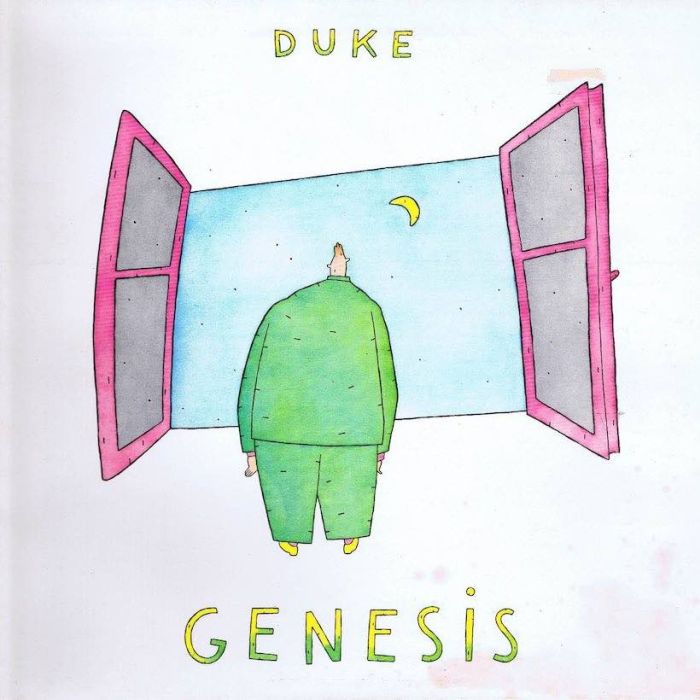
“Duke” is a half-concept album, and across some of the songs it roughly tells the story of a lonely “Duke”, who is left by his beloved but haughty “Duchess” (“Duchess”). Left all on his own (“Behind The Lines”), he sadly weeps and gazes out the window through days that are always the same (“Alone Tonight”), forgotten by the whole world and apathetically slumped in front of his TV (“Turn It On Again”). In the end he does decide to set out and look for her (the closing “Duke’s Travels” and “Duke’s End”), but we never find out whether he found her. The ending of the story can thus be imagined however anyone likes. Maybe this Collins concept sounds slightly corny (like, to be honest, most of his later confessional poetry, especially from his solo career), but still, across the whole album you can feel some kind of concept, or connection between the songs, with certain motifs recurring within individual tracks. “Duke” was reportedly even meant at first as a fully conceptual album with a longer suite in the style of “Supper’s Ready” (Foxtrot, 1972), but precisely because of that they preferred to “chop it up” into several songs, to the great relief of the label and the sorrow of most old fans. The songs that make up the concept are also the best ones on the album.
The pompously dramatic “Behind the Lines” is one of the most energetic openers in the band’s history, with a punchy instrumental opening part on Banks’ synthesizer and the recognizable jazzy Collins-Rutherford rhythm. Then comes a transition into a part that’s clearly built on soul and opened by Collins’ vocals. It’s a song that clearly presents the band’s new face, which marched boldly into the 80s with a new wave sound. Definitely a pretty obvious step toward commercialization, but still a very solid song. Collins released the same song in a slightly altered version on his first solo record “Face Value” (1981). “Duchess” follows right after, with an opening section based on a combination of Collins’ programmed ethnic drum rhythms and modern new wave synths, yet with an epic structure, which makes it one of the more interesting “pop” creations on the album. “Guide Vocal” is a short but dramatic overture on piano with Collins’ deeply felt vocals, followed by “Man Of Our Times”, which has a fragmented rhythm and somewhat distorted but brilliant Collins vocals, plus Banks’ modern synthesizers. It’s an excellent cross between the band’s recognizable progressive variations and new wave, with Collins’ trademark chorus. The commercialization is obvious on the pop number “Misunderstanding”, which was a big hit when it came out, but is otherwise one of the weaker songs on this album, or from the band in general, with pretty corny lyrics. The fact is that you get sick of it pretty fast after a few listens, with all its commercial simplicity. “Heathaze” is therefore one of the better creations on the album, one that even carries a bit of the spirit of classic Genesis, and to me the main motif slightly recalls one of Marillion’s early pieces. “Turn It On Again” is another pop hit with a clever Rutherford riff. It’s nothing special, but still one of the band’s better pop numbers. “Alone Tonight” is a Collins ballad with a rather corny chorus that already recalls a lot of his solo work, even though the track is by Rutherford. Still, I have no doubt that plenty of tender souls will get misty-eyed listening to it, because the guy really sings from the heart. “Cul de Sac”, on the other hand, is a wonderful, half-prog composition that lifts the mood of the album again and has all of the band’s best qualities, and even the lyrics are more like the band’s “good old days”. All three musicians put their souls into it. “Please Don’t Ask” is one of the band’s better ballads with Collins on vocals, and it’s free of unnecessary schmaltz.
The peak of the album is undoubtedly the fantastic epic finale under Banks’ masterful direction, made up of two parts, “Duke’s Travels” and “Duke’s End”, which together form a coherent whole and mark the end of the Duke’s wanderings and a wonderful close to the album. The dramatic “Duke’s Travels” opens with the rushing of waves on the synths and, besides the excellent, classic jazzy Collins-Rutherford rhythm, contains one of Banks’ best and longest solos on modern synthesizers. It’s a real treat for all lovers of classic Genesis. At one point the composition sounds truly cosmic, and when Collins’ excellent vocals join in, the real progressive ninth heaven suddenly opens up. I can’t recall Collins’ voice ever sounding as “uplifting”, before or since, as it does on this song. This epic crown is the band’s last great progressive masterpiece and one of their best compositions, one that can stand shoulder to shoulder with their finest work of the 70s. When the basic motif from “Behind The Lines” returns once more at the end of “Duke’s End”, the album closes in a fitting way, just as it opened. I can say that this phenomenal epic finale lifts the quality of the album up by at least a whole class, and that’s exactly why “Duke” is worth the attention even of those who gave up on the band’s commercialization after “Follow You Follow Me”.
With “Duke”, which was a huge success worldwide and their first “gold” album on the UK charts, Genesis made a very good record. It sails successfully between prog and pop, and it still has enough progressive elements that it doesn’t water down into a plain new wave pop album, even though it’s also more than obviously a sign that the band had decided to commit to that direction and ditch their creative voice. The production is excellent and the album has a very “alive” sound, maybe even the most of any album by the band. For all listeners of AOR and pop rock, “Duke” is a real treat despite its occasional complexity, while for fans of progressive rock and classic Genesis it’s the band’s last album that’s worth listening to, the one where they hadn’t yet sold their musical voice for bigger commercial success and bowed to Collins’ solo career. Anyone who doesn’t burden themselves too much with the Genesis legacy of the 70s while listening will discover plenty of wonderful musical moments in “Duke”.
author: Peter Podbrežnik
Track list:
1. Behind The Lines (5:43)
2. Duchess (6:25)
3. Guide Vocal (1:21)
4. Man Of Our Times (5:34)
5. Misunderstanding (3:13)
6. Heathaze (4:57)
7. Turn It On Again (3:46)
8. Alone Tonight (3:54)
9. Cul-De-Sac (5:06)
10. Please Don’t Ask (4:00)
11. Duke’s Travels (8:39)
12. Duke’s End (3:08)
Line-up:
Phil Collins – vocals, drums, drum programming
Mike Rutherford – guitar, bass guitar, backing vocals
Tony Banks – keyboards, 12-string guitar, backing vocals