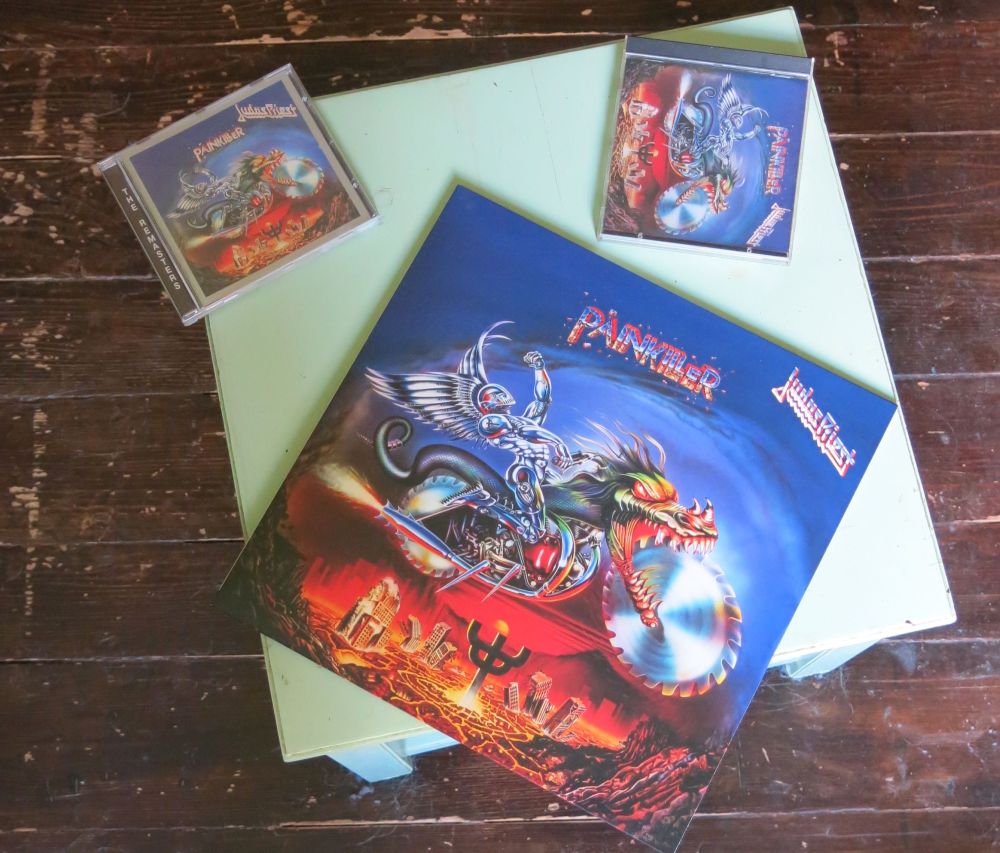
This is the story of the album with which Judas Priest redefined their heavy metal and caught the trends of the moment. In 1990, Judas Priest were seen as veterans, heavy metal elder statesmen of sorts. Painkiller put these enthroned “defenders of metal orthodoxy” right back in the game. It renovated them, freshened them up, reset their image and their mission. As such, it’s an album that didn’t just catch a fashionable cry – which Judas Priest wove into their own, very much their own musical dossier with remarkably smart flexibility – but one that, as it turned out, started inspiring other bands hunting for even more aggression, uncompromising attitude and, to put it mildly, sonic extremes in heavy metal.
RockLine review of Judas Priest’s “Painkiller”!
In 1986 Judas Priest released the quite fascinating “Turbo” (RockLine review of “Turbo“, RockLine review of “Turbo 30“), an album built on contrasting the sound with guitar synths, which moved the band a long way from everything they’d done before. It did well in the US, and the world tour was a big success too, spawning the live album “Priest… Live!” (1987). Still, the fact hung over that album that – at least stylistically – Judas Priest had painted themselves into a corner with it. Developmentally speaking. If they wanted to keep in touch with the primal message of heavy metal, they urgently had to take a step back, flirt again with “Defenders of the Faith” (1984) and make a record that would bring more distorted glare back into their musical vocabulary. That’s how “Ram it Down” came about, released in 1988, but despite some excellent moments and the “crunch” of both guitars being more determined again, it couldn’t climb out of its own “lukewarm” mediocrity. In 1988 that feeling came from a mild sense of being “dated”. By the look of it, Judas Priest were even sitting in a kind of artistic void back then, which hinted that they could no longer put together an album that would truly kick the listener in the teeth and grab them firmly by the throat from start to finish. As is well known, Judas Priest wanted “Turbo” to be a double album – “Twin Turbos” – sold for the price of a single one, which the greedy label rejected. Ask Bon Jovi, who went through something similar in 1988 when they wanted “New Yersey” to be a double album too.
In 1988, Judas Priest took Slayer on tour as their opening act. In their post-tour statements, Judas Priest made no secret of their affection and enthusiasm for the bands playing the increasingly popular thrash metal, led by the breakthrough works of Slayer, Metallica, Megadeth, Anthrax, Testament… Back then Judas Priest wanted to renew their form, their musical vision, even their mission, if you like. They craved freshening up and updates. As a band they had never looked back. It was precisely this constant discovery of new horizons that led them, completely unplanned, to discover the formula of heavy metal and, with their stage get-up, to unwittingly define a look that the metal subculture adopted. But that was the seventies, and the band was more than ten years younger then. Now the question was how much motivation and energy was left for the necessary step forward.
So Judas Priest reached for two radical changes, without which “Painkiller” would never have become what we’ve always known it to be. First, in 1989, they called up Los Angeles and Racer X drummer Scott Travis, who replaced Dave Holland. How did they get to Travis? Officially, of course, through an audition. But there’s a longer story behind it. The band had had their eye on Travis for quite a while. Halford was in touch with Racer X at the time and gave their singer Jeff Martin a song, Heart of a Lion, as a birthday present. That song was written during the “Turbo” sessions and Judas Priest never released it on any album. It only came out many years later on the compilation “Metalogy” (2004). Jeff Martin and the Racer X crew later had quite some trouble protecting their rights when they recorded their own version of Heart of a Lion for the second studio album “Second Heat” (1987). Judas Priest wanted to bring the double bass drum pedal back into their sound. They were no beginners at that – their former drummer Les Binks was already using it in the late seventies. So they could easily have called up Travis for “Ram It Down”, but out of respect for Holland they held off.
They also made another radical move. Before going into the recording process for the new album, they parted ways with longtime producer Tom Allom, who had created their eighties sound, and by their own account Chris Tsangarides was really the only worthy replacement for the legendary producer whom Judas Priest rated enormously and without whom they most likely wouldn’t have conquered the world with “British Steel“. Tsangarides was an old acquaintance of the band, having helped shape the sound of “Sad Wings of Destiny” (1976) as an engineer. That very album is where he took his first steps in the business of twiddling studio knobs. Tsangarides was extremely well plugged into the sonic and stylistic trends of that stage of heavy metal’s development, at the turn of the eighties into the nineties. In the eighties he quickly made a name for himself worldwide and, alongside Tony Platt, Nigel Green, Martin Birch and Robert John “Mutt” Lange, formed the famous “quintet” of the most notorious British “house” producers of their day. He built his career working on albums by jazz rock fusionists Colosseum II and Brand X, and the breakthrough was meeting Gary Moore, who invited him to work on his solo studio albums after their collaboration with Colosseum II. Let’s quickly toss in a few more acts the late producer worked with: Black Sabbath, Anvil, Y&T, Helloween, Thin Lizzy, Angra, Yngwie J. Malmsteen, Anthem, Tygers of Pan Tang, Sinner, Overkill, Loudness, Exodus, Sisters Of Mercy, King Diamond, Ian Gillan and Bruce Dickinson.
With Travis in the lineup, Judas Priest could now unleash a much higher dose of destructiveness, and the playing reached hellish speeds. Rob Halford was in top vocal form too, effortlessly spanning several octaves for fun, and on “Painkiller” he served up a ton of unforgettable screams and extremely high vocal melodies that fit the unbridled execution of power, speed and monstrousness of the newly formatted music like a glove. Travis, the newcomer, announced with the opening 15-second double bass drum torpedo inside the title track that “Painkiller” is an album that holds a unique place not only in the band’s discography, but also when you put it on the scales against the entire heavy metal universe.
So. A stampede of double bass drum pedals combined with utterly devastating riffs that liked to veer even into half-step territory – a kind of new discovery and mini revolution for the band – and bass lines cutting through steel magnified the vertigo-inducing character of Halford’s vocals. We mentioned the rise of thrash metal and its bands earlier, which Judas Priest greeted with great approval and sympathy. A good chunk of that aggression, along with the extremely fast playing, rubbed off on the writing of the new material too. And there’s one more important factor that put the dot on the “i” of the unique and elusive face of “Painkiller”. Guitar solos and guitar ornaments. Both Glenn Tipton and K.K. Downing were guitarists who kept developing even on their twelfth studio album, which “Painkiller” was. Tipton in particular took a slight lead on the new record, having caught the “sweeping arpeggios” bug – from whom else but Racer X guitarist Paul Gilbert. When Travis came to the audition, he also presented Racer X’s material at length, and Tipton in particular made no secret of his excitement. The leap in soloing compared to previous releases is more than obvious.
“Painkiller” cut radically into the band’s previous style, scrubbing out absolutely everything that might smell of blues or rock’n’roll, the roots the band, formed in 1969, actually came from, even if it was only an innocent gentle breeze like the ballad Living Bad Dreams, deliberately left off the album. That way the band shut every door on any chance of the record accidentally going “soft”. They wanted to get a bestial, wild, untamed, ultra-fast and destructive album out of their system, one that knows no obedience, makes your hair stand on end for a solid 46 minutes of playing time and leaves no survivors and no apologies. Songs like the title track – a hellion worthy of heavenly sin and delight, Painkiller – plus Metal Meltdown and All Guns Blazing keep up a distinctly sulky, caustic, bristling, monstrous edge that flirts with the growing popularity of rising thrash metal. That’s why they deliver the album’s most aggressive moments.
The band didn’t give up on musicality. This time around, they once again fused all the raw ferocity of the arrangements with their musical sensibility in a way that’s totally their own. The brilliant discharge of that opening nuclear devastation with the title track gets caught right in the second song, with one of the most striking phrases in Hells Patrol, with another outstanding, evergreen riff breathing down its neck in a similar manner, one that gets established a little later in Rebel Leather. Both songs are delivered with a bit less speed metal madness and aggression, and the double bass drum pedal couldn’t work better in these two excellent phrases in the chosen rhythmic key. Two seriously ravenous cuts. The album closes with the solemn One Shot At Glory, which unwittingly announces that the era of classic Judas Priest has run its course, wound down and come to an end. For good.
The story behind A Touch Of Evil is an interesting one. The song was written by Chris Tsangarides, who wrote tracks for the Burton Music library, where various screenwriters and directors borrowed music to use as a soundtrack in films. That’s where this song came from, so it was meant as backing music for scenes of murder and other far-from-rosy deeds from the dark side of humanity. One day Chris was playing it in the studio while looking for a “soft spot”. When Tipton, who happened to turn up right then, heard it, it hit him: “What the hell was that?!?!” Chris explained, and Tipton told him to hang on a bit. Within a few minutes, a whole Judas Priest garrison had shown up in the studio, Halford wrote the lyrics straight away, and Tipton shaped the mid-eight passage and carved out the verse and chorus. All the riffs and transitions in this song are played by Tsangarides, while the solos are Tipton’s. It’s one of the most musical songs on the album, gripped by a genuine touch of temptation from wicked demons. Tipton contributed all the solos for All Guns Blazing, Nightcrawler, Between the Hammer and the Anvil, Hells Patrol and the aforementioned A Touch Of Evil. On the remaining tracks, the solos coexist in duels with K. K. Downing. Eleven years later, Tsangarides joined forces with Tipton again for Subterfuge and Metal Messiah, which found their way onto the album “Demolition” (2001).
The album was recorded in early 1990 at Miraval studio in Correns, near the French Riviera. A studio surrounded by vineyards. Not exactly the typical surroundings for a band like this, but then again, the band recorded “Ram It Down” in an equally atypical location, Puk Recording studio in Gjerlev, Denmark. So it was a completely different experience compared to the recording days between “Point of Entry” and “Turbo”, when the band recorded in the Bahamas (Compass Point studio) and on Spain’s Ibiza.
Miraval was a fortress that was later bought by Brad Pitt and Angelina Jolie, who lived there for a few years. Ian Hill explained that the band’s communal lunches stretched out considerably every day thanks to the generous supply of house wine, which is no surprise, since the band was smack in the middle of wine country while recording. That probably caused the biggest headaches for Rob Halford, who has been teetotal since 1985, but he passed the test of those bitter temptations with flying colors and stayed true to his principles. Once the work was done, Attie Bauw took the material and did the final sound mix in the Dutch town of Hilversum at Wisseloord studio.
Anyway. “Painkiller” came out with a delay. Judas Priest had finished recording it entirely by the end of March 1990 and wanted to release it as soon as possible so it would really “sink in and settle” with the fans before they hit the road. But they had to wait for the lawsuit to play out. Judas Priest were hit with a $6.2 million suit from the Vance family – you can read more about it all in an in-depth piece written for RockLine by Rok Klemše. For exactly that reason, the label pushed back the release date to a time when it would be clear what would happen in court. The court dismissed the suit on August 24, 1990, for lack of evidence, and threw out the case. “Painkiller” came out on September 3, 1990. So all of its bestiality isn’t driven by any potential anger building up in the band members because of the legal proceedings. Scott Travis, who was just an observer at the time, remembers that the band did mull over the court case, but every discussion ended with the sense that the proceedings would be stopped in any case. The band put work on “Painkiller” first. The funniest thing, though, was the sticker on the album’s packaging that read: “Sounds fantastic. If you play it forward or backward.” Anyone who knows the background of the lawsuit against the band will get the cynicism of that second sentence right away.

Within a week of release, “Painkiller” climbed to number 26 on the UK chart at home. It achieved the same result on the American Billboard chart. Its best placement came on the German best-selling albums chart, where it reached number 7. In January 1991 it went gold. It picked up gold certifications in Canada, the US and Japan. To this day it has sold more than two million copies worldwide. Around the album’s release, the first single, for the title track, also came out. The song Painkiller was also nominated for a Grammy in the best metal performance category, but it lost out to Metallica with their cover of the Queen classic Stone Cold Crazy. Well, in 2010 the band did finally taste the sweetness of a Grammy in that same category, for the song Dissident Agressor. Later the band also released a single for A Touch Of Evil. Both singles come with videos too.
In October 1990, the band set off on the extensive Painkiller tour, which wrapped up on August 19, 1991. The stage set was built around a tank concept. Given the insanely packed schedule, the tour took the most out of Rob Halford in particular. The singer recalls that very good physical shape and fitness helped him “survive” the tour, since he’d already been completely sober for some time, and he also remembers having no trouble sleeping at all during the tour, unlike now.
For the “Painkiller” album, Judas Priest did two tours of North America, and of course they also played Japan and Europe, where they played some venues in the countries of the former Eastern Bloc for the very first time. On February 25, 1991, Judas Priest, supported by Pantera and Annihilator, also visited the Tivoli hall in Ljubljana. The band’s second Slovenian show was a 27-year wait, when Judas Priest played in Tolmin as part of the Metaldays festival! The high point of the world tour supporting “Painkiller” was the band’s headlining slot at the Rock in Rio II festival in January 1991. On the first North American tour, Judas Priest were joined by Megadeth and Testament, while the second North American run was co-headlined with Alice Cooper. That tour was called Operation Rock & Roll, dedicated to the American soldiers taking part in Operation Desert Storm. Considering that grunge had already struck by then and taken over the global mainstream, this final leg of the world tour didn’t go over all that well. At the very last show of this world tour, which also marked Rob Halford’s last show with Judas Priest for more than a decade, it happened that when the band opened the gig with Hell Bent For Leather – and Halford rode onto the stage on a Harley Davidson to its sound – he crashed (in true Spinal Tap fashion) into the riser that Travis’s drums stood on. Not exactly a glittering moment in Rob’s farewell.
Halford first thought about leaving the band back in 1991, but Columbia Records managed to hold on to him until May 1992, when he announced his official departure. The singer founded Fight, followed by the project Two, and then went back to his roots, formed the band Halford, and in 2000 put out the superb comeback album “Resurrection”, which many critics crowned “Painkiller 2000”, followed by two more studio albums. In 2003 he rejoined Judas Priest, where in the meantime Tim ‘Ripper’ Owens had been singing, and with whom the band released two albums. From “Jugulator“ (1997), the song Bullet Train was nominated for a Grammy.
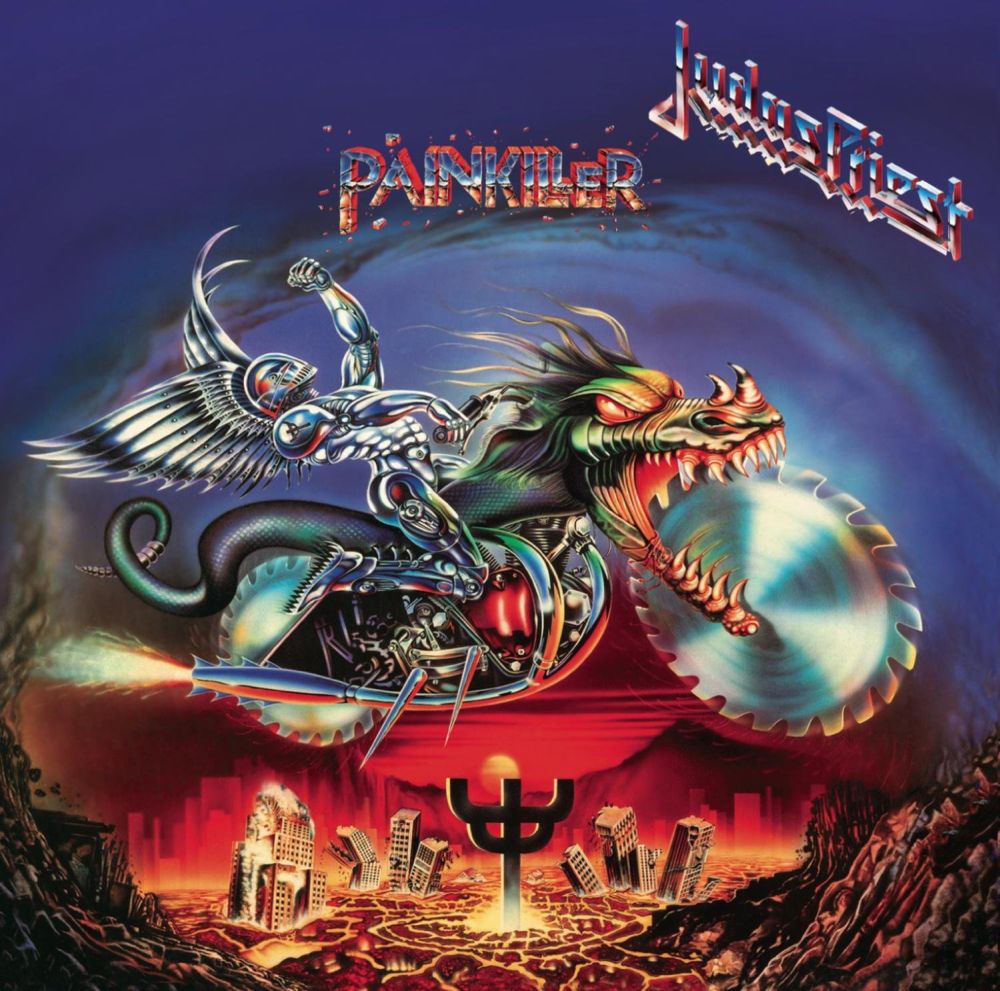
Thirty years later, Painkiller remains a great heavy metal classic and one of the best records this genre has ever produced. From Mark Wilkinson’s phenomenal apocalyptic cover art to the final moments of the epic anthem One Shot At Glory, the album still sounds inspired, defiant, one of a kind, sonically and compositionally boundless, bristling and electrified. Timeless, as if it had just come out. The album isn’t just a moment of renaissance-style rejuvenation for the band, it’s hugely important in the very redefinition of heavy metal, since from then on “Painkiller” became a huge inspiration and role model for many bands, and it still inspires new bands today. It’s one of those albums that has to round out the collection of every fan of heavy metal sounds and the various metal subgenres. Whether or not you’re a die-hard fan of the band, it belongs among those must-have essentials of a lifetime.
Author: Aleš Podbrežnik