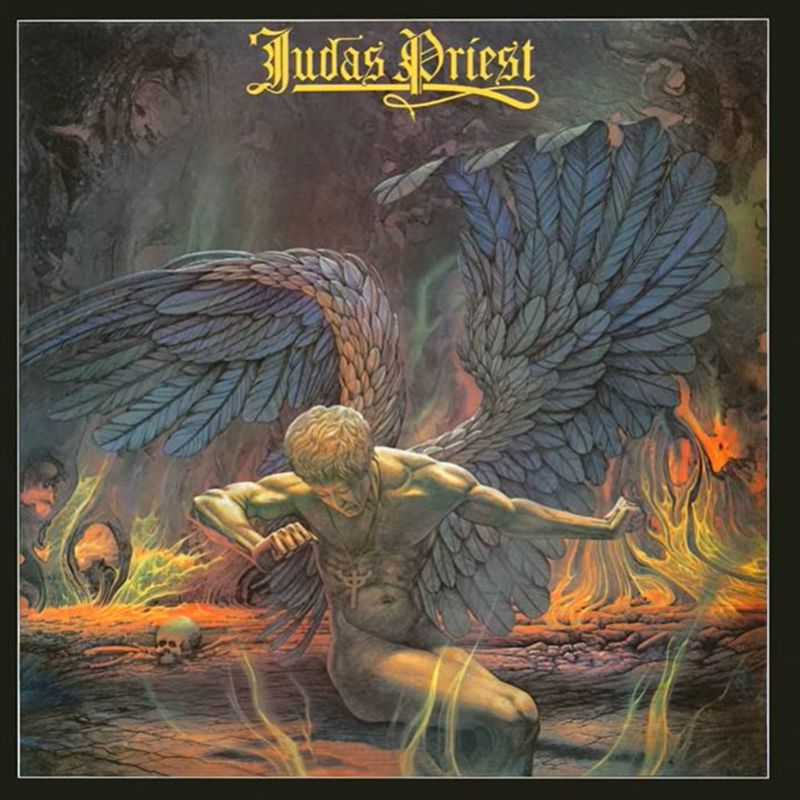
Label: Gull Records
Release date: 23. 3. 1976
Production: Jeffrey Calvert, Gereint “Max West” Hughes, Chris Tsangarides & Judas Priest
Album length: 39.12 min
Genre: Heavy Metal
Rating: 9.0/10
The debut ‘Rocka Rolla’ (1974) failed to break the band through in the media. Judas Priest only picked up a few notable lines in the press after playing Reading Festival in the summer of 1975. Encouraged, they went back into the studio with Jeffrey Calvert and Max West to record a new album called ‘Sad Wings Of Destiny’. On drums, the band swapped John Hinch out for Alan Moore once again. With ‘Sad Wings Of Destiny’, Judas Priest are way heavier, and they were getting louder and much faster compared to their debut. It’s striking how many genre patterns this album carries that would become trademarks of the later N.W.O.B.H.M. Together with the legacy of seventies Black Sabbath and heavy rock bands à la Budgie and Montrose, ‘Sad Wings Of Destiny’ is an enormously important album that landed on the scene, and Judas Priest are one of those bands that paved the way for the bands that followed, the driving force of the movement known as the New Wave Of British Heavy Metal.
Two years after the debut, Priest offered the public much, much more music, but interestingly, even with ‘Sad Wings Of Destiny’ the band still failed to win over the media, and the album somehow didn’t get any real recognition from the masses at the time. The main blame lay with Gull Records, a label too small and too weak to ‘push’ the album onto the market with any real visibility against the heavy competition in the music industry, and people simply didn’t know about the album, or even that a band called Judas Priest existed. Things went so far downhill that some of the band members had to take day jobs again just to get by.
But when fans discovered the album in the years that followed, it became hugely beloved by hard rock and heavy metal devotees, indeed indispensable. The reasons are pretty self-evident, since the album contains what is indispensable on every Judas Priest album that followed, and what the guys kept building on with real dedication from then on. Riffs! Across the whole record they carry the album with a high, scorching heavy rock stance, with the exception of the Queen-flavored Prelude, a very tasteful intro to Tyrant. Simple, witty, daring and energetic heavy riffing. The foundations had turned hard, and Halford’s more confident, unique wailing now marks the whole record. Priest also dropped the meditative, flower-power seventies interludes that are all over the debut, and at the same time moved far away from the elements of the blues.
An interesting feeling that always washes over me when listening to the opening Victim Of Changes is that it sounds like a continuation of the debut ‘Rocka Rolla’. A more complexly built track of just over seven minutes isn’t quite what a fan of the hard stuff would expect from an opening song. The song features Rob’s impressive, extremely high lines in the middle section. They blend wonderfully into the song, and with them Rob brilliantly brings the track to a great finish with a high-flying atmosphere. With The Ripper, the record then gets the run-up it really needs. In The Ripper, Rob shows that besides the conventional way of singing, the high lines come especially naturally to him, and what’s more, that’s exactly where Rob Halford is at his strongest. A punchy, masterful riff, Halford’s excellent melodic screaming. The line ‘You’re in for surprise, you’re in for a shock!’ means only one thing. Judas Priest came to raise hell. And not for nothing. The song is built to hit, flat-out made for a hit, or to put it plainly, Priest came to do ‘business’. In its riffing punch and structure, the song is laid out like a proper metal alphabet. Really, the whole song radiates huge energy, power, will, the unstoppable character of a band that came to take what’s theirs.
Dream Deciever, with its acoustic guitar that for a moment almost slips off into Spanish flamenco, is an absolute upgrade of Run Of The Mill from the debut. Dream Deciever has the same double face as Run Of The Mill, but the riff-driven kick on one side and the acoustic opening on the other are fused together more tastefully, and the song is adorned by Rob’s singing, which sounds incredibly resolute. Of all of them, it’s surely the most ‘seventies’ track. But that’s not all. The band pours oil on the fire with the next one, Deciever, a real smasher. The atmosphere and dynamics of the record keep surging at a high level. The instrumental Prelude works as a great intro to Tyrant as a composition, and at the same time Priest use it to rein in the horses. Tyrant and Genocide are moments full of punchy riffing, the simple kind that instantly makes your blood boil as you listen, with tasty weaving of motifs and shared solo spots from Glenn and K.K., who in the two years since the debut made tremendous progress in what they still breathe together so tightly today. In Tyrant, the left and right guitars deliver equal, united riffing. On top of the basic riff, the two artfully laid a complex three-part melodic harmony that conjures up a completely new mood. A trick that wasn’t new anymore, but a typical pattern that the new wave bands would later use en masse.
Genocide is perhaps an even slightly harder follow-up, mainly because the song has none of the melodic passages that Tyrant is so nicely wrapped in, and so its riffing keeps a touch more aggression. There’s no way back: if ‘Rocka Rolla’ contains plenty of clichéd seventies rock levers, then with Genocide and Tyrant Judas Priest now tip the scales decisively in favor of heavy rock / metal. A thing that was only just about to become a highly prized, sought-after trend. The piano contributed by Glenn Tipton and Rob’s emotional vocals are undoubtedly at the center of Epitaph. A great song with a grandiose atmosphere that heightens the contrast of the whole record, while once again reminding us that Judas Priest were never afraid to experiment. The song really carries an obscure whiff of a ruined land where the sun never shines, where machines rule, along with cold male intellect. Epitaph flows straight into the red-hot finish of Island Of Domination, a great closing song that once more proves which direction Judas Priest were headed in.
‘Sad Wings of Destiny’ represents an incredible genre leap compared to the debut. Harder, more decisive, played with more confidence, you can somehow feel that the guys’ hearts had begun to beat for a common goal.
Author: Aleš Podbrežnik
Tracklist:
1. Victim Of Changes
2. The Ripper
3. Dreamer Deceiver
4. Deceiver
5. Prelude
6. Tyrant
7. Genocide
8. Epitaph
9. Island Of Domination
Lineup:
Rob Halford – vocals
K.K. Downing – guitar
Glenn Tipton – guitar
Ian Hill – bass
Alan Moore – drums