

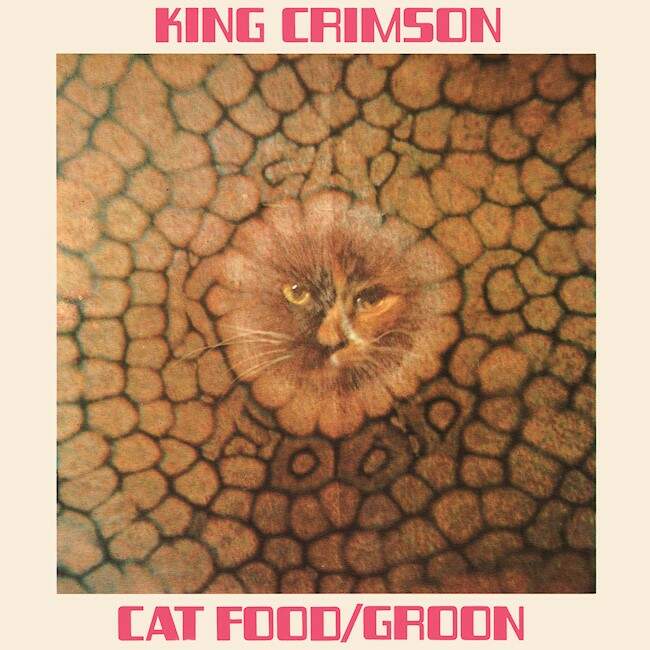
King Crimson released their second studio album, “In the Wake Of Poseidon”, on May 15, 1970. In Europe it came out on Island Records, Atlantic Records put it out for the American market, and Vertigo handled New Zealand. The album was recorded at Wessex Sound Studios in London between January and April 1970, and produced by Robert Fripp and Peter Sinfield. The band also pulled a single from it, “Cat Food”, which was about as uncommercial as it gets for the time. The b-side was an instrumental called Groon.
Before the recording even began, back in late 1969, the album was already marked by the band’s near-collapse. Only guitarist Robert Fripp, poet Peter Sinfield and vocalist and bassist Greg Lake were left.

Still, the band came up with another outstanding studio achievement, one that boasts an eclectic sound and stands as an absolute one-off in the rock universe. As such, it kept opening up new dimensions at the time and paved the runway for the further blossoming of a newborn genre called “progressive rock”. “In the Wake Of Poseidon” is an album of strange and unique experimental mixing: crashing, apocalyptic guitar phrases, sharp contrasts of musical catchiness that crept into the songs thanks to The Beatles’ pop influence, gently mystical ballads, the rustling, predatory sweep of mellotron sound curtains, and mysterious adventures in atonal wildness. All of it keeps up the band’s avant-garde stance, firmly rooted in the debut “In the Court Of the Crimson King“.
The album’s two peaks have to be Fripp’s wild guitar work on “Picture Of A City” and Greg Lake’s breathtaking vocals on the title track, which also happened to be Lake’s last act in King Crimson before joining ELP (Emerson Lake & Palmer).
Thanks to the success of the debut “In the Court of the Crimson King“, the band managed to hold on to enough momentum and updraft during this turbulent, uncertain period to record and release a new studio album in May 1970. It soared to number four on the UK charts and still stands as the band’s highest chart placing of their entire career. The band earned glowing praise from music critics, and one of them wrote at the time: “If Wagner were alive today, he would be working with King Crimson.”

After all the trouble, Fripp, Sinfield and Lake, the only remaining members of the original lineup, did manage to surround themselves with brilliant session players and firm up the band. The biggest catch among them was the brilliant flautist and saxophonist Mel Collins (ex-Circus), who was already a hot-ticket session player back then and, apart from Fripp and lyricist Sinfield, the only one who stayed on as a band member after this record. Gordon Haskell, a former schoolmate of Fripp’s, sings instead of Lake on the gorgeous ballad “Cadence And Cascade”. Fripp invited Haskell to play on the band’s third record too.
It may look like the band reinvented itself for the new album with a new lineup (an octet), but in reality only two (founding) members represented it at the time: Fripp and Sinfield. Greg Lake’s head and heart were already with ELP. The rest of the musicians on the album were, in a way, hired guns, or session players. Besides Fripp, who also took over mellotron duties on this album, Sinfield and the departing Lake, the album features: Michael Giles (drums), Peter Giles (bass guitar), Keith Tippet (piano), Mel Collins (saxophone & flute) and Gordon Haskell, who contributed vocals for the ballad ‘Cadence And Cascade’.

No fewer than three songs deal with the impact of the environment on humanity and vice versa (“Pictures Of The City” (originally “A Man A City”), “Cadence And Cascade” and “Cat Food”), while the whole “Peace” trilogy, the title track and “Devil’s Triangle” (originally “Mars”) are devoted to pacifism. So the band once again made a great record, in many ways a step up from the inimitable debut, only a bit more avant-garde.
By and large, “In the Wake of Poseidon” follows the musical mood and winning recipe of the first record in a lot of ways. Musically and stylistically, at least in the first half, there are no huge departures from the debut, which is actually unusual for this band. But then the second half brings some of their most avant-garde pieces, and that’s the real difference between this record and the last one.
According to Sinfield, the previous record was dedicated to Zeus, or Frederick II, while the new one, as its title says, is for Poseidon.
The album is graced by a superb cover from the mystic artist Taam De Jong. It depicts 12 human archetypes that are also opposites (each has a counterpart). On the cover we see (following Sinfield’s concept) the Greek god Dionysus (called “Madman” in the lyrics, a grinning, red-faced hedonist), the goddess Demeter (a stern, dark-haired woman with a moon, ancient wisdom and the forces of nature), Hades (a horned, bearded man in a helmet, the (symbolic) god of the underworld, war and death), a fair-haired girl with a key (a symbol of purity and innocence), a harlequin (courage), a Black man (slavery), an old man with glasses (“Cold Plato Spawn”, the cold seed of rationalism, a scientist) and an old woman reaper (Harvest Hag, a representative of old knowledge, a conservative who resists progress), Hecate (Midnight Queen, a witch, a woman with blue hair), the sea god Poseidon (an old man with a crown), a sage or astronomer (a fellow in a pointed hat with stars), and Mother Nature (a serene, sleeping face in the grass).
So “In the Wake of Poseidon” is an excellent successor to an album that was tough to follow. In many respects King Crimson surpassed their studio debut with it: musically, stylistically and in the message. “In the Wake of Poseidon” faithfully follows its predecessor in style, yet it remains an overlooked album in the band’s discography, forever overshadowed by its famous forerunner. Let the critics say what they want, the truth is that music critics were never really happy with any King Crimson album that came next. They always expected it to sound like the last one, and if it didn’t, they accused the band of repeating themselves, which is totally untypical for this group. “In the Wake of Poseidon” came closest to that principle when you compare two albums in King Crimson’s body of work.
Thanks to some of its new avant-garde elements, “In the Wake of Poseidon” is an even less predictable record than the debut, and that makes it a real treat for music connoisseurs.
written by: Peter Podbrežnik & Aleš Podbrežnik
edited by: Aleš Podbrežnik
You can dig up more information about the album and King Crimson in Peter Podbrežnik’s extended RockLine essay, an in-depth review of the album “In the Wake of Poseidon .
You can also read a similar piece on the 50th anniversary of the album “In the Court of the Crimson King”. That one was also put together for RockLine by Peter “Dr. ProgRock” Podbrežnik!
