Label: Discipline Global Mobile
Date: 15.05.1970
Production: Robert Fripp & Peter Sinfield
Album length: 40.56 min
Genre: Progressive Rock
Rating: 10 / 10
The mighty Greek god of the sea, Poseidon, clearly stirred up the original King Crimson’s ship good and proper in 1970. The dust had barely settled after the phenomenal first record, “In the Court of the Crimson King” (1969), which among other things officially marked the birth of progressive rock and earned the band cult status, and King Crimson were already shocking the music world again the following year. This time with a tough goal ahead of them: to repeat the success of that outstanding debut despite small but radical changes to the lineup.
After their first tour wrapped up in late 1969, the band lost the brilliant multi-instrumentalist Ian McDonald (later a founding member of the AOR band Foreigner), while the drumming oddball Michael Giles already had one foot in their joint side project McDonald & Giles and appears on this record only as a “session” musician.
Even the ever-excellent singer and bassist Greg Lake couldn’t resist Keith Emerson’s invitation, and this was his last record with King Crimson before the formation of the legendary ELP.
With McDonald gone, the band was practically on the verge of falling apart, so it’s a real miracle they managed to hold together and put out a record that some consider even stronger than the legendary debut.
All in all, “In the Wake of Poseidon” follows the musical mood and winning recipe of the first record in many ways. Musically and stylistically, at least in the first half, there are no huge departures from the debut, which is actually unusual for this band, but in the second half we run into some of their most avant-garde pieces, and those make all the difference between this record and the last one.
Thanks to a few of those new avant-garde elements, “In the Wake of Poseidon” is an even less predictable record than the debut, and so a real treat for music connoisseurs.
After all the trouble, Fripp, Sinfield and Lake, the only remaining members of the original lineup, managed to surround themselves with superb “session” musicians and firm up the band. Especially important was the brilliant flautist and saxophonist Mel Collins (ex-Circus) , who was already a hugely in-demand “session” musician back then and the only musician (besides Fripp and lyricist Sinfield) who stayed in the band after this record. Gordon Haskell, an old schoolmate of Fripp’s, sings instead of Lake on the gorgeous ballad “Cadence And Cascade”. Fripp invited him to work with them on their third record as well.
No fewer than three songs deal with the impact of the environment on humanity and vice versa (“Pictures Of The City” (originally “A Man A City”), “Cadence And Cascade” and “Cat Food”), while the whole “Peace” trilogy, the title track and “Devil’s Triangle” (originally “Mars”) are devoted to pacifism. So the band once again made an excellent record that in many ways built on the inimitable debut, only a bit more avant-garde.
Fripp was never influenced by any particular rock band, except maybe the Beatles. On this record he started using the mellotron for the first time, which had previously been the domain of multi-instrumentalist Ian McDonald. His playing got a bit more sophisticated. There’s also plenty of acoustic guitar (the “Peace” trilogy). After the record was done, Fripp very nearly became a member of Yes. Luckily for both sides, that obviously didn’t happen.
Greg Lake, normally a singer and bassist, only sings this time, since he was already itching to get to ELP. His bass duties were therefore taken over by Peter Giles. He proved once again why he was the best singer in the band’s history. “In the Wake of Poseidon” is his last record before leaving for ELP. But if I’m being honest, I feel a bit sorry for Lake, because in ELP , dominated by Emerson’s organ acrobatics, he somehow never got the role a singer of his caliber deserves, in my opinion.
This time Fripp managed to bring in both Giles brothers from his first project, “The Cheerful Insanity of Giles, Giles & Fripp” (1968). Michael Giles, the original drummer, is here merely as a session drummer, though, since Fripp hadn’t managed to find a suitable replacement for him by the time the record was made (he was looking for a jazz drummer!). He proves again why he was one of the best drummers of his time, even though he remained widely overlooked. Something that long haunted most of his excellent successors too. While the record was being made, Michael already had one foot in “Mcdonald & Giles”, a little-known project that put out only one record and was led by him and the former member Ian McDonald.
Michael’s brother Peter was a member of the legendary Giles, Giles & Fripp in 1968, before Greg Lake replaced him when King Crimson were formed. Technically, in my opinion, he was a somewhat more polished bassist than Lake. Today he’s a member of the 21 Century Schizoid Band, which plays old King Crimson songs.
Mel Collins, who came from the band Cirkus, successfully filled in for Ian McDonald. Unlike McDonald, his sax playing leaned toward the lower registers. Mel was already one of the most talented session musicians around and definitely a great gain for the band. He later became known for working with Alvin Lee, Camel, Brand X and Alan Parsons, and today, together with Peter Giles, he’s successfully carrying on the legacy of the old King Crimson as a member of the 21 Century Schizoid Band
The esteemed classical composer Keith Tippet, the main man in the symphonic band Centipede, was never officially a member of King Crimson, but I’d still count him as one, since he worked with the band on the next two albums as well, while Fripp occasionally worked with his band. He supplied the Wagnerian magic of the title track and brought lucidity and complexity with his piano playing on the excellent “Cat Food”.
Bassist and singer Gordon Haskell was an old colleague of Fripp’s from the early days. Fripp invited him into the band after Lake left early, in mid-1970. Soon afterwards he became the new singer and bassist and sings on the next record, “Lizard” (1970). His voice is lower and not as melodic as Lake’s, but he did a great job on “Cadence And Cascade”. He’s made for drama, and he reminds me a little of Peter Gabriel at times. He later built a successful solo career.
The spiritual father of the band and author of the strangest and most intelligent poetry in the history of progressive rock, Peter Sinfield, deserves congratulations once again. Hats off for the extraordinary lyrical concept about the fall and rise of a new age of humanity, even though most people still don’t get it today. King Crimson were a band truly blessed with a lyricist as exceptional as Sinfield. The truth is that back then he and Fripp were the only members of the group in the true sense of the word, while the rest had more of a session-musician status.
By his own account, the previous record was dedicated to Zeus, aka Frederick II, and this one to Poseidon.
The opening intro “Peace-A Beginning” is a short, light vocal overture from Lake, accompanied by Fripp on acoustic guitar. “Peace” is a sort of central trilogy, split into three segments that tie the record together conceptually. Mood-wise it’s a peace elegy that stays relevant for all time.
It’s followed by a sudden bolt from the “cloudy sky” in “Pictures of a City”. It’s a wonderful, punchy opening track and a fitting spiritual and stylistic successor to the “21st Century Schizoid Man” from the previous album. Originally titled “A Man A City” and inspired by the grime in the suburbs and slums of New York, where the band found that inspiration during their first US tour. The lyrics deal with the problems of modern urbanization and air pollution. A brilliant mix of rock, really early heavy metal, and jazz. Lake’s vocal is stretched to the limit here, and as soon as Fripp’s brilliant solo kicks in, followed by a proper showdown between Collins’ sax and Giles’ drums, you get a real high-speed climax of clashing vibes, which then calms down again mid-song before erupting once more at the end with full force. A great track that will thrill all the music connoisseurs who aren’t afraid of experimenting and who love jazz-rock fusion.
The vocal of Gordon Haskell, who took over from the inimitable Lake as singer and bassist after this record, radiates incredible warmth on the ballad “Cadence and Cascade”. At first I didn’t even realize it wasn’t Lake singing on this one, which means Haskell nailed his mission. Just how good a singer he is also shows on the successor to “Poseidon”, the album “Lizard”. “Cadence and Cascade” is a gorgeous ballad in the vein of “I Talk To The Wind” from the previous album. Lots of Fripp’s acoustic guitar and the excellent Mel Collins on flute, with a xylophone audible in the background. Sinfield’s lyrics once again hide a deeper meaning. Somebody once claimed the lyrics are just a product of bad taste because they supposedly talk about “groupies”, but when I visited Sinfield’s website I realized what they’re really about. Jade is the name of a rare turquoise stone, while a cascade is a river rapid. It’s about the pristine, virginal state of nature, which fits the whole ecological mood that runs through this album.
The title track, “In the Wake of Poseidon”, is one of the best songs in the band’s history (and my personal favorite of all), but at the same time also their most overlooked one. Why it was never on their setlists is a big question for all of us. Every time I hear it I get goosebumps. The song is about the new, bright, coming Age of Aquarius, which is supposed to revive this sick, decaying world of ours. In my opinion this romantic epic is the most overlooked song in the band’s history and I badly want to hear it live, even though I know that’s practically impossible today. Every single instrumentalist shines here, especially composer Keith Tippet and flautist Mel Collins, and of course Fripp on the mellotron, which is here in abundance. The ambience really feels like finding yourself in the middle of a cold, raging ocean, before the throne of the legendary king of the sea, who split the ocean floor with his trident. Definitely one of the best epics in the band’s history. The Wagnerian main motif with its extensive use of mellotron is slightly reminiscent of “Epitaph” and the title track of the previous record. And of course, let’s not forget “Libra’s Theme”. Looks like Wagner was one of Fripp’s spiritual fathers too.
“Peace-A theme” is a short, simple but very beautiful instrumental from Fripp, played on acoustic guitar. In general, maestro Fripp devoted himself heart and soul to the acoustic guitar this year (this is most noticeable on their next record), and although he doesn’t reach for it anymore these days, which is actually a shame, he was known back then as one of the best acoustic guitarists around.
“Cat Food” is definitely the song that differs most from everything they’d done before on their debut, and any comparison with the earlier songs goes out the window here. A grotesque, groovy jazz “humoresque” at the expense of the plastic food modern civilization lives on, it’s great fun and loosens up the otherwise pretty serious atmosphere of the record. This song is the biggest departure from the previous record and shows that the band’s style was already constantly changing, or “evolving”. It also shows the band’s sense of black humor, and its Zappa-esque chorus really makes you think of the aforementioned artist. Jazz fusion, then. Keith Tippet’s brilliant, at times lucid piano will give you goosebumps every time. A superb song that most obviously shows the band’s progress compared to the previous record. Former member Ian McDonald also got a writing credit. “Cat Food” came out as a single with the b-side instrumental “Groon” (an excellent, groovy improvisation), but it didn’t see any real commercial success, though it’s the most representative song on this album and best shows the band’s progress. The single version of this song and the aforementioned instrumental “Groon” are on the latest remaster of the record, which came out last year on the Discipline GM label.
The longer conceptual opus “Devil’s Triangle”, originally called “Mars”, after the famous German classical composer Gustav Holst and his “Planets” suite, is the band’s first studio instrumental, built on the concept of the “Devil’s Triangle”, and also basically the only “cover” in the band’s history (if you can even call it a cover, since the band’s version differs quite a bit from Holst’s original, “Mars the Bringer of War”). It conjures a truly dark Dante’s Inferno atmosphere and at times sounds downright evil. After the intro it differs a bit from the original version of the song, which the band played under the name “Mars” at their live shows before this record came out. It’s the only song in their history that was split into three segments. Yes later did something similar a lot in the structures of their songs. Fripp first “dictates” a sort of military march on the mellotron in the opening part, “Merday Morn,” which then, in the second part, “Hand of Scarion”, heralded by a kind of battle blast of a Viking horn, turns into a ride through a long, dark tunnel across the underground chasms of hellish war. In the last part, “Garden of Worm”, the whole mood builds to a moment of madness, when suddenly all the tension lets go. The song is so dark that even their contemporaries from the “dark side”, Black Sabbath, look silly next to it. This song can push some people to the brink of a nervous breakdown, and spiritually cleanse others. King Crimson played this song a lot in various forms in their early period. A masterpiece for all time.
The acoustic theme returns at the end as “Peace-An end”. The light at the end of the dark passage shines through with full force. The best possible ending to the record, with Lake’s excellent chorus. What I like best is the final message, which is also the main message of the whole record: “you look everywhere but not inside you”. We look for truth (inner peace, love, freedom) everywhere except inside ourselves, which is usually humanity’s main tragedy.
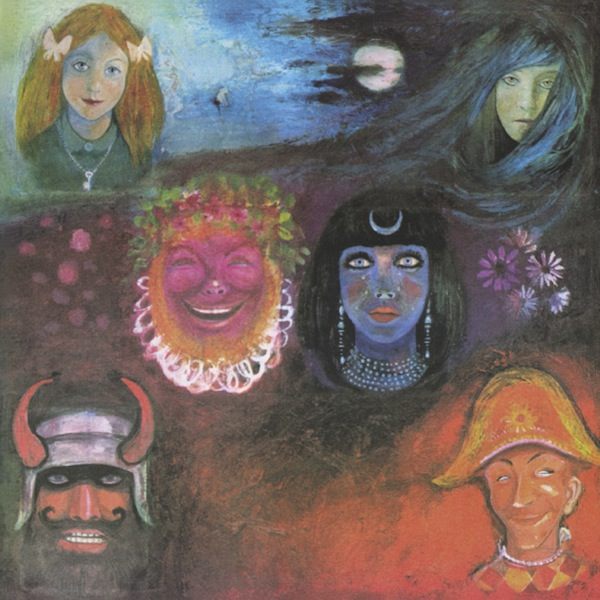
Let me also mention one of the best album covers I’ve ever seen, by the mystic Taam De Jong. It portrays 12 human archetypes, who are also opposites (each has its counterpart). On the cover we see (following Sinfield’s concept), among others, the Greek god Dionysus (called “Madman” in the lyrics, a smiling red-faced hedonist), the goddess Demeter (a serious dark-haired woman with a moon, ancient wisdom, the forces of nature), Hades (a horned, bearded figure in a helmet, a (symbolic) god of the underworld, war and death), a fair-haired girl with a key (a symbol of purity, innocence), a harlequin (courage), a Black man (Slave), an old man with glasses (“Cold Plato Spawn”, the cold seed of rationalism, the scientist) and an old woman reaper (Harvest Hag, a representative of old knowledge, a conservative, resists progress), Hecate (Midnight Queen, a sorceress, a woman with blue hair), the sea god Poseidon (an old man with a crown), the sage or astronomer (a fellow with a pointed hat and stars), and Mother Nature (a serene, sleeping face in the grass).
“In the Wake of Poseidon” was the first studio album by the band that I ever bought and it’s still my favorite, right after the immortal “In the Court of the Crimson King”. A very good successor to an album that was hard to follow. King Crimson have every right to be proud of this album, which in many ways even outdid its far more commercially successful predecessor. Musically, stylistically and in its message. “In the Wake of Poseidon” is also another masterpiece that faithfully follows its predecessor in style. Sadly, it’s also one of the band’s most overlooked albums, one that will apparently forever remain in the shadow of its more famous forerunner. Let most critics say what they want, the truth is that they were never actually satisfied with any of the band’s following albums, because they always expected it to be like its predecessor, and if it wasn’t, they accused the band of repeating themselves, which is completely out of character for this group. “In the Wake of Poseidon” came closest to that principle and most critics still weren’t happy, even though it’s still their highest-charting album commercially, having reached number 4 on the chart of that year’s best-placed albums.
author: Peter Podbrežnik
Track list:
1. Peace – A Beginning (0:49)
2. Pictures of A City(including 42nd at Treadmill) (8:03)
3. Cadence and Cascade (4:27)
4. In the Wake of Poseidon (incl. Libra’s Theme) (7:56)
5. Peace – A Theme (1:15)
6. Cat Food (4:54)
7. The Devil’s Triangle (11:39)
a) Merday Morn
b) Hand of Scairon
c) Garden of Worm
8. Peace – An End (1:53)
– bonus tracks on the DGM reissue (2004):
9. Cat Food [Single Version][Edit]
10. Groon [Single B Side]
Line-up:
Greg Lake – vocals
Robert Fripp – guitar, mellotron, devices
Michael Giles – drums
Peter Giles – bass guitar
Keith Tippet – piano
Mel Collins – saxophone & flute
Gordon Haskell – vocals on ‘Cadence And Cascade’
Peter Sinfield – lyrics