Author: Rok Klemše
Photos: Rok Klemše
Interview date: 14.11.2007
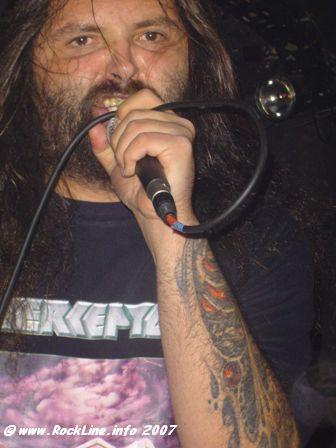
Interceptor is a name Slovenian metalheads know all too well. The legendary Slovenian band, which had its heyday between 1990 and 1999, released three albums of quality death/thrash metal – The Beginning (1993), Fade (1996) and Mora (1998) – then vanished into cult status with a farewell tour in 1999. This year, after an eight-year break, they’ve made an ambitious return to Slovenian stages with the II. Fuck Off Commercial tour. The successful run is slowly coming to an end and will hit its peak on Friday, 30.11.2007 at Maribor’s Štuk, with Aperion, Curse of Instinct, Sabaium and Infidia in support, and mastermind Marjan Pader’s cult Dean guitar will be raffled off too. Before the gig at Channel Zero in Ljubljana’s Metelkova mesto, I sat down with the band’s vocalist, Gregor “master of disaster” Čulk, to talk about Interceptor and everything that comes with it.
RockLine: Your tour, the II. Fuck Off Commercial Tour, is slowly wrapping up (it ends this Friday, 30.11.2007, at Maribor’s Štuk – editor’s note). How are you feeling with the end in sight?
Čule: Yeah, it just got started and we already have to stop… (his phone rings)… Oh, come on, you’ve got to be kidding me!
RockLine: Hehe, so we were talking about the tour…
Čule: Yeah, it’s been eight years since we stopped, and we came back in pretty grand style. We put out an open call for support bands, and 40 bands applied, which showed us that the work and effort we put in over those nine, ten years, from 1990 to 1999, was appreciated. In most cases we were role models for these bands, which means we really left our mark on the scene, and honestly this tour, this comeback, was only a matter of time. True, there could have been more gigs, but there were enough to get ourselves noticed. The next step is the remaining shows and the closing gig in Maribor, at Štuk, where we’ll give away Marjan’s Dean guitar, which we’ve been advertising the whole tour. Pader basically said he wanted a better guitar, he got one, and he promised to give this one away (laughs).
RockLine: You’ve already played a new track on the tour, Homo Stupidus. Will you start recording a new album after the tour?
Čule: Maybe not right after the tour, because first the songs need to be written. But I think they’ll come together just like Homo Stupidus did, “just like that”. I’m really looking forward to the new record, because the band is made up of different people who listen to different styles, and everyone will bring their own flavor, and I think the record will be really good, even better than everything so far, even though all of those were the best (laughs).
RockLine: Where did you and Marjan find the new members? You two are the only ones left from the original lineup.
Čule: Here’s how it went. The other guitarist, Simon Cukjati, called me because he wanted me to record vocals for his project. The idea came up to do a kind of commercial metal in the style of Limp Bizkit or Kid Rock, which immediately sounded interesting to me. And not so much because of the commercial side, but simply because I love playing, I’m a stage guy, music means the world to me. He showed me some song ideas, I liked them, and we needed to put a crew together. Seeing as both of us have a certain reputation, we said we’d only go for the best, so no auditions. We already had the lineup in mind, but none of the members had given a final yes yet. So I went to each of them one by one and told them that this guy and that guy were already on board, and everybody was in right away. I called Marjan straight away too, but he was on vacation and didn’t pick up, though he sent me a text saying we urgently needed to talk. Right after his vacation we met up, a beer, two, the metal classic, and we decided something had to be done. Considering he’d spent quite some time with Tabu, his metal soul clearly wouldn’t leave him alone. We said we’d do a Tribute to Interceptor project, but over time it became clear it couldn’t be just a tribute, because the chemistry in the team is such that it can only be Interceptor 2007. So we went with that and became Interceptor. After all, even in the first lineup it was just the two of us, me and Marjan, and in between eight, nine people came and went. Marjan was always the head of the band and I was the soul, and once that got back together there was nothing else to do. Then all the other members stayed, and the bass player came last. For me, the Tabu bassist, Izi, is insanely interesting, a freak, an alternative guy, a party animal, and on top of all that a great bassist. We invited him in, he was in right away, but over time it turned out he was swamped with work. We were ready to wait for him, but we couldn’t rehearse without a bass, so we asked Dragan Bagarič for help. After the very first rehearsal it was clear this was it, he said himself he wanted to stay in the band, and we stopped thinking about waiting for anyone. And let’s be honest, he’s the best one in the band. He gave us that extra punch, and then we still needed Dado, and when I called him and told him I had a crew and that Marjan was back, he was in right away. Since he’s also the Kaoz drummer, we coordinate with him, because Kaoz are his priority, and we don’t blame him for that. That’s about it!
RockLine: What was the comeback like after eight years, and why did you stop in the first place?
Čule: Ugh… Mostly we stopped because we’d reached the peak, there really wasn’t anything more to be done. We had nobody to set up the international side for us, and in Slovenia we’d achieved everything there was to achieve. The fact that you’re the best and the biggest, yet you can’t get the basic resources you need to keep a band running, seemed so stupid to us that we couldn’t go on. We were the band that pulled the whole scene along, we went “mainstream” and by doing that we opened a hole for new bands. The scene exists, but it’s not connected, it’s not organized, apart from a few individuals who don’t do anything for the scene as such. Let’s go do metal, let’s go capitalism, let’s go sell metal, come to the gigs so I can cover my expenses, so I can have my milk, burek and yogurt, and Slovenian bands are nowhere to be seen. That’s the problem, and we have an important job to help as many bands as we can, so we decided on this open call, so that they show up in the media, so that it’s clear there are tons of good bands out there.
RockLine: We already mentioned your support bands. Since you ran 30, 40 bands through this open call, what do you think of the Slovenian metal scene?
Čule: We’re too small for the scene we have, the market is too small. I can barely name any good or top-notch bands. The problem is that I can’t get in. Promoters would rather book commercial bands to guarantee a certain crowd, and every extra expense is too much for them. It’s up to us to climb back onto the throne, to play a few more festivals and show our quality on stage. The first gig was on a bigger stage, in a bigger hall, and the cherry on top was Grand Rock Sevnica, which showed that we’re ready for big stages. Of course we’re also gathering experience on smaller stages, where we rack up the mileage for the bigger ones.
RockLine: And how does today’s metal scene look to you compared to the metal scene 10, 15 years ago?
Čule: Ten years ago there were mainly fewer bands, and the ones around were oddballs, and of those oddballs very few were actually good. Maybe we stood out because I was that striking personality who kind of dragged the band forward, even though I was a kid, a youngster, 15, 16 years old, but I was so deep into it that everybody talked to me as an equal, organizers included, because I was so convincing that I came across as older. I was a person who wouldn’t take no for an answer. Things used to be different, music editors were our friends back then, people for whom music meant something, and first you were friends with them, and only then did you use the fact that they were at some outlet and that it meant something. Today we’ve got pseudo-editors who have no clue and back God knows what. It’s ridiculous, sick, pointless! The question is whether we’ll manage to change that, because the media’s policy is to support only mass sales. But we’ll work on getting ourselves noticed. After all, Siddharta started from nothing too and eventually got to cult status. I’m a fan of theirs, I’m a fan of Big Foot Mama, of old-school Šank Rock. We listen to a ton of alternative, Miladojka Youneed, and among the newer bands, Last Day Here. With those bands you can tell they’re something more, Slovenia is too small for them, just like it’s too small for us. If they find someone to push them forward (Last Day Here played at our first gig), I expect we’ll get to open for them when they’re huge (laughs). They’ve got potential. What makes me sad is this Slovenian mentality where some foreign band they’ve seen in Metal Hammer or on Headbangers Ball means more to people than some local band, Negligence for example. They were our support in Velenje and we had to try three times as hard as the “stars” of the night, because they tore the place apart. We set ourselves a tough task, but we didn’t regret it, because we had to show we’re a good band.
RockLine: In your band Pade writes the music and you write the lyrics?
Čule: You know what, I don’t do anything in this band. I’m just the clown. Mostly it was Marjan doing the work, he’d come with guitar ideas, riffs, and the whole thing grew afterwards. Now it’s a band with members who each have 10, 15 years of stage time and experience, and I think the new music will be really special, because everyone will contribute their own ideas. Maybe the songs won’t even come about the way they used to, from one person’s idea, but from group jam sessions. That’s the essence of a band, the essence of good bands, the essence of good music.
RockLine: Where do you see Interceptor in 10 years?
Čule: Next year at Mario’s (laughs). In ten years? Probably on that backdrop we’ve got, next to the monuments, one of us will surely be dead by then, we’re not exactly spring chickens anymore (laughs). I don’t know, hard to say. If we stick with it, we can become a cult band, which is what we were and what we could have stayed if we hadn’t… not fallen apart, but stopped back then. Now it’s up to us to leave our mark. From ’99 to 2007 a ton of generations came and went, and if today’s kids don’t have some godfathers who got them into this, into this band, then they have no idea what it’s about. These kids who listen to whatever they’re served… Look, nu metal is good, but they used to make better stuff, though nu metal isn’t bad either.
RockLine: Okay, one last message for Slovenian metal?
Čule: See you in Maribor. Listen to your heart, listen to good music, listen to metal, listen to Interceptor.
Photo Gallery