Interview date: 13.06.2008
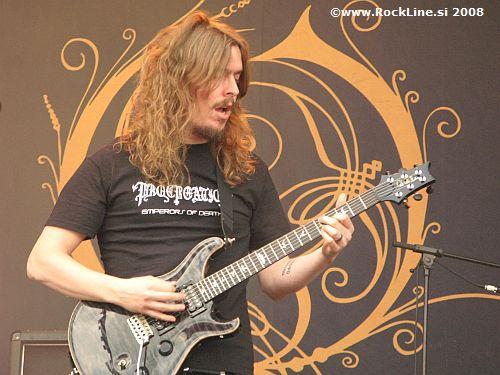
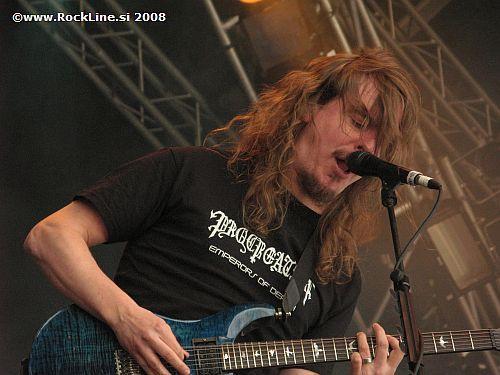
An interview with Opeth isn’t exactly an everyday thing, is it? Right now Opeth are one of the most fascinating metal bands in Scandinavia, thanks to the constant progress and growth of their artistry, whose musical boundaries the guys keep boldly pushing outward in every direction of musical experimentation. They’re a band that sits on the musical map as something completely different from anything you’ve heard. The driving force of the band is the brilliant Mikael Akerfeldt, Opeth’s visionary, an open and sparkling guy who took a bit of time just after three in the afternoon on the second day of Nova Rock festival for a short chat with RockLine.
RockLine: Hey Mikael, how are you?
Mikael: Pretty tired at the moment…
RockLine: Since we’re really tight on time, I’ll just dive right into the questions. How did the studio work go for the new album “Watershed” after you refreshed the lineup with Frederik Akesson and Martin Axenrot?
Mikael: In a friendly, relaxed atmosphere. Looking at our career as a whole, this was actually the first truly professional approach to recording in the studio. We never stressed too much about studio work. When it was done, it was done. There was no rush. This time, though, we had a schedule and deadlines set in advance for the first time. But the work went down in a very pleasant atmosphere. I missed Peter, but I don’t like looking back. Now, with the new lineup, Opeth are an even stronger band.
RockLine: “Watershed” showed up online quite a while before it was officially released. What’s your take on the music pirates who make internet downloads possible?
Mikael: Of course I don’t like it. I like it when you can spread music on the internet. But what I don’t support is our album, for example, turning up online before it’s officially out. After the official release, I don’t care at all if people pull it off the internet. You simply can’t prevent that. But until it’s out, the album is ours alone. The internet has helped us a lot in promoting our band and our music. But I definitely prefer people buying our music over pulling it down illegally. That’s how I see it. But something is going to happen down the line, something’s going to blow up.
RockLine: Not long ago, Royal Hunt’s main man Andre Andersen told me, pretty fired up, that more and more artists who make their living from music are giving up their professional careers, and so on…
Mikael: Yeah. People are losing regular jobs, labels are stagnating, bands are falling apart. I don’t think young people understand this very well. They only think of the label, the fat guy with a cigar, but they don’t see the work of ordinary people in the factories and the record stores. They have it in their heads that labels are greedy, and even bands too. It’s far from the case that Opeth sit around thinking about how we’ll make millions of dollars with the new record. I don’t get the kids who just say: “I want this for free!” I come from a different time, the seventies, the eighties. I love record stores, I love buying records, and they don’t seem expensive to me. Food and drink are expensive.
RockLine: The new album “Watershed” feels even more experimental than its predecessors, as if you’ve started abandoning your death metal roots and replacing them with seventies rock influences. Was that a conscious decision, or did the album just happen the way it did, without any prior calculation? By the way, your clean vocals over blast beats in Lotus Eater are something Opeth fans haven’t experienced before…
Mikael: Every record happens naturally for us. Each one needs a natural process. It can happen that during that process I feel like steering toward a certain musical direction, which I then want to bring into our music. But the evolution of our music is completely natural. It’s not something we’d try to force. If we tried, our music would be garbage.
RockLine: Opeth would lose the true direction of their natural evolution, I mean as a band…
Mikael: Right. And the band is united in what it wants. We do exactly what we want to do. We don’t make music by listening to what the fans dictate. But it’s a really nice feeling when you do hear from a fan who tells you they love our new music. So in the end we always have the fans on our side because we stick to our own path of creating Opeth music, and not because we follow trends.
RockLine: You decided to cover an original by Robin Trower. How come?
Mikael: Yeah. It’s a really lovely song. I’ve been a Trower fan for years. We were choosing between several different options for which cover to tackle. But since it’s in our nature to like exploring, meaning we’re not a metal band that would immediately latch onto Iron Maiden or Judas Priest at the word “cover,” we went with Robin Trower and his song, which is basically a dark blues number. It was a special challenge to try it out and slip into the skin of an old rock tomcat.
RockLine: And as a contrast to that, an Alice In Chains cover too?
Mikael: Well, that sounds less surprising in our case. In our hands it sounds closer to the original, but still not as good as the original itself, of course.
RockLine: How did it come about that you ended Burden in such an unusual way, with detuned guitars?
Mikael: I don’t know, it just happened. I came up with the idea. We wanted to try how the whole thing would sound once we worked it into the song. It sounds like crap, of course, it can’t be any other way, since everything in that passage is out of tune, but in this case the whole point of that passage is that it sounds like crap. That we create this contrasting slide from a beautiful-sounding melody into some kind of annoying noise… It turned out to be very effective.
RockLine: Your new album is very vivid and layered in terms of themes. Can you tell us what stories and messages lie in the lyrics themselves? Is there some hidden concept behind it?
Mikael: Some songs connect slightly to each other, but otherwise the album carries no concept. The lyrics are very personal this time.
RockLine: In Hesian Peel you recorded the lyrics backwards. You can hear lines calling on Satan. Were you referencing the famous story that circles around Stairway To Heaven by the even more famous Led Zeppelin?
Mikael: That’s right. We actually recorded some really good lines backwards and the thing came out sounding really good. It goes roughly like this: “I see you my sweet satan, wondering accros a court yard.”,…
RockLine: Why did you decide to do a mellotron version of Porcelain Heart?
Mikael: The label asked me whether we could do that for the American market. It’s on there as a bonus track and it’s a really simple trick, but it’s a trick precisely so you can win over a few extra buyers, since if people want a special edition, they should get something extra for it. It’s not a move that’s going to rake in the cash, though. We’ll probably put the track up on iTunes or something similar down the line.
RockLine: You just got back from a US tour with Dream Theater. How was it?
Mikael: Yeah, it was a short tour with Dream Theater. We played venues of 4,000 to 5,000 seats. It was relaxing. Our album wasn’t out yet at that point, so we only played one new song a night in our setlist. We used the tour as a kind of warm-up, to be followed by a world tour.
RockLine: And how does the audience in the US take to your music?
Mikael: Every night was very satisfying as far as our performances go, during the tour with Dream Theater. We always did well and gave it our all. But you could spot quite a few grim looks in the crowd telling me: “What the hell is this?” That’s fair, considering the people who listen to Dream Theater aren’t exactly death metal’s biggest fans. In the front rows on this tour sat people with special tickets, kind of VIP passes, which Dream Theater sold in limited numbers. We tried to rile up the people in the first rows as much as we could during the shows, but they stayed cold. Overall, though, we were received very well on this tour. It was definitely a very positive experience.
RockLine: Do you have any goals yet for your future endeavors with Opeth?
Mikael: No. Nothing at the moment. I do have a plan, if you can take that as a goal… I’ll set goals once I get back home.
RockLine: That’s the best possible answer as far as I’m concerned. When I watched your show on 18.12.2006 in Treviso (Italy), I noticed you have a great sense of humor and you’re a great frontman. How do you pull that off? Does it come to you completely spontaneously?
Mikael: Oh, thanks. I don’t even know myself. Apparently it just happens on its own. I don’t like having to write down the jokes I use on stage on a scrap of paper and then read them off in front of the crowd. I like the interaction between me and the audience, that appeals to me, the crowd reacting during our gigs. I don’t like the kind of interaction where you egg the crowd on: “Get fuckin’ insane!” and stuff like that. In the breaks between songs I like to get into conversations, and ideas for dialogue just fly out of me completely unplanned, just like now while the two of us are talking. That way suits me a lot. But I don’t want to become some kind of “gimmick” cracking jokes that people remember Opeth shows by. Still, it’s obvious that a lot of people enjoy the way I communicate with the audience.
RockLine: At one point you got the crowd in Treviso to headbang to nothing, with no music, and I thought I was going to die laughing…
Mikael: Ha, ha, ha… I remember that, yeah…
RockLine: Unfortunately they’re gradually hurrying us along, so we have to wrap up this really interesting conversation. I’ve got a totally standard closing question. Do you have any special message for our readers in Slovenia? Oh right! You’re playing in Slovenia at Metal Camp at the start of July?
Mikael: That’s right. We’re looking forward to that show. The landscape there is gorgeous and I hope your Slovenian crowd turns out in the biggest numbers possible.
RockLine: Mikael, thanks for your valuable time, and I wish you plenty of fun at tonight’s show here at Nova Rock festival!
Mikael: Thanks man, and good luck.
Photo Gallery