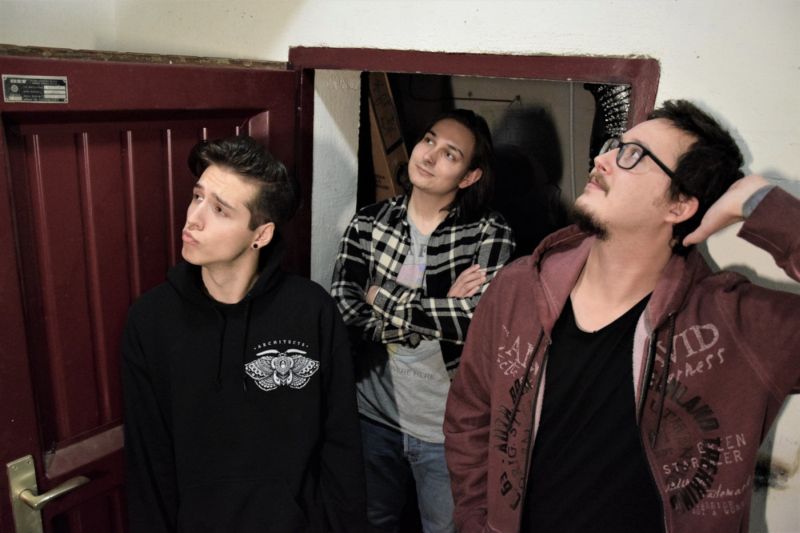
Talking to young people is always something special. They often surprise you with how breezily they state their views and convictions on the world’s most complicated questions, which in an instant become a lot simpler, if not downright unimportant. Conversations with young people who, with total seriousness and dedication, decide to devote their free time to something that these turbulent times are pushing to the margins of society even harder than before are extra special. But that’s exactly the point of music, of rock music. At least that’s what three young guys say, who by their own account make up the quasi-grunge coast-meets-Ljubljana band Sickbreed, which has so far put out a debut album and a handful of singles.
On Friday, October 29, 2021, on the eve of the eve of Halloween, that almost-naturalized holiday we imported from the continent next door, Maks Drobež, Andraž Leben and Damian Sterchi will ‘bid farewell to the foggy, swampy streets and begin invasively infecting the local coastal population’. Scared yet? Not yet? Then let’s add that ‘their lyrics wade into themes like global political/cultural phenomena, an increasingly myopic population, alienation from today’s world, and how and where we can find our place in it’.
If, instead of fear, an unstoppable urge for deep thinking and for finding your own place under the free sun grabs you during Sickbreed’s set at CMK in Koper, they’ll be immensely grateful.
“Our main goal is to keep making better and better music, but we’ll also be happy if a little sheep escapes the pen because of us,” is how they put the essence of what they do, in their own original way.
More on this and that in the lines below.
The first album reportedly came together very gradually, with tracks added to the originally planned format – single, EP, and finally an album. Is that some kind of formula for creating? Did you use it for the second album too?
Andraž: We made the first album as we went. When we’d made one track, we recorded it, then we made another, and once we’d scraped together enough money, we went and recorded.
Maks: We never intended to record an album. First we wanted to make two singles for an EP, so we recorded two tracks, then we made two more and had four singles, so the question came up: why not just make an album? Then we recorded four more tracks. We really put in the effort, because we wanted it to truly sound like an album. And now that I think about it… The tracks fit together pretty nicely.
Andraž: We talked about what would make the most sense so that it would really sound like an album, so we put, say, a ’heavier’ track at the end. But we didn’t want the album to have a story, you know.
Maks: We didn’t plan an album like Pink Floyd’s Dark side of the moon. (laughs)
Andraž: Yeah, we’re not that kind of masters.
Nataša: Yet.
Maks: Yeah, exactly. The third album will be like that. (everyone laughs)
Even if you try to avoid lazy pigeonholing, it’s hard not to notice that the first album was marked by grunge. Does that bother you, and was it planned?
Maks: Depends which member you ask.
Andraž: At first the Nirvana comparisons bugged me a bit, but now I’m totally fine with us being grunge, with us not being ’just another rock’n’roll band’. The first album is definitely grunge, the second one is a bit different, but it still leans that way. Anyway, I don’t care what other people say. Even if someone told me we were turbofolk, I wouldn’t mind.
Maks: I do have to point out that a lot has changed since the first album. I’d say we’re a different band now. Especially since Damian came along, we’re something completely different. Grunge is a way too simple label for us to claim. Unless we create the genre of progressive grunge.
Did you take a different path on the second album, make a detour, or keep heading the same way? How does the second album differ from the first?
Maks: We’ve already played quite a few tracks from the second album live, but looking at the whole thing, the different path is obvious. For instance, we open with a nine-minute track with just bass and guitar, one track is acoustic… We tried to work in as much dynamics as possible.
Andraž: Basically, these are tracks we wrote at the same time as the ones for the first album, only now we’ve refined them so much that something else grew out of them.
Pretty soon after the release of your debut Joy in deception (RockLine review), the band’s lineup changed. What did the new member bring to the band?
Andraž: Damian was my classmate, we tried things out with him and another mutual friend, but Damian did better. One time we were just talking, totally by chance, and he asked me if I had a band, and then jokingly added, do you need a bassist… And we really did.
Maks: Personally, I was really surprised by how quickly we clicked musically. Especially the first time we hung out at his place and played together. It was incredible. We recorded this album ourselves, which means it was just the two of us there, Damian played and I recorded him. And the result is great, really good dynamic. I got goosebumps, seriously, it was one of those fateful moments.
How did you feel when you became part of the band, Damian?
Damian: It was fun. I’d been looking for a band for a long time where I could keep playing bass, which I’ve been playing for about eight years. Until now I’d been in bands that mostly played covers, nothing original. This album was almost entirely recorded already, so it was really interesting to work on it and see what I could do with the existing material. Maks had already written some of the bass parts, so I took them as a base and built on them.
Maks: It’s really hard to find a bassist who also contributes a lot creatively. Damian does. He completely transformed those bass lines.
When it comes to the album, we also can’t skip the lyrics, which are strongly socially critical. A superficial listener might say you’re angry, really angry, but it seems to me that’s not the heart of your message. What are you aiming at (if anything) with these often controversial topics?
Maks: (laughs) There’s really no negative message, maybe it comes across that way because the music is still a little sad, depressive, angry, but… A good inspiration for me is, say, Black flag, Henry Rollins. In general, the hardcore guys of that era staked out the point by bringing a positive message into rock and depressive music. I don’t mean self-improvement in the Instagram sense, but in the sense of getting people to think a little.
Andraž: To say that there’s still a chance. Even if things are bad, you can still find beautiful things. It depends on you whether you’re able to see them.
Maks: I’m thinking what to say… You very rarely think about how you’d describe your lyrics in two sentences. Well, I was a lot younger when I wrote them. If I had to sum up what we’re generally trying to do with the band, I’d say that for each track we commit to a certain idea or direction in a very ambiguous way. We often have different opinions among ourselves, too, so I’d say the lyrics are mostly relativist. They do say something, but it’s more of a description where you want to let the listener draw their own conclusion. On the first album especially, the choruses are really simple, so you can sing them without thinking, while the other parts (like the verses) are a bit more poetically complicated, or the other way around. It still has to be accessible to the average listener, but at the same time it can’t be completely dumb.
Many artists have worked this ‘special time’ we’ve been living through for a second year now into their creative output, sometimes very directly (corona songs are raining down). How have the changed circumstances affected you and your music, if at all, of course.
Maks: Depressingly. A very clichéd answer, I know. (laughs)
Andraž: Personally, it’s important to me that we make music that isn’t relevant only right now, but that people can still listen to in forty years. The way we still listen to the Beatles, for example.
Maks: I find it funny how many tracks gained meaning during lockdown even though they were written earlier. Like the track about boredom, it was really interesting to record it during lockdown, because only then did it get its meaning, at least that’s the feeling I had singing it. Well, one track does touch on corona a little, but not directly. I agree with Andraž, we want to take a stance, but not in a way that would brand us with just one thing.
Maks, you said somewhere that your goal is to make rock dangerous again. Where do you see that ‘danger’, in what way of delivering music, and what function is it supposed to have?
Maks: Rock is avant-garde. The problem comes when the avant-garde becomes mainstream. Rock has had its mainstream moment, which is why today it’s a parody of itself. Bands that were popular in the nineties and are now in their legend phase are hypocritical to their original purpose these days. They champion the opinions of huge corporations, the very things they were supposed to be fighting against. They’ve reached their goals, but they still act like they haven’t.
It’s easy to say that, say, the KKK are terrible, because that’s something we all agree on. Rock music has to hold up a mirror to culture, or rather the opposite of it, something whose purpose is to make people angry. Because that’s when they’re forced to start thinking. The ones who get angry but just keep on being angry and sticking to their opinion, you can’t change. I’d like to have listeners who think, whether they’re 40-year-old men or 12-year-old girls.
A musician’s path usually goes something like this… You like music, you pick up the skills to play an instrument (or several, or to sing), you form a band, you play songs you like, you gig… These days, many people stop right there. What pushed you to make original music? Was that the goal from the start, did the desire develop later, was there maybe a special ‘click’?
Andraž: We only played covers at our first gigs, and even then just a few. You can never play them well enough to sound like the original. If you’re going to play, say what you think, not something somebody else wrote.
Maks: It’s hard to make a good cover. You spend just as much time on it as on your own song, because you have to fit it into your band’s sound. We often talk about whether to add a cover, but then we think that it’s a new song for us that has to be learned… I don’t know, the enthusiasm is bigger when you’re working on your own stuff.
The lyrics are in English. English dominates rock/metal in general, so not singing in your native language doesn’t mean any kind of departure. Still… Why did you go with English? Is it easier to express yourself in it, are you aiming at a foreign audience, or something else?
Maks: When I listen to music, everything I liked was in English. Bands with good Slovenian lyrics are rare, but they still influenced me quite a bit. English was the logical choice for me. It’s also true that we’re aiming at a wider audience. Lots of bands in Slovenia are popular only because their lyrics are in Slovenian. I don’t mean anything bad by that. It’s easier to become a big band here than out in the world, so we set ourselves a bigger goal.
In your taste, what separates a good musician from a bad one? What most convinces you to listen to someone again and again, to follow them?
Andraž: Confidence. That you stand behind what you play and say. Even if you sometimes play a wrong note, the listener will think you did it on purpose.
The second album is finished, but we’ll have to wait for its release. The culprit is the party-pooper of the last two years. So what’s the plan?
Andraž: Right now we’re trying to make music videos so we can put the tracks out gradually. Release singles that will also serve as promo for the album. We don’t have a date yet; the sooner we shoot the videos, the sooner the album will be out. For the official release we’ll of course try to put on a launch show.
Maks: The album will be digital, just like the first one, but it’ll also be available on CD, which we’ll sell at our shows.
What would you tell everyone who’s just starting out on their musical path? What should they be ready for?
Maks: They should listen to AC/DC’s ’It’s a long way to the top if you wanna rock’n’roll’. (laughs) I think a band reaches real success when it breaks up, or after it’s been around for a long time. Because there’s a certain mystique behind it. People give things way more meaning once they’ve lived through them. That goes double for rock.
Author: Nataša Fajon
You can also read the interview on the web portal Opazovalec.si: