Author: Aleš Podbrežnik
Location: Arena / Zagreb / Croatia
Concert date: 13.04.2011
Attendance: 20
Ticket price: €50.75 (floor)
Exactly four years after his last solo tour, on which he played Pink Floyd’s entire “The Dark Side Of The Moon” (1973) album, Roger Waters, now a lone rider for 26 years since the long-ago breakup of Pink Floyd, decided it was time to reactivate the message of his towering conceptual creation. When it came out in 1979, it gave the rock horizon one of the last true auteur albums, one that really lived up to everything the words “advanced,” “progressive,” “innovative,” “experimental”… can describe.
The years rolled by, but this work never lost its message or its powerful symbolic weight, backed by some seriously inventive iconography. As a piece of art, it passes the test of time with flying colors at every reinterpretation, and that can only mean one thing: it’s a timeless masterpiece, one of the holiest creations in the whole rock epic as humanity knows and understands it. This is Pink Floyd’s “The Wall”, by now a mandatory fixture in every household on the planet.
“The Wall” is an album for generations. For those who now wear gray hair and lived through the eruption of rock music’s primal beginnings in the glow of their youth, and for those who weren’t even born yet when Waters had already plunged headlong into his solo career. Waters is a man who knows he’s no spring chicken anymore, so he probably set out, for one last time in his career, on the adventure of a megalomaniac project that, in its early days, demanded a thorough refresh and a new outfit to come down among ordinary Earthlings in the new millennium, in the form of a socially critical revolt, more relevant than ever. “The Wall” is first and foremost an album written as the frustration of a star who, in the glut of everything, lost his own integrity and his power to resist, but Waters long ago cleverly turned it into an open attack on the filth of capitalism. With its virus of unstoppable greed, it destroys everything beautiful and tries, through the embodiment of a single-mindedness in many forms but with the same goal, to drag as many people as possible into the agony of addiction and long-term self-destruction, since material things bring neither happiness nor health, let alone joy. And still we put its importance above the purpose of every single one of us. Let me not wander too far.
To get this megalomaniac tour going, Waters needed roughly, believe it or not, a whopping 37 million British pounds. On top of all the perfectionism that shapes the charisma of this venerable artist, the project involves a whole machinery of side-earners, assorted “legionaries,” each bringing an important building block in his own profession to the mosaic of the whole picture: restoring the “The Wall” concept in three-dimensional form before the eyes of a plebs hungry for “bread and circuses.”
As lead vocalist and bassist, Roger Waters gathered his proven, loyal companions for this tour: guitarists Snowy White and Dave Kilminster, drummer Graham Broad and keyboardist Jon Carin. The keyboard spot of the prematurely departed Floyd man Rick Wright, who played on Waters’ previous tour, was freed up for Waters’ son Harry Waters. G.E. Smith was called in as the tour’s third guitarist. The second lead vocalist alongside Waters is Robbie Wyckoff, in charge of all the lines originally sung by David Gilmour on “The Wall”. And we can’t skip the backing vocal quartet that makes up the new tour’s lineup: Jon Joyce, Michael Lennon, Mark Lennon, Kipp Lennon. None of the three Lennons are related to John, just like the Dalton brothers aren’t.
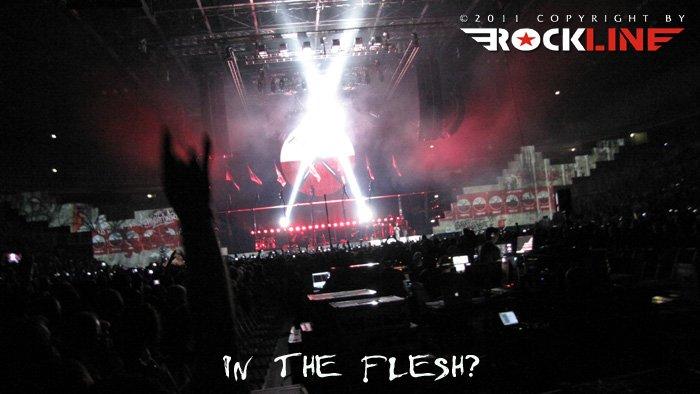
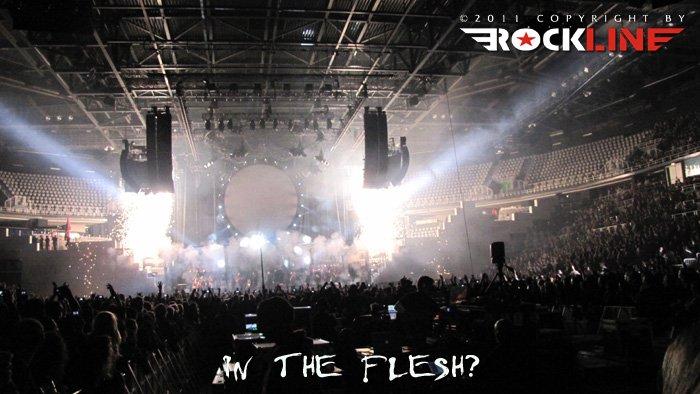
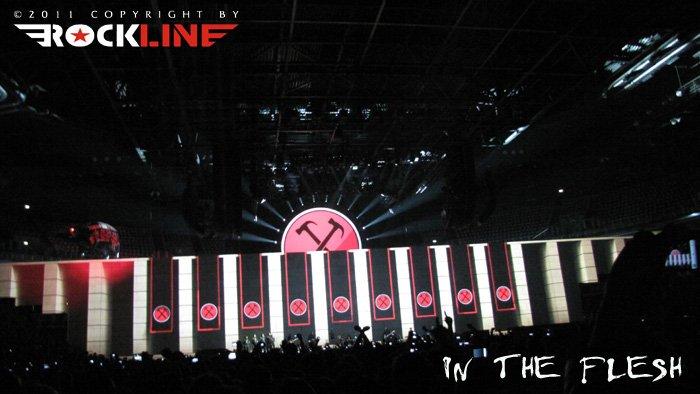
Ten past eight in the evening, the hall goes dark. A thunderous storm of excitement drowns out the populist chant of an escalating, ever-thickening repetition heading for chaos: “I am Spartacus!” A pyrotechnic explosion and a welcome from under the glare of the spotlights. The crowd goes into a frenzy, the stage dressed in the iconography of marching hammers, and the second number is ushered in with a low flyover and the sensational crash of a model of a German Ju-87 B “Stuka” dive bomber, decked out in the markings of unit 7./StG 77, assigned to operations in the Balkans in 1941.
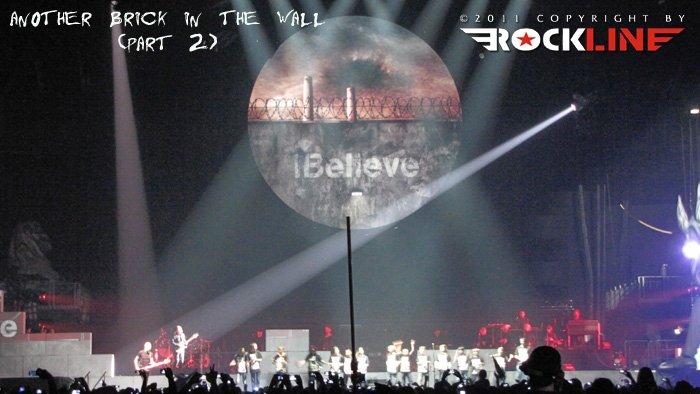
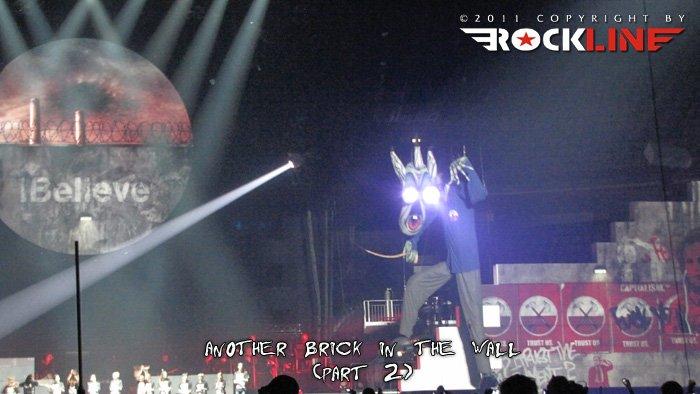
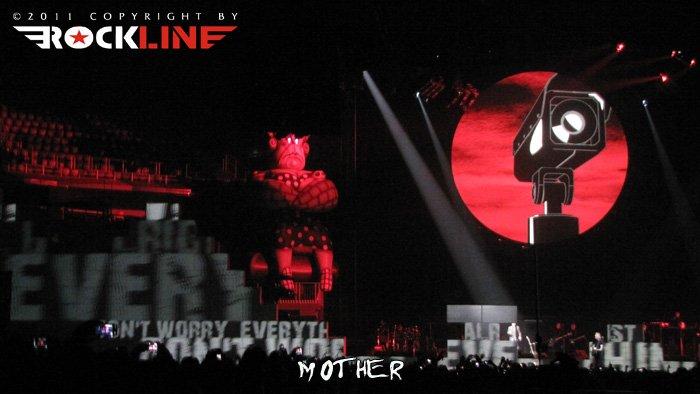
For the first three quarters of an hour, the wall goes up. The lovable teacher obligingly sneaks onto the stage as one of the most recognizable songs in the Pink Floyd legacy, Another Brick in the Wall Part 2, rings out through the hall, and the stage welcomes a special little choir of kids in “Fear builds wall” T-shirts who help set off the climax of the “enlightened” pupils’ school revolt. Then comes Mother, where Roger finally takes a few minutes to catch his breath and reveals in a address that the footage accompanying the song dates from 30 years ago, when Pink Floyd last played a tour promoting “The Wall”, at Earls Court in London. “…when I was poor, miserable, fucked up, little Roger…” is the string of words with which he naturally stressed that there’s no more room for self-pity today. It’s an outstanding number, ruled of course by Roger and his famous delivery of lines that don’t hide their own touch of cynicism, in harmony with an acoustic guitar, joined in the background by the velvety sound of his son’s keyboards. In the middle section we’re again treated to an extended version of the song (the outro of Another Brick in the Wall Part 2 was also extended), which thus grew by an extra guitar solo.
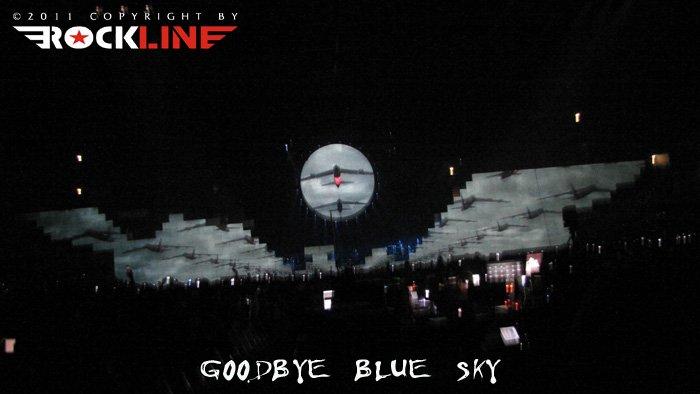
With Goodbye Blue Sky, the “lush” animations true to the legacy of the “The Wall” concept come to life for the first time. Renewed, though. Here we also got the answer to how much Gilmour Waters wanted to keep in the vocals when reinterpreting the album. He wasn’t after a Gilmour clone, just a fitting tone of voice. Robbie Wyckoff certainly justified that with his polished, melodically clean singing, which caught a hint of melancholic longing. Anyone who came looking for a Gilmour clone got the short end of the stick. “The Wall” performed by Roger Waters is not “The Wall” directed by Pink Floyd, and you have to draw a clear dividing line here, or you’ll never walk out of a show completely satisfied. The same goes the other way around for Gilmour’s solo concerts.
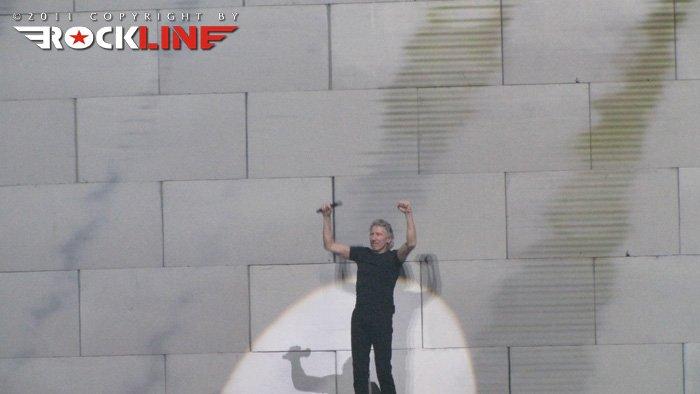
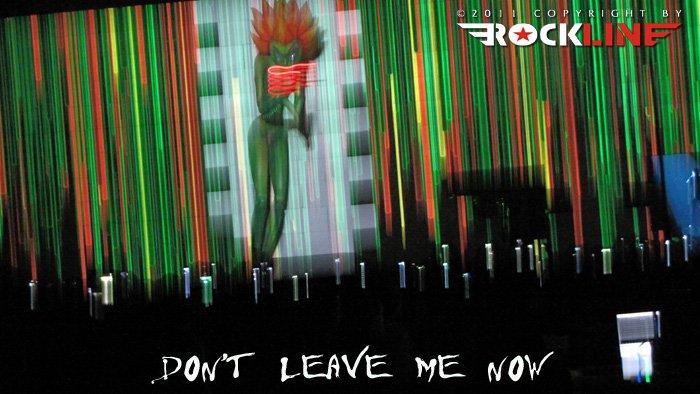
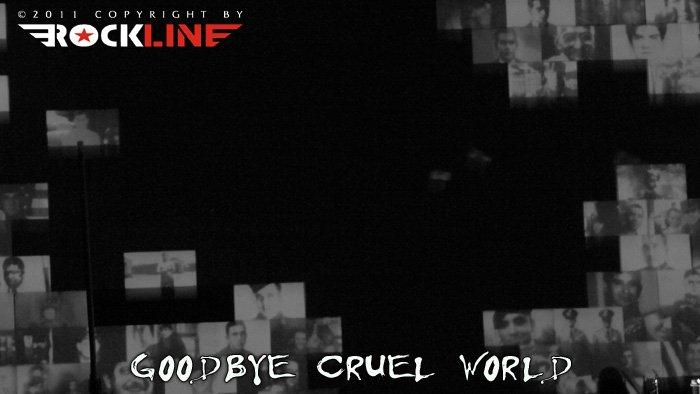
Exactly the same goes for Young Lust, where you had to instantly knock out of your head Gilmour’s deliberately rough, “smeared” original vocal, as it appears on the studio version of the Pink Floyd song. What’s in front of us is Roger Waters, not Pink Floyd. The last third of the first half was a tactical use of minutes that helped the busy little worker ants lay the last few bricks in the wall. So after Another Brick in the Wall Part 3, the band repeated, in improvised variations, the combined themes blended together within the song The Last Few Bricks, once more bringing back the lead motifs of both Young Lust and One of My Turns, until only a single window in the wall was left open. From there, only Roger’s head stuck out at the end (Goodbye Cruel World), and it led us toward the 15-minute intermission.
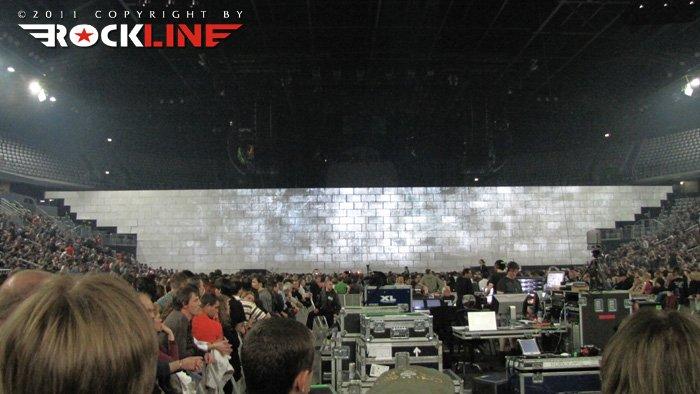
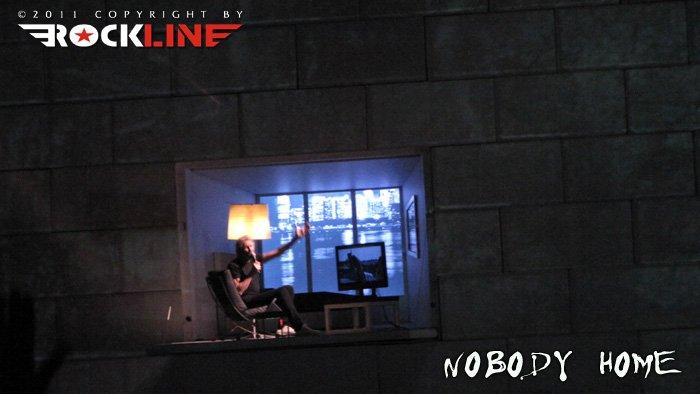
The wall is built! The second half opens with an incredible contrast. Sensitive, fragile, innocent. Hey You, whose softness is carried toward raging flames by the middle instrumental section and a finale with a spotlight on the vocals. The band plays this song entirely behind the wall. In the instrumental Is There Anybody Out There? the wall opens up just enough to let Kilminster and G.E. Smith come into view. Nobody Home proves to be the stronger moment of the second act. Here Waters’ famous vocal approach takes the lead and leaves a real lump in your throat as he feelingly walks through the lines of Pink’s complete isolation.
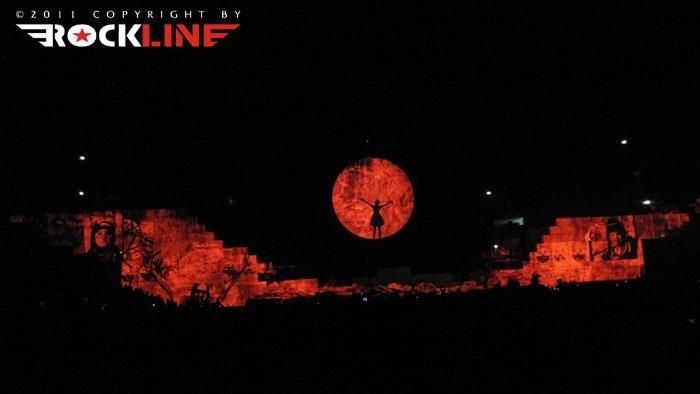
The contrasts are incredible all the way through! Both in the combination of the stage design’s melodies and the shots projected onto the wall, and in the succession of moods dictated by the flow of the individual compositions. Sometimes these transitions are barely noticeable, unbelievably graceful, subtle, tender; other times they hit with straight-up destructive force and no disguise. It’s precisely this shifting between grace and ruggedness, gentleness and roughness, love and hatred, profit and doom, independent and dependent, that awakens in the concertgoer stimuli they’d normally filter out consciously and are reluctant to show, not to say are ashamed of. That’s the point where you can fully let go, so that the magic of music touches the deepest intimacy of the listener’s soul. The way is open, then, for you to merge with the inexhaustible wellspring of creating musical beauty.
Of course, all these powerful and unique contrasts can have a slightly different effect, too. That’s what happened about 20 meters from the stage, maybe a meter closer: at the end of Nobody Home, during the sound-and-light effect of a British RAF fighter being shot down, probably thanks to a combination of being squeezed in and a lack of oxygen, two teenagers fainted. They were carried out of the crush to safety as fast as possible. A “shock” element in the spectacle, then, with real effect.
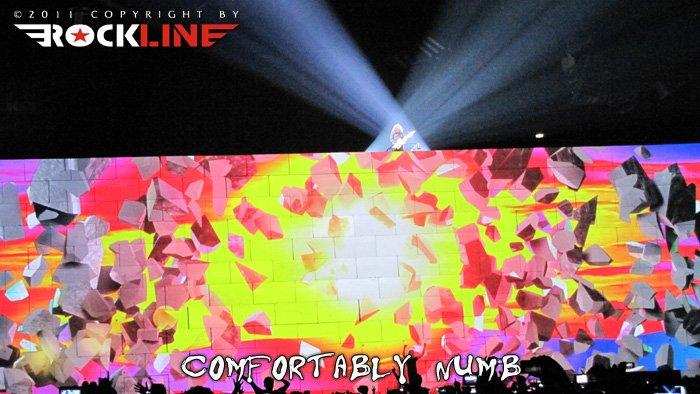
Dave Kilminster, who was in charge of playing all of Gilmour’s lead solos, once again pulled off the most impressive of them with great distinction in Comfortably Numb, a number all on its own. Here the hall woke up again from its hypnotic trance, and the 20,000 attendees backed Roger once more, louder this time, on the lines.
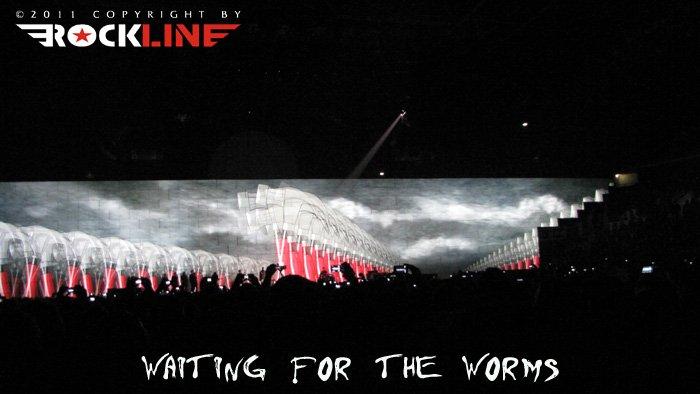
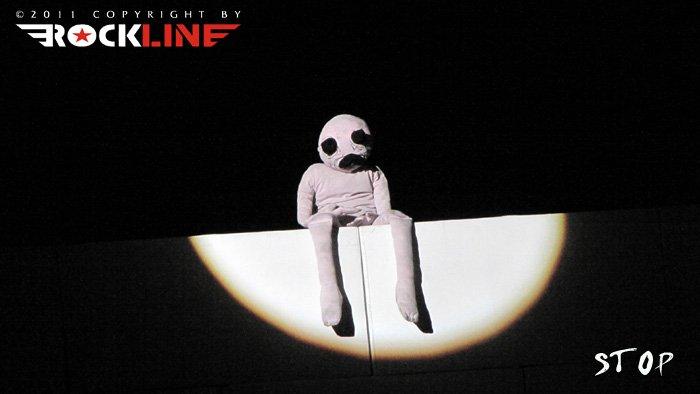
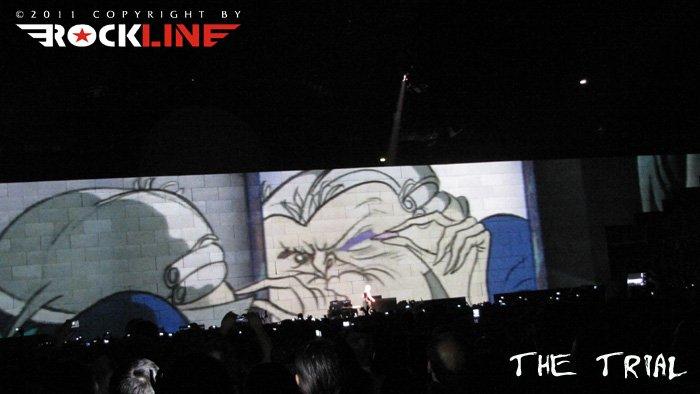
The grand finale is kicked off by an army of worms, which finally brings the main character to a rhetorical question about the burden of his own guilt, leading us to the final judgment. The Trial is the peak of the spectacle in itself. In the revamped “concert” version, with the footage projected on the screen, Roger Waters only rarely kept the original animation from the “The Wall” film. In The Trial, it stayed untouched. He masterfully played five characters himself, getting into all of them at once, as Pink, his mother and wife, and the teacher paraded before the bench of the chief judge, His Honor Mr. Worm. In the end, Roger completely took over through the closing lines of the verdict, when the Worm orders in his sentence that the wall be torn down. Here Roger showed all his artistic power, the elegance and maturity of the creations of his own genius, as he glowed in that very light in which the whole Pink Floyd legacy of exceptional character shines. The lion’s share of it always came down to Roger’s remarkable receptiveness and sensitivity, when he had to transform into a certain role and bring its character to life before the eyes and ears of the lovers of his music. And in all this he pulled a brilliant poker hand of aces out of his sleeve at the end with total confidence, and spellbound the Zagreb Arena completely.
A huge amount has been said, and still even more is left unsaid when we touch the legacy of “The Wall”. “The Wall” is simply a story that’s part of all of us, opens our eyes and widens our consciousness. It’s like a nuclear bomb. It breaks down old habits so that room is made in each of us for new ones to enter, ones that can help us in personal growth and the development of emotional and spiritual intelligence. Many warnings are hidden in it, but also many paths to insights that can enrich you immeasurably. In terms of material and molded carefreeness, they also redeem and liberate for good. “The Wall” is one of those documents of rock music that can boast the most intelligently implanted message, a quiet turn toward “sober defiance”. That doesn’t demand much, even though it demands everything. A small patch of space under the free sun for the self-preservation of each and every one of our individualities. In the realization of a genuine purpose. Of living here and now. And the primal beginning of this whole story comes from nothing but the bare axiom of love for life. So let’s tear down the 2,000-year-old, long-outlived wall of conformist principles!
photos: Helena Vertačnik
Setlist
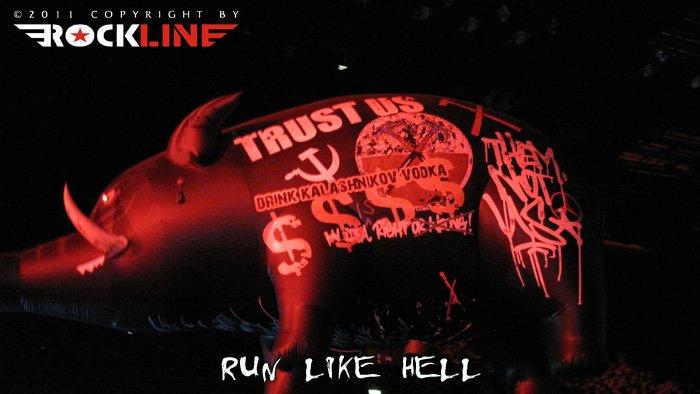
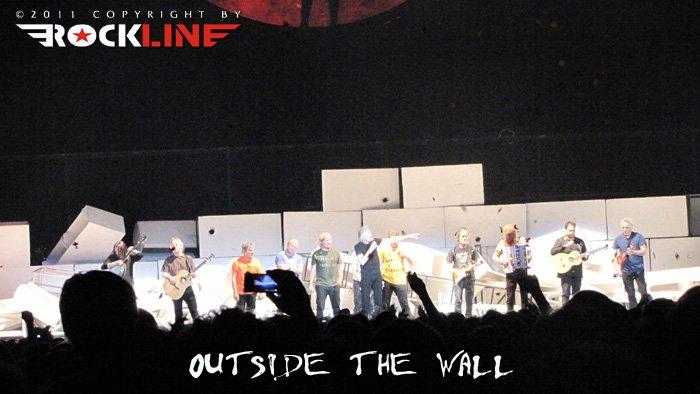
1.In the Flesh? 2.The Thin Ice 3.Another Brick in the Wall Part 1 4.The Happiest Days of Our Lives 5.Another Brick in the Wall Part 2 6.Mother 7.Goodbye Blue Sky 8.Empty Spaces 9.What Shall We Do Now? 10.Young Lust 11.One of My Turns 12.Don’t Leave Me Now 13. Another Brick in the Wall Part 3 14.The Last Few Bricks 15.Goodbye Cruel World —intermission— 16.Hey You 17.Is There Anybody Out There? 18.Nobody Home 19.Vera 20.Bring the Boys Back Home 21.Comfortably Numb 22.The Show Must Go On 23.In the Flesh 24.Run Like Hell 25.Waiting for the Worms 26.Stop 27.The Trial 28.Outside the Wall
Photo Gallery