

Emerson, Lake & Palmer were the first true supergroup in music history. The band was formed in London in April 1970, with a lineup built around keyboardist Keith Emerson, vocalist, guitarist and bassist Greg Lake, and drummer Carl Palmer. To date the band has sold more than 48 million albums, and earned nine gold certifications in the US alone. Before their first year was even over, they put out their self-titled studio debut, which carved their identity forever into a special spot in the lively boom of progressive rock, and in many ways shaped the further development of rock music.
Let’s rewind to the end of 1969 first. Keith Emerson and Greg Lake met in December of that year, when Emerson’s The Nice and Lake’s King Crimson ended up on the same concert bill. It was in San Francisco, at the Fillmore West. On the afternoon of 12/16/1969, Greg Lake and Keith Emerson had a big, sweeping chat about the possible options for their shared musical future. Emerson was already firmly set on forming a new band, while Greg Lake wanted to leave King Crimson. After Michael Giles and Ian McDonald refused to keep playing live with King Crimson, the lineup of the time was slowly losing real credibility, at least in Lake’s eyes. During a soundcheck, before a show by one of the two bands, Keith Emerson and Greg Lake played together for a taste. Greg played a line on bass guitar, Emerson joined in on piano, and according to Keith, magic was born between them instantly. The two musicians had actually crossed paths in similar circumstances before, when The Nice and King Crimson shared bills in England. First in Plumpton at the Jazz And Blues Pop festival, and then at the Fairfield Halls festival in Croydon.

You can read RockLine’s review of the Emerson, Lake & Palmer debut, contributed to RockLine in August 2006 by Peter “Dr. ProgRock” Podbrežnik, HERE.
Despite agreeing to form a new band, the two kept working with their original groups, right up until April 1970, when the British press officially announced that they’d joined creative forces. Even as Lake was slowly drifting away from his King Crimson companions, he stayed on long enough for the band to record its second studio album, “In the Wake of Poseidon” (RockLine review), which came out in mid-May 1970. That spring, Lake and Emerson were frantically searching for a drummer to join them. First on the wish list was Mitch Mitchell, who had just been left without work at The Jimi Hendrix Experience. Mitchell suggested organizing a joint jam with himself, Lake, Emerson and Jimi Hendrix, but it never happened. That didn’t stay secret from the media, though, who quickly seized on it and blew it up into a sensation, claiming a new band was in the works under the acronym HELP (the name derived from the initials of the four musicians’ surnames). Over the next two weeks Lake and Emerson auditioned quite a few drummers, but weren’t happy with any of them. So Emerson started looking more and more toward North America. Still, he turned for advice to his then-manager Tony Stratton-Smith, boss of Charisma Records and also manager of The Nice and of the two fresh, hot prog rock bands Genesis and Van Der Graaf Generator, asking who might fit the drummer’s seat. Tony Stratton-Smith suggested Carl Palmer, who was playing with Atomic Rooster at the time and had previously worked with The Crazy World of Arthur Brown.
Palmer agreed to an audition, and the guys launched into a properly extended blues shuffle; after the jam, Palmer expressed his satisfaction with the chemistry between the three musicians. Still, he said he wanted to stay with Atomic Rooster, since he felt the band was on the verge of a commercial breakthrough. Soon after, Greg Lake’s management called him and asked him to think again. After a few more meetings and jams, Palmer decided to join. He said he made up his mind because he sensed that together they could create something truly big and unheard of. Emerson had a few names in mind for the new band. In the running were: Triton, Triumvirate and Seahorse. In the end they settled on Emerson, Lake & Palmer, since they wanted to avoid anyone tagging them with the nickname “the new Nice” (New Nice). Before long they adopted the acronym ELP too.
Rehearsals followed, where among other things they tested how some King Crimson songs and songs by The Nice worked, and in the end only one of them stuck. It found its way into the future live repertoire too. That was “Rondo”, which Emerson had already played with The Nice. “Rondo” is actually an adaptation of Dave Brubeck’s jazz standard “Rondo a la Turk”. The second pick was Béla Bartók’s “Allegro barbaro”, which Emerson renamed “The Barbarian” in his adaptation, and the third was “Nut Rocker”, an adaptation of Modest Mussorgsky’s suite “Pictures At An Exhibition”, planned for the obligatory encore. Emerson had seen one orchestral performance of this suite at London’s Royal Festival Hall back when he was still playing with The Nice, and he’d always wanted to try the suite himself in a rock setting. After eight weeks of rehearsing at Island studio on London’s Basing Street, Emerson, Lake & Palmer decided to try the material out live at a few shows. On 8/23/1970 they played their first gig at Plymouth Guildhall, supported by the local band Earth. They drove there in Yes’s van and got paid around £400 for the show. It was a small venue near London, picked on purpose in case the gig was poorly attended. It turned out to be exactly the opposite. The next gig was logged for 8/29/1970, when they played the famous Isle of Wight festival, watched by 600,000 people. They closed the set with “Nut Rocker” and two cannon salvos (whose safety Emerson had tested beforehand at Heathrow airport). That show caught the attention of the music press, as well as A&R people at all sorts of labels. The band’s success, plus the high reputation of Greg Lake, a former King Crimson member and one of the most in-demand singers at the time, and of Keith Emerson, a former member of The Nice and at that time an outstanding Hammond player and keyboardist by a mile, got the band a deal with EG Management, who also looked after King Crimson’s management back then. Chris Blackwell snapped up ELP, and so they signed with Island Records for releases in the UK and with Atlantic Records for the North American market. The latter’s boss, Ahmet Ertegun, was convinced that ELP could fill venues in the US with over 10,000 people even before their studio debut came out.
On 9/6/1970 Emerson, Lake & Palmer headed into London’s Advising Recording studio. In one week they recorded their studio debut there. Lake also took on the role of lead producer, as he had done with King Crimson, assisted by sound engineer Eddy Offord, also known for his work with Yes. The first track they recorded, and the one that opens the debut, is the adaptation of Bartók’s “Allegro barbaro”, which they titled “The Barbarian”. Greg Lake said of the piece: “We turned that work quite upside down. We went with the title ‘The Barbarian’ because it sounds very aggressive. The basic message comes from hatred, and the piece has always reminded people of violence.” Because of the radical intervention in the original, Béla Bartók’s wife even contacted the band in outrage, demanding that the composer’s name be removed on the spot. The next track, “Take a Pebble”, was written by Greg Lake five years before ELP existed. Lake and Emerson finished the arrangements before Palmer joined the band. The folk section in the middle is Lake’s, while the jazz arrangements were added by Emerson. They first tried it out at one of the rehearsals in June 1970.
“Knife Edge” is one of the last things ELP recorded for the debut. It’s a combination of two classical works. Emerson and Lake co-shaped the track. Because Emerson “borrowed” the main motif of the first movement of “Sinfonietta”, composed by Leoš Janáček in 1929, for one of the lines, they earned a lawsuit from his wife. Both sides agreed to an out-of-court settlement in which ELP paid a sum for use of the copyright, and Janáček was credited as a co-author of the composition. “Knife Edge” also borrows the central motif of the “Allemande” movement from Johann Sebastian Bach’s “French Suite in D minor”, played on organ.
“The Three Fates” is a pseudo-suite made up of three movements. Keith Emerson wrote it inspired by the Greek myth of three women who are incarnations of fate (Clotho, Lachesis, Atropos). Emerson played the first part, “Clotho”, on the church pipe organ installed at London’s Royal Festival Hall. The second movement, “Lechesis”, is really a solo piece of under three minutes, played on piano, with baroque and jazz elements. In “Atropos”, after a short bit on pipe organ, Emerson moves over to piano, while Carl Palmer holds down the rhythmic framework in 7/8. Improvisation is laid over the whole thing. Through repetitions of the motif across a 4/4 meter, the final movement takes on polyrhythmic dimensions. Greg Lake didn’t take part in this suite.
The fifth track, “Tank”, is an Emerson composition that has a Palmer drum solo in its central section. All three musicians take part in the first part, with Emerson on piano and clavinet, and on Moog in the last part too.
“Lucky Man”, which closes the album, was written by Greg Lake when he was twelve. It’s an acoustic folk rock ballad that became one of the most beloved and recognizable songs in the band’s entire discography. It only made the album after the band needed some extra running time to fill it out. Greg Lake said: “Everything we wanted on the debut album, we’d already recorded. We had nothing else written. We were a few minutes short of making both sides of the vinyl twenty minutes each. That’s when I remembered a song I wrote at twelve, soon after I learned to play guitar.”
Greg Lake continues: “Recording that track started out pretty hopelessly. At first it was just Carl and me. Then the thing started to grow and develop into something really big. Especially when we added backing vocals to the chorus near the end. Still, the icing on the cake was missing. Keith was just messing around on one of the Moogs, and we caught that on tape.”
Keith Emerson adds: “I didn’t have my own Moog yet back then. But there was one in the studio, belonging to Mike Vickers from Manfred Mann’s Earth Band. Greg was just finishing work on the song, which I was hearing for the first time. He was shrugging, since even he wasn’t sure how it would all turn out. Well, a few hours later he asked me if I could add something to the closing part of the track. He spun the reel, and I played a solo on the Moog. I actually had no idea my solo was really being recorded. I thought it was just a run-through. While playing I looked ahead and noticed Greg in the studio control room, jumping around with excitement. When I finished he called me over to listen to what they’d just recorded. I explained that it was only my ‘flyover’ of the thing and suggested we record it again. As a proper solo. But Greg insisted on that first solo of mine, so we kept it in the final version of the track.”
Greg Lake says the following about the later popularity of “Lucky Man”: “I don’t even understand where the success of that song came from, which, as a single, helped the album sell over 10 million copies. People read the lyrics as a protest song about the Vietnam War. But that’s not true. I wrote the song when I was twelve and poor, imagining what it feels like to be rich.”
“… He had white horses and ladies by the score …”
“… All dressed in satin, waiting at his door …”
So for Greg Lake and company, the day when dreams became reality wasn’t far off. The album “Emerson, Lake & Palmer” came out in the UK on 11/20/1970 and in the US on 1/3/1971. In the UK it reached #4 on the album chart, and in the US #18. The single “Lucky Man” hit #48 on the US singles chart. ELP became a worldwide hit. Ironically enough, “Lucky Man,” released as a single in several countries, never got the same treatment in the band’s home country, the UK.
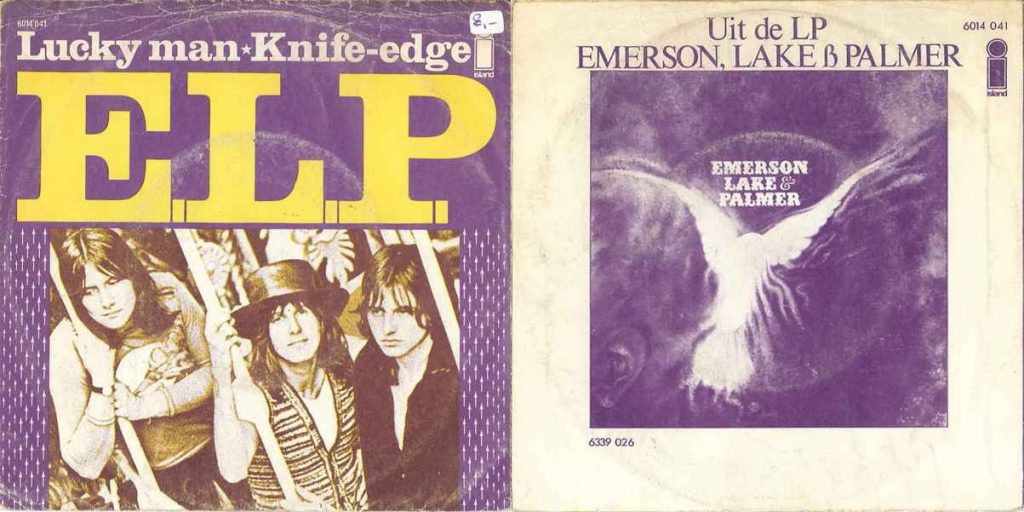

The debut “Emerson, Lake & Palmer” is a work of absolute eclecticism. It’s the joint creation of three extraordinary musical talents who, united in an artistic cumulus of three equal contributions, built the foundation of new musical standards amid rock music’s rapid branching into genres, in which, at the end of 1970, a special place was held by the blossoming of highly perceptive, daring experimentation. “Emerson, Lake & Palmer” gradually climbed to the very top of the flourishing prog rock scene, where they reigned for the next five years. Already the following year they almost fell apart thanks to a clash of three huge egos. Instead, they went and made one of the greatest albums in the history of prog rock. We’ll be writing about it soon.
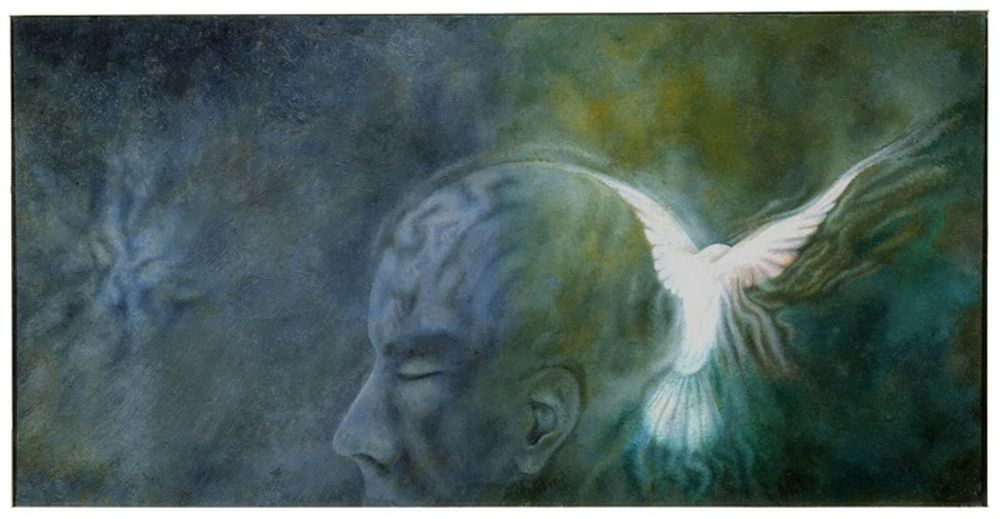
For the finale, let’s briefly linger on the background of the artwork that graces the debut’s cover. It was created by British artist Nic Dartnell. The motif is a bird, or white dove (front of the album), symbolizing the soul (the holy spirit) leaving a dead man (back of the album). Nic Dartnell later rejected hints and speculation that it’s the same motif used on the album by the American band Spirit from Los Angeles. He had actually drawn two similar motifs at the same time. He sent one of them to Spirit, who put it on the back of the album “Twelve Dreams of Dr. Sardonicus”. Dartnell adds: “The bald head next to the bird has no connection to Spirit drummer Ed Cassidy, as it doesn’t look like him in the slightest, and it has no connection whatsoever to the one on the first ELP album.”
Author: Aleš Podbrežnik
