Author: Peter Podbrežnik
Location: Gouveia / Portugal
Concert date: 13.04.2008
Attendance: 5000
Ticket price: 400
Gouveia is a small town somewhere between Lisbon and Porto that has been hosting an art rock festival since 2003. The event has gained stature every year, and slowly the really big names started showing up. Last year visitors already got Magma, and this year Van Der Graaf Generator were on the bill, touring to promote their new album Trisector. The venue’s location surely played a big part in the festival’s rise too. Gouveia sits in a truly beautiful spot, in a fertile part of Portugal where everywhere you look it’s green. I’d have a hard time picturing a prettier setting. This year a two-person RockLine crew made the trip as well, aiming to soak up all the charms of this lovely country and its famous festival.
Day 1:
BEDUINOS A GASOLEO
José Carlos Fialho – keyboards
Flávio Pena – drums
Ricardo Leite – bass
Luís Oliveira – guitar
Guests: Petra – vocals , Janita Salomé – vocals, Sérgio Costa – flute, Rui Teles – vocals
The opening act of the two-day Gouveia art rock festival was local band Beduinos A Gasoleo, whose name translates as “gasoline Bedouins”. They pleasantly surprised every single foreign visitor with their set, including both Slovenes, who weren’t totally sure the Portuguese had an ear for quality symphonic prog rock too.
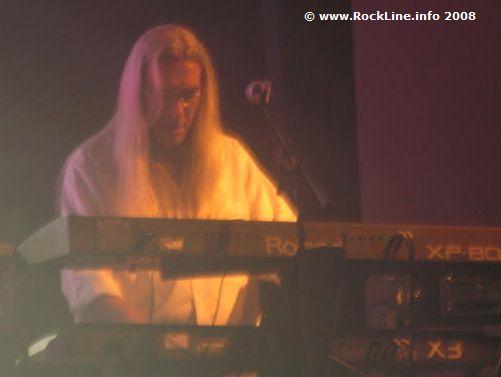
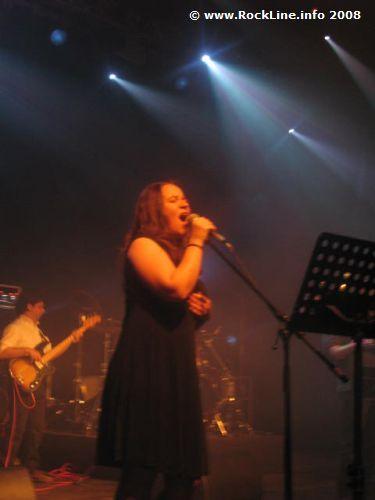
The sight of the rich spread of keyboards under the fingers of the band’s leader was enough to inspire confidence that something good was coming. With his white hair and overall look, he came across as a cross between Rick Wakeman and Gandalf. He showed a distinctive skill and a quiet feel both for working the keys and for building rich symphonic arrangements that carried some influences of the best acts in the history of progressive rock. Besides a decent rhythm section, which for this kind of symphonic-flavored rock might have sounded a little too loud (that was already obvious during their soundcheck, mind you), especially the bass, the Portuguese “Wakeman” was joined by a female and a male singer. The female singer, whose charms were more vocal than visual, fortunately fit their music well and helped build the atmosphere with her voice.
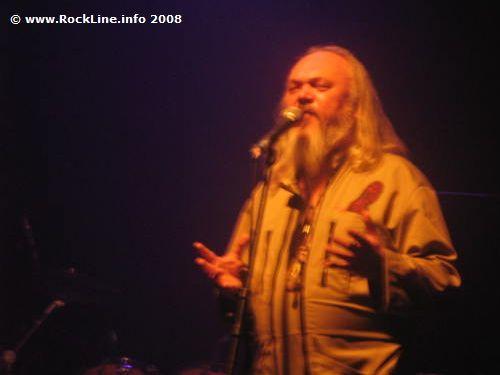
The male vocalist added a good contrast, an excellent singer who in his pirate bandana and shirt looked like an aging Don Juan. He was quite likely a “local hero”. After Beduinos A Gasoleo’s set you could see he was selling his own albums too. Sadly his appearance was short-lived, and a less flashy but still solid singer took his place, who in my view fit the female singer’s vocal color better anyway. The band, clearly with quite a bit of experience, also served up a good number of longer instrumental sections, for the delight of those of us to whom the lyrics, in otherwise melodic Portuguese, sounded foreign, and they were packed with atmospheric waves of keyboards and melancholic guitar solos. Beduinos A Gasoleo were thus a very pleasant surprise and a more than promising start to the festival.
Set list for Beduinos a Gasóleo:
Canto IV
Desculpa Lá
Convergir
Review of Beduinos A Gasoleo by: Peter Podbrežnik
PÄR LINDH
Pär Lindh – keyboards
Guests: Flávio Pena – drums, Ricardo Leite – bass
With the appearance of world-renowned multi-instrumentalist and above all keyboardist Pär Lindh, Sweden’s mentor of classic symphonic prog rock, the festival began to take shape as an international project too. In his homeland Pär Lindh is respected mainly as one of the main drivers of the Swedish progressive rock revival of the early ’90s, which kicked off with bands like Anekdoten, Anglagard and Landberk, and also as a top-notch musician who has tried his hand at rock, classical and jazz over his career and has released several symphonic-flavored prog albums under his project’s name.
Par Lindh first thanked the audience when he arrived and said that his decision to attend the festival, after he’d nearly canceled because of illness, had turned out to be the right one. In his set, which he played entirely solo without a backing band (except for the last two pieces), he chose to show some of the influences of classical music on the development of early progressive rock. He framed the show as a sort of lesson on the beginnings of symphonic prog, which certainly drew some people in the hall in and put others off, especially those who were expecting more original material and rock punch. They were all disappointed, since his set was much closer to classical music than to rock. During the show he mostly played classical piano, and in places hammond organ.
Among the classical composers he tackled Bartok, while among the prog classics he especially delighted with his take on the opening sections of the Emerson, Lake & Palmer classic “Tarkus”. In one piece he also slipped into the role of a jazz keyboardist, not hiding his discomfort in a funny way. He allowed himself even more humor in a short sketch in which he read out the lyrics of ELP’s honky-tonk burlesque “Benny The Bouncer” from the album “Brain Salad Surgery”, which he obviously loved. His fascination with ELP hasn’t waned one bit since the ’70s, and in a way that’s fair enough. Those bothered by the fact that he was playing without a band were cheered when for the last two pieces, his own “Jazz Eruption” and The Nice classic “Rondo”, the bassist and drummer of Beduinos A Gasoleo joined him. The two noticeably livened up his set and brought in some rock energy. Then Par Lindh left the stage and, despite the crowd’s demands, didn’t come back for an encore, so his set came out rather short and left quite a few people unsatisfied.
Those who had high expectations of the Swedish prog enthusiast were probably pretty disappointed. Personally, I even found his “lesson” on the beginnings of progressive rooted in classical music useful for anyone who hadn’t yet broadened their horizons on that front, although I’d have preferred to see him play with a band and do more of his own music, since he has released quite a few interesting albums. The format of the set was surely also down to the illness he’d just gotten over. For someone who didn’t know what to expect, though, it was a thoroughly decent and entertaining show and a chance to revive some symphonic prog nostalgia.
Set list:
1. Bartok, Allegro Barbaro
2. Prokofiev arr. Pär Lindh, Montagues & Capulets
3. Gurdieff, Song of the Fisherwomen
4. Brubeck, medleys arr. Pär Lindh
5. Pär Lindh, medley from Mundus,Veni Vidi Vici & the new album
6. ELP, Benny the Bouncer
With the band:
7, Pär Lindh, Jazzeruption
8, Brubeck/The Nice, Rondo
Review of Pär Lindh by: Peter Podbrežnik
ARANIS
Jana Arns – flute
Joris Vanvinckenroy – double bass
Marjolein Cools – accordion
Axelle Kennes – piano
Liesbeth Lambrecht – violin
Stijn Denys – guitar
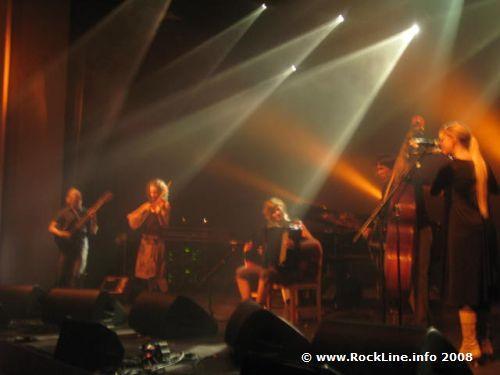
For me, one of the most anticipated shows was the concert by Belgian band Aranis. They’ve often been compared to Univers Zero, and I was really curious how they’d stack up. I deliberately didn’t listen to any samples beforehand, because I wanted to go in with zero expectations. And they didn’t disappoint one bit. They put on an unforgettable concert full of dramatic and tense moments, where not a single instrument stood out above the rest. Including a band that’s usually counted as chamber classical rather than rock might have seemed out of place to some, but after the show there was no doubt left. Aranis were a huge hit, as the crush at their CD stand after the gig showed. The music wasn’t as dark as Univers Zero in their first phase; the whole thing was more like a blend of old and new Univers Zero, darkness and light. Personally, they were one of the festival’s highlights, if not the highlight.
Set list:
Kitano
Vala
Looking Glass
Gona
Walk in one’s sleep
Moja
Trog
Lovey-Dovey
Mythra
Turbulentie
Asilah
Labyrinth
Review of Aranis by: Rok Podgrajšek
MIKE KENEALLY
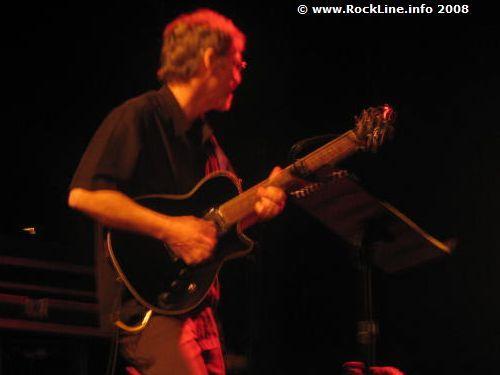
Mike Keneally: guitars, piano
The set by American avant-garde guitar oddball Mike Keneally promised
another top-notch musical show. Mainly through a combination of technical chops, a mix of different musical styles and humor. Over his career Mike has, among other things, played as a touring member with the legendary Frank Zappa. It shows in his performances, which are mostly infused with “Zappa-esque” humor even though he mostly plays instrumentals. Because of his brief stint with Frank at the end of the ’80s, his solo career often gets overlooked, and many people don’t know he has already racked up nine solo albums. In his “spare” time he also worked with Frank’s son Dweezil and with Steve Vai’s touring band. On top of that he’s been involved in a bunch of other side projects.
When Keneally got on stage, it was slightly jarring that, just like Pär Lindh before him, he came out without a backing band. To start, he asked the crowd which they’d prefer: opening the set on acoustic or electric guitar. Although the crowd was about equally keen on both, he went with acoustic. So the first part of his set was quite folk-rock flavored. Mike, as is often the case with avant-garde and folk rock singers, has a somewhat annoying and shrill voice, which doesn’t bother at all in his musical concept. He impressed far more when he picked up the electric guitar, showing why he once worked with Steve Vai too. He also proved to be a successful pupil of Frank Zappa’s “sinister” school for “talented musicians who don’t want to play in popular bands”. That he is, although not exactly some towering innovator, an oddball and top-notch multi-instrumentalist, he confirmed by playing piano and especially by using electric guitar and piano at the same time, pounding the keys with one hand and the guitar strings with the other.
Besides originals, of which “Potato” stood out for its very weird but fun chorus, he couldn’t resist two covers either. The first was from none other than his legendary teacher Zappa, Mike’s favorite Zappa classic – “Idiot Bastard Son” from “We’re Only In It For The Money” (1968). Apart from the lyrics and the singing style it had little in common with the original, but on the other hand it’s not every day you hear a Frank cover on stage. So anyone who has ever worked with him and keeps his rich legacy alive by playing his work always gets half-forgiven, regardless of the quality of such performances. A much bigger surprise was the cover of The Beatles’ “And Your Bird Can Sing” from “Revolver” (1966), since I wouldn’t have expected Keneally to have much of an ear for the “British side of the story” of rock music, but The Beatles are The Beatles, nearly everyone has tackled them, and he couldn’t resist the temptation either.
Mike’s set, despite all its shortcomings, was interesting and flew by. It had a pinch of that Zappa energy that’s always welcome today and all too often missed. Like Pär Lindh’s set before it, though, it could have been even better with a backing band. He thought of that himself and promised to bring along extra musicians next time. He wasn’t ashamed to admit he isn’t too used to such “lonely” shows and that this was only his third of the kind.
Review of Mike Keneally by: Peter Podbrežnik
ANGE
Christian Décamps – vocals, acoustic guitar, keyboards, accordion
Tristan Décamps – keyboards, vocals, choir
Caroline Crozat – vocals, choir
Hassan Hajdi – guitar, vocals, choir
Thierry Sidhoum – bass, vocals
Benoît Cazzulini – drums
Quite a few visitors were waiting with special interest for Ange, the legendary French champions of symphonic progressive rock, who were the headliners and thus the last act of the festival’s first day. Ange, who carry on into the 21st century with their own musical vision under the leadership of charismatic Christian Decamps, singer and multi-instrumentalist (as needed), remain a unique stage attraction. Besides top-notch musicianship, their shows often come with a heaping dose of theatricality of a kind you rarely meet anymore, even in progressive rock. Christian Decamps, a sworn leftist philosopher and social satirist, sharply but wittily skewers modern society through his music, lyrics and stage shows, which are almost on the verge of a theater production, especially organized religion and politics. Along the way he often uses specifically French humor and even puppets and eye-catching costumes. In recent years Christian is the only original member left. He’s now joined by his son Tristan Decamps, who has more than obviously inherited his father’s exceptional musical and acting gift, since he’s not just an excellent guitarist but also a very good singer, by attractive singer Caroline Chrozat, guitarist Hassan Hajdi, bassist Thiery Sidhoum and drummer Benoit Cazzulini. Since they’re all much younger than Christian, they add extra youthful energy to the band, which its leader certainly doesn’t lack, as we got to see with our own eyes that night.
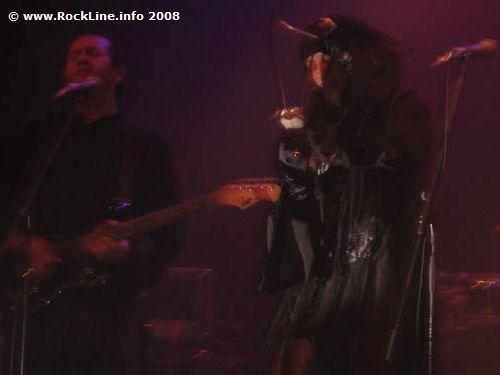
Ange shocked those present with their extravagant stage look alone, which fit perfectly with their often dramatically tinged music and satirical lyrics. The latter were, as is their tradition, in French, so sadly I didn’t understand a word (with rare exceptions), but their music and stage show were enough to pick up some of the messages of their musical concepts. Christian Decamps was in all his patriarchal majesty, with the indispensable gray beard of some Marxist philosopher, dressed as a car mechanic, with a baby pacifier hanging around his neck. His son was no less extravagant, and with his look recalled a cross between Groucho Marx and pirate Jack Sparrow. Guitarist Hajdi was dressed like some priest. Special attention was also drawn by Caroline Crozat, who in her provocative dress and coat most likely portrayed a prostitute. Except for the two keepers of the rhythm section, all of them were a true comic personification of certain layers of society.
They opened the set with newer pieces, mainly from the current album “Soufflers de Vers” (2007) and also from the previous album with the extremely unusual title – “?” (2005). On the more rock-flavored pieces the band played with such energy that it could have been a totally young band instead of an institution with almost 40 years of service behind it. Along the way the incredibly vital Christian often put on hilariously comic acting performances, or steered the band like the leader of some big stadium rock band. During one song he got so into his role that he ended up on the floor. At one point he very convincingly played someone who’d lost it and mentally gone back to childhood, loudly honking on the pacifier. In the theatrics he was nicely helped on some pieces by backing singer Caroline, who, when she wasn’t hitting plastic with a stick, reading a newspaper or dancing with a puppet representing death with a crown, contributed an excellent vocal contrast.
Of course the musical performance lagged not at all behind the acting, as Ange proved to be phenomenal instrumentalists. Besides singing, Christian repeatedly switched between acoustic guitar, keyboards and accordion. His son even had a solo spot where he showed off his mastery of keyboard instruments, and on one song he proved himself a good singer too. Hassan proved to be an extremely eclectic guitarist, easily moving between harder passages and more jazz-flavored parts, and the rhythm section was likewise bursting with potency and flexibility. Ange didn’t disappoint their old followers either, playing a few classics from their most popular albums,
“Au-delà du Délire” (1974) and “Emile Jacotey” (1975). They stretched their set to a full two hours and, despite the late hour, held the crowd’s interest to the end and delighted most of the audience. Christian, despite his national pride, which doesn’t let him use English lyrics, communicated with the audience in perfectly decent English, though it wasn’t of much help with the Portuguese part of the crowd. He cracked an appropriate joke about this “linguistic Babel”.
Ange’s show was excellent, if not beyond all expectations, and put the cherry on top of the festival’s first day. Fans of theatrical symphonic prog rock could lick all their fingers after Christian Decamps and his in-great-spirits gang, and wait a little more easily for the festival’s central “stars”, billed for the end of day two.
Review of Ange by: Peter Podbrežnik
Day 2:
LES REINES PROCHAINES
Michèle Fuchs – vocals, trumpet, percussion
Sus Zwick – vocals, saxophone, percussion
Fränzi Madörin – vocals, bass, accordion
Muda Mathis – bass, clarinet, melodica, vocals
Barbara Naegelin – vocals, guitar, bass, percussion
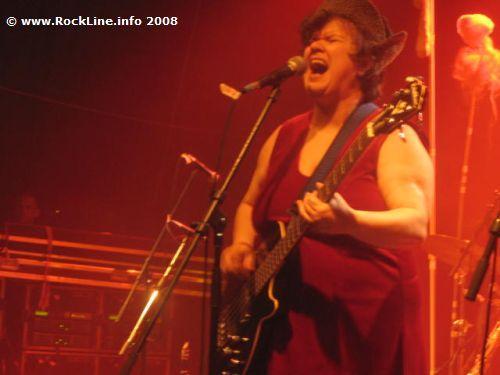
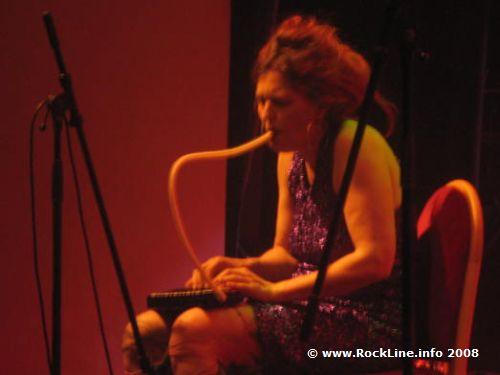
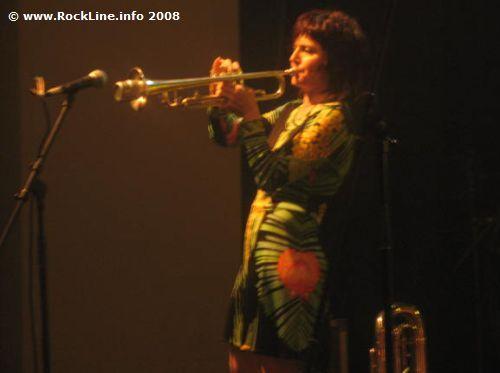
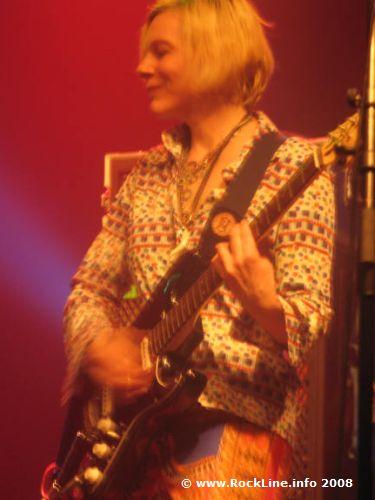
Swiss band Les Reines Prochaines, who have already played in Slovenia, came to the festival as the biggest unknown. Almost nobody knew who they were or what the show would be like. From descriptions of their shows, I figured there were only two options. Either it would be a complete flop or the show would be something special. The festival organizers clearly know what they’re doing, since the Swiss women won over most of the crowd. Even the announcement of the gig showed it wouldn’t be a typical show. Luis Loureiro introduced them as a band that also weaves some music into their performances. Five women staged a real cabaret spectacle, with no shortage of laughter, theatricality, tragedy and banality. A very unusual show for a progressive festival, but also a very successful one. Their music has plenty of the elements that formed progressive rock in the beginning – unconventional performance, unusual melodies, extravagant personalities. It’s as if you’d mixed Marlene Dietrich, Frank Zappa and the Sex Pistols together. Their set was lively, charged with sexual energy and joy in creating and in living. In my opinion it was the best visual show in Gouveia.
Review of Les Reines Prochaines by: Rok Podgrajšek
THINKING PLAGUE
Mike Johnson – guitar
David Wiley – bass
Dave Kerman – drums, percussion
Stevan Tickmayer – keyboards
Mark Harris – woodwinds
Deborah Perry – vocals
Elaine di Falco – vocals, keyboards
Guest: Bob Drake – drums
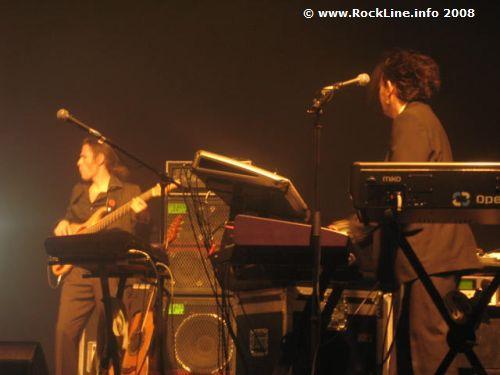
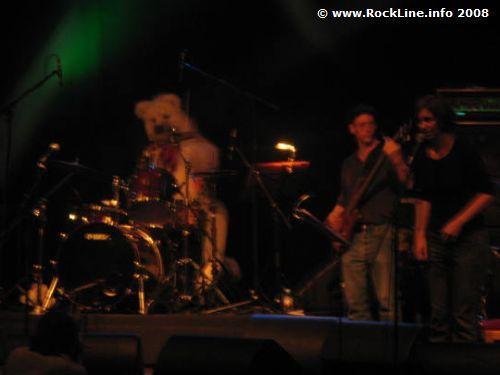
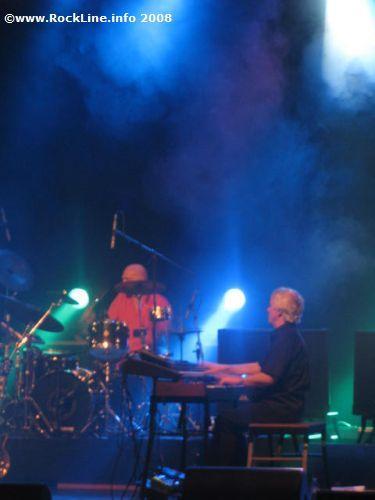
For me, one of the most eagerly awaited shows was by Americans Thinking Plague, one of the founders of the rock in opposition movement in the US. The band is built around leader and guitarist Mike Johnson (not the former sprinter). Once again I got to see drummer Dave Kerman in the lineup, who is practically indispensable at this kind of festival. The band reunited after a multi-year break, but you couldn’t feel that in their music. Extremely complex structures and melodies flowed without a hitch, with just a bit of trouble on vocals, where Deborah Perry stumbled a couple of times. That was an even bigger surprise considering Perry is a constant in the band, while the other vocalist is new. Elaine di Falco handled her part more confidently than Perry, but Perry found her footing later too, so we got to hear some really nice duets from the two lovely singers a few times. Thinking Plague put more attention on the instrumental parts than the vocal ones, and those lifted the set to a higher level. A surprise in the middle of the show came when someone dressed in a bear-dog costume showed up. Mike Johnson hinted at who it was with the line that it was “bear-dog, initials BD”. It was none other than another old acquaintance from the rock in opposition festival, Bob Drake, who, unlike in France, where he played guitar with the Peter Blegvad Trio, this time tried his hand behind the drums (and in costume, no less!). His drumming was confident, but Dave Kerman still stepped in to help a couple of times, and after three songs he took over from him, and Bob Drake took his leave. Thinking Plague delivered the most complex set with the hardest songs, and their gig was also the loudest, for which sound engineer Udi Koomran surely deserves credit. Individual instrumental solo spots provided relief from the tension. Thinking Plague delighted and proved that with little practice (they rehearsed together for only a couple of months) you can play at the top level.
Set list:
Behold the Man
Blown Apart
Maelstrom
Gudamy
Least Aether For Sax
Improvisation
Lycanthrope
Love
Keyboard solo
Warheads
Review of Thinking Plague by: Rok Podgrajšek
ARANIS IN THE CATHEDRAL
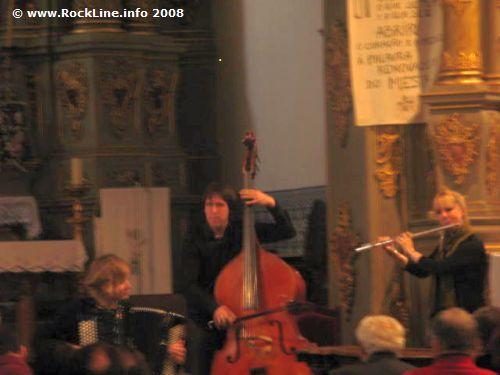
After their excellent show in the hall, Aranis played one more concert in the cathedral for all the locals and festival visitors. The concert was free, so the locals, who mostly didn’t get to share in the festival atmosphere, got their share too. The cathedral was packed to the last corner, which is also a sign that the festival has gained standing among the locals. This time Aranis played, besides their own pieces, some classical works and a few Renaissance improvisations. The audience rewarded them at the end with thunderous applause, which they undoubtedly earned with yet another top-notch performance. The band, which earns its bread in Belgium as a classical group, is so tight that they play completely flawlessly, and yet very emotionally and soaringly.
Set list:
J.S.Bach- eine ouverture
Joris Vanvinckenroye- Hirione
Joris Vanvinckenroye-Vala
Improvisation
Anonymus- Tous Bien Playne
Joris Vanvinckenroye- Walk in one’s sleep
Anonymus- Tous Bien Playne II
Peter Verdonck- Trog
Joris Vanvinckenroye- Moja
Joris Vanvinckenroye- Wespengraf
Turbulentie (short version)
Asilah
Review of Aranis in the Cathedral by: Rok Podgrajšek
VAN DER GRAAF GENERATOR
Peter Hammill – vocals, keyboards, guitar
Hugh Banton – organ
Guy Evans – drums, percussion
After nearly all excellent shows across both days, the festival’s grand peak arrived, the one that many of us visitors had been waiting for impatiently and with high expectations, and finally got – the show by the indestructible progressive rock legends Van Der Graaaf Generator, a band from the antediluvian era when high musical creativity and experimentalism knew no limits. Those were the days when countless bands were born that blurred the genre lines between popular music, classical and jazz, and VDGG quickly earned a reputation as leading representatives of that era. Even a few years ago most people were fully convinced that after their (seemingly final) breakup in the late ’70s they’d belong forever to the “good old days”. But three years ago, with their triumphant return and the excellent album “Present” (2005), they shocked many music connoisseurs in the most delightful way and announced that they were far from done and that even in the 21st century they want new musical challenges.
No doubt many visitors came to the festival precisely because of their appearance, since these days it’s almost as hard to see them live as to hit the lottery jackpot. Many of their followers, including outside Portugal, therefore didn’t hesitate to decide that this show must not be missed at any price. Every chance to see these musical legends with more than 40 years of service (not counting the in-between “breaks”), who are no longer in the bloom of youth and never were famous for the stability of their lineup, could be the last.
For this tour, on which they were presenting their newest, superb album “Trisector” (2008), Van Der Graf Generator announced only eight concert dates in total. And those in, by Slovenian standards, rather remote European cities, with the tour finishing in Moscow. The tour was a big novelty for the band, as it was their first as a trio after longtime and hugely popular saxophonist David Jackson left. The legend is now carried on by a trio made up of the extremely charismatic singer, guitarist and poet Peter Hammill, who’s also known for his great solo career, keyboardist (above all organist) Hugh Banton and drummer Guy Evans. Since this trio has formed the backbone of the band almost since the beginning, and since they fully justified their newest incarnation with the superb new album, there were no fears that the show wouldn’t live up to the big expectations. In my case these weren’t tied to song choice, since VDGG have never written a bad song in their career and I didn’t fuss much about that, though of course I had certain wishes about some of the picks. What lingered more were some questions about their stage show, namely how their classics would sound live without sax. Jackson’s departure undoubtedly took some theatricality and energy out of the band, but in the end it turned out the trio coped well and adequately made up for his absence on stage.
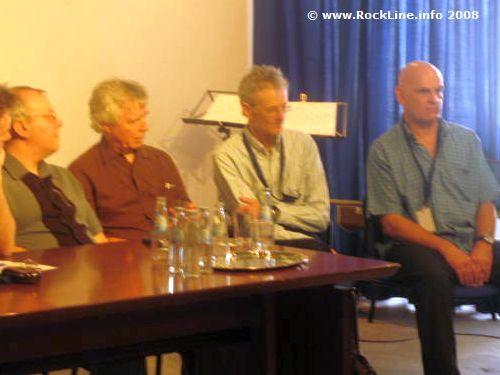
We’d already had a chance for a close encounter with all three band members in the morning, when together with the other performing musicians from the festival they attended a special press conference on the topic “Does humor belong in music”. Even though their music, setting aside the many sarcasms and black humor in Hammill’s lyrics, is usually considered quite serious and full of Hammill’s dark, socially critical and sci-fi-salted themes, the trio had quite a lot to say on the topic, especially its charismatic “doctor”. Along the way they dropped quite a few Anglo-Saxon-flavored witticisms that set off salvos of laughter. Before the evening show Hammill and his buddies seemed extremely relaxed and an excellent gig was in the offing, despite the doubts of a Swedish visitor we spoke with before the show.
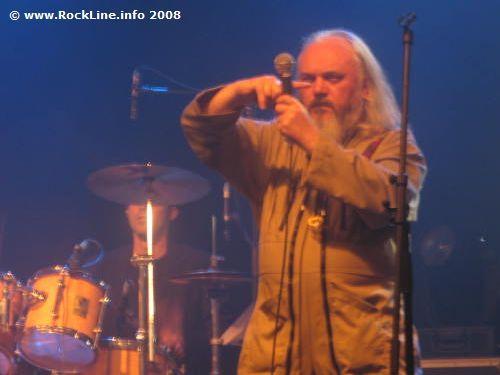
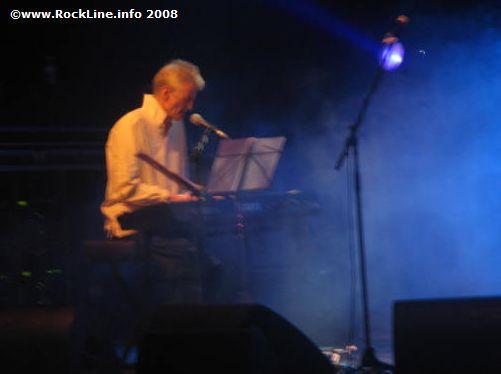
The sheer applause of the crowd after the announcer introduced them let you know that real musical giants were coming on stage, who in their day significantly shaped the development of experimental and popular music of the 20th century. VDGG, somewhat unexpectedly, opened with “Interference Patterns”, one of the best pieces on the new album, though most probably expected the melodic instrumental “The Hurlyburly”. The stage setup of the instruments was highly successful. On the left Hammill sat behind an electric piano, delivering his dramatic and chameleonic vocal acrobatics through the mic. Always calm Banton, with his organ “kingdom”, under which he had special pedals that replaced the bass guitar parts (he only uses the guitar in the studio), sat on the right. And in between, as the main link between the two buddies, sat Evans with his giant drum kit. If you connected them with lines, going by Hammill’s geometric analysis, you’d get a triangle and with it the central message of the album “Trisector”. VDGG next surprised with a performance of “In The Black Room” from Hammill’s solo album “Chameleon In The Shadow Of The Night” (1973), which is almost an adopted song of theirs, since they’d already played it on stage many times in the past and took part in its creation as a band. With it they demonstrated for the first time that Jackson’s departure hadn’t hurt them one bit. His parts were covered here by Banton and by Hammill on electric piano.
Despite Hammill’s sarcastic remark that VDGG aren’t a tribute band that would play only their old stuff, they continued with a performance of the classic “Lemmmings” from “Pawn Hearts”, during which many in the hall held their breath, mainly thanks to Hammill’s excellent vocal performance. On this one he also picked up the electric guitar for the first time and showed how far he’s come as a guitarist over all these years (far from becoming a top one, but perfectly decent for the band’s needs). Between pieces he didn’t hide that tuning the guitar still gives him headaches. For that he used a special device on the floor and wittily reminded the audience several times of the importance of what he was doing. In places on the classics, Hammill and Banton either skipped Jackson’s parts altogether or replaced them, more or less convincingly, with passages on guitar and organ. Banton is generally a peculiar one among rock keyboardists, since he uses almost exclusively just organs, and so it was this time too.
With “Lifetime”, which calmed the extremely energetic set a bit, and “All That Before” they returned to “Trisector”. In between, Hammill joked about the festival poster, which showed him in the foreground on guitar and his buddies blurred in the background, saying that “the two of them are the real musicians who belong at the front of the band, in fact”. The hall went wild at the legendary epic “Man-Erg”, one of the best pieces of their career, which gave many people goosebumps from excitement. Although with his guitar parts in the usual spot of the saxophone he wasn’t the most convincing here, Hammill disarmed all the skeptics with his vocal performance. Making sure the hall didn’t cool off for even a moment was another epic classic, “Sleepwalkers”, in which theatricality, drama, superb poetry and breathtaking vocal and instrumental performance once again came together in perfection. All three VDGG members didn’t show their age for a moment, and if I’d been watching from afar and hadn’t seen the gray hair I’d have said they’d teleported in from the ’70s. True, Hammill prefers to avoid high registers and too much screaming, but his voice hasn’t lost a thing when it comes to expressing rage and pain. The show was (sadly) slowly nearing its epilogue through phenomenal performances of both closing pieces from “Trisector”, the epic “Over The Hill” and “(We Are) Not Here”, which are inseparably linked. The victorious close of the main set was another legendary post-apocalyptic epic, “Childlike Faith In Childhood’s End”, from the album “Still Life” (1976), after which the delight of those in the hall just wouldn’t die down.
The hall demanded an encore, of course, and the band members, like proper polished English gentlemen, granted their pious wish, but first they thanked both the audience and the festival organizers. Some voiced their encore wishes quite loudly and shouted out some wild requests, among them “Octopuss”, but Hammill quickly hushed them with words along the lines of “that will never happen, at least not in this guitarist’s lifetime”. What followed was the beautiful classic “Still Life” from the album of the same name, which, besides the close of the main set, was surely the biggest surprise of the show (VDGG did change their set list several times between tour dates, so surprises were always possible). After they raised the hall into thunderous applause once more, they left the stage after their thank-yous, all too quickly, even though the crowd wanted to call them back. But an hour and a half with the indestructible legends of progressive rock was enough for numerous unforgettable memories, and at times it was truly hard to resist the temptation to pinch yourself in the middle of their set, for fear of waking up from a dream.
After what I saw, which for me was undoubtedly the peak of the whole festival, one can hope for great things from Hammill and his two companions in the future too, since they confirmed the feeling they’d already given with the new album – that after Jackson’s departure they’ve found a new source of motivation. Unlike many uninformed impressions, especially from those who have never met him and who usually put him alongside dictatorial musical figures of the Robert Fripp type, Hammill came across throughout the set as a true English gentleman and a mighty actor. He was extremely polite to the audience the whole time and spoke in nearly flawless standard English, often poking fun at himself and at Banton’s almost proverbial taciturnity. Many will probably find eleven pieces rather few, but considering this was VDGG and progressive rock, where some songs often run over ten minutes, one shouldn’t be too surprised. I could sum up the close of the Gouveia art rock festival with the saying: Van Der Graaf Generator – came, saw, conquered.
1.) Interfrence Patterns
2.) In The Black Room
3.) Lemmings
4.) Lifetime
5.) All That Before
6.) Man-Erg
7.) Sleepwalkers
8.) Over the Hill
9.) (We Are) Not Here
10.) Childlike Faith in Childhood’s End
Encore: Still Life
Review of Van Der Graaf Generator by: Peter Podbrežnik
The festival ran extremely smoothly. There were no complications or other incidents. The audience breathed as one for the music and enjoyed the varied performances. Credit is due to the organizers, who didn’t look for performers only among conventional “prog”, but also brought in some unknown yet extremely interesting names (for example Les Reines Prochaines). All the performers showed just the right measure of professionalism and musical perfection. It would be hard to single out just one act that stood out. The event was more than successful and it’s quite possible I’ll come back some day.
Intro and conclusion by: Rok Podgrajšek
Photos: Rok Podgrajšek
Setlist
Day 1: Beduinos a Gasoleo Pär Lindh Aranis Mike Keneally Ange Day 2: Les Reines Prochaines Thinking Plague Aranis Van der Graaf Generator
Photo Gallery