And then came “British Steel”. The sixth studio album from Birmingham heavy metal outfit Judas Priest. The year was 1980. A landmark year for metal. That’s when it became a fixture. It kicked down the door of every household on the planet that puts any stock in itself and in good rock’n’roll. As you know, this is the year the new wave of British heavy metal caught fire. It had been building up momentum during the industrial crisis in Great Britain, which in 1980 still hadn’t fully recovered. N.W.O.B.H.M. reflects the spirit of the time. There was no room for wafflers and posers here! The working class, the very bottom rung of society, knew full well that nothing was handed to it. It knew what bleeding fingertips felt like. For every crust of bread. Forget the crust. For a crumb. So N.W.O.B.H.M. suddenly erupted from the underground. That year Saxon released their second and third albums, while Iron Maiden, Def Leppard, Girlschool, Angel Witch and Diamond Head put out their debuts. Beside the point, but still a reflection. Because in the final tally the capitalists cashed in again, but to calm the enraged masses, who had been partly fed by the fiery, quickly fizzled punk, catapulting N.W.O.B.H.M. onto the market was a necessary tactical move. One of the few good ones from that cruel system.
And Judas Priest? That tornado certainly didn’t pass them by. But Judas Priest were already a name the masses knew worldwide by then. The band, formed more than ten years earlier in Birmingham, already enjoyed the status of a well-known group that had pulled off an incredible stylistic transition over the previous decade. From humble beginnings inspired by blues, psychedelic and progressive rock, they steadily chiseled out their own style through the seventies and, almost without noticing, wrote the bible of metal along the way. Young bands drew inspiration from them. They wanted to sound even faster and even louder. Album after album, Priest kept upgrading their doctrine of noise and speed. At the same time, Halford surprised everyone in 1978 by bringing leather and studs onto the stage, a getup that co-founded the metal subculture.
RockLine review of the album “British Steel”!
With “Killing Machine” (RockLine review HERE), the band delivered a record that was an absolute artistic contrast to its predecessor “Stained Class”(RockLine review HERE). “Killing Machine” was stripped of the more demanding arrangements Songs got shorter, guitar phrases were pushed way up front, and with them came the band’s desire to serve up a punch that grabs you instantly. For “British Steel” Judas Priest kept the musical direction of their predecessor. In fact, they dug in deeper and built on it. Arrangements were pared down to the absolute minimum, and even the solos got trimmed. Hearing a song like Living After Midnight in 1980, from the same band that a few years earlier had made far more thrilling music, led by the hard rock mini-suite Sinner, Stained Class, Victim Of Changes, or the darkly fantastical epic drama Beyond the Realms of Death, feels like an artistic step backwards. But given the time and circumstances in which “British Steel” was made, any path other than this “arrangement regression” wouldn’t have done the band any good. A band already followed by a strong, loyal army of fans needed, in the same breath, a hard-hitting and commercially breakthrough album to finally bring them worldwide fame. Above all, to finally win over the American market completely. According to Halford, that outlook was also heavily shaped by Judas Priest’s joint tour with AC/DC.
Before »British Steel«, Judas Priest had already racked up their first hit single with Take On The World, which landed in the UK top 20, and then came »Unleashed In the East« (RockLine review HERE), a live album that, thanks to its “sonic and performance perfection”, many cheekily dub “Unleashed in the Studio”. With it, the band cracked the UK top 10 for the first time in their career. That’s also where Tom Allom stepped in for the first time as the band’s new producer. Contact with the band was supposedly supposed to happen long before, but the Brummie quintet shied away from Allom like the devil from the cross, since they considered Allom part of the elite, too refined and highfalutin for them. But the gentleman of great breeding surprised the band. At first the guys didn’t even know who they were dealing with, but it soon turned out what a big-hearted collaborator they had gotten. Allom became part of the Priest family, and from then on the band entrusted Allom with the producer’s wheel. Even as late as 1988, when »Ram It Down« came out. According to Downing, the gentlemanly, well-groomed Allom was nevertheless always up for a good party with the band, though sometimes had to be dragged out of bed at home for it.
»British Steel« was recorded in exactly one month. February 1980! For the sessions the band settled into the residence of the Tittenhurst Park estate (Ascot, Berkshire – this is also where Allom produced Def Leppard’s debut “On Through the Night” later that same year), a property of a respectable 29 hectares, owned at the time by none other than Beatle Ringo Star. Ringo had bought the whole thing from Lennon in 1973. Lennon had built his Ascot Sound studio there, which Ringo later renamed Startling studio. Priest first started recording in the studio, but soon figured everything would go better right in Ringo’s residence. Ringo was making frequent trips to Los Angeles at the time. That’s where Ringo was meeting up with future wife Barbara Bach (a film actress). Ringo’s then-wife Maureen was no longer at the residence either. So Judas Priest and Allom had Ringo’s private property all to themselves. And Ringo didn’t leave things to chance. Ringo put everything valuable in the house away for safekeeping as a precaution, and laid down rules that Judas Priest had to follow dutifully and conscientiously. Every form of cycling around the grounds was banned, for example, as was fishing in the ornamental pond! Downing adds that Ringo kept two giant dinosaur models in the cellar, and if you were stumbling back from the pub toward the studio happily buzzed, you could get one hell of a scare.
Each band member claimed a room of their own to play in while recording. Downing, for instance, was in the room with Lennon’s famous white piano, the one the late, legendary Beatle shot the Imagine video on. The recording gear sat in a small room right next to the kitchen. For the first time ever, the band went into the process of recording a new album without having finished writing all the material beforehand. Tipton says Priest had about 60% of the material written by the time they arrived at Ringo’s estate, and that The Rage and Living After Midnight were written entirely in the studio. Downing adds that Living After Midnight got its title after Tipton and Downing stayed up late into the night one evening. Halford, like any normal British citizen of course, was trying to get some solid sleep at the time. But the two guitarists wouldn’t leave Halford in peace. So Halford came to ask them: »Can I please? Some of us are trying to sleep, you know? It’s already past midnight.«
The »British Steel« album is the first Judas Priest album with Dave Holland. From a technical standpoint, interestingly, swapping out Les Binks for Holland was actually a step down for Judas Priest. Holland, for instance, never mastered the double bass drum pedal, which never gave Binks any trouble. On the other hand, Holland was an exceptionally good dictator of hard-hitting rhythmic crotchets, which, together with Hill’s bass lines, built the ferocious skeleton of a minimalist rhythm section that was after raw, unbridled penetration above all. That rhythmic duo pushed destructive power to the front. An excellent contrasting catapult that the guitar phrases of Downing and Tipton conversed with phenomenally.
During the sessions the band also showed a hefty dose of inventiveness, using certain sound effects in individual songs that they had to record themselves back then. The police siren effect for Breaking the Law, for instance, was captured by actually recording the wail of a passing police car. They also smashed a few milk bottles (empty, of course) for Breaking The Law. In Rapid Fire you can hear Halford swinging a pool cue, while for extra effects in Metal Gods the band stuffed cutlery into a drawer and shook the whole thing. And the opening effect that kicks off Metal Gods is a recording of a door slamming.
The idea for the album title came from bassist Ian Hill, while reading the daily paper, in an article reporting on new strikes by workers at the British Steel Corporation, where Glenn Tipton had worked for five years. The band wavered on the idea at first, but had no alternative suggestion at the time. As the days went by, Hill’s suggestion made more and more sense.
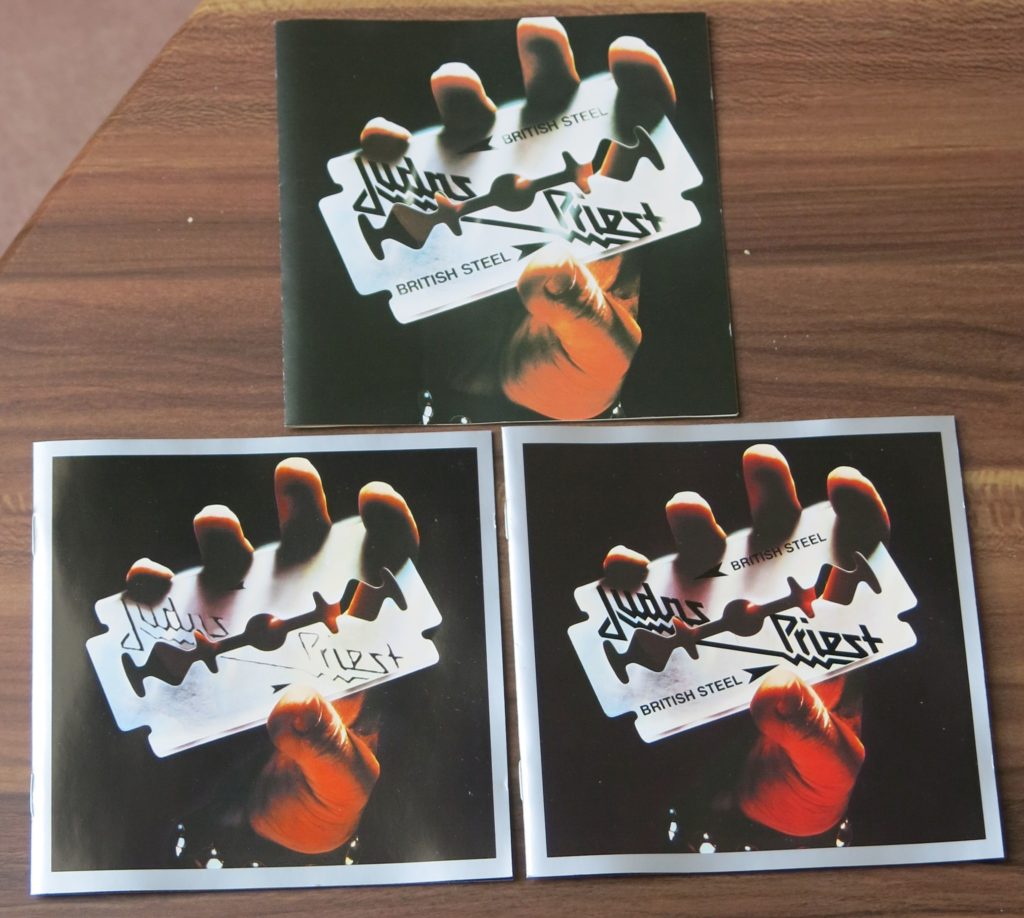
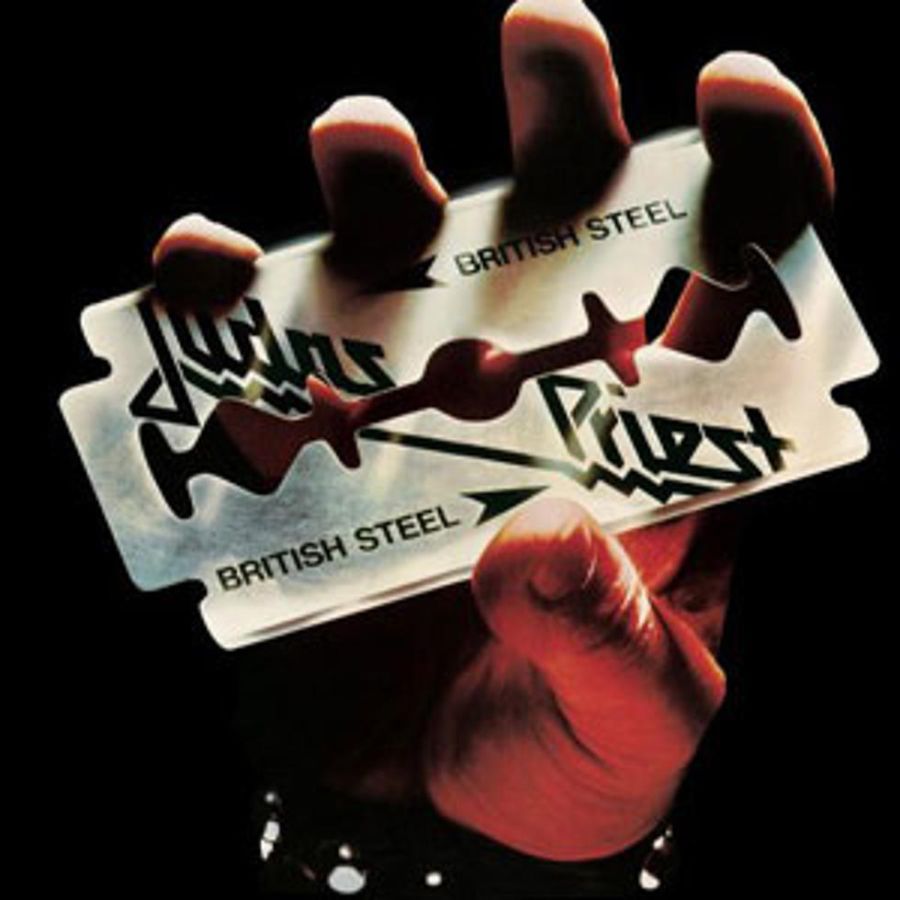
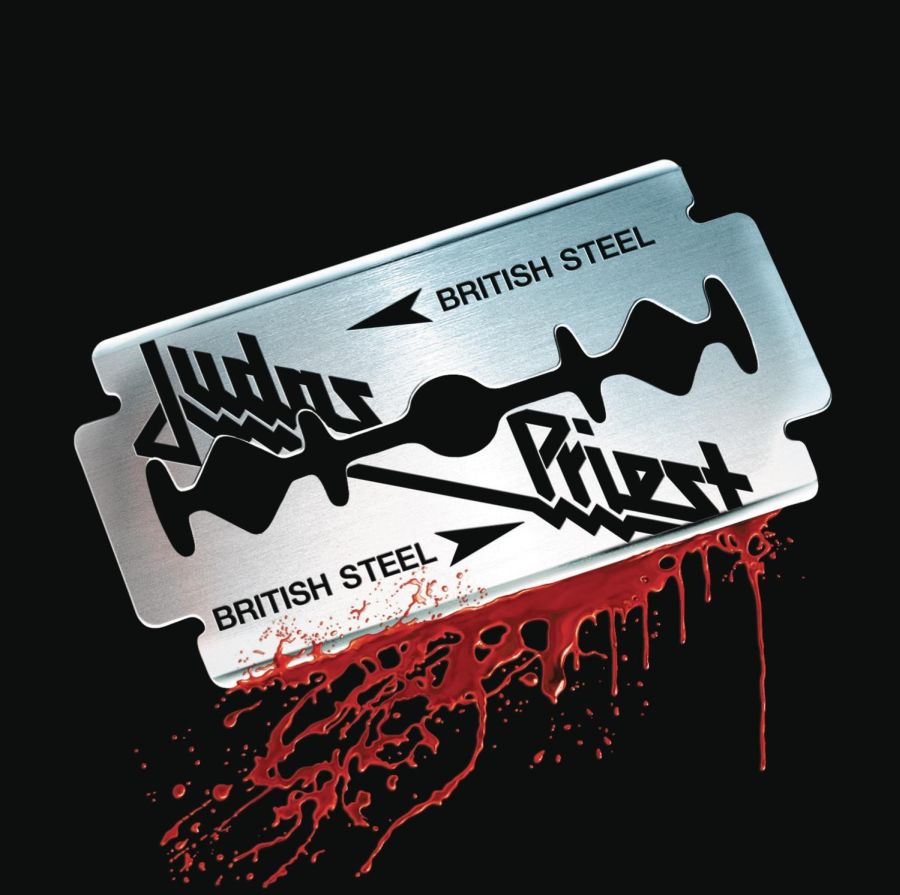
The album title meshed perfectly with the choice of cover too. The first version of the »British Steel« cover, created by Polish artist Roslav Szaybo, featured just a bloodied razor blade (Judas Priest used this version of the cover for the 2009 reissue of “British Steel”). Even though the version eventually chosen has a razor blade in a hand, without a drop of blood in sight, with the fingers laid on the blade in a way that makes it feel like the blade is cutting into them, some people tried afterwards to push the band to change their pick. There were even attempts at retouching. But the band flatly refused it all and didn’t budge.
The cover radiates sharpness, the album title stresses toughness and defiance. The adjective “British” knocks hard on the hearts of fans of heavier sounds! The right place at the right time. A coinage of a winning combination. »British Steel« is an authentic reflection of those times. An absolute one-of-a-kind. With this album the band purified and refreshed their musical philosophy and found a newly drawn focus that they stuck to throughout the eighties, and with concise expression, an aggressive stance and a captured spirit of rebellion, they fired up all the bands of the N.W.O.B.H.M. movement. The influence reached beyond the Atlantic, with Ian Scott (Anthrax) claiming that the thrash metal Big Four could never have been imagined in the form we know them without the release of »British Steel«.
»British Steel« is the album where Judas Priest, for the first time in their career, bared the teeth of socially critical engagement in their lyrics and compositions. Titles like You Don’t Have To Be Old To Be Wise, Breaking the Law and The Rage make that crystal clear. The messages of the album, together with the arrangements, nicely caught the trend the labels were looking for at the time. And that trend was strongly tied to the general reflection of musicians on the years of economic and social instability in Great Britain. That made it even easier for the masses to identify with »British Steel« when it came out.
Allom, who deserves the most credit for steering the band to capture heavy metal punch and radio-friendly (commercial) accessibility so effectively in the same breath on the album, first rushed off with the recordings to London’s Morgan studio (the final mix), and then flew to New York, where »British Steel« got its final sonic mastering.
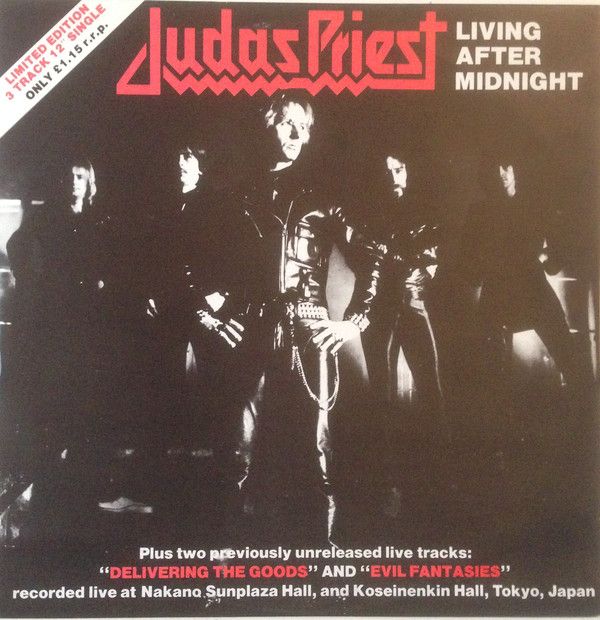
For the first single from “British Steel”, Judas Priest picked Living After Midnight. In March 1980 it reached number 12 on the UK singles chart. For shooting the video they chose Julien Temple. Temple was known for making videos for the Sex Pistols, and because of that reputation nobody at the time would touch Temple with a bargepole. Judas Priest had no problem with that. The footage for Living After Midnight was shot at a concert at Sheffield City Hall. Temple also made the video for Breaking the Law, the album’s next single, which matched the chart position of its predecessor Living After Midnight. For the Breaking The Law video shoot, Temple chose the area around a London Barclays bank. The third single, for the song United, was released by Judas Priest in August 1980 and did a touch worse. It reached number 26.
The energy in the studio was great and the band radiated incredible ease, even though everything had to be done in a single month. The team knew they had created strong material, and that was confirmed by Howard Thomspon of Columbia Records, part of the A&R staff, who worked closely with the band at the time and said: »The first minute I heard Living After Midnight, I thought, this is going to be a hit. I really loved Breaking the Law. Who wouldn’t?«
»British Steel«, released on 14.04.1980 (just like Iron Maiden’s debut), climbed to number 4 on the UK albums chart (just like Iron Maiden’s debut). Judas Priest also managed to break into a very respectable number 34 on the American Billboard 200. »British Steel« became the first Judas Priest album to go gold in the USA. To date, with over a million copies sold on US soil, it has been certified platinum.
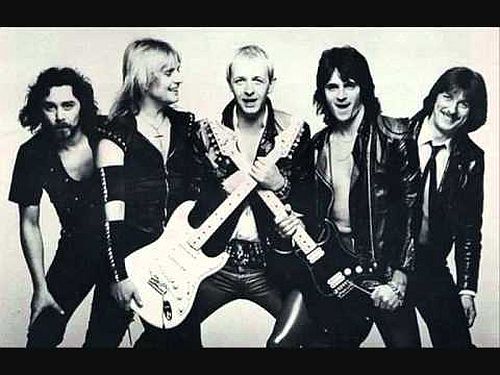
Between 07.03.1980 and 23.08.1980 Judas Priest were out on their British Steel tour of Europe and the USA. On the March leg, Iron Maiden supported them across Great Britain, and on the American leg it was Def Leppard and Scorpions. On 16.08.1980, Judas Priest also played the very first edition of the legendary Monsters Of Rock festival (Castle Donington), where they were second to last on the bill. Rainbow closed the festival as headliners.
In terms of its big commercial breakthrough, »British Steel« is surely the most important Judas Priest album. Its content and new direction flung the doors wide open for the band into the eighties, where, completely at ease and riding the wings of the ever-growing worldwide popularity of the then newborn heavy metal, they created some unforgettable and truly magnificent classics of the heavy metal universe.
author: Aleš Podbrežnik