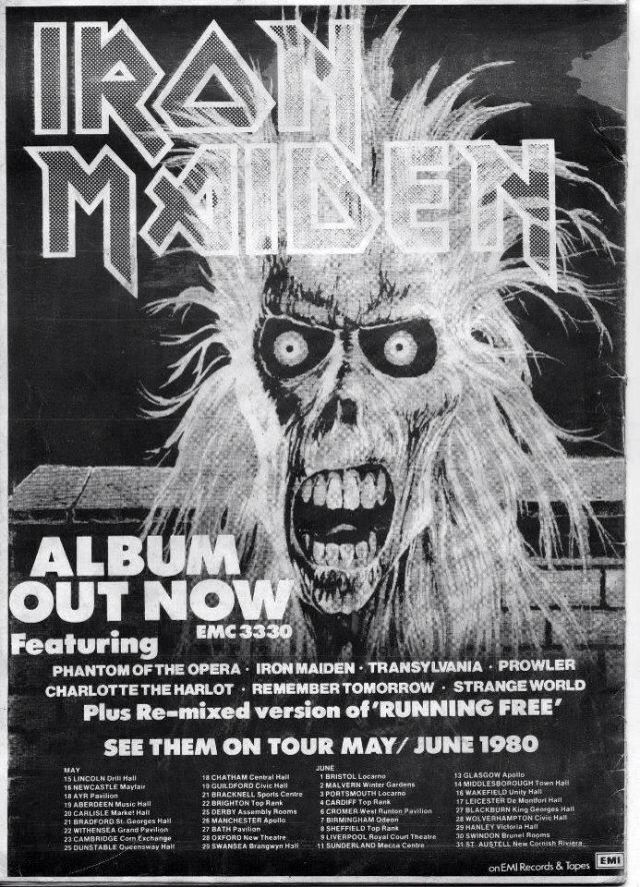
Four decades ago, on April 14, 1980, heavy metal giants Iron Maiden unleashed their self-titled studio debut on the world. The road to it was thorny, but when the album landed, it actually charted one spot higher than the red-hot Saxon, who had briefly taken over as the main locomotive of the new N.W.O.B.H.M. movement. The crowds knew them a lot better, mostly thanks to the hugely successful joint tour with Motorhead in the fall of 1979, and they already had a debut in their pocket too. Unlike the far more modern mold of Iron Maiden, Saxon built their fast, noisy, hard-hitting vocabulary on the traditions of boogie rock, blues and rock’n’roll, and they put out their second album, »Wheels Of Steel«, just ten days before Iron Maiden’s debut.
Before we start rambling about »Iron Maiden« the album, it’s worth flipping the calendar back a few more years. To the mid-seventies. As we know, Britain fell into a serious economic recession at the time. It hit the working class hard and made its position even worse. Unemployment was massive. The first reaction and revolt came with the explosion of punk, which settled scores with the elite through the language of escapism and nihilism. But at the same time, another front was swinging wide open in the musical underground, one that hardly anyone paid special attention to, and one the media deliberately ignored at first. And as punk faded (it stayed in the spotlight later through the musical language of new wave and post-punk bands), the underground at the end of the seventies was literally boiling. Lots of people were looking for a way out in new life challenges and new opportunities, a big break that would keep them from becoming victims of the misery the recession was causing. In 1979, among other things, Mrs. Thatcher moved into 10 Downing Street. A pile of new bands had sprung up across the island, and more were still being born. Punk had burned out, but there were plenty of new hopefuls trying their luck in another musical sphere. Including absolute musical illiterates. Either they couldn’t play their instruments at all, or they could, but very, very badly. But punk had shown that you could make it with very little musical know-how. It all came down to hunger and talent. This current of future musicians drew inspiration from the rock pioneers of the seventies, especially those bands that, on top of compositional talent and skill, cooked up plenty of noise. Their aim wasn’t to settle scores with the rock dinosaurs who had invented progressive rock out of a comfortable middle-class elite, the way punk did.
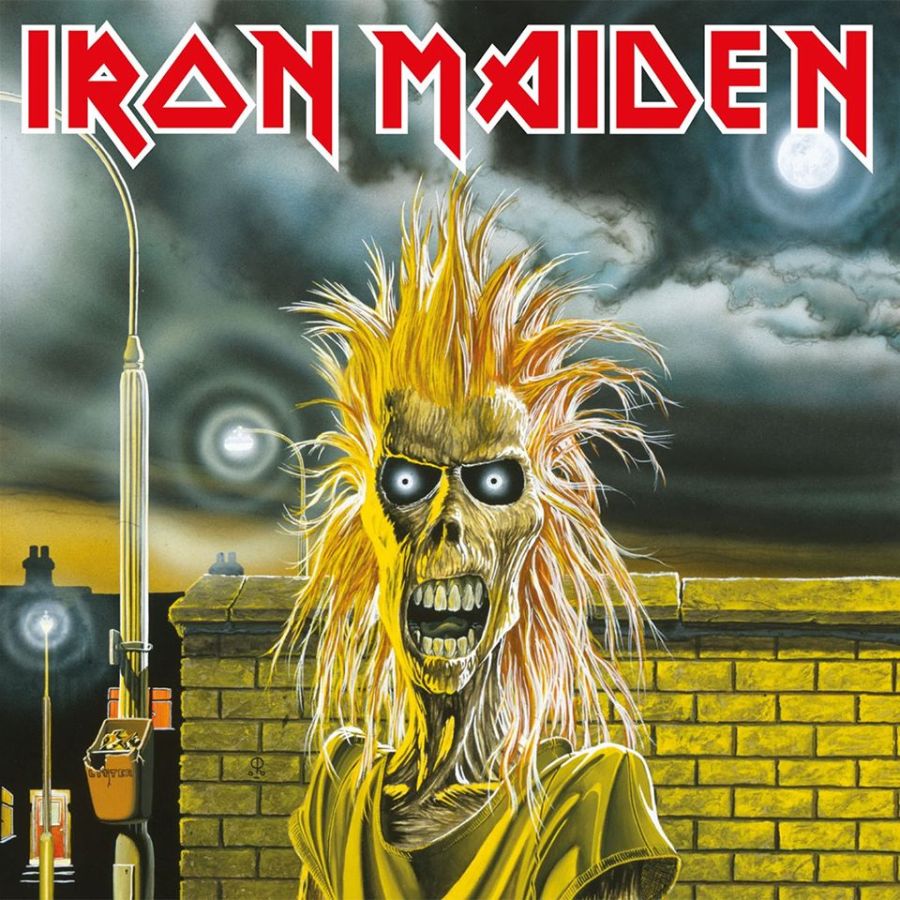
You can read the review of Iron Maiden’s debut “Iron Maiden”, written for RockLine long ago by the ever-meticulous Rok Klemše, HERE!
The lack of any life prospects hit the working folk of Britain’s industrial cities hardest. A young gentleman named Steve Harris didn’t escape it either, and he decided he wasn’t going to be a footballer after all, but would rather dedicate himself to music. A few circumstances that played into the hands of the wave of incoming bands as they built a new genre are worth pointing out. Three bands that were giants at the time, known to the whole world, Deep Purple, Black Sabbath and Led Zepeplin, were struggling. The first had fallen apart, the second had lived out their golden days after having to fire the “immature” Ozzy, and the third had a whole string of unlucky circumstances on their shoulders (personal tragedies, a brawl at one of the concerts on the American tour involving management and drummer John Bonham, drugs,…) and had to drastically scale back their activities. That opened up room on the scene for other bands. For example, the second front of bands that were widely recognized on the scene but were still struggling to reach their career peaks. From Thin Lizzy, UFO, Judas Priest and Whitesnake to Rainbow. And finally, there was one more band whose popularity was growing exponentially at the time. Motorhead. From day one of their career they stubbornly and deliberately rejected any equating of their rock’n’roll racket with metal. They were a band that played fast, put all their energy into limitless noise, and shrugged off any technical constraints. They were the only band that brought punks and a new tribe of listeners called “mutants” (Muthas) under one roof at the time (and still does today). The latter found their comfort in a phalanx of new bands that emerged as their generational peers, including first-wave ones like Saxon, Def Leppard, Girlschool, Diamond Head, Angel Witch and, of course, Iron Maiden. The music of the future, in other words, which would soon change the world. One more thing helped these bands popularize their punch. The career breakthroughs of Motorhead and Judas Priest, who released »Ace Of Spades« and »British Steel« in 1980. Australia’s AC/DC added their share with Back in Black. And there’s another factor to add: established bands like Uriah Heep, Rainbow, Black Sabbath (they released »Heaven And Hell« at the end of April that year) and Wishbone Ash were chasing a commercial sound at the time, which called for a higher dose of distorted decibels.
Interest from managers, labels and A&R people in this current of new bands was growing. A pile of independent labels sprang up (Rondolet, Ebony, Killerwatt, Neat Records), while the already established EMI, MCA, Polydor and Mercury Records opened the door to the new style. At the time it was hard to get into a position where heavy metal, then a newborn, could stir up any serious interest. The media simply weren’t interested in the musical underground. Luckily, Neal Kay thought differently. At the Bandwagon Heavy Metal Soundhouse in London he organized gigs for unsigned bands in front of roughly 100 fanatical Muthas, and as a DJ he also made sure this new music got radio exposure.
Iron Maiden also visited this venue in December 1979. But before we get to their debut, it’s worth adding a few details about the summer of 1978. At that time Iron Maiden were Steve Harris (bass), Dave Murray (guitar) and Doug Sampson (drums). The guys were rehearsing hard and writing material, with Harris also stepping in as vocalist, since the band didn’t have one then. Harris had wanted Murray in the band earlier, but the band even broke up for a while because of a backlash from the members at the time. Then came November 1978, when the legendary Paul Samson, at the Red Lions Pub in Leytonstone, connected Harris with a fellow by the name of Paul Di’Anno. After a successful audition he joined the crew as vocalist. So Iron Maiden were operating as a quartet at the time, and Murray was such a good guitarist that it was hard to find an equal, let alone better, partner for him. Harris always envisioned another guitarist in the lineup, but most candidates were simply too intimidated by Murray’s quality to join the band. After hearing what the band V1 had done with their first demo (they were led by former Iron Maiden vocalist Dennis Wilcock, the man who first came up with the idea of Eddie, and the man who would sue the band over copyright many years later, but that’s another story), the band decided to record their own demo there. It was December 30 and 31, 1978, when Iron Maiden put the songs Iron Maiden, Invasion, Prowler and Strange World down on tape. The band barely scraped together the £200 that Mike Kemp, owner of Spaceward studio, where the demo was recorded, was asking for. Iron Maiden picked the four songs that, in Harris’s words, they performed most convincingly on stage at the time. That way they hoped to avoid, as much as possible, any later overdubbing and embellishments, because like we said. They were broke. So all four demo recordings were mostly played in the very first take. According to Murray, Spaceward studio later wanted to make another £50 to “spruce up” the raw sound of the originals. Iron Maiden didn’t have that money, but the studio went ahead with sound corrections without their knowledge, which surprised and shocked the band no end. Iron Maiden made their peace with it. So they took with them what they had on hand at the time. One more thing. Although it isn’t officially credited on the release, a fifth member also took part in the recording: Paul Cairns, who came straight from the band Mad Mac, but didn’t last very long in the crew.
And so we’re back at Neal Kay. Not long after, Harris showed up at Neal’s with this recording, a copy of the cassette, to be exact. Thrilled by what he heard, Neal soon started pushing the band hard. Among other things, he ran his own Soundhouse chart, and Prowler soon took the number one spot there. At the same time, Neal’s alliance with Geoff Barton of the magazine Sounds (Barton writes for Classic Rock today) worked very well, and it was in Sounds that Geoff Barton first used the term »New Wave Of British Heavy Metal«, after catching a joint show of Samson, Iron Maiden and Angel Witch in May 1980. Through these maneuvers by Kay, and by Barton too, the band’s good name reached Rod Smallwood, who also received a copy of the cassette with the band’s demo recordings. He took the band under the wing of his management company, which he later named after one of the Iron Maiden songs (Sanctuary), and he rushed off with a missionary’s zeal to the heads of EMI Records, where he convinced them to sign the band.
While the band was waiting for the deal with EMI Records to be officially signed, the guys decided to self-release the demo made at Spaceward studio. Quite simply, demand for any kind of physical release was huge at Iron Maiden gigs, and fans just couldn’t understand how the band didn’t yet have a single release of their music that they could buy. They named their first official recording »The Soundhouse Tapes«, and it featured the songs Iron Maiden (A-side) plus Invasion and Prowler (both on the B-side of a seven-inch vinyl). The run was limited to 5,000 copies, and 3,000 of them were gone from pre-orders alone (by mail). Interest in the release was so strong that the shops HMV and Virgin Records ordered a total of 20,000 copies, but according to Smallwood, the band wanted to stay true to their real fans, even though Iron Maiden could have made a very nice sum from reprints even then. So they waited for the debut.
Even before they signed with EMI Records in December 1979, on exactly 14.11.1979, Iron Maiden turned up on “The Friday Rock Radio Show” (after Def Leppard, Samson and Praying Mantis, they were the fourth band in a run of shows that had only just started airing on the BBC). There they played Iron Maiden, Running Free, Transylvania and Sanctuary. Playing guitar alongside Murray in Iron Maiden at the time was Tony Parsons, who said his goodbyes to the band after just three months. Even back then, Murray was trying to drag his old school buddy Adrian Smith into Iron Maiden, but Smith was bound by obligations to his band at the time, Urchin, and stuck with them. So Harris turned to Dennis Stratton, after catching his gig with Remus Down Boulevard. Around this time there was yet another shake-up in the lineup. Doug Sampson left the band because of exhaustion and fragile health. On 26.12.1979, Clive Burr stepped into his place, recommended to Harris by none other than Stratton. Clive Burr had been out of real work for a whole year, ever since he left Samson at the end of 1978. And who replaced him there? Thunderstick, who had also played for Iron Maiden before.
In January 1980 the band headed to Kingsway studio, based in West London, to start recording their debut. Because of promo duties, though, they carved out two weeks for eleven gigs. On 10.02.1980 Iron Maiden appeared on Top of The Pops, where they played Running Free. They were only the second act in the show’s history to pull off playing a song live. Before them, only The Who had managed it, back in 1972. It had been their condition from the very start, when they were hammering out the EMI Records deal: if an invite to “Top Of the Pops” ever came, they’d only appear if they got proper live-gig conditions, with no miming to a recording whatsoever. Meanwhile, on 15.02.1980, EMI Records also put out the compilation “Metal For Muthas”, featuring the Iron Maiden tracks Sanctuary and Wrathchild, recorded in the four-piece version, meaning still with Doug Sampson on drums. The release of the compilation, which the label used to “feel out” the market, laid the groundwork for a tour featuring the bands from the comp. There were eventually as many as 22 acts in total, and they played in front of Motorhead, Samson and Saxon, who took turns as headliners on individual dates. Iron Maiden played the opening eleven shows of the tour, which kicked off on 01.02.1980. During the tour, on 08.02.1980, the first single came out, for the song Running Free, which hit number 34 on the UK singles chart. After the tour, still in February, Iron Maiden finished the last mixes of the new album at Morgan studio in North London.
The band had some trouble picking a producer. Back in December 1979 they first sacked Guy Edwards because they weren’t happy with the overly “dirty” sound. They also didn’t click with The Sweet guitarist Andy Scott, who kept pushing Harris to play his bass lines with a pick. Although Wil Malone is credited as producer on the album (the guy had previously helped Black Sabbath with arranging songs in the studio), Iron Maiden weren’t happy with him either, and they tactically sidestepped the disinterested engineer by finalizing the album’s sound themselves. The sound keeps its rawness and primal edge, it radiates defiance and aggression, it announces the birth of a new heavy music, born out of hard times for new times. So even though Iron Maiden were never completely satisfied with the sonic look of the debut, it’s precisely that sound that only won the band’s fans over even more. And even if the sound reflects a certain kinship with how music was being made while punk was raging across the planet, Harris firmly insists that the band despised absolutely everything that had anything to do with punk back then. Oh, and by the way. Martin Birch, whom the band wanted right from the debut, was up to his neck in work on the Black Sabbath album “Heaven And Hell” at the time. As we know, Birch came on board with the band for the next album.
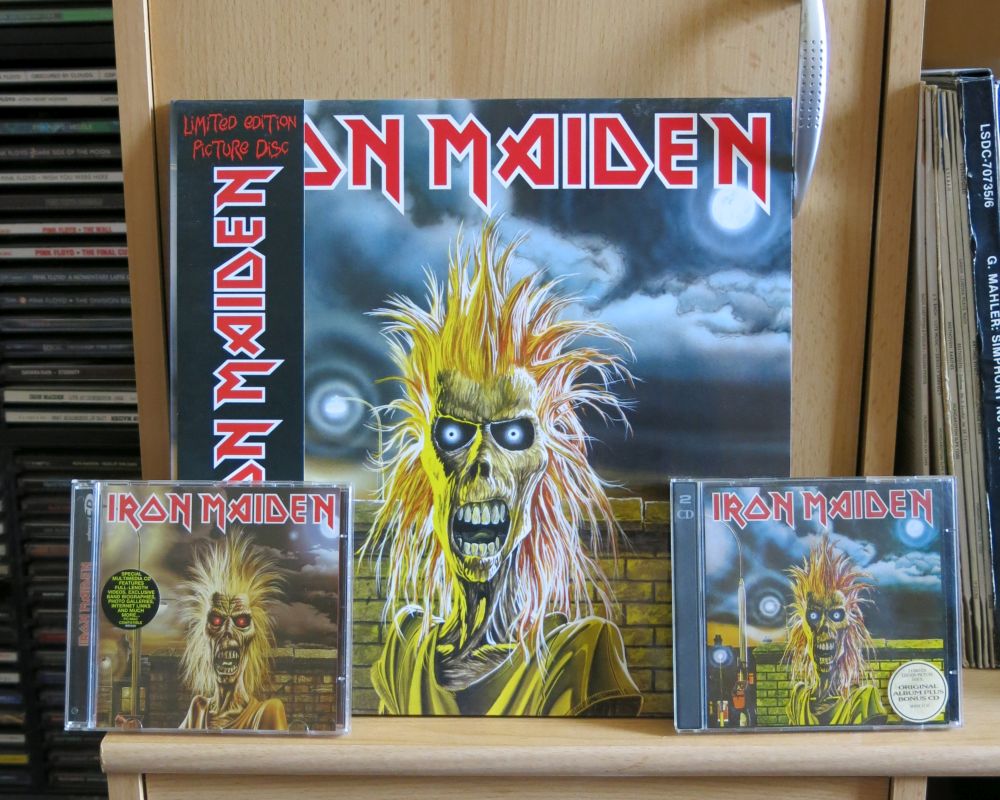
About the lyrics to Running Free, the first single off the Iron Maiden album, Di’Anno said the message is very autobiographical. It’s a reflection on the days when he was a punk kid. Although the lyrics hint at him spending six days in a Los Angeles jail, that line rings prophetic, since in 1991 Di’Anno landed in exactly that place. On the debut, Running Free counts as one of the most traditionally built rock songs, with Di’Anno adding an especially pronounced punk touch. The B-side of the Running Free single, the track Burning Ambitions, dates from the time when Iron Maiden were still a four-piece with Doug Sampson on drums. Interestingly, Iron Maiden took a slightly different route for the Japanese market. They chose Prowler for the single and stuck the European-market version of Running Free on the B-side. The single’s cover was different for Japan too. They went with a censored version of the European Sanctuary single cover.
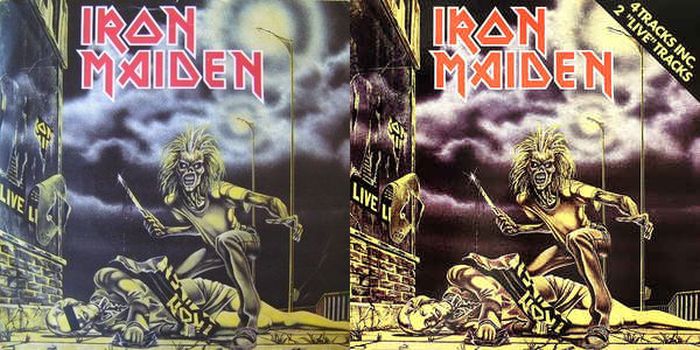
Sanctuary was picked as the debut’s second single. It came out on 23.05.1980. It sported a controversial cover. The later censorship of it was supposedly suggested by Rod Smallwood himself to EMI Records, as he shrewdly figured it would push the media to draw even more of the masses’ attention to the single. According to Smallwood, the cover shows Prime Minister Margaret Thatcher, caught by Eddie himself while tearing Iron Maiden posters off the wall, and he’s dealing out justice with a dagger. The original version of the seven-inch single has live versions of Drifter and I’ve Got the Fire (a cover of the Montrose original) on the B-side, both recorded at the band’s gig on 03.04.1980 at the Marquee club. The Dutch-market version of the single is expanded. The A-side also has a live version of Prowler, likewise from the Marquee, and the cover isn’t censored, with the face of the helpless uniformed woman really looking a lot like Thatcher. According to some sources, although the songwriting credit goes to Harris, Di’Anno and Murray, Sanctuary was actually written by guitarist Rob Angelo, a former member of the band back in 1977, who supposedly later gave up his rights in exchange for a payment worth 300Ł. Let’s add that the European version of the “Iron Maiden” album didn’t include this song, while the American one did. In 1998 the first nine albums got remastered and reissued. The newly released version of the debut also includes Sanctuary, while that “distorted”, spine-chilling Di’Anno shout in the repeat of the closing verse of Phantom Of the Opera “… you torture me back at your lair…”, right before the start of the instrumental Transylvania, was cut out of the reissue (the same goes for the picture-disc vinyl, which doesn’t include Sanctuary).
The album opens with Prowler. Aggressive! Right off the bat Murray shows off his sharp-minded sense of dynamics, dressing the riff up with wah-wah, and the tune itself, for its time, sounds like something nobody on the planet had ever heard before that day. Di’Anno’s lyrics here are of course childish and carry a dose of lucid comic-book machismo. According to Di’Anno, Prowler tells the story of a bestially depraved man looking for sexual satisfaction. The song Remember Tomorrow, a track with incredible build between verse and chorus, is, according to Di’Anno, about his grandfather, a diabetic who first lost a finger in surgery, then a leg, and then gave in to fate. Something similar carried off to the happy hunting grounds the former marshal of Yugoslavia too, who died in the Ljubljana clinical center less than a month after the Iron Maiden debut came out.
Charlotte The Harlot is one of the few Iron Maiden songs in their whole career where the songwriting credit belongs entirely to Murray. It’s the first part of a saga about a girl who found her permanent address in a brothel and sells her body, and there’s always the danger that you’ll be doomed if you fall for her, because she’s a “femme fatale”. An extremely punchy track on the debut, which, after the dreamy Strange World, gets the listener ready for the album’s big finale. That, of course, comes with the closing title track, Iron Maiden. You can’t picture a single gig by the band in all the years of its existence without this song. Let alone Eddie, who’d lose his whole raison d’être without it.
The Iron Maiden debut is interesting from more than one angle. Simply put, it’s a one-of-a-kind product of the time it was made in. Even though Harris said the band despised everything tied to punk, the album can’t shake that element off, and yet it’s exactly that element that gives it a sense of timelessness, which makes it really special. Never mind that Harris quickly fell in love with theatrical composition, with rhythm changes all over the place and a mood that bounces around through shifting lead phrases and harmonies run in thirds. Di’Anno’s punk energy is all over this record. Harris had always been fascinated by progressive rock bands like Genesis, Yes and Jethro Tull, and he also drew inspiration from Uriah Heep, Wishbone Ash, Nazareth, Nektar, UFO, Deep Purple and Thin Lizzy. On Phantom of the Opera, Maiden deliver the type of songwriting that would later be refined and mature through Harris’ Killers, Hallowed Be Thy Name, To Tame A Land, Rhyme Of The Ancient Mariner and Alexander the Great, before hitting its progressive peak in the unforgettable epic Seventh Son Of A Seventh Son. Phantom of the Opera is a sort of original mold for this Harris approach. Then there’s Transylvania. A superb instrumental full of drama, which got a follow-up on the studio successor “Killers” (Genghis Khan) and which Iced Earth covered many years later around the time of “Horror Show”.
From the moment he joined Maiden, Di’Anno carved out a kind of untouchable status. He could get away with anything. He wore his hair short, dressed in pretty much whatever he felt like, and sang and picked his own vocal lines however he pleased. Nobody pushed back. With his proverbial street-tough swagger, he soon became a bit arrogant, and according to Stratton, who didn’t enjoy that kind of immunity and, unlike the singer, had his days numbered, Di’Anno was also going through an identity crisis at the time. Stratton says that at some point in a show Di’Anno might start singing like Sting from The Police, and a minute later he’d walk out on stage in a hat symbolizing the ska movement of the day (the Brits call it a “pork pie hat” because it looks like a pork pie, a traditional British dish).
The rift slowly growing between the singer and the rest of the crew became reality when Di’Anno, by then pretty seriously full of himself, dared to taunt Judas Priest, who took Iron Maiden out on the UK leg of their tour in March, saying Maiden would “blow them off the stage” every night. A month earlier, during the “Metal for Muthas” tour dates, according to Stratton, Di’Anno pressured the band to cancel one of their shows because of the singer’s sore throat. Iron Maiden didn’t even think about letting their fans down, and played the gig without Di’Anno, with Steve Harris taking over vocals. During the show Di’Anno silently watched his bandmates from the side of the stage, and Stratton remembers his piercing glare, lightning bolts flashing the whole time. Dennis adds that Di’Anno never dared pull a stunt like that again, not even in his dreams.
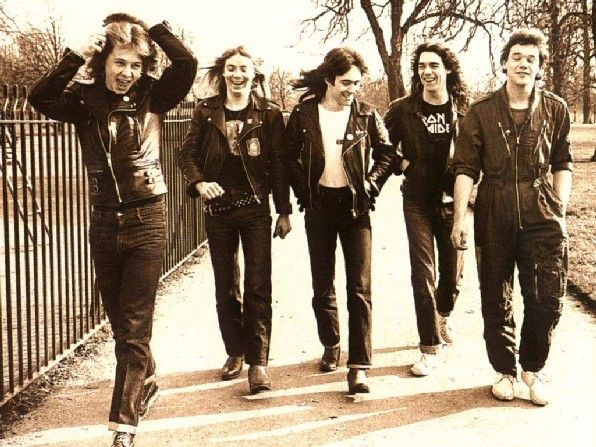
Unlike Di’Anno, Stratton had to leave Iron Maiden soon after because of differing musical views. He played his last show with Maiden on October 13, 1980. One evening while the debut was being recorded, Stratton and engineer Martin Levan stayed in the studio long after everyone else had gone home. Stratton got the idea to “embellish” Phantom of the Opera on his own, without the okay of the rest of the band, with extra six-string arrangements, and he also added extra choir-like vocal harmonies that strongly recalled the style of Queen’s Bohemian Rhapsody. A move that turned a few (precious) hairs gray on Harris’ head, and Smallwood’s too. Dennis also stood apart from the other members in terms of age. He was a few years older, and he listened to “softer”-sounding American acts like Styx, REO Speedwagon and Eagles, which of course didn’t fit the band’s context. Harris adds that he started noticing Stratton enjoyed playing Strange World at gigs far more than, say, Prowler or Iron Maiden.
In March of that year, Iron Maiden appeared as the opening act on the UK leg of the Judas Priest tour, which was promoting their commercial breakthrough album “British Steel”. Funnily enough, “British Steel” and “Iron Maiden” came out on the very same day!
On release, the Iron Maiden debut climbed to number 4 on the UK chart. It stayed on the British best-seller chart for a whole 15 weeks! Critics gave it a great reception. Its content is timeless, and with its look, revolutionary for the time, and its unique charisma, it paved the way for metal’s boom and development through the eighties. In that sense it counts as one of the elemental, foundational albums that metal looked up to in the years that followed.