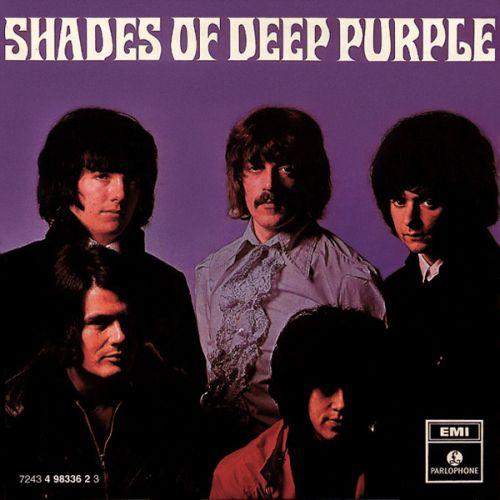
Label: Parlophone Records
Release date: July 17, 1968
Produced by: Derek Lawrence
Album length: 43.27 min
Genre: Heavy Rock / Hard Rock
Rating: 7.5/10
The story behind Deep Purple’s debut “Shades of Deep Purple” is inseparable from the birth of this legendary, many-sided British hard rock band. With all the famous feats of the “golden” Mark II lineup, still the one most fans of these hard rock legends rate highest, it’s easy to forget there was once an original Deep Purple lineup (Mark I) that, with its unique blend of psychedelia, symphonic touches, blues and rock, played a hugely important part in the development of early heavy rock and progressive rock too. Even though they’re now cherished almost equally by heavy metal, hard rock and progressive rock fans, the members of Deep Purple still don’t like being pigeonholed, which is perfectly understandable given how often their music burst through genre boundaries.
It all started when former The Searchers drummer Chris Curtis got a wild idea: to form a supergroup called Roundabout, with members constantly rotating in and out. His vision of a superstar merry-go-round slowly began to take shape when he brought in his first recruit from The Artwoods, the classically trained Hammond organ player Jon Lord. Lord was soon joined by the headstrong guitar gem Ritchie Blackmore, who, after some serious arm-twisting, rushed back from Hamburg to try out at the audition. Even then Blackmore was a highly respected session guitarist, with stints in bands like The Outlaws, Neil Christian and The Crusaders and Screaming Lord Sutch behind him. Curtis’s paranoid behavior, which surfaced very quickly, grew more and more unbearable, until he was finally forced to leave his own project.
Lord and Blackmore, who had meanwhile figured out that their playing styles went together like bread and butter, decided to carry on building the newly redefined Roundabout project anyway, and brought Blackmore’s old acquaintance, bassist Nick Simper (ex-Johnny Kidd and The Pirates), into the budding band. Bobby Woodman was originally supposed to take the drum stool, but the auditions for a singer, which landed Rod Evans (ex-The Maze), took a different turn. Blackmore was completely blown away by the barely 18-year-old Ian Paice, who had previously earned his keep alongside Evans in The Maze, and after the audition the drum seat was immediately his. Paice is still the only original member who has played on every single version of the legendary band to this day. And so the original Mark I Deep Purple lineup was born, and it threw itself into recording the debut with gusto. The name Roundabout was chucked in the bin soon after the first gigs, while the new band name was picked at Blackmore’s suggestion.
“Shades of Deep Purple,” which got a rather lukewarm commercial reception at home, while the response in the US, mostly thanks to the hit “Hush,” was completely different, was, interestingly, stylistically closer to psychedelia and early progressive rock than to the hard rock with which they would conquer the world a few years later. Most of the compositions are dominated by a fusion of the massive, layered sound of Lord’s Hammond organ, Blackmore’s guitar artistry rooted in bluesy romanticism, and Paice’s generous drum fills. Evans’s melodic, classic “old-school English” vocal approach was key to the American door swinging wide open for them so early, while Simper provided an unspectacular but solid helping of bass lines.
“Shades of Deep Purple” contained four originals and four covers, the standout being the aforementioned Joe South cover “Hush,” which they still play live today. At its core it’s a pleasant pop rocker with a distinctly lovely chorus riding on Evans’s melodic vocals and a love-song lyric where the Beatles’ influence is easy to feel. It’s all backed by the rustling sound of the Hammond organ and a lusciously sensual Lord solo in the middle section, which is even one of the most picturesque of this legendary keyboardist’s entire career. Despite Blackmore’s roaring guitar passages, “Hush” rides an almost danceable rhythm the whole way through, which makes for a good time and went a long way toward their early American success.
The opening instrumental “And the Address,” which shows off all the strengths of the individual players mentioned above, was the product of numerous early jams, a practice that became a favorite way of creating new compositions throughout Deep Purple’s history. “One More Rainy Day” is another relaxed track with a distinctly catchy, melodic chorus that, backed by Lord’s full-bodied organ passages, Blackmore’s stinging guitar phrases and Paice’s well-measured drum fills, somewhat surprisingly didn’t get a bigger commercial response.
Next up is the progressive rock hybrid “Prelude/I’m So Glad.” The opening section is an instrumental orgy based on an arrangement of the first part of the Scheherazade suite by the classical Russian composer Nikolai Rimsky-Korsakov, which Lord deftly turned into a veritable organ duel between the Hammond and Blackmore’s electric guitar. The latter was already cutting through the air with unusual sharpness back then, so the later stylistic shift to hard rock wasn’t all that surprising. The second part of this fun experiment flows into a cover of “I’m So Glad” (originally by Skip James), which Cream had covered before. Evans and Paice had also already covered it in their previous band, The Maze. Deep Purple took their cue from the Cream version, and their take is similar in many ways, with the important difference that it’s longer and sounds a lot heavier as a whole, while the rowdy Hammond once again helps Paice’s drums dictate a distinctly fiery rhythm.
Marked by unpredictable instrumental meanders, the progressive rock orgy “Mandrake Root” is another beloved Deep Purple classic that came out of a long group jam, and it’s perhaps the best proof on the album of the quality of the original Mark I lineup. The instrumental jam in the middle section stands out above all thanks to Lord’s mouthwatering organ soloing and Paice’s unbridled taming of his drum kit. Blackmore, too, with his offering of dizzying guitar riffs, proves why he soon became regarded as one of the greatest guitarists of all time. At later gigs it became one of those Purple classics they liked to stretch out to more than 20 minutes.
The very successful cover of The Beatles classic “Help,” which the legendary Fab Four themselves reportedly liked, also got a nice commercial response from the Americans. Evans’s melodic, classically English vocal approach was made for singing Beatles classics, while Lord’s organ adds an extra, special kind of warmth to this evergreen. Deep Purple wouldn’t have been great innovators if they hadn’t spiced it all up with a short instrumental break, in the middle of which a brief but mighty guitar solo stands out. The psychedelic standard “Love Help Me” is a typical example of the cheerful, positive-minded Mark I style, with frisky rhythms and Evans’s endearingly melodic vocals under a strong Beatles influence. Still, despite the fairly transparent love lyrics, there’s not a trace of instrumental naivety to be found.
The closing melancholic prog rock-blues hybrid “Hey Joe” (originally written by Billy Roberts) is yet another instant Deep Purple classic, with an instrumental intro featuring a military march on the drums, a bristling run of guitar phrases and a booming layer of Hammond organ. Lord’s organ antics tie in perfectly with Blackmore’s untamed guitar escapades and lead into a blues rock-flavored section where Evans’s vocals join in. Weighed down by the burden of unexpected American success, the original Purple singer here, with a blues-spiced approach, demonstrates his often overlooked vocal versatility more clearly for the first time. Massive layers of Hammond accompany it all the way, while Blackmore’s guitar solo this time might even be the best on the whole album. Although the original creator of “Hey Joe” was Billy Roberts, the band’s main inspiration for the adaptation was the 1966 version by the Jimi Hendrix Experience.
Deep Purple’s psychedelic-tinged debut is a vivid mirror of the original Mark I lineup, a band that leapt forward with every subsequent release, and today it’s especially fascinating for anyone digging into the roots of heavy metal, hard rock and progressive rock. Despite the fact that it doesn’t reflect the much heavier hard rock approach that later made them famous, “Shades of Deep Purple” is a better debut than many achievements of comparable legendary bands, and given Deep Purple’s astonishingly fast stylistic evolution, it’s an extremely valuable document of their early days.
This review is dedicated to Jon Lord (1941-2012).
Author: Peter Podbrežnik
Tracklist:
1. And The Address (4:37)
2. Hush (4:25)
3. One More Rainy Day (3:39)
4. Prelude: Happiness / I’m So Glad (7:20)
5. Mandrake Root (6:08)
6. Help (6:00)
7. Love Help Me (3:48)
8. Hey Joe (7:32)
Lineup:
Rod Evans – vocals
Ritchie Blackmore – guitar
Jon Lord – Hammond organ, keyboards, backing vocals
Nick Simper – bass guitar, backing vocals
Ian Paice – drums