Label: Tigermoth Records
Release date: July 1, 2020
Production: Robert Reed
Album length: 62.13 min
Genre: Progressive Rock
Rating: 10/10
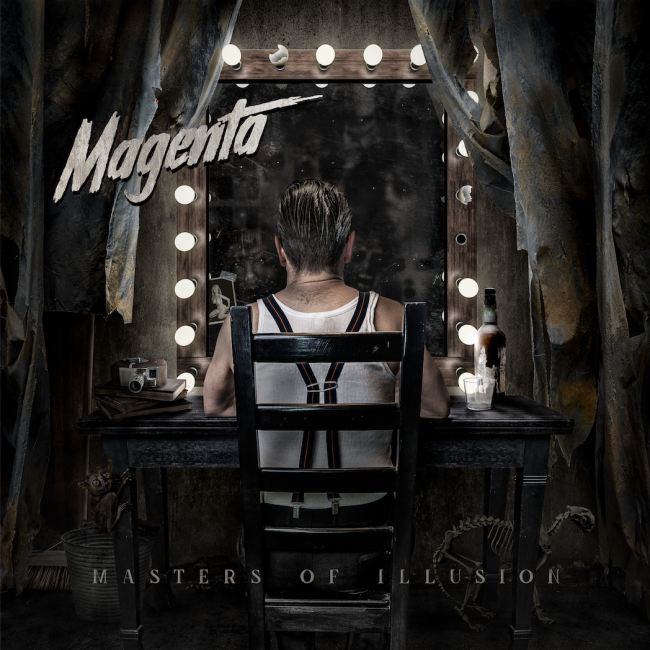
“Masters Of Illusion” is the new studio album from the Welsh progressive rock outfit Magenta. With a career that now stretches a little over two decades, they’ve slowly grown into one of the most respected bands coming out of the British Isles, cultivating their music on the legacy of seventies symphonic prog and drawing inspiration above all from Renaissance, Camel, Yes and Genesis. And then there’s the incredible Christina Booth, whose voice counts as one of the most captivating and charismatic female vocals in the genre today. With her voice, mystique is born with feather-light ease and emotions come alive, waking the listener’s imagination in its most hidden corners. This time is no different. But let’s take it from the top.
Magenta have once again come up with some fascinating stories behind the six tracks on the new album. They picked six characters, legendary screen actors who popularized horror movies back in the day, way back. But the songs aren’t concerned with these actors’ roles in any particular film script. Instead they draw on their private lives. So the opener Bela goes to the actor Bela Ligosi, who created the unforgettable character of Count Dracula in the thirties, the track A Gift From God belongs to Christopher Lee, who, being so full of talent, could have become an opera singer too, and Reach for the Moon goes to Craighton Channey, who’s known for having to play the part his famous father had played, which earned him the nickname Lon Channey Jr. Then there’s the track Snow, which belongs to the actress Ingrid Pitt, and The Rose, dedicated to Peter Cushing, while the most ambitious piece, the nearly seventeen-minute composition that closes the album, is dedicated to the figure of the famous Vincent Price. Its story revolves around the tense relationship between him and the director of the film “Witchfinder General”, Michael Reeves, during the shooting, which most likely led Price to deliver the best screen performance of his career in that very film. All the lyrics were written by Robert Reed and his brother Steve, who also came up with the album’s concept.
Even though Magenta get linked to the neo-prog genre, at least going by their ID number, the Genesis influence is very nicely “muffled” in the character of the tracks and never for a second takes over to the point where you could stick a “neo” onto the word “progressive”.
You won’t easily find a soundscape as full as the one on “Masters Of Illusion”. The band has built a truly grandiose sound that gives you goosebumps. With her delicacy, Christine Booth occasionally comes within inches of the timeless figure of Kate Bush. The nuances of the deeply felt approach with which she addresses the listener are a downright enchanting experience, and at the same time she manages to breathe into the songs exactly what the band was specifically after. That moment, that touch of theatrical cinematics.
The compositions are seasoned with oboe, bagpipes, mandolin and saxophone. The sax comes from Tiger Moth Tales multi-instrumentalist Pete Jones, and the dialogue of solos between saxophone and Moog in the album’s title epic counts as one of its highlights. There’s also a ton of acoustic extras (twelve-string guitar), which only confirms the “orchestral” vision of the band’s main guru Robert Reed. Compared to their last album, “We Are Legend” (2017), where Magenta chased a modern sound and tried on a more contemporary musical wardrobe, on “Masters Of Illusion” they’re flirting with the giants of prog rock again, along with their image and work. They’ve intensified the sound again by bringing in Moog, Mellotron and Hammond organs, which, alongside the piano and synths, throw the doors wide open to shaping the compositions into sweeping, progressively epic symphonies, full of sudden motif jumps, ravenous drama theater, moments of mystique, melancholy, longing and solemnity. Add the esoteric guitar playing of Chris Fry (his style is similar to Steve Rothery of Marillion), drawing inspiration from Andy Latimer, Steve Hackett and David Gilmour, and the magic is born. At the same time Magenta are developing an exceptional accessibility in the musical sense. In fact, even on this album, where they’ve once again ambitiously loosened up their arrangements and songwriting, they’ve kept an exceptional ear-friendliness. Not only for the forever spoiled, hard-to-please music gourmets, but with this kind of approach they can also stir up interest without major obstacles among less demanding listeners, who as a rule jump aside at the mere mention of “progressive”. And the sound is of course brilliantly complemented by a contrasting bass that, with its “rattling Chris Squire aesthetic” full of kinetic dynamics, constantly seeks maximum musicality, deepening the retro-nostalgic element of the golden age of prog rock. This is an album worth listening to with headphones. Actually, it’s pretty much a must. It creeps into your ears absolutely slowly, but once it settles in, you can’t get tired of it. In the moments of the album that are especially musically infectious, a pop charm stands out too, as you can sense in Snow or Reach For the Moon (the chorus), which could easily have been included on Magenta’s album “Home” as well.
The album bursts with creative inspiration and gigantic conceptual insight, and there’s no end in sight. That’s exactly what’s especially thrilling. A brilliant mix of loose arranging, constant upkeep of pronounced musicality, the creation of mystique and a phenomenal feel for all the players within this compact and polished (multi-faceted) musical body is what you look for in a genre that’s tied in any way to the “progressive” label. The band’s front line of Robert Reed, Chris Fry and the incredible Christine Booth remains – as the creative nucleus of the group – its ultimate force, which, with this new, wildly fascinating and enchanting studio achievement, keeps driving forward the hypnotically attractive magnetism of Magenta.
Author: Aleš Podbrežnik
Tracklist:
01. Bela (11:16)
02. A Gift from God (8:30)
03. Reach for the Moon (9:27)
04. Snow (6:04)
05. The Rose (11:18)
06. Masters of Illusion (16:38)
Lineup:
Christina Booth – vocals
Robert Reed – keyboards, mandolin, acoustic and electric guitar, backing vocals
Chris Fry – acoustic and electric guitar, backing vocals
Dan Nelson – bass guitar
Jonathan ‘Jiffy’ Griffiths – drums, percussion
Guest musicians:
Karla Powell – oboe on all tracks except track 4
John Mitchell (Arena, It Bites, Frost*, Lonely Robot) – vocals on track 2
Troy Donockley (Nightwish) – bagpipes on track 5
Pete Jones (Tiger Moth Tales) – saxophone on tracks 3 and 5