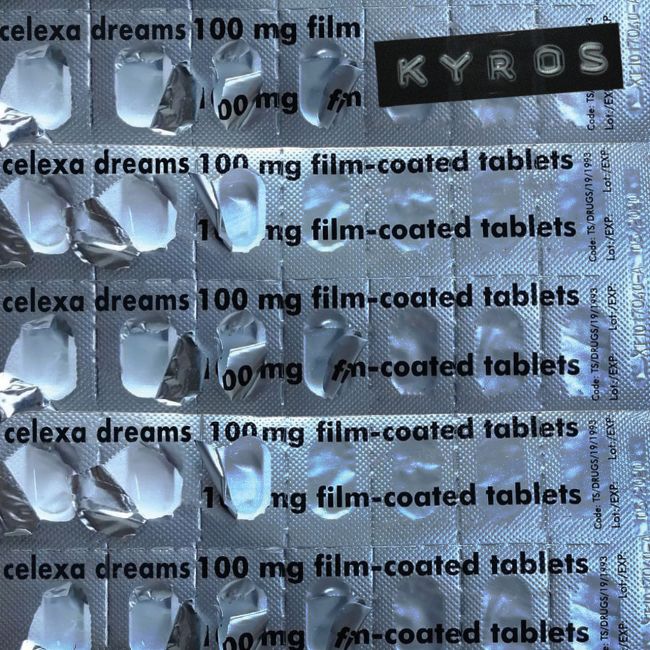
Label: White Star Records
Release date: July 1, 2020 (digital)/August 14, 2020 (digipak CD)/October 9, 2020 (2LP)
Production: Adam Warne
Album length: 62.13 min
Genre: Art Rock/Progressive Rock
Rating: 9.5/10
Kyros are a new British art rock outfit riding the new wave of their contemporaries, the generation with a “post-90s” birth year, who experiment with cross-genre fusion without a care in the world and have racked up a pile of stunningly good albums in recent years, proving that the evolution of rock ‘n’ roll is far from over. These bands (from The Dear Hunter to Voyager and Thank You Scientist, to name just the first three that pop into my head right now) all come with an eclecticism reached the natural way, through their own homegrown artistic development. Kyros are no exception, and they get to their musical uniqueness in their own way. Let me say it right off the bat: if you’re a music gourmet who’s drawn to difference and the thrill of musical oddity, you don’t need to read any further, because with Kyros you’ll definitely hit the jackpot.
Kyros are led by young Adam Warne, of Thai roots on his mother’s side, who studied pop music at a university in London. He’s a composer, producer, audio engineer, multi-instrumentalist and vocalist. The roots of Kyros go back to 2009, when Warne, not quite seventeen yet, started the project Chromology, which later turned into Synaesthesia, with which he put out a more than promising self-titled debut in 2012. After the label Giant Electric Pie shut down, the second album came out on his own, already under the name Kyros and titled “Vox Human” (2014), and with it Warne took a decisive artistic step up in establishing his style and sound. By 2020 he had brought several more musicians on board. So four years went by, Kyros grew from a project into a quartet, and this July they released (digitally at first) the album “Celexa Dreams”.
Adam Warne’s musical vision blends the best of the legacy of eighties pop rhetoric, elements of modern alternative rock aesthetics “with brains,” and the legacy of progressive rock. The inherited “new wave synth pop electronics” are brilliantly “slipped” into the band’s artistry, and the production takes its cues from what Trevor Horn, for example, did on Yes albums in the eighties. That means all the building blocks of the sonic picture are backed up in contrast by fierce intensification. Transitions are often skillfully “broken up,” which boosts the modern approach in progressive rock. The composing rests on a concise stitching together of several motifs that build the progressive vocabulary, yet Kyros keep things listenable throughout, with an incredible musical payoff that grabs you right away. The album develops an exceptional sense of bombast. A given motif is strung together from several separate pieces, arranged like a puzzle with an extremely intelligent way of linking up with one another. As if they were passing a relay baton among themselves. Let me try to put this into words. For example, a motif in the opener In Motion starts on the synth, which plays just a piece of that motif, then a sudden drum insert takes over and in turn hands the “baton” to a sequence of notes played on bass guitar (including some impressive “slap” figures), and so on. It’s exactly these chain-like successions in the lead motivic figures that speak progressive, unusual and eclectic, since they can also evoke cross-genre associations. But the focal point of the album is clear. Homegrown, expressive artistry. That’s what Rush did in the eighties, for instance, when they phenomenally wove the fashionable trends of the time, “new wave” and “synth pop”, into their artistry. Well, Kyros are doing something similar, just in their own way. Associations with eighties Rush, and with the period of their three albums from “Grace Under Preassure” (1984) to “Hold Your Fire” (1987), are noticeable especially in the opener In Motion (its chorus would be the envy of Australia’s Voyager too), a little later in In Vantblack, and near the end of the album in UNO Attack. But without the dynamic lines played on bass guitar, which announce that “somebody” in the crew once studied Geddy Lee’s bass playing, those associations couldn’t be achieved in the songs.
Muse fans will find something to love in Two Frames Of Panic, then there’s the track Technology Killed the Kids III, which ties back to its first and second parts (found on the previous two albums) and unmistakably announces that Kyros are a band of the new generational trends in progressive rock artistry, one that fans of the genius Devin Townsend will identify with as well. Eighties pop rhetoric is captured most vividly by the track Rumor, which goes straight into your ear and would have been a big hit in the eighties for sure. It carries quite a bit of the sentiment of the good old Talk Talk from the “It’s My Life” era. Warne is also a fan of movie musicals, as the closing Her Song is Mine shows; it stands out on the album and is therefore sensibly placed at its tail. If Sinatra were still alive, he could sing a duet with Warne here. The darker-structured Phosphene and Sentry don’t hide Radiohead’s influence either, but the musicality Kyros develop across the album is “current” and from time to time can recall the musicality of progressive rock/metal bands of a similar birth year, like The Dear Hunter or Voyager.
It’s not yet clear whether this is the album of their artistic zenith. Given Warne’s youth and his top-notch talents as a composer and audio engineer, plus the exceptional chemistry the quartet has in sensing each other and following the musical direction, it’s impossible to draw that conclusion for now. Kyros are still developing artistically by leaps and bounds, and “Celexa Dreams” is a definitive, mature step up from its predecessor “Vox Humana”, on which they had already deepened and sculpted their own homegrown artistic musical dossier. Put simply, “Celexa Dreams” is a thrilling and brilliant achievement in every respect, brimming with freshness and exciting growth. In terms of production, outstanding compositional solutions, exceptional musicality and the constantly challenging interplay of all the building blocks of the sonic picture, which keeps developing a perceptible eclecticism throughout. As such, it suggests a bright future ahead for the band.
Author: Aleš Podbrežnik
Tracklist:
1. In Motion
2. Rumour
3. In Vantablack
4. Ghost Kids
5. Phosphene
6. Technology Killed the Kids III
7. Sentry
8. Two Frames of Panic
9. UNO Attack
10. Her Song is Mine
Line-up:
Adam Warne – vocals, keyboards
Joey Frevola – guitar, backing vocals
Peter Episcopo – bass guitar, backing vocals
Robin Johnson – drums, percussion