Label: R&D Multimedia
Release date: June 19, 2020 (digital) / August 28, 2020 (physical format)
Production: Rick Wakeman
Album length: 55.28 min
Genre: Progressive Rock
Rating: 9.5/10
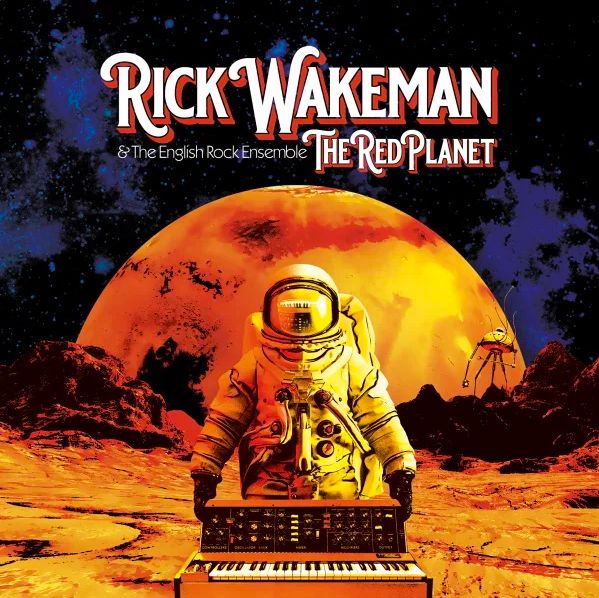
Legendary keyboard wizard Rick Wakeman, who made his name among the musical immortals as a member of Yes, is back with us once again with his latest studio effort, “The Red Planet.” This one is among his most ambitious outings in the past two decades, featuring a reshuffled version of his backing band The English Rock Ensemble. Two names stand out: bassist Lee Pomeroy, one of the most in-demand bass players in modern prog rock, and drummer Ash Soan, who has worked with plenty of commercially established musicians, though Yes fans know him best from his stints in backing lineups for Trevor Horn and Geoff Downes, the former The Buggles and Yes duo. Guitarist Dave Colquhoun, another respected hired gun, already worked with Rick on 2001’s “Out of the Blue.”
After 2003’s “Out There,” which featured vocals by Damian Wilson (Arena, ex-Threshold), “The Red Planet” is once again the ‘real deal’ prog rock album that Rick’s followers have had to wait almost twenty years for. Unlike “Out There,” this one is entirely instrumental, with eight superbly arranged and played symphonic prog rock compositions that will delight everyone who has stuck with Rick’s solo career through all its ups and downs. All those doubting Thomases who figured the old keyboard fox, in the ‘autumn of his life,’ could only manage to noodle around on a grand piano with moral support and applause from the grandkids? They’ve gotten a rude awakening this time.
Rick’s virtuoso chops are completely intact, and although he often grabs the solo spotlight, as you’d more or less expect from him, he still leaves plenty of room for his three bandmates, and together they craft eclectic compositions that make real sense from start to finish and, with their specific ambient leanings, have a seriously hypnotic effect. As the title and the track names make clear, the compositions on the album are dedicated to Mars and to individual regions of the ‘red planet.’
The astronaut trek across Mars kicks off with “Ascareus Mons,” dedicated to the extinct volcano of the same name. It opens with a majestic organ intro that sets a sacred, churchlike mood. Before long the whole rhythm section piles in, ratcheting up the ambient drama until the entire band is firing on all cylinders and masterfully steers this eclectic piece to its close. “Tharsis Tholus” brings odd time shifts, complex guitar passages and wildly eclectic keyboard arrangements from one of the greatest masters of the keys. The high-register mini moog lines are especially fun, and they’ve long since become one of the trademarks of Rick’s keyboard style.
“Arsia Mons” is proof positive that symphonic progressive rock can hit as hard and be as defiant as traditional heavy metal or progressive metal, without sacrificing any of its eclectic arranging or ambient finesse. The mood of this excellent piece shifts by the minute, and a few times Mr. Wakeman even reminds us of his work in the new age field. The keyboard arrangements on “Olympus Mons” are played with an unusual mix of playfulness and energy, while the atmosphere goes from dark and melancholic to almost anthemic. The high point of this brilliant track is an unexpected, clever swerve into a section whose central motif stirs up a huge wave of nostalgia. “The North Plain” opens with fragile piano tones and obscure-sounding effects that together create an air of total loneliness, just what we usually picture when we think of the first human on Mars. Soon it moves into a dramatic section where the maestro Wakeman dazzles with all kinds of keyboard wizardry, while bristling guitar lines keep him almost on equal footing.
“Pavonis Mons” features dramatically playful moog passages that conjure a mysterious mood, while the rowdy rhythm duo, backed by eclectic guitar lines, wins you over just as much as the keyboard wizard himself. “South Pole,” unlike most of the pieces on “The Red Planet,” offers a friendly, warm ambience, with the focus this time on orchestral pads and some outstanding piano soloing. The closing epic masterpiece “Valles Marineris” is the album’s magnum opus. It opens with the sound of a military march, reminding us that the red planet got its name from the Roman god of war. In time Rick’s trademark high-register synth lines come in, and together with the rest of the players they play a key role in building a grand, majestic atmosphere.
“The Red Planet” can proudly take its place beside the finest achievements in Wakeman’s hugely sprawling solo output. For all its sheer quantity, there aren’t actually that many records in it that deserve the label of masterpiece, as you might expect from a musical master of this caliber. “The Red Planet” definitely belongs in the inner circle of Rick’s best albums, alongside classics like “The Six Wives of Henry VIII” (1973), “Journey to the Centre of the Earth” (1974), “The Myths and Legends of King Arthur and the Knights of the Round Table” (1975) and “No Earthly Connection” (1976). So Rick’s claims that he was aiming to make a prog rock album on par with those records weren’t ‘made up out of thin air’ after all. “The Red Planet” is practically flawless, and there’s really nothing to hold against it, except maybe that a few of the compositions might have come off even better with the right vocalist.
Author: Peter “Dr. ProgRock” Podbrežnik
Track list:
1. Ascraeus Mons (5:53)
2. Tharsis Tholus (6:17)
3. Arsia Mons (6:10)
4. Olympus Mons (5:20)
5. The North Plain (6:53)
6. Pavonis Mons (7:14)
7. South Pole (7:35)
8. Valles Marineris (10:02)
Lineup:
Rick Wakeman – keyboards
Dave Colquhoun – guitar
Lee Pomeroy – bass
Ash Soan – drums