

Soon after forming in the second half of the sixties, Van Der Graaf Generator became a band that pushed musical boundaries with its progressive vision and unbridled pioneering swagger, throwing the doors wide open for the progressive rock genre to flourish. They quickly picked up the label of one of the weirdest bands of their time. No surprise, then, that the shock therapy of their “musical excess” was idolized by, among others, two big figures of the later punk wave: John Lydon (Sex Pistols) and Mark E. Smith (The Fall). But let’s not get ahead of ourselves. In February 1970 the band released their first real studio album, “Least We Can Do Is Wave To Each Other” (RockLine review). Why the first real one? Because the debut, “The Aerosol Grey Machine” (1969, RockLine review), was meant to be a solo album by Peter Hammill, and the band doesn’t even claim it as their own. But to survive at all and save their skin, they agreed to a compromise: the album would come out under the name Van Der Graaf Generator. You can read more about the backstory in the RockLine feature marking the 50th anniversary of “Least We Can Do Is Wave To Each Other”.
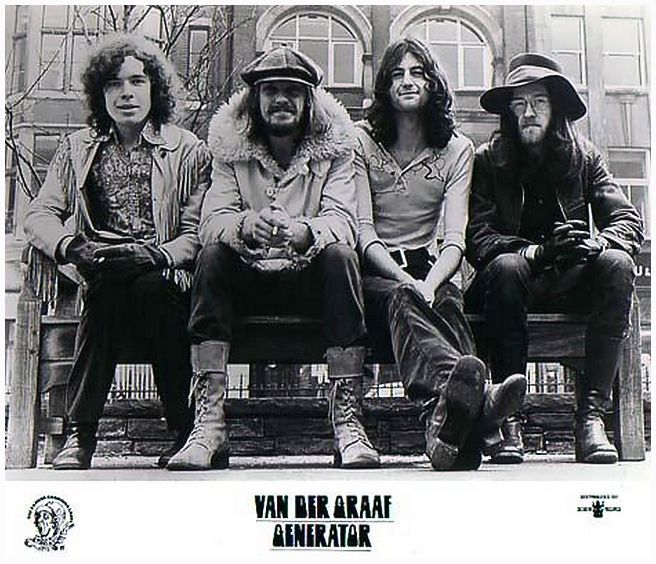
Anyway, by April 1970 the band had already cemented its place on the scene, mostly thanks to live shows that won them more and more sympathy from the music public. What they were doing, they were absolute oddballs at it, and the main engine of the band was the charismatic vocalist and keyboardist and chief songwriter Peter Hammill. His take on music was incredibly innovative at the time. Hammill was literally impossible to pin down. His approach to singing was special in every way too, and in the early part of his career David Bowie took a lot of cues from it. The band gained extra visibility not only by signing with Charisma Records, but also with the single for the gorgeous ballad “Refugees”. Around then, Van Der Graaf Generator also accepted an invitation to help create the music for the film “Eye Witness” by director Cubby Broccoli. They took on the project, but very little of the music they wrote was eventually used in the film. In early April 1970, Van Der Graaf Generator traveled to Bremen, where they played two songs on the TV show “Beat Club”: “Darkness 11/11” and “Whatever Would Robert Have Said?”. That part of “Beat Club” wasn’t aired until June of that year. Two much-talked-about performances at two home festivals followed. The first, the Plumpton festival, took place on May 24, 1970, and the second and even more important one on June 1, 1970 at London’s Royal Albert Hall. The latter was organized by the head of Charisma Records and Van Der Graaf Generator’s manager Tony Stratton-Smith, and hosted by DJ John Peel. It was meant to give the bands on the Charisma Records roster extra exposure and recognition. At that festival, Van Der Graaf Generator shared the bill with East of Eden and Audience. In July, Van Der Graaf Generator headed to the old continent for the first time, playing two German festivals (Munich, Aachen) alongside Pink Floyd, Deep Purple, Black Sabbath and Fairport Convention.
Peter Hammill recalls: “Back then, about half the audience would leave during our shows. The half that stuck it out to the end became so devoted and loyal that they came to every show after that. We didn’t pay much attention to it, because quite simply we were incredibly focused on what we were doing. Our music completely absorbed and consumed us. We stuck to our musical principles and our vision. We didn’t follow what was stylistically emerging around us and we didn’t listen to other rock bands. Simply because we had no time for that. We brought jazz influences aboard, and elements of classical music too, especially through Hugh Banton – though that was nowhere near the influence of some romantic symphonies. Even though it reads as egotistical and ignorant, back then we were convinced that what we were doing carried tremendous value and was therefore far too important.”
To record the new album, Van Der Graaf Generator went back to Trident studio. Once again they picked John Anthony as producer, having clicked with him very well on the previous record. But the album wasn’t recorded in a few days; it was done in shorter bursts between live shows. Right after the show on August 9, 1970 at the 10th International Jazz and Blues Festival in Plumpton, bassist Nic Potter quite surprisingly left the band. The band first offered the bass spot to roadie Dave Anderson, who was also Brinsley Schwarz’s tech at the time, but they never managed to develop the tightness they wanted with him. Then Hugh Banton came up with the idea of playing bass pedals himself. Simultaneously with playing the keyboards. For that, though, the band had to buy a Hammond organ, which Banton added to his main stage rig. That was a Farfisa organ. Hugh Banton was a classically trained keyboardist, and also skilled at playing church music. Van Der Graaf Generator kept Dave Anderson on as a roadie. The new fact that they could play live without a bassist only underlined the band’s reputation for sheer weirdness. Not only did they barely use guitars in their compositions (at least not yet, in the first era of the band), now they’d even ditched the bassist. Peter Hammill said that for Potter the touring schedule, combined with the remaining time in which the creativity of writing new material was peaking, was simply too much of a burden. In the studio, Hugh Banton played all the missing bass parts on bass guitar to the end. On stage, he played the bass lines on pedals. Potter’s bass lines are fully preserved on the original studio recordings of “Lost”, “Killer” and “Emperor in His War Room”.
The band wasn’t just richer by a Hammond organ and bass lines played on pedals, though. David Jackson kept refining his own particular way of playing saxophones and flute, especially in expanding the sound effects, bringing new innovations to sax playing, including running the saxophones through a wah-wah effect. Guy Evans also upgraded his drumming technique in this period, and his contribution to “H To He, Who Am The Only One” is even more varied, and in the transitional passages even more sparkling and provocative. Evans, too, came out of the jazz drumming school.
The song “Killer”, originally called “A Cloud As Big As a Man’s Hand” – a name given to it by Chris Judge-Smith – was created back in 1968. Hammill co-wrote it with his school friend John “Stephen” Ward, back when he was playing in the band Heebalob. Hammill wrote the main motif for it, as well as the whole lyric. It’s generally one of the first compositions Hammill wrote in his musical career. The song, which Hammill originally performed with Heebalob, was updated with new arrangements, and the band started playing it regularly in their live shows in 1969. The song “Emperor In His War Room” is considered Hammill’s dark portrait of an embittered tyrant. This was a brand new composition. For it, Hammill roped in none other than King Crimson guitarist Robert Fripp. Fripp, who had never worked as a session musician before, was a fan of Van Der Graaf Generator. Especially after what he’d heard on “Least We Can Do Is Wave To Each Other”. John Anthony also helped convince Fripp to get involved. So Robert Fripp hauled all his famous gear into the studio and recorded two separate solos, without ever having heard “Emperor In His War Room” even once beforehand. Van Der Graaf Generator included both solos in the song.
“Pioneers Over c” is the only song that was recorded in pieces and later stitched together. That made it impossible for the band to play it live. On this one, Hugh Banton used an oscillator to create a special extra sound effect that accompanied Hammill’s melodies. “Pioneers Over c” tells (in Hammill’s words) of the first astronauts trying to break the speed of light on their journey. A time anomaly catches them. In it they are disembodied and come into contact with various sources of energy and information. They can even merge with what we call God – let’s say universal truth. They just can never take on human form again. Like ghosts, they exist in infinity. They live death, or die life. In infinity. They wander through eternity. They don’t die. “It’s pure speculation,” says Peter Hammill. The song was largely co-created by Peter Hammill and David Jackson, and soon became a big favorite among the band’s fans. Jackson remembers: “Suddenly the media noticed us. I wasn’t used to that. Because of the way I played sax, they started ranking me among the more important musicians. One outlet even went so far as to put me ahead of Miles Davis, which I just couldn’t accept.”
“H To He, Who Am The Only One” was an even darker achievement than its predecessor. At the same time, all the musicians had grown further over the ten months in between, both as performers and in the sense that they’d matured into even better composers. The album creeps into your ear with more difficulty than its predecessor and demands more attention and time. Hammill says the band had an incredible time recording it.
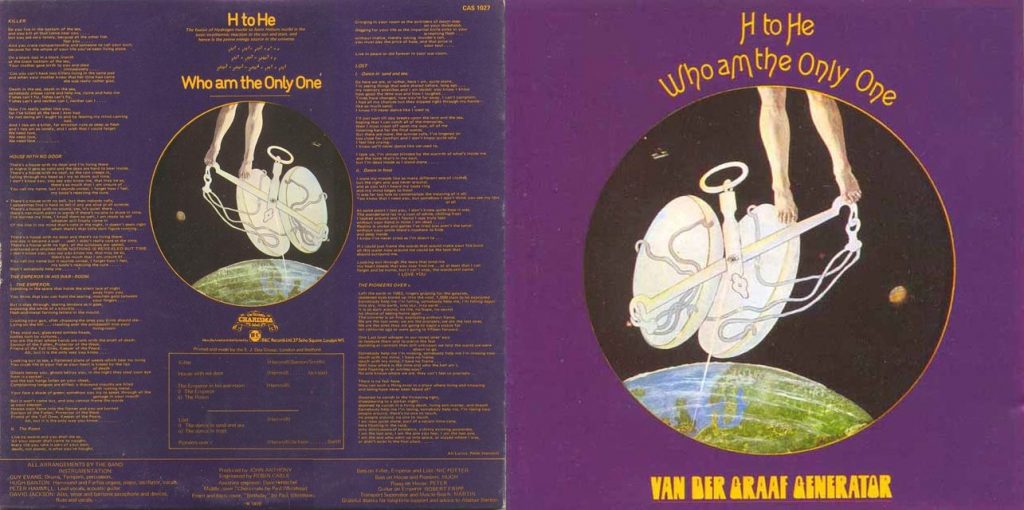
The cover, titled “Birthday” and contributed by Paul Whitehead, was inspired by the song “Pioneers Over c”. Whitehead first offered the band a different picture, but Van Der Graaf Generator turned it down. The added ray of light on the cover points straight at London. “H to He” is the name for the fusion of hydrogen nuclei into helium nuclei, a basic exothermic reaction that takes place in the sun and the stars. It’s the reaction that, among other things, defines how a hydrogen bomb works. Whitehead later contributed more album covers for bands such as Genesis, becoming the true “house painter” of Charisma Records in the early seventies.
“H To He, Who Am The Only One” came out on December 14, 1970. In the US the album was released by Dunhill Records. The cover for the American market had a white background. The 1980 reissue and the 2005 CD remaster have a dark blue background. The album released for the European market has a purple background in its original form.
“H To He, Who Am the Only One” wasn’t as commercially successful as its predecessor “Least We Can Do Is Wave to Each Other”. The band didn’t release a single. Charisma Records showed interest in putting out “Killer” as a single, but Van Der Graaf Generator wouldn’t allow it, afraid listeners would start treating them as a harder rock band. Interestingly, they didn’t want to reach for Hammill’s fantastic, deeply personal ballad “House With No Door” – its lyrics tell of a person who has trouble connecting with their surroundings and other people – as the single, even though it soon turned out that, alongside “Refugees” (the single from the previous album), it became, at least as far as listening goes, one of the most accessible songs of Van Der Graaf Generator’s entire career.
After the album came out, the band hit the road on the “Six Bob” tour. Van Der Graaf Generator were joined on the tour by Genesis and Lindisfarne. All three bands were on Charisma Records, but Van Der Graaf Generator were picked as the tour headliners because they’d been with the label longest of the three. Already during the tour they started writing new material, which was used on the next album, “Pawn Hearts”.
So 50 years ago, with the release of the fantastic “H To He, Who Am The Only One”, Van Der Graaf Generator stepped into the most creative stretch of the first era of their career, which culminated in 1971 with the release of what many of the band’s followers consider the most treasured album of their career. That’s the outstanding “Pawn Hearts”.
You can read the review of “H To He, Who Am the Only One” that Peter “Dr. ProgRock” wrote for RockLine in 2007 HERE!
Author: Aleš Podbrežnik
