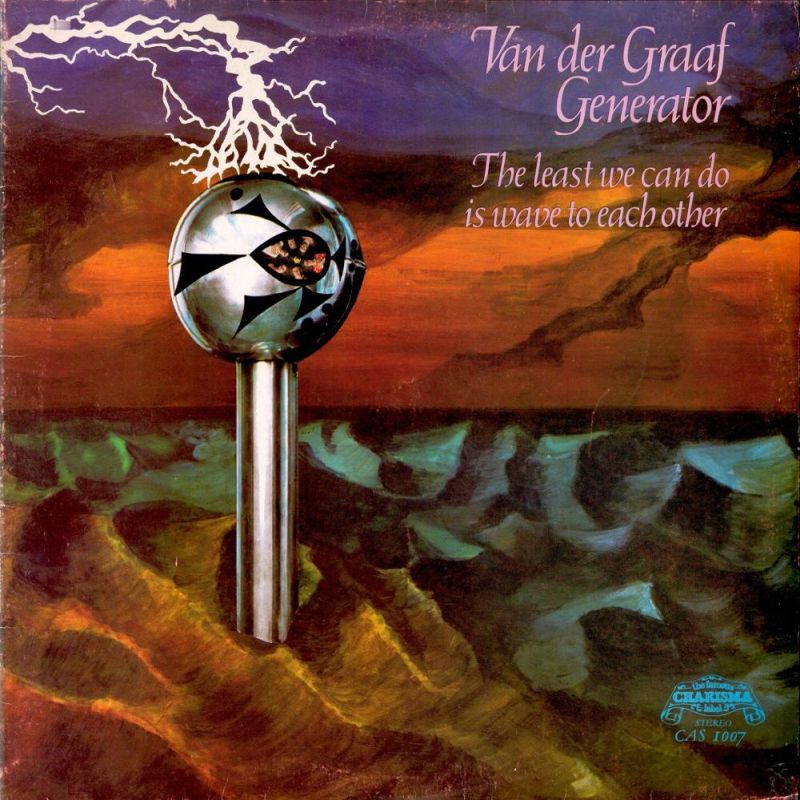
Label: Charisma Records
Release date: 06.02.1970
Production: John Anthony
Album length: 43.56 min
Genre: Progressive Rock
Rating: 9.0 / 10
Van Der Graaf Generator are a band that still stirs things up today with their visionary albums, packed with complex progressive rock anthems that offer a lyrical glimpse into the intricacies of the human soul and are full of gloomy visions of the near future. Apart from King Crimson, the chief torchbearers who lit the fire of a new chapter in the history of popular music, there was (as yet) no progressive rock band at the time that could measure up to these worshippers of electrical conductors, physics and metaphysics, a band whose odd, uncompromising blend of rock, jazz and classical music gave the music scene of the day a proper shock. That scene was still picking itself up after the collapse of the hippie illusions of “peace and love” and was just starting to wake up to gray everyday life and a near future under the iron fist of “Big Brother”. The music and lyrics of Van Der Graaf Generator were accordingly often brutal, cynical, futuristic and apocalyptic. One critic once said that the devil would probably make pretty similar music if he had a band of his own. With that, the “generators” became one of the main heralds of a new era in popular music and, pretty much, outran upcoming musical trends by at least a decade, which is one of the main reasons the band is respected today not only by plenty of prog rock fans but also by followers of such extreme genres as metal and punk.
But back then, before their second album, sarcastically titled “The Least We Can Do Is Wave To Each Other”, came out, probably nobody expected them to ever come back at all (over the years that’s become something of a tradition for them). After the release of their rather psychedelic-tinged debut “The Aerosol Grey Machine” (1969), originally conceived as a solo album by Peter Hammill, the singer and main writer of music and lyrics, came a second breakup since their formation, and they came within an inch of being buried forever in a sea of obscurity. The guys got lucky when they signed with Tony Stratton-Smith, the boss of Charisma and a great patron of progressive rock (his “protégés” included Genesis, Lindisfarne and String Driven Thing, among others), which motivated them enough to decide on a comeback with a somewhat reshaped lineup and a very different sound. Their rise from psychedelic experimentalists to one of the superpowers of progressive rock started right on this album, which defined their sound for years to come.
The brilliant Peter Hammill, with his utterly unique and peculiar voice, is the main factor that usually decides whether a person ends up liking the band or not. With his poetic way of singing, often outside of melodic tonality, and with plenty of swings between highs and lows, between the epic and the brutal, he established himself as one of the best singers and lyricists in progressive rock, and he occasionally picked up an acoustic guitar too (while he only learned the electric one several years later). One of the big peculiarities of VDGG’s music is that they leave very little room for guitar, which is mostly replaced by the saxophone of David Jackson, for whom this was the first album with the band. Jackson instantly became one of the key elements of their utterly unique sound. The original bassist Keith Ellis was replaced by Nic Potter, who also takes care of the little bit of electric guitar found in a few spots. Nic’s stay in the band would be just as short, since VDGG would soon swap the bass guitar for bass pedals on Hugh Banton’s keyboards. Banton, with his wizardry on the Mellotron and Hammond organ, is often the main keeper of the contrast between “light” and “darkness” in their music. And let’s not overlook the excellent jazz drummer Guy Evans, the only member of the band who worked with Peter on every VDGG album. Most of Peter’s poetry is a sarcastic critique of the senselessness of wars, the abuse of technological progress, and eternal human delusions and yearnings for the unknown.
The band’s new look comes alive right on the opening masterpiece “Darkness (11/11)”, the first of Peter’s many visions of a dark future, or a looming apocalypse (good thing the date in brackets isn’t 9/11, or America would probably be banning the album right about now). It all starts out very mysterious and gloomy, with wind sounds on the keyboards, before an ominous build-up on piano and percussion kicks in and only ramps up the tension. After a while Peter’s dramatic vocal drops in, joined by an excellent saxophone passage, which creates a dramatically epic harmony. Peter sometimes pushes his voice to the extreme and sounds completely enraged, almost evil. Then an excellent instrumental section crashes in, with layers of keyboards, saxophone and piano piling up and heightening the feeling of total chaos and destruction. Jackson’s saxophone, joined in the backing by a trumpet and hellish drum fills, adds a special kind of atmosphere, as if some crazed terrorist were dancing in the ruins of a burned-out wreck.
VDGG sail between enchanting beauty and raw brutality with incredible ease the whole time. The esoteric, utopian, symphonic epic “Refugees” proves it too, showing the band’s gentler side, where they let a ray of light into the gloomy future . Indescribable melancholy and epic grandeur blend throughout, created by the incredible harmony between the keyboards, the flute and the gorgeous tone of Peter’s voice, which is in its highest register this time. Banton meanwhile lays down a beautiful bed on clavinet and Mellotron. In the middle section comes an excellent jazzy drum passage, followed by a triumphant, melancholic main chorus, where Hammond organ, Mellotron and saxophone all boom out in the same breath alongside the vocal. VDGG find themselves in their most romantic moment. After a while, gorgeous epic choral harmonies join Peter’s voice, radiating incredible melancholy and a longing for freedom. Surely one of their most beautiful songs, and its lyrics are also Peter’s critique of all totalitarian regimes. Few singers are able to conjure up so many different emotions in a single track.
“White Hammer”, which tells of the Inquisition and the witch hunts, is another VDGG classic. It’s announced by the roar of the Hammond organ, then Peter’s brutal vocal ushers us into a creepy atmosphere. Individual passages swing between calm and energetic, as proper hellish cataclysms break out between the saxophone and the rhythm. It’s a composition of many contrasts. On one side there’s high epic grandeur, on the other brutal jazzy outbursts, with the drama further stoked by a layer of Mellotron and Peter’s almost manic vocal. The drum fills and a few distorted guitar bits, combined with saxophone and keyboards, sound incredibly heavy for their time. In the last part a truly spine-chilling (and thoroughly convincing) atmosphere emerges, almost like something out of a psychedelic horror flick, brought on by an extensive jazz improvisation. In its feeling of chaos and total darkness it can even go toe to toe with a masterpiece like King Crimson’s “Devil’s Triangle”.
“Whatever Would Robert Have Said”, dedicated to the father of the Manhattan Project, Robert Oppenheimer, with lyrics dealing with the looming threat of total nuclear annihilation of humankind, is another highly complex apocalyptic-hellish treat. After a relatively innocent keyboard intro, joined in time by drum fills and a menacing saxophone, a downright shamanic rhythm kicks in, quickly calmed by Peter’s vocal (which is purely narrative at the start). In the background you can hear some deliberately out-of-tune electric guitar from Potter, joined in contrast by some of Peter’s acoustic guitar, more for relaxing sonic decoration than anything else. The main, crazed saxophone motif over the manic vocal really sounds like Mephistopheles himself dreamed it up. Suddenly an interesting jazz improvisation arrives and grows into a real battle between the instruments, especially the electric guitar, saxophone and keyboards. Despite a few acoustic interludes, its course never fully settles down, and its ending comes off pretty cataclysmic.
The band’s brighter side comes back to life on the dreamy ballad “Out Of My Book”, dominated by a romantic motif on David’s flute and Peter’s acoustic guitar. It’s all led by a calm, poetic vocal that’s not even slightly like the brutality that ruled his previous composition. Hugh’s keyboard layers are laid down with exceptional feeling too. Of everything on the album, this is the piece least like the new VDGG and closest to their psychedelic past. The main folk-rock-flavored motif on acoustic guitar, flute and harmonies will charm all those who claim the band made a deal with the devil, and carry them off to cloud nine. Personally I love this contrast between light and darkness that these kinds of “relaxing” pieces bring into their music.
The closing masterpiece “After The Flood”, where a thick bass line, ominous keyboards and acoustic guitar usher us into the final epilogue of human delusions and mockery of the natural balance, is another piece that takes your breath away with its unpredictable and complex nature. Peter is once again in that vocal element of his, where you never know when the epic will give way to the brutal. The opening tempo is fairly calm until a hellish drum march and possessed, booming Hammond organ kick in. Thunder can occasionally be heard in the background. The epic central motif, accompanied by a cynical vocal that sings of the final apocalypse and the cleansing of the world from the yoke of human filth through a “universal flood”, may even be aimed at the downfall of Atlantis. The hellish flashes carry on through individual passages on saxophone, bass and booming organ, forming high symphonics mixed with bits of obscure jazz. In the second part comes an exceptionally tasteful jazz improvisation , where David’s flute solo shines. After that the pessimistic main chorus comes round once more, with saxophones and organ blaring triumphantly alongside Peter’s sarcastic vocal. Then follows another nightmarish instrumental cataclysm, ending in an actual flood, represented by an acoustic guitar passage, rattling bass and an intrusion of a deliberately robotized vocal (somewhat in the style of the King Crimson classic “21st Century Schizoid Man”), which introduces the final robotization of all living things, or the birth of the Matrix. Right at the end, that main epic motif returns once more, representing the end of the future for humankind. Not exactly an optimistic closing to the album, but to be honest, expecting anything else from VDGG would be almost utopian.
With “The Least We Can Do Is Wave To Each Other”, VDGG created the first of their many classic albums, a downright masterpiece of early progressive rock. And although they hadn’t yet reached the incredible level of maturity they would on the next album, it’s a stunning achievement, far ahead of its time, that still doesn’t stop impressing with its dark visionary streak. At the same time, this album marks the key moment when VDGG defined their recognizable sound and reached a crucial stage of their development, since it was a huge step up from their relatively average debut. VDGG instantly became one of the main and most exciting superpowers in the development of early progressive rock. Even though most of their music was far from immediately accessible, after this album’s release they started building up a legion of extremely loyal fans who knew how to appreciate their advanced visions. “The Least We Can Do Is Wave To Each Other” is one of those albums that was, in a way, at least ten years ahead of its time. Over the following year Hammill would push the band to the very limits of what it could do, and with the next two masterpieces VDGG would carve their names into immortality.
author: Peter Podbrežnik
Tracklist:
1. Darkness (11/11) (7:27)
2. Refugees (6:22)
3. White Hammer (8:15)
4. Whatever Would Robert Have Said? (6:17)
5. Out Of My Book (4:07)
6. After The Flood (11:28)
“Bonus” tracks from the reissue (2005, EMI Records):
7. Boat of millions of years (3:50)
8. Refugees (single version) (5:24)
Lineup:
Peter Hammill – vocals, acoustic guitar
Nic Potter – bass guitar, electric guitar
Hugh Banton – organ, piano, backing vocals
Guy Evans – drums and percussion
David Jackson – saxophone, flute, backing vocals
GUEST MUSICIANS:
Gerry Salisbury – cornet on “White Hammer”
Mike Hurwitz – cello on “Refugees”