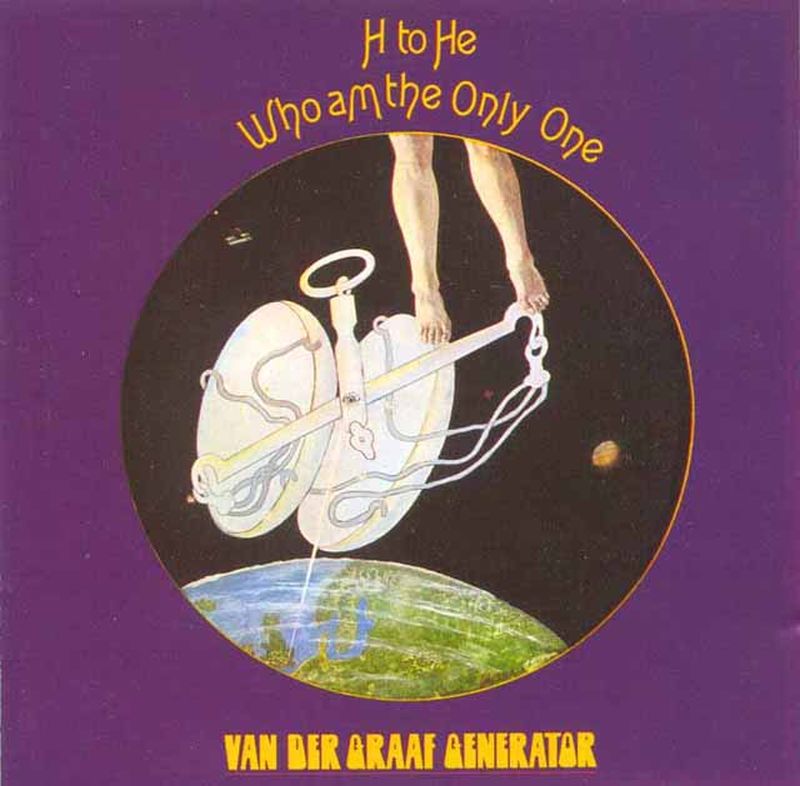
Label: Charisma Records
Release date: 12/14/1970
Production: John Anthony
Album length: 47:15 min
Genre: Progressive Rock
Rating: 9.5/10
With their third album, “H To He, Who Am The Only One,” Van Der Graaf Generator wrote themselves into history once and for all as some of the greatest innovators in British prog rock, delivering one of the best records of their turbulent career. Believe it or not, their excellent second album, “The Least We Can Do Is Wave To Each Other” (1970), which shook up the prog world with an unbelievable mix of unbridled brutality and epic beauty, wrapped in poetic visions of a dark, apocalyptic future, was only the warm-up for their greatest creative triumphs. The first of them is definitely this groundbreaking album, a true masterpiece of darkly conceived progressive rock, put together just a few months after its superb predecessor, which shows the incredible work ethic, energy, and wealth of musical ideas of Messrs. Hammill, Banton, Jackson, and Evans. These peculiar musical oddballs and visionaries, each a unique master of their instrument, seriously threatened King Crimson’s crown as the most thrilling, experimental, and dark prog band of that year with this release (interestingly, King Crimson also put out two phenomenal albums within a short span that same year). King Crimson will come up several more times in this review, because the album is full of that apocalyptic “crimsonoid” spirit.
“H” is the album where their classic four-piece lineup finally took shape, one that, among other things, left out the bass guitar, which had become almost completely unnecessary for their apocalyptic experiments. Former bassist Nic Potter lent his services to only three tracks, and after his departure he was replaced by keyboardist Hugh Banton on bass pedals, which he hid under his keyboards. This absence of bass guitar also became one of the defining trademarks of the Van Der Graaf sound, along with the standard absence of electric guitar, which David Jackson’s saxophone usually replaced very effectively. Jackson often stuck two saxophones in his mouth at once (alto and tenor), which certainly made him one of the great wind oddballs of the era. Guy Evans, undeniably one of the best jazz/rock drummers in prog, really shines on this album and shows off some of the most fiery and complex moments of his career; he especially stands out on timpani. Singer Peter Hammill, the undisputed genius and soul of the band and one of the best and most unique singers and poets in prog history, occasionally picks up the acoustic guitar too (until he more or less learned to play electric). Interestingly, for the track “The Emperor In His War-Room” Hammill invited his friend, none other than the “father” of prog rock, Robert Fripp (King Crimson), who played his instantly recognizable guitar solo on electric guitar.
Mixing VDGG and King Crimson elements is without doubt a match made in heaven (or, more fittingly, hell), a perfect instrumental apocalypse and the fulfillment of every prog fanatic’s dream (this was only the beginning of the collaboration between Fripp and the band, which would peak on the next album). And that is far from the album’s best moment. “H” is stuffed with so many different goodies and such rich instrumental and vocal expression that my heart always skips a beat when I hear how effectively the band built branching bridges of atmosphere between musical heaven and hell. Hammill’s instantly recognizable, poetic singing is in my opinion some of the best of his career here, at least when it comes to the harmonic switching between lower, brutal registers and high, clean ones. Through them he very effectively delivers his lyrics, mostly apocalyptic and socially critical (they usually take aim at institutions and other harmful achievements of Western civilization). Banton must have literally knocked on hell’s doorstep at the time to come up with such a demonic sound for his organs, while Jackson truly became the Van Gogh of his craft on saxophones and flute. The combination of Banton and Jackson is in my opinion the main key to the wicked essence that surrounds most of the tracks on the album, although there is no shortage of incredibly beautiful, spirit-lifting moments either. As for how Evans manages to create so much rhythmic variety and such vivid percussion work, I’d struggle to find an answer. I’d roughly describe “H” as an apocalyptic mix of complex, mostly symphonic epics with plenty of jazzy improvisation and unique vocal drama, where the mood constantly shifts from majestic to malevolent, all of it seasoned with Hammill’s apocalyptic, often quite sci-fi lyrics, which have always fascinated me, since some of them have even proven prophetic over time. Apart from one ballad, it’s all epic, highly complex pieces that run over an unprepared listener in a heartbeat with their incredible energy, and you can discover something new in them with every listen.
The opener “Killer,” with its deadly, anthemic main motif (which more than effectively stands in for a guitar riff), pulls us straight into the apocalypse. It’s incredible to hear how tastefully Jackson’s saxophone and that hellish layer of Banton’s organs intertwine in this motif. When Hammill’s brutally sarcastic vocal jumps in, sounding not just mocking but almost wicked, the atmosphere really does make you feel like you’ve landed in the middle of a pit of hell. It’s interesting how the piano and acoustic guitar now and then calm the charged, malicious mood of the composition a little. Even though the hellish organ and sax passages trade places at astonishing speed, the band keeps the melodic main motif present the whole time. The brutal chorus, with Hammill shrieking as if a killer were really on his tail, easily freezes the blood in your veins. At one point comes an extremely interesting transition into a crazy jazz improvisation, where we witness a true instrumental cataclysm on drums, bass, piano, and saxophone. Jackson’s passages, and especially his sax improvisations, along with Hammill’s menacing singing, bring a touch of total madness and paranoia to the piece. They keep the melodic main motif nicely intact the whole way and bring it back at just the right moments, though of course the obligatory madhouse on piano and organ follows in the end.
After the apocalypse comes a moment of total release from the tension, in the form of the gorgeous symphonic ballad “House With No Door,” laid over tasteful arrangements of Banton’s piano and very good flute work from Jackson. Peter’s vocal is almost unusually melodic and clean this time. Interestingly, when Hammill sings clean, in higher registers and without his “choleric” outbursts, his voice even sounds a little like David Bowie (some of the vocal lines in the chorus may even be the highest of his entire career). The chorus is incredibly beautiful and melancholic. Peter’s vocal conveys incredible longing and easily enchants the listener with its remarkable expressive power. The real symphonic treat, though, is the closing, extremely melodic arrangement of piano and Jackson’s flute, which ranks among the most charming moments in the band’s story. With this beautiful ballad, VDGG show how quickly and effectively they can move the listener from hell to heaven and back again just by changing the mood.
“The Emperor in His War Room” is one of Hammill’s best poetic sci-fi/socially critical experiments and at the same time one of the most majestic symphonic moments on the album. It’s split into two sections, “The Emperor” and “The Room.” In the latter, the band is joined by the aforementioned special guest Fripp (to get a bit witty: a real musical dictator, made to order for a song about a dictator) on electric guitar. The ice-cold, Eastern-flavored opening motif on flute, organ, timpani, and acoustic guitar shakes the listener instantly with its eerie atmosphere. Along the way, energetic organ and drum passages start trading places, occasionally joined by Hammill’s furious vocal expression (where he tries to step into the role of an imaginary tyrant ruler), which peaks in an epic chorus with vocal harmonies and an excellent symphonic arrangement. The central motif on flute and piano really paints a picture of a lonely tyrant. The listener can easily imagine some futuristic emperor. Personally, I usually think of the one from Star Wars, sitting and cackling on his throne while choosing through the glass of his space station which planet to destroy. Maybe the surname Hammill is partly to blame for that association, I don’t know. In the second part, “The Room,” an incredibly turbulent passage kicks in, triggered by excellent instrumental interplay and a symphonic chorus with harmonies that raises the hair on your neck every single time. Hammill keeps “slitting his veins” with his vocal performance; only the greatest masters of their craft are capable of that much vocal expression, and Peter undoubtedly belongs among them. Then comes an extremely tasteful, instrumentally focused section, one of the album’s greatest treats. Here Fripp storms in on electric guitar with his instantly recognizable solo (which is slightly reminiscent of the one from the famous King Crimson instrumental “Sailor’s Tale”). His solo overlaps wonderfully with the machine gun of drums and organs. Then that cold, space-oriental motif returns as Hammill finally has his “nervous breakdown” and announces the collapse of decadent civilizations under the emperor’s fist. The ending, ironically, is incredibly beautiful and serene.
“Lost,” which is likewise split into two sections, “The Dance in Sand and Sea” and “The Dance in Frost” (two extremes of a cohesive, interconnected epic), is another of the album’s epic peaks, with very good choruses. It opens with a motif on sax that’s almost, dare I say, “sick,” before a bouncing rhythm kicks in on drums. Jackson’s sax lunacy, along with Hammill’s once again phenomenal vocal, which is front and center this time and mostly aimed at high, epic registers (though he never runs out of rage), is the main attraction of this composition. The rhythm section is again of an extremely schizoid nature and combined very effectively with the hellish sound of the organs. The majestic choruses are often followed by murderous, hellish instrumental outbursts on drums, sax, organ, and bass guitar (Potter showed one of his best moments here before leaving). The composition hangs on that thin line between genius and madness the whole time, which is more or less a constant of their sound. The instrumental madness is followed by a half-calm, relatively epic part, where Hammill steps in with a melancholic vocal and sings what’s almost a lament. An interesting sax improvisation and a marching rhythm join in. Then comes a jazzy instrumental section built on calm interplay between sax and organ. But that calm is again followed by a proper instrumental cataclysm, which announces the second section of the composition. Here the brutal motif and the epic chorus with the vocal that “slits veins” crash in again. “Lost” really does sometimes sound like an icy pit where demons dance at the bottom of Dante’s hell. I’d struggle to think of another of their creations that sounds more ominous than some of the improvisations on this excellent epic.
“Pioneers Over C.” is in my opinion the peak of Hammill’s science-fiction poetry. The lyrics tell of the first astronauts to test the speed of light, but their journey didn’t end well: because of the laws of physics (according to Hammill) they disintegrated in space and time and became a kind of bodiless ghosts, somewhere between life and death, completely alone in the depths of space. Besides being the most complex piece on the album, I think it’s also the best one on it, since the band pretty much shows off all of their experimental potential on the individual instruments here. The track opens with a strange effect, followed by a rhythmic build-up on Banton’s bass pedals and Hammill’s mysterious, watchful vocal. Suddenly the dark mood dissipates, majestic organs burst in, and a triumphant Hammill vocal follows, again sounding very poetic and telling the story of the unfortunate astronauts in an extremely dramatic way. The composition is packed with juicy instrumental sweets. The majestic, epic choruses are often followed by alternating jazzy transitions and interesting acoustic interludes (a very solid use of acoustic guitar). Special mention goes to an especially interesting motif that repeats several times and sounds like a kind of apocalyptic march, laid over sax, organ, and Hammill’s almost paranoid vocal. The psychedelic organ section and some of the sax improvisations that sound almost mocking are interesting too. In the second half the mood calms down considerably, a kind of lull sets in, and a very beautiful acoustic guitar part arrives, joined by the clean, gentle timbre of Hammill’s voice. It doesn’t last long, and the very next moment a completely off-the-wall Jackson sax improvisation kicks in that sounds like water got into his horn. That’s followed by another instrumental, wound-up-to-the-max madhouse on piano, plenty of psychedelic sounds, and stormy drum transitions. Hammill’s vocal turns mysterious and paranoid again. The ending is excellent, because the central, signature motif comes back once more and is capped by deliberately high vocal avant-gardism. For the grand finale there’s the obligatory Zappa-flavored jazz improvisation on sax, which ends with the hum of an electronic effect on keyboards.
“H To He, Who Am The Only One” is in my opinion one of the brightest jewels in the history of progressive rock and certainly among the four, if not three, best achievements in the band’s history, a band that had shown incredible progress over its predecessor with every album up to then. When it came out, the album was a big treat for everyone looking for suitable rivals to the then “kings” of highly eclectic prog rock, King Crimson (Genesis were only just warming up, Yes were on the verge of a sound change, ELP had only just appeared, Jethro Tull were still playing hard rock, so were Gentle Giant, and Pink Floyd were still quite psychedelic and hadn’t yet invented their recognizable sound). “H” was also a big inspiration for some lesser-known prog bands, especially in Italy, where they knew best how to appreciate VDGG’s work. The album still sounds incredibly fresh today and is a must for all fans of classic prog built on darker notes and admirers of unbridled experimentalism (including some more avant-garde leanings). At the same time I have to note that this is a masterpiece that is definitely not for every listener, especially not for delicate souls who, instead of thinking for themselves, prefer to be led by the hand by one trend or another. In other words, exactly the thing that the “sharp-tongued doctor” Hammill and his band always sternly warned against. After the release of “H,” VDGG would by no means rest on their laurels, and with the next album they’d do something astonishing: they wouldn’t just take another creative step forward, they’d create their greatest masterpiece, which would be both the peak of their body of work and one of the most glorious triumphs in the history of progressive rock.
Author: Peter “Dr. ProgRock” Podbrežnik
Tracklist:
1. Killer
2. House With No Door
3. The Emperor in His War Room
4. Lost
a. The Dance in Sand and Sea
b. The Dance in Frost
5. Pioneers Over c
Bonus tracks (2005 remaster):
6. Squid 1 / Squid 2 / Octopus” (Recorded during the sessions for Pawn Hearts)
7. The Emperor in His War Room (first version)
Lineup:
Peter Hammill – vocals, piano on track no. 2, acoustic guitar
Hugh Benton – Hammond and Farfisa organs, piano, oscillator, bass guitar on tracks no. 2 and 5, backing vocals
David Jackson – saxophones, flute, backing vocals
Guy Evans – drums, percussion
Guest musicians:
Nic Potter – bass guitar on tracks no. 1, 3, and 4
Robert Fripp – electric guitar on track no. 3