

Five years have flown by in a flash. Five years since we lost one of the greatest musical visionaries in the history of rock ‘n’ roll – the brilliant mind of David Bowie. Fifty years ago this November, the man put out his third studio album, “The Man Who Sold the World,” in the US, while in the UK it came out on April 10, 1971.
The album was recorded at Advision and Trident studios in London in April and May of 1970, with Tony Visconti producing. Two musicians who left a major mark on David Bowie’s future career also made their way onto this record. And then some. They even shaped his artistic growth going forward. The first is guitarist Mick Ronson, the second drummer Mick “Woody” Woodmansey. Over time it turned out that Bowie, in his search for his own artistic identity, had started leaning on Mick Ronson. With “The Man Who Sold the World,” Spiders from Mars began to take their first shape. Slowly, though.
You can read the review of the album “The Man Who Sold the World,” which Peter “Dr. ProgRock” Podbrežnik contributed to RockLine on January 27, 2016, HERE!
Its predecessor, the album “David Bowie (Space Oddity)” from the year before, is full of acoustic arrangements and folk tunes, but “The Man Who Sold The World” marked Bowie’s turn toward a heavier sound. The guitar phrasing in particular got sharpened to a point. The new album was a turning point lyrically, too. The themes turned dark: madness, religion, fear of advancing technology, dehumanization and war. The album didn’t give Bowie a single one, but between 1970 and 1973 its songs showed up on the B-sides of other Bowie singles.
The album was supposed to be called “Metrobolist,” Bowie’s riff on Fritz Lang’s 1927 film “Metropolis,” but at the last minute, and without consulting the artist, the label Mercury Records changed the title.
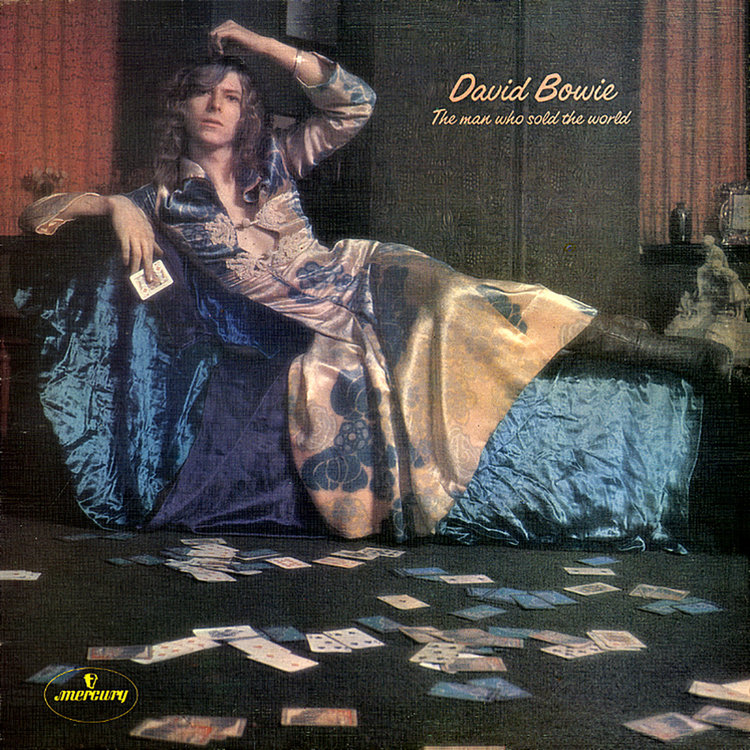
The album came out on both sides of the Atlantic with two different covers. The cover for the American market featured a comic-style illustration of a cowboy standing in front of an insane asylum. Its creator, Michael J. Weller, found his inspiration in one of John Wayne’s film roles. Bowie hated the cover. So he picked Keith MacMillan to create an alternative version. For the new cover, Bowie put on a dress designed by fashion designer Michael Fish, and the controversial photo, in which Bowie looks like he’s dressed as a woman, was chosen for the edition that came out on the British market a few months later.
Bowie had broken through the year before with the single “Space Oddity,” released in July 1969. It brought him commercial success, and the public started noticing the new stage name. Still, the album “David Bowie (Space Oddity),” released that same year, didn’t repeat that success. Partly because the label Philips Records wasn’t pushy enough with its promotion. That carried over into 1970, when Bowie’s next single, for the song “The Prettiest Star,” didn’t chart anywhere at all. In 1972 the album was reissued by RCA Records, with a black-and-white photo of Bowie in his Ziggy Stardust getup on the cover, a look he was already using at gigs by then.
Sensing his potential as a solo performer was fading, David decided to start a rock band with his buddy and bassist Tony Visconti, who had already worked with him on “David Bowie (Space Oddity),” and drummer John Cambridge, who had previously played with The Rats (we’ll come back to that name). Thus Hype was born. All they needed now was a guitarist.
In 1970, Mick Ronson joined Hype. That had a decisive effect on Bowie’s career. Together they created a string of unforgettable classics and classic albums in general: “Hunky Dory,” “The Rise And Fall Of Ziggy Stardust And The Spiders From Mars,” “Aladdin Sane.” Without Ronson, Bowie would have had a hard time getting to the “spiders from Mars.” Ronson became famous and is still known in the rock world first and foremost for his work with Bowie, even though later, after Spiders from Mars fell apart, he worked with a whole series of musical heavyweights such as Bob Dylan, Lou Reed, Ian Hunter, Roger McGuinn, Morrissey and John Mellencamp.
The man of few words, a municipal gardener from Hull, built the Bowie legend, putting himself in the role of the unrivaled king among glam rock guitarists of the day. True, Ronson made his name with Bowie, but the guy had been active since the sixties. He played in various Hull bands, including The Mariners, whom Rolling Stones bassist Bill Wyman personally advised to change their name to King Bees. Funny enough, around that time Bowie was leading a band called David Jones and The King Bees. Ronson also played in The Rats, who in 1967 managed to squeeze out their one and only hit single, “The Rise And Fall Of Bernie Gripplestone.”
Benny Marshall, then the vocalist of The Rats and a very good friend of Ronson’s, said: “Mick was the best guitarist in Hull, and when he decided to head south to join Bowie, I was really angry. Our drummer John Cambridge, who played for Bowie on the ‘Space Oddity’ album, came back to Hull in January 1970 just to take Ronson back to London with him. He literally dragged Mick off to London – he found him at the municipal football stadium, where he was out on the grass marking the lines for the goal.”
From there, Cambridge took Ronson straight to the Marquee club, where Bowie was playing on February 3, 1970. It took Ronson just two days to master most of the licks and structures of Bowie’s compositions, enough to back him, Cambridge and Visconti at a gig for the John Peel Radio 1 Show, broadcast live from the Paris Theatre in London. The band played fifteen songs, including the then-fresh “Width of a Circle” and a pile of material from the then-current album “David Bowie (Space Oddity).” The crowd response was positive. Better than at his last show, when Bowie performed as a solo artist in Beckenham, where he was living with his family at the time. Ronson then simply moved into Bowie’s house and became part of his family.
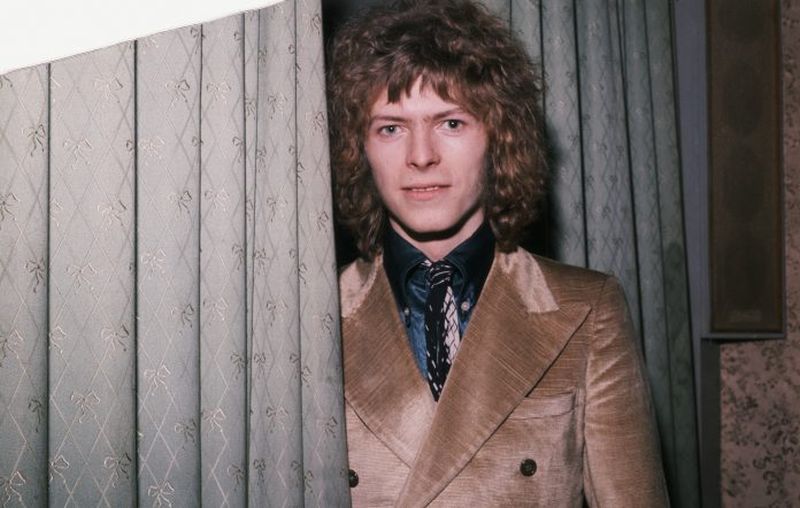
The band started recording “The Man Who Sold the World” on April 17, 1970, at Advision studio in London. Before that, at the end of March, Hype had kicked Cambridge out of the lineup. Though sources say Bowie fired him, according to Visconti it was Mick Ronson’s request. Bowie’s first impression of Mick Woodmansey – the band’s new drummer – was this: “The kid lived and breathed to become a rock ‘n’ roll star.” By April 1970, all four musicians were living at Bowie’s home in Beckenham, England. More precisely, at Haddon Hall, a former mansion that had been converted into an apartment block. One visitor once described its atmosphere as something like Count Dracula’s living room. Under the mansion’s giant staircase, Visconti and Ronson set up a makeshift studio where Bowie recorded most of the demos that came out of the early seventies.
It was a time when quite a few bands were rejecting hippie collectivism or slowly getting sick of it. David Bowie was one of them, and he wanted to make a hard-sounding rock album. Tony Visconti later said: “We respected bands like Cream, but we were missing what they had. We needed to bring someone into the team, and that someone had to bring change. That’s when it became clear how important Mick Ronson’s arrival was.”
Everybody quickly fell for Ronson, mostly thanks to his infectious northern humor. Bowie in particular took him to heart. What really mattered, though, was that he won over Visconti and Bowie right away, since he was incredibly inquisitive and curious by nature and loved to learn. Visconti says: “When David and I first saw Mick, it was obvious he looked the part for the band, but we had no idea what would happen when he picked up his Les Paul. He nailed the few songs we’d already rehearsed with Cambridge in an instant. When he came to rehearsal, he just watched our hands on the guitars and bass and immediately knew what to play. But he was a man of few words. Relaxed, but quiet by nature. Later David and I figured out that coming to our place in Beckenham had opened up a whole new world for Mick, and that it completely swept him away.”
According to Tony Visconti, Ronson supposedly showed up at Trident studio as early as September 1969, while Bowie was wrapping up work on his second studio album: “We asked Mick to play a short guitar line in the middle of ‘Wild-Eyed Boy From Freecloud’ during the mixing stage, and he joined in with some handclaps in that section too.”
If Visconti is right, then Ronson never got any official credit for his contribution to the album “David Bowie (Space Oddity).” At least, that detail isn’t cited in the basic info about the album. The first recording on which Mick Ronson officially worked with Bowie is the single “Memory Of A Free Festival Part 1/Part 2,” recorded in September 1969 and released in 1970.
Recording of the album »The Man Who Sold the World« kicked off on April 17, 1970, at Advision studio in London. First up was the track »All the Madmen«. Just the next day, Ralph Mace showed up at the studio, hired by the band to record a Moog solo – on a Moog that was actually borrowed, by the way. It belonged to George Harrison. Mace also played on the previously mentioned single »Memory of a Free Festival«. By then he was a seasoned 40-year-old musician, well respected as a concert pianist, and he also ran the classical music department at Mercury Records. Around this time David Bowie parted ways with his then-manager Kenneth Cooper Pitt, and Tony Defries stepped in as his new manager – in fact, Defries was the one who had talked Bowie into making the move in the first place. On April 21, 1970, the band moved to Trident studio in London, where they wrapped up the album over the rest of April and into mid-May 1970. On May 4, 1970, Hype recorded the tracks “Running Gun Blues” and “Saviour Machine”. The latter was originally picked as the working title of the album, until Bowie adapted the lead melody, which led him to rename the track »Saviour Machine«. Recording and mixing moved back to Advision on May 12, 1970, and finished ten days later. David Bowie laid down the lead vocals for the album’s title track on the very last day of the sessions.
While the album was being recorded, David Bowie was totally wrapped up in his new wife Angie, and also busy sorting out his management mess. So the music on »The Man Who Sold The World« was arranged mostly by Tony Visconti and Mick Ronson. Ronson, in turn, learned a huge amount from Visconti during this time about recording techniques and album production. Even though David Bowie is credited as the songwriter, Tony Visconti had this to say about how the material came together: »We all four wrote the songs together. We did some jams down in the basement, Bowie listened to the whole thing and basically just decided which of our ideas he’d use for the album. The band would then record a track as an instrumental, with David occasionally pitching in on guitar, though that didn’t necessarily come from his original idea. Right at the end, Bowie coughed up the lyrics. He sat there with his wife on this giant sofa while he did it.« Bowie, however, begged to differ in a 1998 interview, saying: »Apparently the claim that I didn’t write the songs for »The Man Who Sold the World« has eventually grown into quite a big deal. All you have to do is check the chords. Nobody writes chord modulations like that. »The Width of a Circle« and »The Supermen«, for instance, were written before the album sessions even started.«
Brilliant as »The Man Who Sold The World« is, for Bowie it meant another commercial nosedive. The album was received so poorly that Bowie was set on disbanding the group. Ronson, Visconti, Mick »Woody« Woodmansey and Benny Marshall – who had joined them and played harmonica on two tracks of the album »David Bowie (Space Oddity)« – decided instead to record and release a single for the track »4th Hour Of My Sleep«, with »Powers Of Darkness« keeping it company on the B-side. It was a freewheeling rock-metal romp, with Ronson’s Les Paul playing front and center, naturally. The single vanished without a trace, even though Vertigo Records later put both tracks on the compilations »Superheavy Vol 1 and 2«.
These heavy metal maneuvers of Ronson’s would later fit more and more snugly with Wagnerian, dystopian lyrics and words wrestling with a tangle of madness and pain. Ronson’s contributions to Bowie tracks like »She Shook Me Cold«, »Running Gun Blues« and the epic »Width Of A Circle« cemented the guitarist’s position, and Mick gradually got so far under Bowie’s skin that Bowie liked to call him simply “my Jeff Beck.”
Both David Bowie and Ronno were huge fans of Beck’s album »Truth«. Benny Marshall, who also came down to London from Hull (we mentioned earlier that he’d worked with Ronson in The Rats), says: »Mick knew every detail of that album, except for »Beck’s Boogie«, where he could only play certain parts. It really ate at him. In 1969 The Rats opened for Jeff Beck at the Ballou club – that was in Grantham – and afterwards Ronno asked Beck if he could show him how to play the fast intro to that track. Beck played it, and Mick said: ‘No, please, can you play it slower?’ Beck replied: ‘If I play it slower, I’ll stop.’ But Mick insisted, and that’s how he nailed that phrase too.«
The machine started rattling, and in August 1970 Hype found themselves at the Atomic Sunrise festival (at the Roundhouse), packed to the rafters with hippies. Glam rock was born at that gig. It was still only 1970. Ronno remembers: »I knocked back a shot and smoked a joint and got so stoned that I don’t remember a thing about what happened on stage. They told me Marc Bolan was there too, but I don’t even remember that. Back then the bands hung out together quite a bit, and Marc often turned up at all sorts of gigs.«
Ronno adds: »In the stretch between the two albums, meaning »Hunky Dory« and »Ziggy Stardust«, there was a kind of deadness in the air. The way Bowie started dressing up gradually rubbed off on all of us in the band, and that’s exactly what rock’n’roll badly needed at the time. It wasn’t my style, but at the same time the whole thing thrilled me. As a kid I was very shy and nervous, but in a stage costume I turned into a different persona and could break loose from everything.«
Anyway, Bowie’s »The Man Who Sold The World« didn’t bring the singer a commercial breakthrough, but it did boost Ronson’s confidence. Ronno and Visconti built the album’s sound and polished all the arrangements, while Bowie more or less only chipped in the lyrics. »She Shook Me Cold«, one of the dirtiest tracks Bowie ever actually wrote, refers directly to his Angie, aka Mrs. Bowie, but it was Ronson who brought the “epileptic” intro, inspired by Hendrix, while the Ronson-Visconti-Woodmansey trio gave the track its whole character. Even Angie later admitted that Ronno never really got proper thanks for his contribution to an album that was truly enormously important.
Hype – whether with Cambridge or with Mick Woodmansey – stormed the strongholds of Harrogate and Scarborough with their occult rock blitzkrieg, and Ronson and Bowie even played the songs at the Marquee and Hill Country clubs. As an acoustic duo, in the time right before bassist Trevor Bolder joined them. When Visconti – unhappy about Bowie’s lack of enthusiasm, and about the new manager Defries too – left in August 1970, Ronson got a free hand to take over the string and piano arrangements. He said: “I’d never done anything like that before. But I could read and write music, and since I’d watched Tony’s work at Haddon Hall, how he composed and wrote certain parts for the music, I’d actively worked with him on it too.«
So Ronson wrote a short piece of music, recorded on four tracks, which was slotted into a break within »All The Madmen«. That was Ronson’s debut as a producer. Ronson says: »If Tony can pull it off, so can I, I thought. One day David, Dana Gillespie and I went out for dinner. Dana needed string arrangements for her new songs and David blurted out: ‘Mick will take care of that!’ That didn’t actually happen, but it felt great to hear something like that. It all started forming in my head. Then you just sat down at the piano or grabbed a guitar. David egged me on. That was his role. In everything. He was the initiator of everything, the reason things even started happening.«
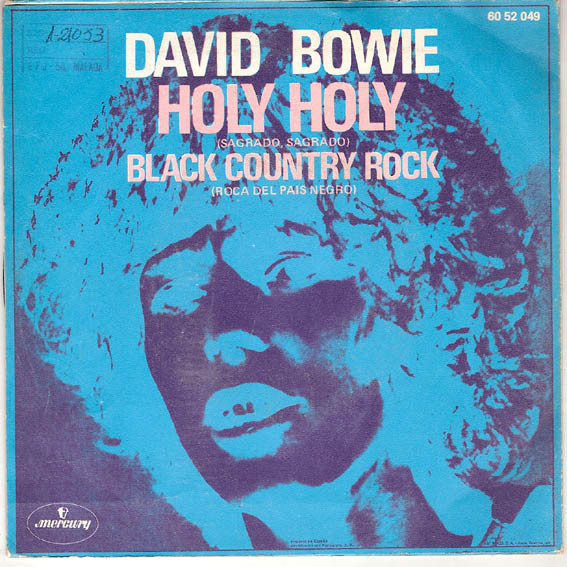
Then, in early January 1971, the single »Holy Holy« came out. The goal was to stir up more interest in the album »The Man Who Sold The World«. But it didn’t make a dent on the charts. Still, the single’s release later helped Bowie land a deal with Chrysalis Records. The track was produced by bassist Herbie Flowers of Blue Mink, known for his bass line on Lou Reed’s hit »Walk on a Wild Side«. That one comes from his album »Transformer«, which was co-produced by none other than David Bowie and Mick Ronson. »Holy Holy« flirted a bit with The Move, but its B-side was the more interesting part, featuring the track »Black Country Rock«. It drew parallels with the stance of Bolan’s Tyranosaurus Rex at the time, which might have made for a better choice of single. Bowie and his crew first played »Holy Holy« on the TV channel Granada TV. It was also one of the first chances he used to hop into one of the outfits by designer Mr. Fish (Michael Fish). Those very outfits made by Mr. Fish would later accompany Bowie and his career in large numbers and pave the way for glam rock’s solid affirmation.
Bowie’s artistry at the time, meaning his musical style and sound, suddenly became very dependent on Ronson. On the next album, “Hunky Dory”, the guitarist finally got concrete recognition for his creative contribution. Ronson helped arrange the songs “Changes”, “Life On Mars?”, “Kooks”, “Quicksand” and the cover of Biff Rose’s original “Fill Your Heart”.
After the album came out, Ronson and Woodmansey followed Visconti out the door. Personal conflicts with Bowie were said to be behind it. Even so, Visconti kept rating “The Man Who Sold The World” very highly in later years. He eventually came back to Bowie and topped the artistry of “The Man Who Sold the World” in grand style when “Scary Monsters (and Super Creeps)” came out in 1980.
“The Man Who Sold The World” fared better on the other side of the Atlantic, and the folks at Mercury Records decided to send Bowie on a promotional tour of the US in February 1971. After he got back, David Bowie wrote a ton of new music, which found its home on “Hunky Dory” (1971) and “Rise And Fall of Ziggy Stardust and the Spiders from Mars” (1972). Back from the US, Bowie made up with both Ronson and Woodmansey, and the two musicians decided to keep working with him. With Trevor Bolder in as the new bassist, the Spiders from Mars were in fact born even before “Hunky Dory”, which, interestingly, brought yet another commercial letdown. But Bowie didn’t have to wait much longer for success. “Rise And Fall of Ziggy Stardust and the Spiders from Mars” (1972) paid it all back.
So “The Man Who Sold the World” is the album where David Bowie got onto the right track artistically, the one that led him to shape a sound and style all his own. It’s the album where Bowie began to mature and grow as an artist. In a way, “The Man Who Sold the World” is the opening step into the classic years of Bowie’s career. It’s the first step on the road to that notorious – “swaggering, chaotically bristling, plugged-in sound” – that defines “Rise And Fall of Ziggy Stardust and Spiders from Mars” and “Aladdin Sane” (1973). But before that, David Bowie had to make one more “pit stop”. With “Hunky Dory” (1971). “The Man Who Sold the World” has stayed somewhat overlooked in Bowie’s discography to this day, but it’s still a hugely important album in the history of rock music, even if it sold poorly. In the US, where it came out in January 1971, it sold just 1,395 copies by June of that year. Bowie admitted that same year that in Beckenham the album sold like hotcakes. Sadly, only there and nowhere else.
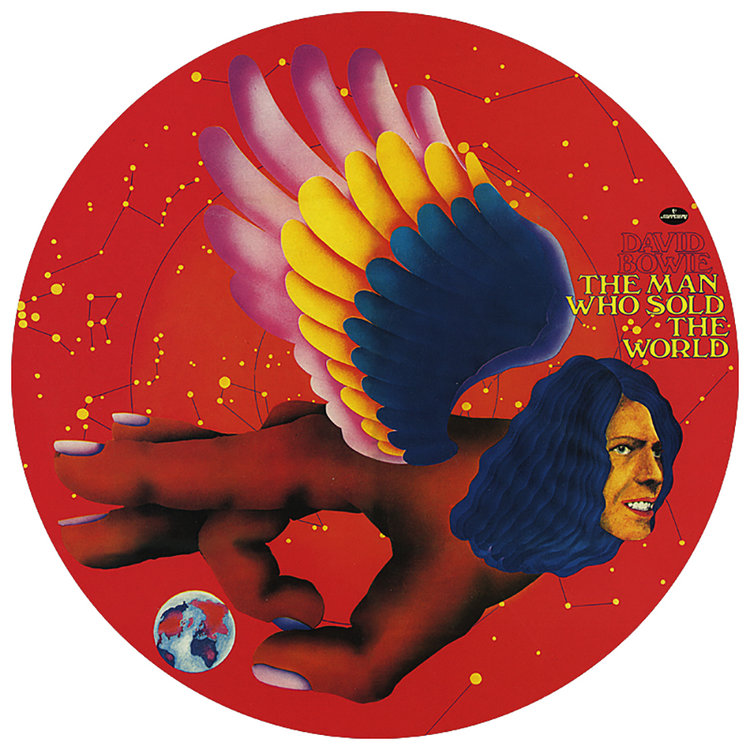
Anyway, “The Man Who Sold the World” got a reissue just two years later. In 1972 Bowie had his commercial breakthrough with “Rise And Fall of Ziggy Stardust and Spiders from Mars”, so RCA Records decided to put “The Man Who Sold the World” out again. The reissue climbed to number 24 on the UK albums chart and stayed there for a whole 30 weeks. In the US, on the Billboard 200, it crawled up to number 105 and hung on for 23 weeks. The 1990 reissue pushed it to number 66 (in the UK). In November 2020, for its 50th anniversary, “The Man Who Sold The World” got another reissue in the US. This time, finally, under the title “Metrobolist”.
Author: Aleš Podbrežnik
