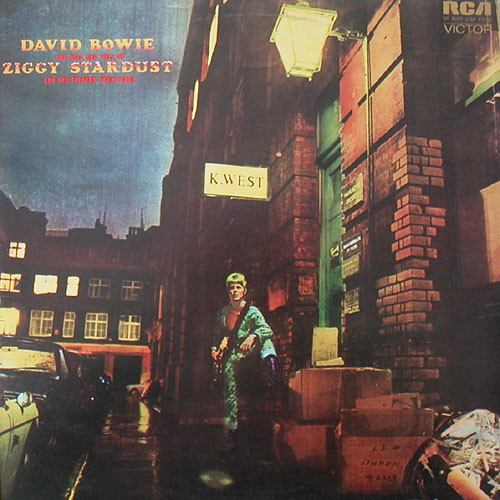
Label: RCA
Release date: June 16, 1972
Production: Ken Scott & David Bowie
Album length: 38:29
Genre: Glam Rock / Hard Rock
Rating: 10/10
In 1972, the single “Starman” hit the music scene like a bolt from the blue, suddenly became a huge hit, officially kicked off the glam rock era and announced the arrival of Ziggy Stardust, an androgynous, bisexual spaceman who was, by trade, a rising rock star with a very special mission on planet Earth. Of all the alter egos of the legendary British artist David Bowie, who, together with his backing band the Spiders From Mars (guitarist Mick Ronson, bassist Trevor Bolder and drummer Mick ‘Woody’ Woodmansey), finally stepped up into the “premier league” of the biggest music stars of the 20th and 21st centuries, Ziggy Stardust was the most beloved, even though he existed for less than two years. In 1972, ‘Ziggy-mania’, or ‘Bowie-mania’, drove the youth of the day wild like few comparable musical phenomena ever have, and it influenced some cultural trends along the way.
Before his fifth studio album, the conceptual masterpiece “The Rise and Fall of Ziggy Stardust and the Spiders From Mars”, Bowie was a fast-rising name who, despite plenty of great musical achievements, still hadn’t reached star status. The outstanding previous album “Hunky Dory” (1971) hinted that something truly magnificent was coming in the near future, something that would thoroughly shake up the music scene of the time, but nobody expected Bowie to become a global phenomenon with Ziggy, or a whole generation of teenagers to imitate his new character, who shocked the self-appointed guardians of public morality with his androgynous look, bisexual hints, controversial messages and wild red glam rock hairdo, which went on to influence the later punk scene too. Bowie’s statement about his sexuality, hugely controversial for those days, added fuel to the fire, and it later turned out to be a deliberate provocation.
Musically, with Ziggy, Bowie completed his mutation into a glam rock star, while his take on glam rock also contained plenty of art rock and hard rock elements from the earlier albums. Guitar master Ronson played a key role here: besides his signature riffs, he was also crucial in writing the arrangements, while Ken Scott once again helped David with the superb production.
“Ziggy Stardust” featured an truly enviable number of songs that became some of Bowie’s best-loved evergreens, all tied together by a seemingly simple but actually fairly complex, socially critical concept about the rapid rise and fall of a glamorous rock musician from another planet, who came to Earth to use music to spread his philosophical beliefs about love and peace. After a fast rise on the wings of revolutionary youth, Ziggy’s mission fails and leads to his tragic end at the hands of the very people who worshipped him most. Bowie reportedly drew inspiration for Ziggy (especially the name) partly from the British singer Vince Taylor and from The Stooges frontman Iggy Pop, with whom he’d go on to collaborate several times. Ziggy was also Bowie’s semi-autobiographical character, with one important difference: unlike Ziggy, who gets torn apart by his own fans in the end and commits ‘rock’n’roll suicide’, David managed to climb out of the decadent life of a brand-new rock star in one piece, even though the situation (especially in the mid-seventies) was already pretty critical.
Propelled by a slow tempo, “Five Years”, still one of the best openers of any (cult) rock album today, is an account of the five years left before the final destruction of planet Earth, when a revolution-minded youth, unlike the apathetic ‘elders’, waits for the arrival of its messiah, who will prevent the cataclysm. They recognize him in the androgynous space musician Ziggy, who becomes their idol overnight. The rhythm is built up by dramatic piano arrangements and David’s wonderfully soulful, chameleon-like singing, which peaks in a rebellious chorus. “Soul Love” is an exquisitely tasty glam rocker with slight soul tendencies thanks to seductive vocal harmonies and playful sax passages, while a punchy guitar riff makes the half-fatalistic, half-glamorous atmosphere come across even better.
“Moonage Daydream”, which carries a similarly surreal message to “Life On Mars?”, soon became a huge hit and one of Bowie’s best-loved songs from his glam rock era. The driving riff, paired with a refined piano arrangement, introduces the space rock star Ziggy, who arrived on Earth full of confidence, rebelliousness and showmanship, delivering it all in a pretty brazen way and driving the youth completely wild with his actions, as they expect him to somehow stop the approaching cataclysm. The phenomenal chorus with its layered vocals deepens the overall ethereal, mysterious and futuristic atmosphere.
A huge fan of science fiction, Nietzsche’s writings and glamour reveals himself in all his glory on the mega hit “Starman”, the personification of Ziggy, which quickly took its place among the immortal classics of David’s career. It also has one of the most upbeat choruses he ever created. In an interview, Bowie mentioned that, contrary to popular belief, Starman and Ziggy aren’t the same character; rather, Ziggy, who in this case isn’t an alien, is a kind of go-between connecting the spaceman Starman and Earth’s youth. “It Ain’t Easy”, a cover of the American musician Ron Davies, where Ziggy already starts giving in to the decadence of a typical rock star (sex, drugs and rock’n’roll), features a simple but highly effective multi-voice chorus and a bluesy guitar riff.
“Lady Stardust”, a romantic, epic confession laid over a gorgeous piano arrangement, indirectly reveals Ziggy’s weak spot, the one that speeds up his decline and farewell: a femme fatale. It’s also a nostalgic tale about the time when the star’s backing band was still solid, as if David already knew that his time with the Spiders From Mars would be short-lived. This song is also said to be dedicated to Bowie’s glam rock contemporary Marc Bolan. On “Star”, which has a sped-up rhythm, David deliberately adopts a rather arrogant, almost unrecognizable and downright cocky vocal approach, because by this point Ziggy has become selfish and rebels against any thought of someone else overshadowing him as the biggest rock star of his time. Ziggy’s ego doesn’t cool down even on the dance-oriented “Hang On to Yourself”, an interesting cross between glam rock and proto-punk that had a considerable influence on the later punk scene.
The title track, which mixes glam rock and hard rock elements, is another unforgettable classic, and after the main bridge it’s distinguished by Ronson’s signature guitar riff, from which the nostalgic central motif is cleverly spun. “Suffragette City” has a rock’n’roll pulse in the style of a ‘post-apocalyptic’ Little Richard, courtesy of the driving piano riff. Bowie reportedly offered this song to Mott the Hoople, who turned it down, but they later recorded David’s “All the Young Dudes” anyway. Ziggy’s dramatic story ends with the melancholic “Rock’n’Roll Suicide”, as the would-be savior is torn apart on stage by his own followers, who realize in the middle of the frenzy that he’s not the messiah who’ll save them from the impending cataclysm. Here Bowie cleverly combined elements of chanson and avant-garde, creating a brilliant finale to the whole concept.
The conceptual classic “The Rise and Fall of Ziggy Stardust and the Spiders From Mars” wasn’t just a record that defined the glam rock era; it was also the key work of Bowie’s career, turning him into a global phenomenon of astonishing artistic dimensions. “Ziggy Stardust” is, quite simply, one of the best records in human history, and it had a very special cultural impact at the time of its release, while the whole concept was a mockery of the entire music industry and its manufacturing of instant stars who quickly burn out. David’s long-held dream of becoming a rock star in a way entirely his own came true, though at a high price, because Bowie, much like Ziggy, had to face all the consequences of his star status. Another problem that started cropping up in the middle of ‘Ziggy-mania’ was that Bowie had become so tightly entangled with his alter ego even off stage that there was a serious danger of schizophrenia. That was also one of the reasons Bowie ‘retired’ Ziggy so quickly and replaced him the very next year with another, somewhat more ‘level-headed’ and empathetic spaceman, who became known as Aladdin Sane.
Author: Peter “Dr. ProgRock” Podbrežnik
This review is dedicated to the memory of David Bowie (1947-2016).
Track list:
1. Five Years (4:42)
2. Soul Love (3:34)
3. Moonage Daydream (4:40)
4. Starman (4:10)
5. It Ain’t Easy (2:58)
6. Lady Stardust (3:22)
7. Star (2:47)
8. Hang On to Yourself (2:40)
9. Ziggy Stardust (3:13)
10. Suffragette City (3:25)
11. Rock ‘n’ Roll Suicide (2:58)
Lineup:
David Bowie – vocals, acoustic guitar, saxophone
Mick Ronson – electric guitar, piano, organ, synthesizer, backing vocals, string arrangements
Trevor Bolder – bass guitar, trumpet
Mick Woodmansey – drums
Rick Wakeman – harpsichord (“It Ain’t Easy”)
Dana Gillespie – backing vocals (“It Ain’t Easy”)