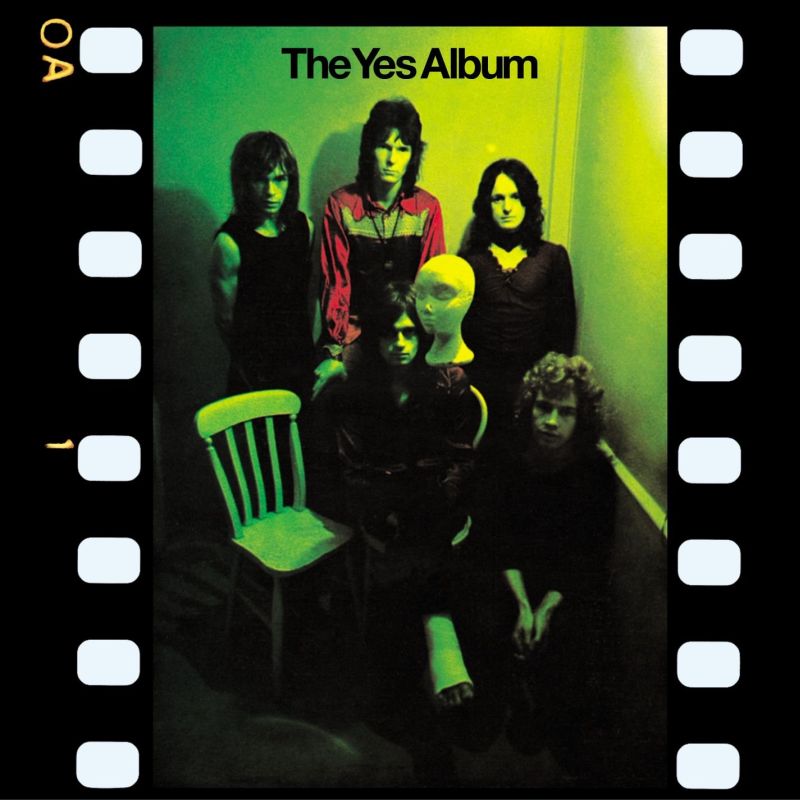
Label: Atlantic Records
Release date: February 19, 1971
Production: Eddie Offord
Album length: 40.56 min
Genre: Progressive Rock
Rating: 9.0/10
(for an English version, scroll down the bar)
Aaaaaaa! Forgive me, but this review is going to sound more like “A Short Story About Steve Howe”. After two studio albums, Yes were hanging over the edge without a clue. Atlantic Records was ready to cut them loose if they kept putting out albums that were this commercially unproductive. With “The Yes Album” they rose like a phoenix from the ashes (even though, on paper and to the ear, they hadn’t really been lacking anything with Peter Banks on guitar) and went through a complete rebirth. Banks left the band and was replaced by the fantastic Steve Howe. Steve’s integration into the band is the main culprit behind a metamorphosis after which neither the world nor Yes would ever be the same. Steve proved right away that he could play his predecessor’s whole legacy with ease. Usually, when bands swap members and fill gaps in the lineup, they struggle to replace the missing piece, hoping and trying to get the newcomer to copy the guy who left as faithfully as possible.
But in Yes’s case, funnily enough, that was the least important thing for them. What was truly groundbreaking was that Steve Howe was the driving force behind this total overhaul, bringing in a whole heap of novelties, and Yes made an enormous qualitative leap in their musical expression. Not only was Steve more versatile than Banks before him, fresh ideas just kept flying out of him one after another. A stylistically diverse guitarist, he had a bit of everything under his belt, from boogie country excursions (The Clap, or the part of Starship Trooper called Disillusion) to jazzy experiments in the solos inside the songs. His quirk was also clear: sitting too long on strummed chords bores him to tears, so in every transition he tries to find a gap that he then airs out with a solo and flips upside down. That’s why he makes good use of the keyboard lines holding down the melodic backdrop, weaving all sorts of specialties into the songs. At its core, Steve’s style comes from jazz. Dropped into a rock band, his style was a real revolution. Nobody before him sounded like him and (luckily) nobody ever will. In one word, simply “Howeish”! And Yours Is No Disgrace is direct proof of Steve’s individuality and the versatility the guitarist is armed with. In the mini hit Your Move he plays around with a Portuguese vachalia (a type of guitar), while the band as a whole radiates remarkable softness and sophistication. The band never sounded like before again, either. Steve pulled everyone up with him to a higher level of quality. T. Kaye on Hammond B3 organ, with his heavy lines, made sure the songs didn’t fall apart into motifs and kept them compact. For the first time in the band’s history, the phrase “being progressive” can sound truly adequate. The full measure of Steve’s improvising is perfectly grounded through the Hammond lines, while the rhythm section got even more room to maneuver with Steve and brought even more melody into the whole Yes expression, and with it additional contrast into the music of Yes.
It might sound ironic, but Yes became harder and lighter at the same time. Harder in sound, lighter in arrangements. Lighter above all in the sense that they found a formula for a coherent combination of motifs that sit in “prime” balance throughout the songs and flow fluidly. They got harder mainly thanks to the sound of Chris’s bass, which kept getting more prominent, and Tony’s aforementioned way of working the organ. Add the contribution of Jon Anderson’s indispensable husky soprano vocals, and the reborn Yes boldly headed toward their most productive period.
Author: Aleš Podbrežnik (the review was first published in 2003 for the Firegoat music web portal)
English version:
AAA!!! Forgive me, but this review is more like “A Story of Steve Howe”. This is where a real take off for the band starts. It changed band’s musical expressions forever. Peter Banks leaves the band, Steve Howe joins in. As a band’s new recruit Steve was already very familiar with Peter’s guitar playing style and that was more than obvious, ’cause he has integrated very easily into the band’s musical directions.
Funnily enough, perhaps even ironically this seemed to be the less important fact for the band. When comes to splits of original line ups it is usual problem for the band to find appropriate replacement and to find a guy who would be successful in copying his predecessor’s playing style. But the point where Peter and Yes parted their ways was, looking back now over thirty years, not only of extreme importance for the band’s further musical directions, but also for the entire rock scene. Highly talented and gifted newcomer served not only as Peter’s replacement, he was also the income of fresh ideas that were new to the band. Steve developed his own guitar style that influences even now days on many young guitarists. Guy brought a good portion of jazz inside the music. And specialty which was translated into new Yes language sounded as nothing else ever sounded or will ever sound. It can be described as strictly “howeish”. Term “progressive” in Yes music, becomes more appropriate for the first time.
Whole sound becomes cleaner and structures are figured now on much tighter and compact way and beside that assembled together on a way that leaves motives to run smoothly and more fluidly as on first two records. Generally speaking the whole sound becomes heavier thankfully to the chunky Hammond B3 organ dashes (Perpetual Change, Yours Is No Disgrace, Starship Trooper) and of course Chris’s heavy bass drives, that began to sound more and more thunderous. On the other hand it seems as if band learned to compose in a much sophisticated and subtle way (Your Move). At those days no one even think about that challenging Steve’s integration into Yesworld would be of such great importance. Steve’s advantages were not only that he was more diverse skilled than Banks (don’t get me wrong Peter, I respect all you’ve ever done for Yes), but also cause his uniqueness and the way how he freely and spontaneously delivered the whole Yes sound a new qualities. So “The Yes Album” (1971) is somehow band’s new beginning, a rebirth if you wish. Listen Yours Is No Disgrace. Howe’s involvement of putting all those unmistakable diverse touches surely outstands in that song. Other guys just followed him. Rhythm line also becomes more melodic then ever before. Accompanied with Anderson’s soaring irreplaceable vocals and Kaye’s keyboard lines that helped in keeping all songs not to fall apart, renewed and stronger Yes moved now bravely forward into their most productive period.
Track list:
1. Yours Is No Disgrace (9:36)
2. Clap (Recorded Live at the Lyceum, London) (3:07)
3. Starship Trooper: Life Seeker / Disillusion / Wurm (9:23)
4. I’ve Seen All Good People: Your Move / All Good People (6:47)
5. A Venture (3:13)
6. Perpetual Change (8:50)
bonus tracks on the 2003 reissue:
7. Your Move (single version) (2:59)
8. Starship Trooper: Life Seeker (single version) (3:27)
9. Clap (studio version) (4:01)
Line-up:
Jon Anderson – vocals, percussion
Steve Howe – acoustic and electric guitars, Portuguese 12-string guitar on track 4, backing vocals
Tony Kaye – Hammond organ, piano, Moog synthesizer
Chris Squire – bass guitar, backing vocals
Bill Bruford – drums, percussion