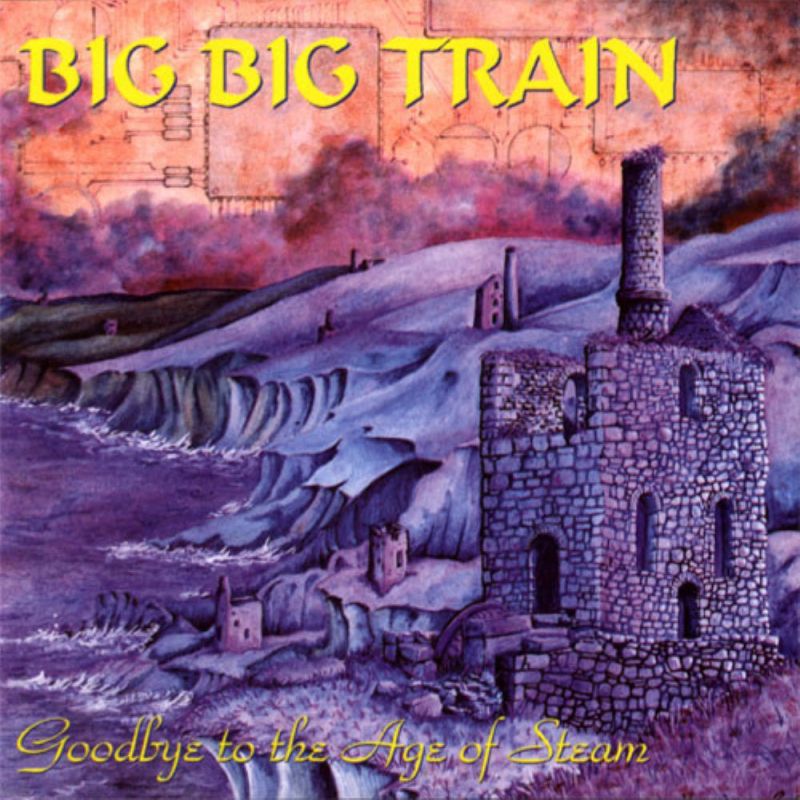
Release date: 1994
Label: Giant Electric Pea
Production: Rob Aubrey, Greg Spawton & Andy Poole
Album length: 51.33 min
Genre: Progressive Rock / Crossover Prog
Rating: 9.0/10
“Goodbye to the Age of Steam” was the debut of English prog-rock revivalists Big Big Train, who today, with the band having won worldwide fame among prog fans, enjoy near-cult status. Big Big Train were founded in 1990 by guitarist/keyboardist Greg Spawton and bassist/keyboardist Andy Poole. Of the two founders, only Spawton is still active in the band today. Before Big Big Train signed with the independent label Giant Electric Pea, who put out “Goodbye to the Age of Steam”, they had already recorded two demo albums off their own bat, “From the River to the Sea” (1992) and “The Infant Hercules” (1993).
Giant Electric Pea, founded by Mike Holmes, guitarist of IQ, spotted the young band’s talent early on. In its early days the lineup featured, besides Spawton and Poole, singer Martin Read, keyboardist Ian Cooper and drummer Steve Hughes. Cooper left the band soon after this album came out, kicking off a trend of unstable Big Big Train incarnations that carried on right up to the end of the first decade of the new millennium, when they slowly managed to “stabilize”. Former IQ keyboardist Martin Orford was the most notable name among the guest musicians on “Goodbye to the Age of Steam”, one of the better debuts in the story of the so-called third wave of progressive rock, in which the leading roles were played not by the Brits (as had usually been the case) but by Scandinavians and Americans.
“Goodbye to the Age of Steam” wasn’t a concept album, but Spawton once said that the central, unifying message of this studio effort is a reflection on ‘how most people eventually stray onto the dark side’ on their life’s journey, or simply get completely ‘lost’.
Most of the songs on the album are steeped in a melancholic, nostalgic mood, which you can hear right from the opening “Wind Distorted Pioneers”. Read was nowhere near the most charismatic or representative singer in the band’s history, since all his successors overshadowed him, so it’s no surprise he left after just three studio albums. Still, you have to admit he did his job very well in Big Big Train’s early phase, with a theatrical, dramatic approach. His melancholic vocals, paired with the occasional layered harmonies, nicely crank up the romantic, nostalgic atmosphere of most of the tracks on the album. Even in their early years Big Big Train weren’t your typical neo-prog crowd gazing backwards at the past, since they were up to speed with some more contemporary art-rock influences. Of course, on most of the songs you can still feel quite a few influences from the legendary Genesis.
“Head Hit the Pillow”, for instance, despite its almost Victorian or ‘old-English’ flavored acoustic-symphonic arrangements, is closer in direction and production to some of the newer third-wave prog bands than to the seventies prog pioneers or the eighties neo-prog scene led by Marillion and IQ. “Edge of the Known World”, with its melodic, multi-voiced chorus and almost Celtic atmosphere, is undoubtedly one of the highlights of this splendid album. Even though Poole was far from the best guitarist in the band’s history, he already had some very neat ideas back then, and almost all of his solos on this album are still a joy to listen to.
On the romantic treat “Landfall”, Read really shines with a dramatic vocal performance, while dreamy guitar-and-keyboard harmonies supply a heaping gallon of nostalgia. On the acoustic, neo-classically leaning instrumental “Dragon Bone Hill”, you can clearly hear that Poole’s guitar technique was shaped most by the two key Genesis guitarists, namely the legendary Steve Hackett and his often unfairly overlooked predecessor Anthony Phillips (no surprise that Big Big Train recorded a cover of Phillips’ solo standard “Master of Time” in 2010). “Blow the House Down” is the first of two longer, epic-leaning pieces, where the ambitious instrumental section impresses most. “Expecting Snow” is a short instrumental that serves as an overture to the epic “Blue Silver Road”, where you can admire above all the band’s already remarkably developed knack for creating nostalgic layered harmonies, which would stay a hallmark of their sound in the years and decades to come. Soaked in indescribable sorrow and romance, “Losing Your Way” is the closing masterpiece, which in quality and depth stands fully on par with the later compositional gems in the band’s history, even if those were on an even higher vocal and instrumental level.
Even though Big Big Train enjoyed generous backing from one of the key bands of the British neo-prog scene when their debut came out, “Goodbye to the Age of Steam” didn’t contain many eighties neo-prog influences. Instead, the band had already carved out their own ‘face’ with a modern-sounding production. Later in their career Big Big Train recorded a good handful of albums better than “Goodbye to the Age of Steam”, but regardless, their debut still ranks among the best in the history of progressive rock. To the band members’ surprise, the album soon got a very good reception, and it seemed Big Big Train would become one of the key acts of third-wave prog rock in their early years, but things got seriously complicated after the poorly received second album “English Boy Wonders” (1997), which almost caused them to fall apart. “Goodbye to the Age of Steam” was reissued in 2011 with three bonus tracks and a different (worse) cover.
Author: Peter “Dr. ProgRock” Podbrežnik
Tracklist:
1. Wind Distorted Pioneers (3:21)
2. Head Hit the Pillow (5:49)
3. Edge of the Known World (4:47)
4. Landfall (4:18)
5. Dragon Bone Hill (3:53)
6. Blow the House Down (9:20)
7. Expecting Snow (2:36)
8. Blue Silver Red (10:04)
9. Losing Your Way (7:29)
Lineup:
Martin Read – vocals
Greg Spawton – guitar, keyboards
Ian Cooper – keyboards
Andy Poole – bass guitar
Steve Hughes – drums
Guest musicians:
David Longdon – flute and keyboards on track no. 11
Nick D’Virgilio – drums on track no. 11
Steve Christey – percussion
Martin Orford – arrangements, backing vocals
Gary Chandler – backing vocals
Ken Bundy – backing vocals
Mandy Taylor – backing vocals
Sally French – backing vocals
Stuart Nicholson – backing vocals
Rob Aubrey – backing vocals