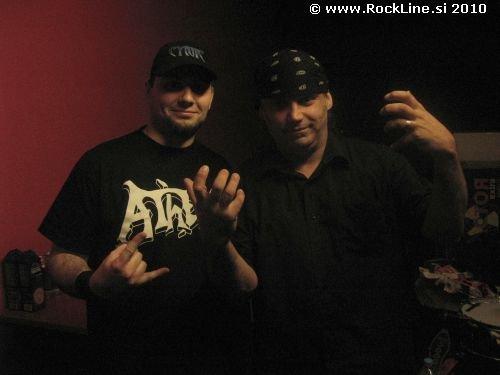
Author: Rok Klemše
Location: Kompleks / Ravne na Koroskem / Slovenia
Interview date: 01.05.2010
Blaze Bayley needs no special introduction. He started his music career in Wolsfbane and in the mid-nineties landed in the giants Iron Maiden. With them he recorded the excellent album The X Factor and the somewhat weaker Virtual XI, and after leaving Iron Maiden he carried on with a successful solo career. He recently released his fifth studio album Promise and Terror, and the tour presenting it has brought him back to Slovenia too. Unlike our chat at last year’s Paranoid Open Air, where he was tight-lipped, visibly tired and in a bad mood, this time Blaze showed a completely different side. Deep faith in metal just radiates from him, and his answers make it clear he really is almost a true (silicon) metal messiah. A really good conversation that could have gone on, but Dawn Patrol had already started tearing up the stage and the dictaphone couldn’t handle that much metal at once…
RockLine: Hey Blaze! Welcome back to Slovenia, the last time we got to see you was at last year’s Paranoid Open Air festival. This time you’re back with the new album Promise and Terror, which is getting extremely good reviews. Tell us how the tour’s going so far.
Blaze: The reaction to the new album from fans and the media has been good. There are a lot more people at the shows. We want to play as many smaller venues as we can. We didn’t want to blow a ton of money on a music video or buy magazine covers, so we picked the old-fashioned way and just took the music to the fans ourselves. In the end, it’s the fans who decide which bands are really successful. I think our music is what matters most, and the fact that we play live, so we ask fans to keep an open mind, and if they think we’re worth their support, we hope they’ll stick with us. We try to play in as many cities as possible in Europe and South America, so lots of people get the chance to come and see us for the lowest possible price, without having to spend extra on a train, a plane ticket or a hotel. We drive ourselves everywhere, we have no crew, our costs are as low as they get, and we take care of all the gear and the “merch” ourselves. That’s how we do it, and sometimes it’s really tough, but there are also times when it all pays off. So far we’ve had nothing but fantastic support. At most shows I got the chance to meet the fans before and after the gig. We play cities we’ve never played before and go back to cities we’ve already been to. I’m glad we’re here today, I really love playing in Slovenia. I love the nature, the weather’s always nice, and the fans are crazy! I hope today turns out to be one of the highlights of this tour.
RockLine: The fans appreciate this direct approach to music, touring and management too.
Blaze: Yeah, I’m not a rock star, I’m a musician. I’m a singer, I love singing and playing metal. The songs we write with the band are about us and our lives. I’ve been on big labels and small ones, and they were all the same. We played fewer shows because we had a label contract. The best times of my life were in Wolsfbane, when we had no deal. All we had was a van, we did everything ourselves, first playing to 3 people and then to 300. Since I had that experience, I decided to start my own label, sort out distribution myself and sell more records at shows. If the fans can see the passion and that the music is the highest standard I’m capable of, why couldn’t it happen again? Sometimes we play for 30 people, sometimes for 300, and other times for 1000, and at festivals even for 70,000. We started the tour in England, and I told the agent I wanted the shows booked so that no promoter would lose a lot of money, so that we could come back next time. That’s what we did, and sometimes we played for almost nothing, we couldn’t even afford guitar strings and food, and other times we got more money. The next year when we booked shows, everyone wanted us again, and suddenly we had a 30-show tour ahead of us. We’re trying to do the same in Europe, but it’s harder because we don’t have as many contacts. Here we’re Blaze Bayley the underground band, and the fans often give us tips and contacts for clubs.
RockLine: Looks like the band is doing much better now that you have your own label. And a big label isn’t screwing you over…
Blaze: Not really, there’s still a huge number of little things to coordinate and I’m not good at them…
RockLine: But you have all the control…
Blaze: Yeah, we try to stay in control. We get to decide when to go on tour, when to start recording an album, what we’re going to record. It doesn’t always work, but I think with Promise and Terror it did.
RockLine: Let’s get to the new album, which got a ton of good reviews and a positive response from fans when it came out. Was Promise and Terror easier to make, given that the whole band contributed and not just you, like in the past?
Blaze: I think that was really the case with the last two albums. The last album was bitter and vengeful, and this album is basically its consequence. We’d had some ideas for a really long time but never managed to finish them, and some were similar and connected, and all these ideas started coming together until they formed the two halves of the album. The second half of the album tells a real story with real emotions, it’s like a concept. The songs on the first half are about never giving up, about individuality, about how to survive in different circumstances. I think a lot of fans can unite around that, because they see we’re honest and that we’re saying it’s really hard sometimes. They hear our music and lyrics, and even if English isn’t their first language, they hear the vocal expression, which lets them understand that my life is hard, just like somebody else’s. That obviously touches people, even though it’s not something I set out to do on purpose, all I did was decide not to censor myself. Whatever I feel is right, whatever is appropriate musically and lyrically, I’ll do it. I think that’s the most honest way, and I changed my style a bit after Blood and Belief, because I wanted to say with it: this is me, and these are the situations I had to go through. At the same time, they’re situations other people have had to go through too. If we have the fans’ support, we’ll be able to keep going like this.
RockLine: Like you said, Promise and Terror has two faces. The first is positive and optimistic, while the second is really dark and melancholic. Was writing this record cathartic for you?
Blaze: No, not at all, it was very hard. I went through my lyrics, Nicko already had some guitar parts. The track that was the basis for The Trace of Things That Have No Words had existed long before, even before The Man Who Would Not Die, but it never fit with the rest. When we looked at it again, it clicked with the other material incredibly fast. Another idea, for example, came up when we were moving gear out of my house, it hit me and I jotted it down on my phone. That’s how Letting Go of the World came about. I didn’t have the lyrics yet, I only had them in bits on my phone, on scraps of paper, and I also started going through my notes and my diary. Raw emotions were present in all of it, clearly the result of losing my wife. That dark period, the sadness, the complete despair is what brought it all about. Because it’s so honest, I think people find it easier to relate to the music. We picked Letting Go of the World mainly because it’s easier vocally, emotionally speaking. It has lots of different parts and melodies, but it also has an aggressive side, the darker side of grieving. It’s like saying the rational world has no room for these feelings, so I’ll let go of the world and find my own place. Everybody tells you how you should feel, how you should react, but the emotions of grief are so personal that we all feel differently. It’s strange that you start asking yourself whether you’re reacting and feeling the right way, because nobody is prepared for moments like that. The album was really hard to record, because we ran out of money, we had problems with the agent, and a huge number of shows were cancelled. We sat there writing the album, but we didn’t have enough money for recording or a producer. We hoped for a miracle, I don’t even know how we pulled it off, but we did. I think it’s one of the best things I’ve ever recorded.
RockLine: All the trouble you went through paid off, because Promise and Terror is a really great record.
Blaze: Yeah, I hope so. If a wider audience picks up on it, I hope people will see that we do things differently from most bands. I think that’s how we can make it.
RockLine: Your lyrics, especially on the first three albums, drew heavily on science fiction, particularly on Silicon Messiah and Tenth Dimension, while the lyrics on the last two albums are more real and rooted in life.
Blaze: Yeah, that’s true. The lyrics were always very personal, but I told them from the point of view of a character, like, this is the character and this is how he feels, instead of this is how I feel. I put myself into the lyrics from a distance. When I recorded Blood and Belief I was going through really hard times, the band was falling apart… I decided to be completely honest. Some of the lyrics I’d had for a long time, and I decided to finally use them. Songs like Tearing Myself to Pieces. The lyrics for Hollow Head were also something I’d had for almost 18 years and never found a way to use. When I’m writing an album I always dig out my notes, and the line “If that phone call is for me, please tell them that I don’t exist” finally came out and described exactly how I was feeling at the time. The song turned out great, but in a totally unusual way. On this album I have a lyric about Galileo, 1633, and how the Inquisition persecuted him and how he had to renounce his beliefs to save his life. The lyrics to God of Speed are about Burt Munro, who in 1923 broke the world speed record on a motorcycle, which also became the longest-standing world record. So it’s about another person who said he’d do something even though it was impossible. I admire people like that.
RockLine: Your lyrics are often tied to these strong personalities. Back on Tenth Dimension, for example, you built the concept around the story of Oppenheimer and the atomic bomb.
Blaze: Yeah, in a way, definitely! Some of the concept for Tenth Dimension did get lost, because the people I was working with didn’t have faith in me and in the fans, they claimed the concept would seem stupid to them. But the idea drew a parallel with Oppenheimer: my character, a scientist and doctor, discovered the human soul, found out how to measure it, how to capture it and how to exploit it. Of course, just like in Oppenheimer’s case, the government got involved and wanted to use the discovery for its own purposes, like, now we can hold all people hostage: you can’t have an afterlife unless you go through us. The character then destroys the device he invented and wants to tell everyone that there is an afterlife. That people have to believe, whether they’re Christians or Muslims, that there’s life after death. I also believe we’re all connected.
Rockline: How do you put music together now that the lineup is stable and you don’t always have to look for new members?
Blaze: It totally depends, we don’t limit ourselves. Sometimes I have a melody on my own, sometimes Nicko has a guitar part, sometimes Jay brings lyrics and riffs, like for a song on Promise and Terror. Sometimes I even have the melody, with lyrics and arrangement, and I ask the others to play it just like that, for example Waiting For My Life to Begin. Surrounded By Sadness, for example, grew out of just the phrase of the title.
RockLine: You recently put out a book with a really funny anecdote in it. If I’m not mistaken, on the first day of writing the first album with Iron Maiden at Steve’s place, you stepped in dog shit?
Blaze: Yeah, that’s true (laughs). His cleaner had already left, he looked at me and asked if I’d stepped in dog poo. His dogs, big Great Danes, are the size of small horses, so they produced a really huge pile of dog shit. I thought I’d get fired on the first day, on my very first day creating with Iron Maiden I was cleaning dog shit off the floor. Still, we wrote some really good music that day, and I never liked those dogs, and I think they don’t like me either.
RockLine: Does it bother you that people still ask you about Iron Maiden?
Blaze: No, not at all, it’s a big part of my life and I’m proud of it. They’re a fantastic band, I was a fan before I joined them. As a fan of the band, I know it’s like being a former member of Kiss. Every Maiden fan knows every member of Maiden. I’m really proud of that, and I think the music on The X Factor is timeless and has survived. It was a hard period, but also a truly wonderful one. Now I think more and more Maiden fans are getting interested in my music too. Before, only a small percentage of people were interested in Blaze Bayley. I think it’s only now, ten years later, that people pick up The X Factor, wonder what this guy is up to these days, listen to my version of Clansman, and only now are Iron Maiden fans getting interested in Blaze Bayley.
RockLine: If I’m not mistaken, you started preparing the Silicon Messiah concept back when you were working on the third album with Iron Maiden?
Blaze: Yeah, I started working on a few songs like Born As a Stranger and Ghost in the Machine on the Virtual XI tour. I’d record these ideas on a dictaphone and write them down.
RockLine: One last, clichéd question. What does the future hold for Blaze Bayley?
Blaze: I don’t know, it depends on the fans. If the fans support me and want to hear me at shows, I’ll carry on. If they want to hear my songs, I’ll write new ones and record new albums. If not, I’ll stop. My future career is entirely in the fans’ hands.
interview conducted, translated and edited by: Rok Klemše
photos: Aleš Podbrežnik
Photo Gallery