Label: Frontiers Music Srl.
Release date: March 6, 2020 (reissue) / March 24, 1998 (original release)
Production: Buck Dharma
Album length: 41.17 min.
Genre: Heavy Metal / Hard Rock
Rating: 9.0/10
Ladies and gentlemen, here’s the reissue of Blue Öyster Cult’s 13th record, “Heaven Forbid”, first released in 1998. Why was that even necessary, when it’s not even a round anniversary? A logical and fair question. But the move ties in with the fact that, after nineteen years, Blue Öyster Cult are putting out a new studio album. Two years ago, the legendary Blue Öyster Cult signed a deal with the Italian label Frontiers Music Srl. When it comes to reviving the name of the “cult of the blue oyster”, the label already showed serious commitment in the first half of this year. It took care of the reissue of “Cult Classic”, a reissue of “Curse Of the Hidden Mirror” is planned for mid-June, and at the start of March this year we got the reissue of “Heaven Forbid”. This year the label has also already put out two brand-new live albums by the band, and a third lands on the same date as the reissue of “Curse of the Hidden Mirror”.
So, up for reissue is “Heaven Forbid”, an album we here at RockLine, in all these years of rock soul-searching, still haven’t managed to put under the reviewer’s microscope. It originally came out four years after the “compilation” of re-recorded hits “Cult Classic” and ten years after the previous studio album “Imaginos” (1988), if we don’t count the music for the flop film “Bad Channels” (1992). Why the “Cult Classic” phase matters here, you’ll find out soon. Blue Öyster Cult survived the eighties with some serious sonic and stylistic experimenting. They released few albums, but those, especially in terms of the evolution of the band’s sound, are hugely interesting and, on top of that, very good efforts. Sadly, every last one of them got slammed by music critics. Mostly because of (unfairly, as far as the band goes) exaggerated comparisons with the seventies achievements, which for Bloom, Dharma and Lanier were nothing more than a pale, distant memory by 1998. So the band arrived at the studio to record “Heaven Forbid” after first giving some classic riffs from their treasury of evergreen seventies hits a studio makeover, which is exactly what “Cult Classic” stands for. When it comes to hunting for family ties with the seventies, “Heaven Forbid” is a more classic-rock “sobered up” album compared to the albums released after “Cultosaurus erectus” (1980). “Heaven Forbid” again carries more tangible musical substance that we can connect to the spotless legacy of the big seventies, when Blue Öyster Cult were moving mountain ranges of rock pioneering and opening up new dimensions for the future evolution of heavy metal. “Heaven Forbid” has quite a bit of open flirting with the classic R&B sound, primal rock’n’roll instincts and blues rock too, though it has to be stressed that it would be total madness to go looking on “Heaven Forbid” for, or demand, the magic of the golden days, when drummer Albert Bouchard was still in the band. “Heaven Forbid” is an excellent achievement in a one-of-a-kind blend of heavy metal and hard rock, creating Blue Öyster Cult’s unmistakable art metal and art rock aura. Even though the band left the commercial success of the golden seventies far behind, “Heaven Forbid” holds a special place in their discography.
The reissue got a sound remaster, handled, as you’d expect, by Frontiers Music Srl.’s go-to guy Alessandro Del Vecchio. Nothing wrong with it. The contrasts between the building blocks of the sonic picture are deepened further and the colors intensified, but otherwise “Heaven Forbid” is the kind of classic where you’re more likely to do it an injustice than a favor by “fixing” the sound. So it’s an unnecessary move, one that’s more likely to make the band’s stiff-necked diehards angry than anything else.
The ten new original songs are very conscientiously worked out, both sonically and compositionally. As compositions they reach a high level of variety in how they use their guiding ideas, while the band keeps the recognizable trademarks of its musical aura on them. Once again the main players are Eric Bloom and Buck Dharma. Once again they’re also the main creators of the mood swings on the album. Eric’s vocal jargon again owns the more wound-up songs on the album, where his incredibly piercing, villainous, accusing and rough vocal comes through, crowned with giant charisma that always gives the songs a note of uniqueness. On the other side there’s the no less charismatic vocal of Buck Dharma, mostly used again in the more “relaxed”, more musical spots, where that same voice manages to generate feelings of coldness, detachment, mystery,… These two voices are the essential element that has always guaranteed striking mood contrasts and a dynamic flow of events on the band’s albums. By conjuring up a gloomy, even creepy atmosphere, Blue Öyster Cult once again pull off a tense drama theater that keeps the listener in a constant “checkmate” position (held tight beside them).
This album too is full of mysteries, the occult, “discussion circles” with extraterrestrial intelligence, and it goes conspiratorial too, right from the opener See You in Black. A bristling, caustic track built on metal thrashing about, it lives up to the heavy metal label, as it was first used in the galaxy, a long time ago, in the very context of Blue Öyster Cult, by their (late) manager and visionary Sandy Pearlman. In it, Bloom slyly and cunningly urges his female friend to get herself into a black dress (“…I like to see you in black…”) and, dressed like that, do away with her husband, since he’s been treating her violently, beating and humiliating her, for far too long.
Power Underneath Despair carries quite a few links in its opening phrase to the cult Blue Öyster Cult riff from the seventies, This Ain’t the Summer Of Love. It just works differently, because it’s of course a different composition. This is one more proof that on this album Blue Öyster Cult found a connection with their roots, even though the album never comes across as retro-nostalgic. Something like that would be downright pathetic for composers this good. Power Underneath Despair deals with the power you gain when you’re born again. As the Gospel tells it, and other sources dealing with mysticism too, you have to die first. But die in what way? What does that actually mean? The lyrics tell of a man who was betrayed and ends up in prison. During his sentence he focuses his thoughts, and when he gets out of prison, he takes revenge and kills everyone who was responsible for the betrayal. A striking chorus, where Eric Bloom reigns in all his glory.
A top-notch composition in terms of potentially taking over the radio frequencies, and the one that stands out on this album, is Harvest Moon. It’s considered a distant cousin of the cult hit Don’t Fear (The Reaper). With his vocal, Buck Dhrama creates an atmosphere that makes you freeze, as he calls out the wandering souls of the dead from battlefields of centuries ago. There’s an excellent modulation into the mid-eight passage, where Buck flips the mood with the high-octane voltage of an inventive solo. Harvest Moon is still regarded today as one of the best songs, in terms of potential hit, that Blue Öyster Cult have created since Burning For You.
In Live for Me the vocal is again taken over by Buck Dharma. The chord progression, or rather the way the chords are strung one after another, hints that this track could spill over into the hit Burning for You at any moment, but the chorus pulls it into a completely different sphere. Live for Me tells of a guy who was in a car accident together with his brother, who died in it. The accident was caused by a drunk truck driver. The brother dies in his arms and says his last words to him: “Live for me. Do all the things I won’t get to experience. Live your life to the fullest, but live wisely, so you survive and live for me.”
The song The Cold Grey Light Of Dawn is a kind of tragic realization of a personal nature. A simple realization of the fact of mortality. Of dying. That your life, in terms of reaching your goals, is limited. Real World asks what’s reality and what isn’t. Everything is subjective. Miracles hover at the edge of perception, hiding behind us, waiting for us beyond the horizon. Damaged is a rhythmically sharpened song that flirts with funk, and the phrase is also fitted out with chunky Hammond lines. The verses tell of a man who tries to hold back, rein himself in and behave nicely, but burns out in the process. Because he enjoys being “a little crazy”. An “Eric Bloom song”. From head to toe.
X-Ray Eyes is a track built on Buck’s favorite chord line, Am-Gd-Fd, with which he harnessed a whole bunch of hits, led by Don’t Fear (The Reaper). The song comes with an ominous synthesizer backing that creates an extremely pleasing depth contrast in the sonic picture. The lyrics ask what it would be like if someone could see more than the eyes of reality perceive. And would you even want to see something like that? To actually see everything the effect of drugs really brings, and what God looks like? The man with these eyes warns that it’s better to give up such a delusional wish. The lyrics were inspired by the low-budget film in which Ray Milland played one of the roles. In the contrasting follow-up, the metal-vampirized Hammerback brings Bloom’s enraged pose of paranoid realization that you have to be ready for action at every moment, since we live in uncertain times. The closing Still Burnin’ is, in its message, a continuation, or second part, of the story of the hit Burning For You. Tacked onto the tail end of the album is a live version of the “Mirrors” track In Thee. Most likely this was a move meant to add to the commercial appeal of “Heaven Forbid”.
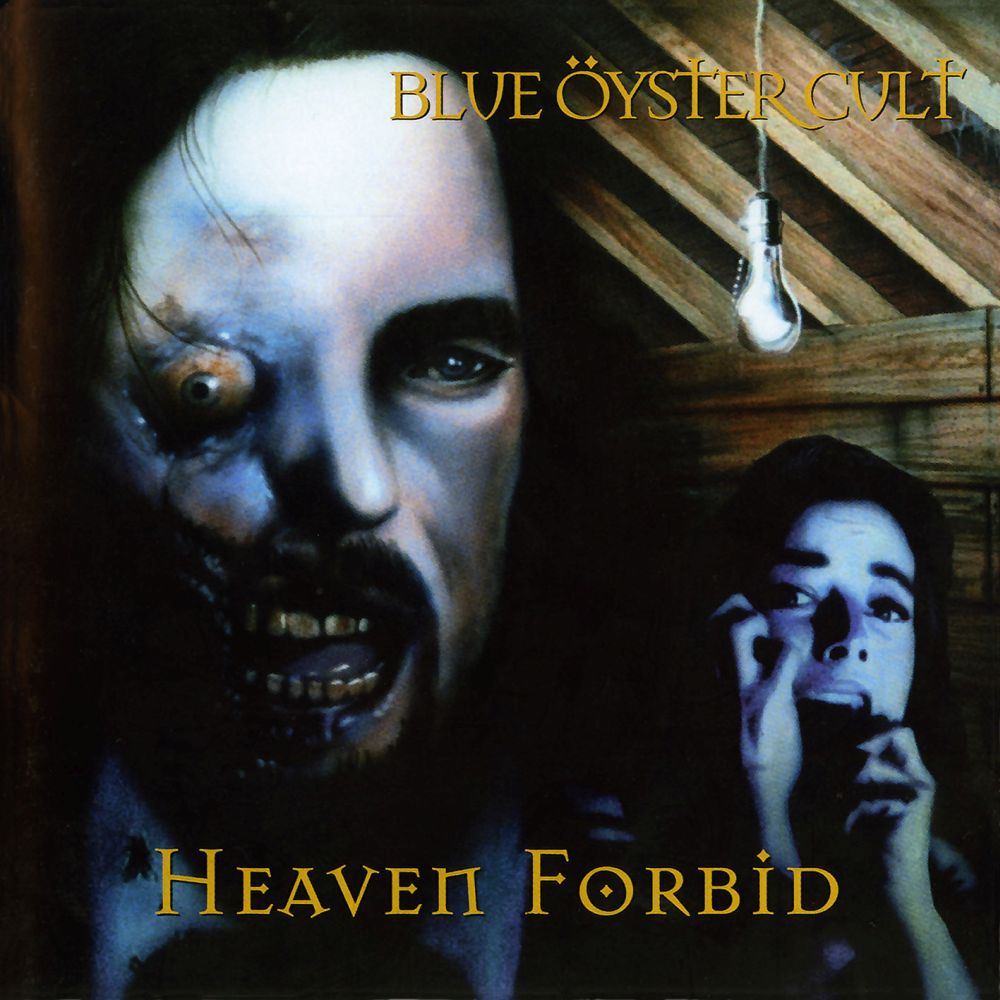
The cover of the current reissue of this album boasts a motif that could be lifted from any horror flick out of your nightmares. Among Americans the cover picked up the nickname “Melting Man”. In the US this cover was already used at the album’s first release. For the reissue, the very same cover is used in the other markets of the world too. Also in Japan and Europe, where the album came out in 1998 with a different cover. That one was created inspired by the image of the film actress Morgan Fairchild.
Most of the lyrics for the album were contributed by American horror and science fiction writer John Shirley. The working title of the album was “Ezekiel’s Wheel”, which is one of the tales from the Bible about the transformation of African Americans into Christians, or, to put it bluntly, about visits from extraterrestrials.
“Heaven Forbid” remains the overlooked album in the band’s huge discography, which makes a lot of sense when you set it next to Blue Öyster Cult’s seventies legacy. Still, it’s a superb effort, one where the band worked some of the essence of their seventies output back into the material, while breathing in the then-modern studio production tricks at full lung capacity. That kept the album and the band relevant at the time of release. It’s an excellent achievement in the one-of-a-kind musical character that has always adorned this unique rock band, and it stands in the line of released albums on an artistic throne of its own. Even though “Heaven Forbid” wasn’t a big seller for Blue Öyster Cult either, after a long time it at least met with positive reviews from music critics again. Blue Öyster Cult had been unfairly waiting far too long for something like that. Far too long. More than a whole decade.
Author: Aleš Podbrežnik
Track list:
1. See You In Black
2. Harvest Moon
3. Power Underneath Despair
4. X-Ray Eyes
5. Hammer Back
6. Damaged
7. Cold Gray Light Of Dawn
8. Real World
9. Live For Me
10. Still Burnin’
11. In Thee
Lineup:
Eric Bloom – vocals, guitar, keyboards
Buck Dharma – vocals, guitar, keyboards
Allen Lanier – guitar, keyboards
Danny Miranda – bass guitar, backing vocals
Chuck Bürgi – drums, backing vocals
Bobby Rondinelli – drums on track no. 9
Jon Rogers – bass guitar, backing vocals on tracks no. 2, 3, and 10
Tony Perrino – additional keyboards
George Cintron – backing vocals