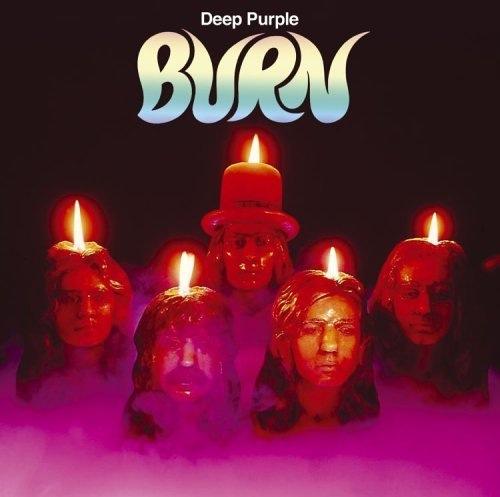
Label: EMI Records
Release date: 15. 2. 1974
Producer: Deep Purple
Album length: 41.37 min
Genre: Hard Rock / Heavy Rock
Rating: 10/10
With their eighth studio album »Burn«, the legendary English heavy rock titans Deep Purple rose like the mythological phoenix from the ashes of the Mark II lineup and came back in a renewed form with one of the best achievements of their long and colorful career. »Burn« marked the birth of the so-called Mark III version of the band, featuring the then practically unknown singer David Coverdale (ex-The Government) and singer/bassist Glenn Hughes, who had previously been earning a decent crust with funk rock pioneers Trapeze. Hughes had been on their radar even before he became an official member, since he was originally envisioned as the bassist and lead singer, with Deep Purple planning to carry on as a four-piece after the departure of Ian Gillan and Roger Glover. Coverdale, meanwhile, joined the band after the guitar virtuoso Ritchie Blackmore, a man wise to every trick in the book, decided he wanted an additional singer with a strong blues streak.
Coverdale, who had a dreadful image in his early Deep Purple days, being not only chubby, pimply and half blind but also completely clueless about fashion, brought to »Burn« an unmistakably masculine, eroticism-laced vocal approach. Hughes, meanwhile, hooked on funk (and later on cocaine) and sometimes dubbed the white Stevie Wonder, was a truly versatile vocal gem whose voice already blew past any genre boundaries. Their distinct, clearly contrasting vocal styles blended superbly while trading individual verses on »Burn« and fit perfectly into the band’s changed style, which suddenly started soaking up far more blues, boogie, soul and funk. Hughes was an especially passionate champion of a funkier sound, while Blackmore was far more drawn to a heavier dose of bluesy subtlety and melancholy, and funky sophistication got on his nerves more and more. Before long the first conflicts over the band’s future sonic direction began brewing on that front, though on »Burn« the balance was still very good and never tipped into any stylistic extreme.
At the same time, thanks to structurally far more complex and inventive, in places almost progressive songwriting ideas, »Burn« once again hit the punchy sonic standards of the classics »In Rock« (1970) and »Machine Head« (1972), compared to its relatively pale predecessor »Who Do We Think We Are« (1973). With its untamed, raw nature and the eroticism-spiced energy radiating from both lead vocalists, and above all with a fiery atmosphere that never lets up across the whole album, it wrote itself into the hearts of the band’s followers and heavy rock fans in golden letters soon after release. The moody but brilliant Blackmore blossomed again on »Burn« with his virtuoso guitar masterpieces, and he helped keyboard wizard Jon Lord, who gave nothing away when it came to crafting melodramatic organ meanders, with the assistance of the ever damn-effective drumming miracle-worker Ian Paice, create some of the most vivid classics in the whole Deep Purple career.
Coverdale, who soon after the first live shows shed his zits and excess blubber, fixed his eyesight with eye drops and learned which clothes didn’t make him look like a scarecrow, demonstrates his distinctive vocal authority more than convincingly right on the opening title track »Burn«, a hard rock wrecking ball that is still one of the most beloved Mark III evergreens today. Blackmore’s fiery guitar riff, backed by Paice’s rolling drums, tears down everything in its path while weaving a fully fired-up, fast-paced atmosphere, carried on the wings of dual vocal harmonies between a vengeful Hughes and a thoroughly furious Coverdale, with the latter singing the key verses. The mighty multi-part chorus is the epic peak, while Hughes adds a touch of refinement with his soul within this incarnation of technically accomplished heavy rock cataclysm, which sucks the listener straight into the heart of the album. Ritchie’s mellifluous guitar solo is a real balm amid the raging drum barrages and Hughes’ energetic bass lines, while Lord’s rustling organ passages provide the richest, most potent rhythmic undulation imaginable.
The next classic, »Might Just Take Your Life«, set at a mid-tempo for a change, is another superb incarnation of Mark III’s songwriting polish and exceptional feel for blending hard rock, blues, soul and funk. Coverdale’s vocals, accompanied by mighty organ passages and a potent guitar riff, instantly conjure an eroticism-soaked mood, while Hughes joins him on the epic chorus over funk-flavored rhythmic nuances. The ambient magic between the two vocal champions is simply incredible, and it’s worth noting that Hughes, who this time adds a nice dose of soul with his singing, was not only a phenomenal vocalist but also a technically accomplished bassist with a remarkable ear for melody. Jon Lord impresses at the end with a piercing organ solo, while the closing vocal harmonies carry this splendid standard, which was also released as a single, completely into soul waters.
The heavy rock masterpiece »Lay Down, Stay Down« is spiced up with a furious guitar riff, a quickened tempo and a thoroughly raging vocal interplay between Coverdale and Hughes that creates an exceptionally dynamic overall atmosphere. The lyrics are laced with erotic fantasy, which already suited Coverdale down to the ground and would later define his entire career, while the eternally debauched hedonist Hughes was born for this kind of lyrical outpouring anyway. Ritchie’s complex guitar solo in the middle section is a real treat, while the potent rhythmic nuances keep a strong bluesy pulse going throughout.
The romantic evergreen »Sail Away« is likewise among the best achievements of the Mark III incarnation of Deep Purple, with both lead singers delivering emotionally all-in vocal performances and literally competing over who can conjure the more intense atmosphere. The nostalgic aura is fueled by a funk-tinged guitar riff and boogie-style rhythmic quirks, forming a fine backdrop to Coverdale’s inconsolable daydreaming and Hughes’ furious murmuring, peaking in the unforgettable chorus. Blackmore’s weeping guitar passages hit the height of ambient magic with the closing solo.
On the funk-tinged standard »You Fool No One«, a bouncy, fully wound-up rhythm is led by playful guitar phrases and cowbells, while mighty vocal harmonies once again set the stage for a passionate swap in the lead vocalist spot. Blackmore bursts into bloom once more with a sensual guitar solo, while Paice keeps the potent nature of this splendid achievement going with mighty drum fills. »What’s Going On Here«, which wades into somewhat bluesier waters, is marked by a spirited guitar phrase, ‘barroom’ piano and harmonic vocal trading between Coverdale and Hughes. While Hughes brings refined cheekiness with his soul- and funk-based singing, Coverdale’s vocal approach is once again the picture of untamed passion. Lord’s polished piano solo adds a dash of glamour to the prevailing punchy atmosphere, which suits the vocal outpourings of the two notorious hedonists nicely, though it has to be added that Coverdale was still a real greenhorn and amateur next to Hughes when it came to the (stereo)typical enjoyment of the fruits of rock’n’roll stardom (sex, drugs and rock’n’roll), but the student, especially in the ‘sex’ department, soon outgrew the teacher.
The immortal blues rock epic »Mistreated« is the magnum opus of the whole album and of the Mark III version of Deep Purple. Despite its seemingly simple opening blues structure, it soon proves to be a far more complex creation with plenty of progressive tendencies. Blackmore reportedly came up with this unforgettable evergreen back in the Mark II days, but saved it for after the departure of his ‘best friend’ Ian Gillan. Here Coverdale fully takes over the lead vocals, which is as it should be, since this tale of a broken heart, which with its extraordinary ambient magic still doesn’t stop wowing people today, was simply made for his distinctly masculine, heart-rending voice.
David’s extremely demanding vocal performance, most impressive for its unusually honest emotional intensity, rides on the melancholic wings of Blackmore’s inconsolable guitar phrase, while the Paice-Hughes rhythm section lays down calm yet complex rhythmic nuances. Ritchie then conjures up one of the best solos of his entire career, which gives a clear insight into how his guitar artistry was becoming ever more piercingly melancholic before his farewell to Deep Purple and the start of a new story called Rainbow. In the closing section Coverdale tears his wounded heart wide open, and with the help of ‘Heep-esque’ multi-part harmonies and yet another phenomenal guitar solo, an epic atmosphere builds toward the grand finale, one that still sends shivers down your spine to this day.
The prog rock instrumental »A’ 200« is by far the strangest experiment on the whole album, since it is completely different from every composition before it and marks the first Deep Purple instrumental since the end of the Mark I era. This is Lord’s big ‘star’ moment, as the legendary keyboardist takes the central instrumental lead this time and experiments widely with the moog modular synthesizer, backed by mighty guitar passages and a combative drum march. Once again there’s no shortage of another mouthwatering Ritchie guitar solo, but the main source of the exceptionally pompous and melodramatic mood is Lord’s brilliant performance on the moog modular, which for a moment recalls similar instrumental maneuvers by the legendary Emerson, Lake & Palmer.
The CD reissue of »Burn« released for the album’s 30th anniversary comes with a few tasty bonus goodies. Besides alternate versions of the classics found on the regular part of the album, there’s also a ‘forgotten’ prog rock, instrumentally tinged masterpiece with the odd title »Coronarias Redig«, which sounds like Deep Purple had a baby with Uriah Heep (melodramatic, synth-made multi-part harmonies in the chorus) and ELP (brilliant textures on the moog modular). Blackmore’s melodramatic guitar outpourings already lean pretty heavily toward his later works with Rainbow, since he later used the main motif for the unforgettable classic »Catch the Rainbow«. This instrumental treat is a nice example of how a classic Deep Purple instrumental jam grew into a proper, remarkably interesting composition with real shape and a melodramatic core, one that’s fully on a par in quality with the ‘regular’ »Burn« material.
»Burn« was the magnum opus of the newborn Mark III lineup, which blazed with incredible fire from its very first post-birth pangs, hell-bent on showing the world a revitalized face of the legendary English heavy rock champions. For the reborn Deep Purple it was a huge artistic and commercial triumph that landed right when they needed it most and gave them a fresh burst of energy for crafting sonically complex, thrilling and innovative studio achievements. The incredible vocal talent of both new lead singers ensured an exceptionally successful sonic transition and the realization of Blackmore’s blues-coated sonic vision, which, against his plans, Hughes’ funk influences soon began to eat away at. The moody man in black somehow gritted his teeth through the ever-growing infusion of funk for his last studio dance with the Mark III lineup, which ended the moment the dose of the unwanted genre became too much for his ears.
Author: Peter Podbrežnik
Tracklist:
1. Burn (6:00)
2. Might Just Take Your Life (4:36)
3. Lay Down, Stay Down (4:15)
4. Sail Away (5:48)
5. You Fool No One (4:47)
6. What’s Goin’ On Here (4:55)
7. Mistreated (7:25)
8. “A” 200 (3:51)
Lineup:
David Coverdale – vocals
Glenn Hughes – vocals, bass guitar
Jon Lord – keyboards, Hammond organ
Ritchie Blackmore – guitar
Ian Paice – drums