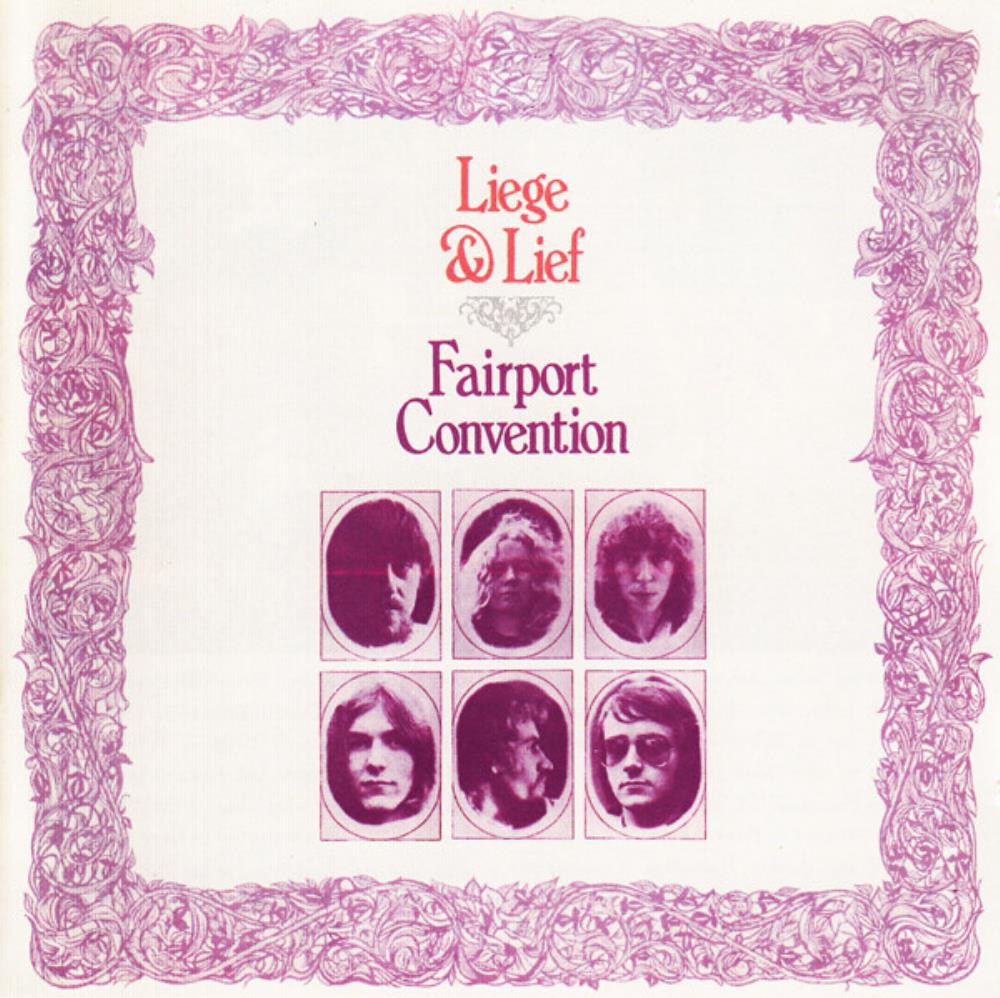
Release date: December 1969
Label: Island Records
Producer: Joe Boyd
Length: 40:33
Genre: British folk rock/folk rock
Rating: 10/10
With “Liege & Lief,” folk rock pioneers Fairport Convention made their first evergreen masterpiece, and probably the most important and most revered British folk rock album of all time. It came together thanks to the outstanding guitarist and songwriter Richard Thompson, the ethereal-voiced singer Sandy Denny, bass visionary Ashley Hutchings, guitar enthusiast Simon Nicol, ‘Renaissance’ fiddler Dave Swarbrick and superb drummer Dave Mattacks, and the result was a groundbreaking album for English folk rock.
Rearranged covers from the treasure chest of centuries of British folk music were rounded out by increasingly complex originals, while the electric guitar, mostly thanks to Thompson, started playing a much bigger role in their music than on the previous three albums. Mattacks successfully stepped in for Martin Lamble, his predecessor who died in a road accident, while Swarbrick, who had already guested with Fairport Convention on the previous album “Unhalfbricking” (1969), practically revolutionized the sound of these ever more ambitious folk rock pioneers with his string arrangements. Some of Thompson’s most beautiful and personal lyrics are found on this very album, which ‘wrote a key chapter’ in British folk rock. By this stage of Fairport Convention’s evolution, every trace of American folk rock influence had completely vanished, and the band had finally forged its own distinctive sound.
On “Liege & Lief,” folk rock classics follow one after another, and the album’s sound is defined not just by the originals but above all by electric-guitar versions of traditional English folk songs, Swarbrick’s fiddle wizardry and Sandy’s dramatic yet velvety singing. The opener “Come All Ye,” a prototype Fairport Convention classic, is a completely original creation with a rousing pulse, a hefty guitar riff and a multi-voice chorus.
“Reynardine” is a rearranged traditional English folk ballad and one of the early examples of a thorough, convincing fusion of traditional English folk and rock music. Reynardine is a mythological creature from Anglo-Saxon folklore, a kind of magical fox who turns into a seductive dandy when it suits him. That’s how he likes to hypnotize young women, who follow him in a trance to his castle. What evil or benevolent fate awaits them there is still a matter of folk speculation to this day. The lyrics make it clear that this is a ballad from Victorian times, since it carries a heavy moral lesson warning girls about assorted unknown ‘foxes.’
“Matty Groves,” which quickly established itself as a Fairport Convention evergreen and is now the name of their independent label, was a rearranged version of a traditional folk ballad from northern England, telling the story of forbidden love between a poor young man and a beautiful noblewoman. The story ends tragically, when the noblewoman’s rich husband discovers her lover and kills Matty first, then his unfaithful wife. In some versions he kills himself at the end too, after realizing what true love means and seeing the error of his ways. The song contains one of Thompson’s most iconic guitar riffs, with a superb interplay of melancholic fiddle solos. Sandy’s dramatic singing and a sudden shift in the middle section, where the distinctly minor-key mood gives way to a frolicsome major key, mark the moment when the band suddenly turns this musical lament into something close to a dance-rhythm romp.
The romantic ballad “Farewell Farewell,” with phenomenal vocals from the tragically departed singer, was dedicated to Richard’s late girlfriend Jeannie Franklyn, who died along with former drummer Lamble in the aforementioned terrible road accident that nearly broke the band up. “The Deserter” is a rearranged traditional English folk song that leans on dense, ringing fiddle arrangements.
The bouncy instrumental medley “The Lark In the Morning/Rakish Paddy/Foxhunter’s Jigg/Toss the Feathers,” with its wild guitar and fiddle runs, is one of the first examples of progressive folk rock, something the cult band would flirt with again in later years. The level of virtuosity here is enviable and shows what gigantic progress this band made in just two years since forming in 1967. It all sounds like a cross between the soundtrack to an Irish wedding dance outside a hunting lodge and the accompaniment to a morning hunt, with Scottish ‘highlanders’ chasing local game.
“Tam Lin,” another “Liege & Lief” highlight, is a rearranged traditional folk song from the border region between England and Scotland. It tells the story of a young girl’s bond with a human-fairy hybrid named Tam Lin, a former mortal. He wants the help of the fair maiden to break the spell the Fairy Queen put on him. An atmospheric drama with Celtic-flavored arrangements and strongly dramatic vocals builds from start to finish through clever rhythmic twists.
The album closes on a melancholic note with the evergreen “Crazy Man Michael,” another original, whose lyrics are about a man who killed his one true love and has since been doomed to wander the world forever, to no purpose. According to some accounts, the lyrics are autobiographical for Richard, written soon after the tragic loss of his beloved. Some reissues of “Liege & Lief” include a special vocal version of the Fairport Convention standard “Sir Patrick Spens” as a bonus track. The song officially first appeared on their next album, “Full House” (1970), while this early version of the rearranged traditional British folk song was recorded with Sandy still on lead vocals.
“Liege & Lief” is the cornerstone of the British folk rock scene and an album that every lover of good music should own, even if folk rock isn’t one of their favorite genres. With it, Fairport Convention made their most important and representative statement, and they finally landed the commercial breakthrough they’d been chasing for so long.
Sadly, it wasn’t enough to convince Denny and Hutchings to stay in the band. Hutchings left and kept laying the foundations of English folk rock, first as a founding member of Steeleye Span and later of The Albion Band. Denny, together with her future husband Trevor Lucas, formed the short-lived Fotheringay, named after the Fairport Convention classic of the same name. Lucas later joined Fairport Convention, and in 1974 he lured Denny back too. In her short life she also recorded four solo albums and guested on the Led Zeppelin classic “Battle For Evermore.” The seemingly fairytale reunion didn’t get the commercial response everyone hoped for and lasted only for the live album “Live Convention” (1974) and the studio album “Rising for the Moon” (1975). Denny’s life ended tragically in 1978, at just 31, from complications after a fall down the stairs.
Review by: Peter Podbrežnik
Tracklist:
1. Come All Ye (4:55)
2. Reynardine (4:33)
3. Matty Groves (8:08)
4. Farewell, Farewell (2:38)
5. The Deserter (4:10)
6. Medley : The Lark In The Morning/ Rakish Paddy/ Foxhunter’s Jig/ Toss The Feathers (4:00)
7. Tam Lin (7:20)
8. Crazy Man Michael (4:35)
Bonus tracks on the 2002 CD edition:
9. Sir Patrick Spens (Sandy Denny on lead vocals) (4:00)
10. Quiet Joys Of Brotherhood (Take 1) (7:48)
Fairport Convention:
Sandy Denny – vocals, arrangements (10)
Richard Thompson – electric and acoustic guitar, backing vocals
Simon Nicol – electric and acoustic guitar, backing vocals
Dave Swarbrick – fiddle, viola
Ashley Hutchings – bass guitar, backing vocals
Dave Mattacks – drums, percussion