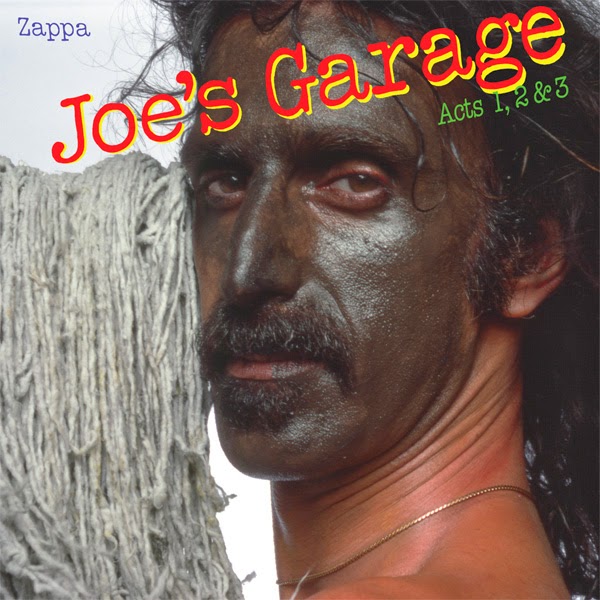
Album length: 1:55:14
Production: Frank Zappa
Release date: 1979
Label: Rykodisc Records
Rating: 5/5
“Joe’s Garage”, a progressive rock opera in three acts built around the concept of what could happen if music became illegal, ranks among the most brilliant achievements in the career of the legendary American composer, guitarist, singer, satirist and director Frank Zappa. A genius of every form of musical experimentalism and social parody (or provocation, if you prefer), who lived to create musical works of art, he turned this album, originally released in two parts (first Act I, then Acts II and III together), into a timeless masterpiece in every respect, and maybe even his best piece of social satire ever. Maybe the best proof of how far-reaching and important this legendary album has been for generations of musicians and listeners is the fact that in September 2008 “Joe’s Garage” got a stage production by American theater actors, who received exclusive permission from Frank’s family for the undertaking.
The concept of “Joe’s Garage” is first and foremost Frank’s symbolic reckoning (far from his first and not his last) with censorship and the self-appointed American guardians of public morality, who increasingly attacked his music, claiming it was “pornographic” and dangerous to the “normal” development of their children. A few years later this hit its climax with Frank’s triumphant appearance before the U.S. Congress, where he thoroughly made fools of the most conservative senators who stuck to their delusions. Despite Frank’s victory, which bought him peace from meddling political lunatics in his work for the rest of his days, the conservative camp (united under the leadership of Tipper Gore, wife of Al Gore, vice president in the Clinton administration and later a self-proclaimed environmentalist) scored a small consolation prize: all records with potentially explicit content on the American market must now carry a special sticker (much more on that in the upcoming review of the album “Frank Zappa Meets The Mothers Of Prevention”, 1985).
“Joe’s Garage” is in many ways an uncompromising and intelligent jab at this kind of conservative paranoia, and a fiction about what could happen in the extreme case, someday in the future, if paranoid senators triumphed by banning music with “dangerous” content and thereby restricting the right to free speech and artistic expression. Besides the classic Zappa mockery of the delusions of American politics and the system, which the lyrics are crawling with, there are plenty of other satirical barbs too, for instance at the typical slobbishness of the average American, influential religious cults like the Scientologists, the debauched lives of famous rock musicians, garage bands, institutionalized fetishism and repressive regimes like Iran’s, where almost all “Western” music is still banned.
Act I: the opera opens by introducing a bizarre entity called the Central Scrutinizer, who serves as the story’s main narrator. This strange character has no personality of his own, but diligently does the job of introducing the restrictive laws that will form the basis of the coming and expected ban on music. The Scrutinizer presents an instructive case study of “what can happen if you choose a career in music”, followed by the introduction of the opera’s protagonist, Joe. Joe used to be a “nice boy” who, according to his petty-bourgeois neighbors, regularly mowed the neighbor’s lawn. That ended when he discovered rock music and spent hours on end with his band in the garage playing loud music that constantly got on the neighbors’ nerves, so they often called the police.
After yet another such incident, Joe is taken to the police station, where a “benevolent counselor” offers him a doughnut and recommends he take up some “church-oriented social activities” instead. Later Joe meets a girl named Mary. Their relationship is limited to holding hands and cultivating “clean thoughts”. But Mary, a Catholic girl, leaves Joe one evening to see her favorite band Toad-O (the name is a parody of the popular American rock band Toto) and get close to the band members. Her attempt ends with her landing on their tour bus, where she has group sex with the roadies and becomes a “groupie”. She travels with them on tour until they dump her in Miami when she gets too tired to do anything anymore. Wandering around town, she enters a wet T-shirt contest to earn enough money for the trip home. Joe eventually finds out about her antics, gets depressed, drinks himself silly and goes to bed with a girl named Lucille, who works at the fast-food restaurant Jack-In-The-Box. Lucille “gives” him an unnamed, nasty venereal disease (probably gonorrhea), though in his naive lovesick daze he convinces himself he caught it from sitting on a filthy toilet seat.
Act II: to solve his problems, Joe turns to religion and donates a huge amount of money to L. Ron Hoover, leader of the so-called First Church of Appliantology (a parody of the Church of Scientology). Hoover identifies him as someone who is a latent appliance fetishist deep down. When Joe decides to confess his sexual orientation, Hoover advises him to find sexual affirmation through sex with a machine. Joe heads to a club called Omarica, which offers special machines for rent to satisfy sexual needs. There he picks a suitable machine named Sy Borg, which looks like a robotic pig. Together they go to Sy’s apartment, where they have a wild orgy with Sy’s roommate, a modified doll called Gay Bob. At the end of the sex Joe destroys Sy’s circuitry with a “golden shower”. He then ends up in big trouble, since he gave all his money to the First Church of Appliantology and can’t pay for the robot’s repairs. As punishment he’s locked up in a special penitentiary where all the interior walls are painted green. It’s home to assorted disgraced figures from the music business (former musicians and their managers), who gang-rape Joe over and over. Their ringleader is a former promotion agent for a big record label named Baldheaded John.
Act III: by the time Joe is released from prison, music has already become illegal. He goes mad over it and starts imagining in his head every guitar note he can’t play, while a reporter documents his ramblings. In the end he accepts that music is gone for good and takes a job as a routine laborer at the Utility Muffin Reasearch Kitchen (really the name of Frank’s music studio, where he recorded many tracks over the years), where he freezes cupcakes. In the finale the Central Scrutinizer tells the listener that if the story of Joe hasn’t convinced them that music is evil, he’ll sing in his real voice. He then switches off the vocoder that distorts his voice, and it turns out he’s none other than Frank Zappa.
Besides the Scrutinizer, Frank also played Joe’s friend Larry, L. Ron Hoover, Father Riley and Buddy Jones. Guitarist and singer Ike Willis plays Joe superbly, singer Dale Bozzio shines as Mary, rhythm guitarist Warren Cuccurullo tried his hand at the bizarre Sy Borg, while longtime drummer Terry Bozzio, who appears on this album only as a special guest, was suitably menacing as “Baldheaded” John.
The lineup of musicians who helped Frank pull off this wildly ambitious project was a dream in every respect. Among the new collaborators the standout was the fantastic drummer Vinnie Colaiuta, the drumming incarnation of technical perfection and musical versatility. Vinnie got his Zappa “initiation” after, among other things, successfully nailing the extremely demanding piece “The Black Page” (the oldest released version is on the live double album “Zappa In New York”, 1977). He passed the drum audition so well that he stunned even his predecessor Terry Bozzio. He supposedly even found time mid-playing to scoop up sushi and fix his glasses. He worked with Frank successfully for two more years, after which he became famous mainly as a session drummer (his work with Sting is the best known). The other notable name in the “Joe’s Garage” lineup was the young guitar hero Warren Cuccurullo, who earned his spot as rhythm guitarist as a longtime Zappa fan who could play from memory every guitar part from Frank’s vast career, even the most bizarre ones. During his time with Frank he got especially close to Terry Bozzio and his wife Dale, whom he convinced to form the new wave band Missing Persons together with bassist Patrick O’Hearn. He later became a longtime Duran Duran guitarist and built a successful solo career, while the bizarre episode with porn films is best forgotten as soon as possible. The third standout among the newcomers was guitarist and singer Ike Willis, who thanks to his vocal charisma became one of the most beloved members of Frank’s band and one of the few longtime Frank collaborators he worked with until the end of his stage career.
The musical picture of “Joe’s Garage” is a dazzling portrait of extreme eclecticism, mixing all kinds of musical genres, from classic Zappa comedy rock, progressive rock, hard rock, pop, reggae and blues to jazz fusion and more. The album is also famous for its huge number of excellent guitar solos. Frank recorded most of them using the so-called xenochronic technique, which in plain language means that he lifted most of the solos from older, unrelated recordings and dropped them into the new songs. Most of the solos except those on “Crew Slut” and “Watermelon in Easter Hay” were put in this way.
Joe’s story opens with the muffled voice of the mysterious entity “Central Scrutinizer” (Zappa tells the story through a special vocoder that distorts his voice so that it sounds like some kind of robot; personally, probably out of silliness, I always picture Bender from Futurama, even though he talks in a “normal” voice). His narration is laid over a funky rhythmic backdrop, while plenty of goofy sounds dominate the background. This original intro convincingly leads the listener into the title track. “Joe’s Garage” is one of the most easygoing and likable songs of Frank’s career, built on a compact melody, bluesy riffs and bouncy rhythms, with room for a short but fiery saxophone solo. An excellent vocal exchange between Ike Willis (as Joe) and Frank (as Joe’s friend Larry) adds extra fun. High backing harmonies and handclaps provide the comic “Californian” pop-rock charm. In the closing stretch the song shifts to a faster tempo, while police sirens can be heard in the background, along with the shouts of crazed neighbors complaining that they’ll call the police because of the noise.
Next up is the pop-rock candy “Catholic Girls”, where Dale Bozzio steps in as backing singer playing the loose Catholic girl Mary. It’s the best possible parody of the detours of double-faced Catholic morality and one of the most notorious songs in the catalog of those that stirred up the imagination of members of the American political “elite”. The lyrics alone and the chorus about naughty Catholic girls and boys (Vinnie and Warren are named among the latter) guarantee plenty of laughs, and when the deliberately high-pitched vocals kick in, backed by funky rhythmic lines, the burlesque is complete. A touch of refinement comes from the witty jazzy interludes and Ike’s all-round singing.
“Crew Slut”, which tells of Mary’s dirty adventures, is a song full of comic twists and juicy narrative interludes. It’s built on a sleepy bluesy riff and almost pentatonic rhythmic runs, so it pulls toward the music of some American road movie, which fits the lyrics very well, where Mary gets mixed up in a wild orgy with the roadies (the dialogue about Mary’s love of leather is especially juicy). Here we also meet the first of Frank’s excellent guitar solos, which this album is full of, and in which he shows up in the unusual role of blues guitarist.
“Fembot in a Wet T-Shirt” is another utterly lovable little song, built on “Hawaiian” rhythms, where an extremely complex structure hides beneath a seemingly simple, almost pop-rock surface. What impresses most is Ike’s excellent singing, which holds the rollicking melody together, while the brilliant fusion interplay between xylophone and guitar passages is nothing to sneeze at either. Eventually a burlesque narrative interlude arrives, where a sarcastic Frank plays the host of a goofy wet T-shirt contest, in which the winner is the girl whose chest looks most attractive after a cold shower. Credit also goes to former Playboy bunny Dale Bozzio, who superbly plays the stereotypically dumb and squealing blonde Mary, who after the dousing declares she’d do anything for money.
The instrumental fusion treat “On the Bus” features a monumental Frank guitar solo set over an enviable rhythmic foundation, one that all fans of this guitar giant can lick their lips over once again. Next comes a personal favorite, “Why Does It Hurt When I Pee?”, where typical Zappa toilet humor reaches one of its peaks. Set aside the roar-worthy lyrics and the legendary chorus led by the complaining Mr. Willis, and you’ve got an excellent progressive rock song that, despite its short length, packs in a dramatic and pompous, I’d even say “Queen-style”, operetta interlude.
On the tender love ballad “Lucille Has Messed My Mind Up”, besides the innovation, where you can feel new wave rhythms and especially reggae influences (proof that Frank occasionally liked listening to the music of the legendary The Police), what impresses is also Frank’s not so often displayed knack for crafting subtle melodies without a trace of mischief. The exceptional romanticism comes from Ike’s fully immersed singing. It’s one of Frank’s very rare “serious” pieces with not a hint of humor or mockery (maybe just irony), since Joe’s short fling with Lucille is a rather sad chapter. With “Scrutinizer Postitude”, where the Scrutinizer tries to convince the listener that music is a disease and the source of all evil, as Joe’s mishaps supposedly prove, the first act of the concept wraps up.
The pop-rock-flavored classic “A Token Of My Extreme”, where Frank vocally nails the role of the leader of a bizarre religious cult and sends Joe off to sex with a machine, opens the second chapter of the concept. Plenty of rhythmic wit and playful guitar passages constantly accompany the burlesque dialogue between Joe and the cult leader. Appliantology is portrayed as a cult operating in close alliance with the totalitarian regime that rules Joe’s world, which is a more than obvious parody of Scientology.
“Stick It Out” is another comic highlight of the album, where the bouncing rhythm and the main melody oddly recall the theme tune of the cult British comedy series Only Fools and Horses. Here Joe, with the help of his sexual partner, the robot pig, learns German, which ends with the robot’s destruction. Frank’s singing alone, a bizarre mix of English and German, is legendary and simply makes you crack up. With that “den-den-den-den-den” rhythm I instantly think of Del Boy and Rodney riding around town in their falling-apart three-wheeler, while the juicy lyrics about the orgy between Joe and Sy Borg are a phenomenal parody of the frequent sexual deviations of members of certain church groups.
The excellent fusion appetizer “Sy Borg” delivers a surprisingly subtle close to the first disc. Front and center is Willis’s emotionally well-inhabited singing, convincing in the role of a wrecked Joe, whose sanity slowly slips away during and after the unpleasant experience with the robot, while witty jazzy and reggae rhythmic interludes wander through the background. The lyrics are crawling with sexual allusions, especially about oral sex (the three-way orgy between Joe and Sy Borg also includes the doll Gay Bob, probably a parody of Bob Dole, the conservative Republican senator and failed presidential candidate). The individual solos, especially on guitar and keyboards, are manna from heaven for all musical gourmets, while the grooving bass line won’t leave any lover of quality jazz fusion cold.
The second disc, which opens with Joe’s arrival in prison, consists of longer tracks, mostly over eight minutes, with a series of Frank’s breathtaking guitar solos. The funk-spiced “Dong Work For Yuda”, where a gang of former musicians and associates led by Baldheaded John takes the stage, has a touch of gospel atmosphere thanks to the many falsetto vocal harmonies in the background and handclaps. Terry Bozzio, who appears on the album only as a guest vocalist, is excellent in the role of the crazed rapist John with his “mafioso” voice. The rowdy, wound-up-to-the-max “Keep It Greasy” is a veritable hard rock explosion with plenty of funky rhythmic interludes and excellent vocal harmonies. The instrumental fusion section contains many wild improvisations with which Frank and the gang once again demonstrate that they were always one of the superpowers of quality jazz fusion. Among the solo improvisations, Frank’s killer guitar solo stands out especially, still a gift from heaven for all guitar virtuosos of this world.
The melancholic “Outside Now”, where the unfortunate Joe suffers a mental breakdown when, after leaving prison, he learns that music has become banned and starts losing himself in delusions, is built on pentatonic scales, within which Vinnie’s dynamic drum fills stand out. The subtle central melody is built from charming vocal harmonies that create an atmosphere as sad as it is funny. Another breathtaking guitar solo delivers a mighty finish. On “He Used To Cut The Grass”, where Joe feels a tremendous emptiness after saying goodbye to every form of music and starts daydreaming about imaginary guitar notes, you can enjoy plenty of tasty jazzy improvisations, among which, as it should be, Frank’s highly complex and sprawling guitar solo once again stands out. The burlesque finish comes from Joe’s fantasizing about his guitar days, when he played with a garage band, so in his head he again hears the shrieking of the neurotic neighbor who decides to call the police.
The more than eleven-minute “Packard Goose” is another wonderfully slick fusion stew, where pop-rock, jazz, funk and hard rock motifs once again merge into an extraordinarily tasty cohesion. The ambience of this excellent song changes from minute to minute. One of the sections features Frank’s famous quote, which ends with the line “music is the best”. The transition into the wild fusion section, where Frank once again explodes with yet another supersonic solo, is brilliant, and I can easily imagine someone like Al Di Meola guesting on it. In the closing stretch the song returns to the opening motif, followed by a witty pop-rock chorus and a jokey build-up with playful vocal harmonies. The ethereal “Watermelon in Easter Hay” is the moment Joe decides to play his last imaginary guitar solo before surrendering to fate. This ambient-minded masterpiece contains Frank’s best solo when it comes to effectively conveying exceptional subtlety, instantly charming the more romantically inclined listeners.
With “A Little Green Rosetta” Joe’s tragic epic comes to an end as he settles into his new life as a cupcake freezer, which is yet another parody of American society’s preference for mediocrity over talent (instead of becoming a successful musician, he’s forced to become a routine worker, because that’s more useful for the social well-being of a totalitarian regime). Against the sarcastic triumph of the Central Scrutinizer, who turns out to be Frank Zappa himself, the closing burlesque tune, with its many vocal gurns, handclaps and goofy dulcimer interjections, sounds even more mocking.
“Joe’s Garage” is a conceptual work of art that with its provocative messages still stirs up all the conservative bigwigs obsessed with the idea that censorship is the best solution for everyone who doesn’t want to speak the same language. With this phenomenal record the untameable and tireless composer left behind one of the finest monuments to his creative genius. “Joe’s Garage” is an incredible masterpiece that I can’t praise enough for its musical, lyrical and conceptual scope, so I’ll say without hesitation that it ranks among the three, if not the top two, best moments of Frank’s vast career. Above all, it’s an album that guarantees the listener almost two hours of pure fun, better than watching any wet T-shirt contest, as even the two Catholic boys, Lovro Šturm and Mihael Jarc, would agree.
Author: Peter Podbrežnik
Tracks:
CD1:
- Central Scrutinizer
- Joe’s Garage
- Catholic Girls
- Crew Slut
- Wet T Shirt Nite
- Toad O Line
- Why Does It Hurt When I Pee
- Lucille Has Messed My Mind Up
- Token Of His Extreme
- Stick It Out
- Sy Borg
CD2:
- Dong Work For Yuda
- Keep It Greasy
- Outside Now
- He Used To Cut The Grass
- Packard Goose
- Watermelon In Easter Hay
- Little Green Rosetta
Musicians:
Frank Zappa – vocals, guitar
Warren Cuccurullo – rhythm guitar, vocals, choir, organ, guitar
Denny Walley – vocals, slide guitar, guitar
Craig Twister Steward – harmonica
Jeff – tenor saxophone
Marginal Chagrin – baritone saxophone
Patrick O’Hearn – bass guitar, woodwinds
Peter Wolf – keyboards
Stumuk – baritone saxophone, bass saxophone
Tommy Mars – keyboards
Vinnie Colaiuta – drums, percussion
Arthur Barrow – bass guitar, vocals
Ed Mann – percussion, vocals
Dale Bozzio – vocals
Al Malkin – vocals
Ike Willis – vocals
Barbara Isaak – choir
Geordie Hormel – choir
Terry Bozzio – guest vocals