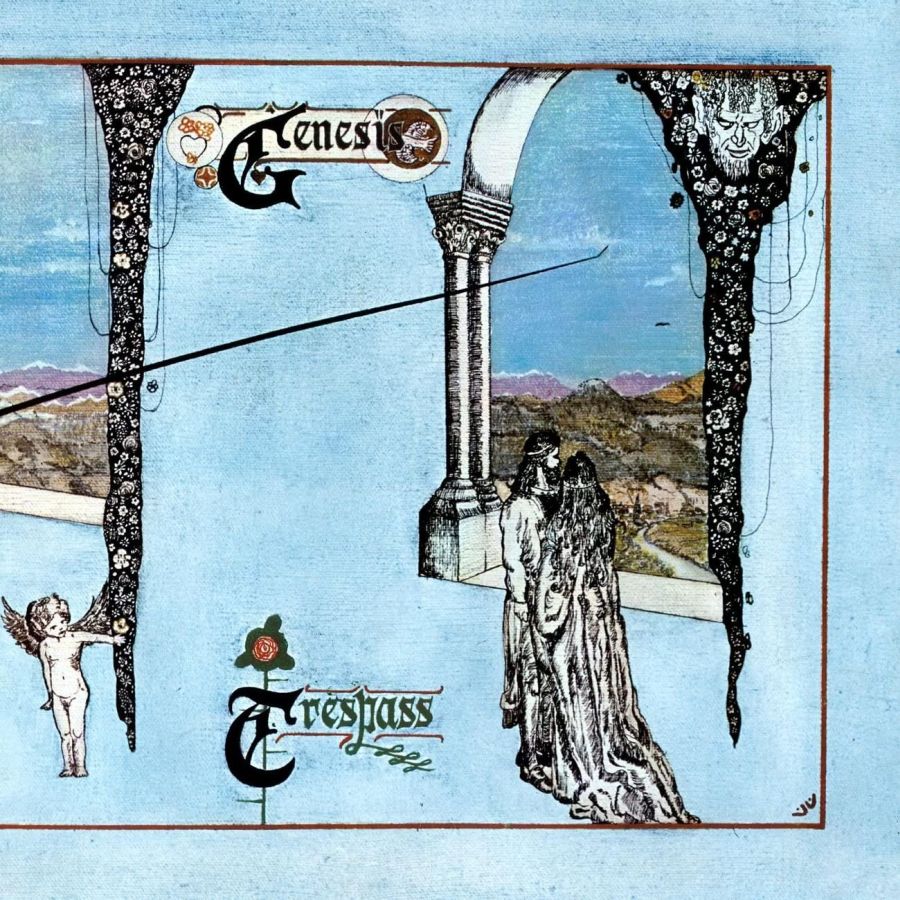
Label: Charisma Records
Release date: October 23, 1970
Production: John Anthony
Album length: 42.56 min
Genre: Progressive Rock
Rating: 9.0/10
With “Trespass”, their first proper prog record, the band took a massive step forward from their debut and showed that, despite the members’ youth, they were one of the most mature groups of their day. Or better put: the music they started making from this album on, up to the mid-seventies, was their “golden” era, when they were practically unstoppable and hardly any band could match the polish, complexity and sheer intelligence of their compositions. So here’s a band that was way ahead of its time that early on, despite how young they were, and it still stirs up debate today. Young as they were, their music sounded like it was coming from some legendary, forgotten, antediluvian era of Celtic tales and legends. And “Trespass” was also the first step on their road to becoming music legends.
The brilliant and, to this day, mostly misunderstood singer and occasional flutist Peter Gabriel became the central figure of the band on “Trespass”. With his striking readings of the lyrics and his unforgettable, original stage performances, which even involved a whole range of costumes, he became the soul of the group, the Lennon of Genesis, you could say, a personality “larger than life”.
Guitarist Anthony Phillips, with his romantic, Celtic-tinged solos and folk-rock-minded acoustic guitar, brought a whiff of mystical English countryside into the songs. As well as a dark, mysterious atmosphere. That combination was exactly what dominated their music in the “golden”, or classic, era, when the band made progressive rock history and created most of their best work.
Banks’s massive Hammond organ and excellent use of the Mellotron added the most to the mystery and drama. The mix of these three elements was crucial in making the band recognizable and setting them completely apart from every other rock band of the time. Swapping drummer John Silver from the first album for John Mayhew was a considerable step forward, even though Mayhew didn’t stay in the band long either. He gave them a much more rock-oriented rhythmic backbone than his predecessor. If anyone happens to know where Mayhew disappeared to, I’d be very grateful for the info.
Mike Rutherford had already come up with his signature, melodic way of playing bass, and even though he often gets forgotten today next to all the brilliant musicians in this band, I can say he was definitely one of the more original bass players of that time.
“Trespass” opens with the dramatic and romantic epic “Looking For Someone”, or more precisely with Gabriel’s dramatic call expressing loneliness. The sonic backdrop of Banks’s organ and Mellotron builds up the climax of the whole song, with a dark mood melting into an optimistic one. Phillips’s inventive and at times mournful riffs and the superb rhythm section of Rutherford and Mayhew crank up the tension in the last part of the song. And Gabriel’s melancholic, dramatic vocals are of course what turns the whole song into an immortal classic for all time.
Even more dramatic and tense, downright tragic, is the epic “White Mountain”, which tells the story of a lone wolf from the novel White Fang. It’s not hard to picture snowy mountains with a lonely wolf running across them, hunted by savage hunters. Gabriel’s melancholic and at times furious vocals, practically accusing humanity over the tragic fate of a noble animal, never leave you cold. The many folk elements and the Mellotron fit this tense, “wintry” mood brilliantly.
“Visions Of Angels” is another dramatic epic, though a bit brighter in the chorus, even if the lyrics are once again full of Gabriel’s sarcasm at the expense of humanity, which has denied the God within and swapped him for false, material idols. Banks shines on organ and Mellotron again, and Mayhew surprises with his excellent drumming. Phillips’s acoustic guitar stays consistent throughout.
“Stagnation” is a song full of different motifs and moods. The intro is bright and positive, opened by Phillips’s acoustic guitar and Banks’s Mellotron backdrop. The best part of the song comes in the middle, when the whole mood calms down completely and a hushed, almost transcendental groove follows on acoustic guitar, with Gabriel coming in on the lines “and each will find a home, and there will still be time, for love in my friend…”. That’s followed by an onslaught of organ, Mellotron, drums and guitar, and then another melodic, mellow section arrives on flute, with a multi-voiced, uplifting chorus. Overall, this song is the centerpiece of the album and best captures its mystical, mysterious spirit, along with Gabriel’s lyrics full of humanity’s eternal conflict and its personal battle between good and evil.
“Dusk”, with backing vocals in the chorus, is a very pretty song that takes the edge off the album’s mood a little and works as a kind of warm-up for the closing finale. It’s built on Phillips’s melodic acoustic guitar, Gabriel’s flute and Banks’s Mellotron, plus the vocal harmonies mentioned above.
“The Knife”, the closing drama about the brutality of the institutions that keep us under control, isn’t just one of the best songs on this album but also one of the “heaviest” compositions in their entire history. It’s also the least mystical, most down-to-earth track on the record. It reflects the spirit of most of the band members at the time, for whom music meant, among other things, an escape from the ossified British system, which offered such artists little prospects in life. For a long time this song was the obligatory closer of their live shows. Anthony Phillips, who mostly sticks to acoustic guitar on the record, here comes out with plenty of electrified, raw riffs and an excellent solo in the middle section, full of three-part harmonies, practically calling for a clash of the forces of darkness and light; of control and freedom. In my opinion this is also his best work with the band, or the best showcase of his exceptional musical talent. His successor Steve Hackett learned a lot from him. The tempo is fast, one of the fastest they ever did, and drummer Mayhew shows he was no slouch and that he remained widely overlooked, unlike his successor Phil Collins, who became one of the best-known music icons. Gabriel’s sarcastic critique of British society and the repression of the regime was just one of his many reckonings with humanity’s “narrow-mindedness”. With its epic compositions, the album shines from start to finish.
As I mentioned earlier, the original and brilliant guitarist Anthony Phillips left the band after this record, officially because of poor health, unofficially and by his own account because of severe stage fright. He later did start a solo career and made some excellent symphonic progressive rock albums. His first record, “The Geese And The Ghost” (1977), is a must-listen for all fans of early Genesis, since in style it’s the closest thing to “Trespass”. Two very important changes followed for Genesis, which shaped the “classic” Genesis and eventually put them at the very top of the genre, right alongside the greatest, and which brought rock (and pop) music two immortal icons.
“Trespass” is an excellent record, a classic, really, marking the beginning of classic, progressive Genesis, and precisely because it was followed by albums that for a long time each topped the last, it has unjustly ended up somewhat overlooked by fans today.
Author: Peter “Dr. ProgRock” Podbrežnik
Track list:
1. Looking For Someone (7:06)
2. White Mountain (6:42)
3. Visions Of Angels (6:50)
4. Stagnation (8:48)
5. Dusk (4:13)
6. The Knife (8:56)
Lineup:
Peter Gabriel – vocals, flute, accordion, tambourine, bass drum
Anthony Phillips – acoustic 12-string guitar, all electric guitars, dulcimer, backing vocals
Anthony Banks – organ, piano, Mellotron, guitar, backing vocals
Michael Rutherford – bass guitar, nylon-string and acoustic 12-string guitar, cello, backing vocals
John Mayhew – drums, percussion, backing vocals