Author: Peter Podbrežnik
Photos: Aleš Podbrežnik
Location: Azzano Decimo (Pordenone) / Piazza Liberta / Italy
Concert date: 20.07.2014
Attendance: 2000
Ticket price: €32.00
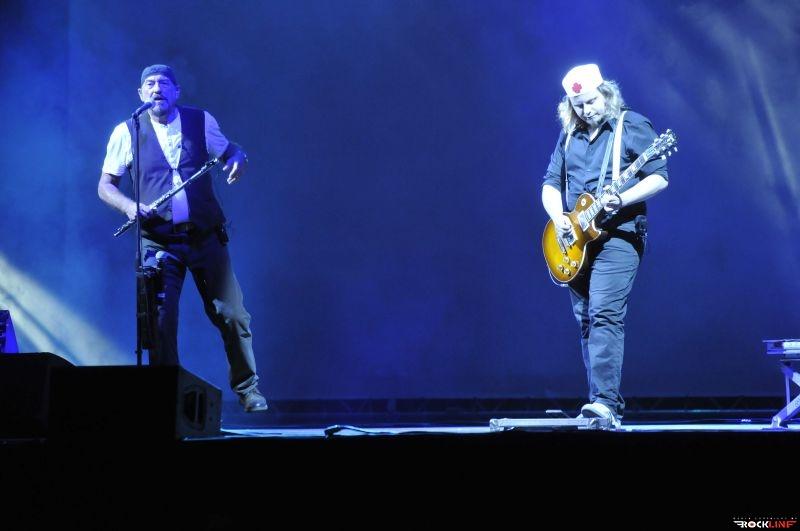
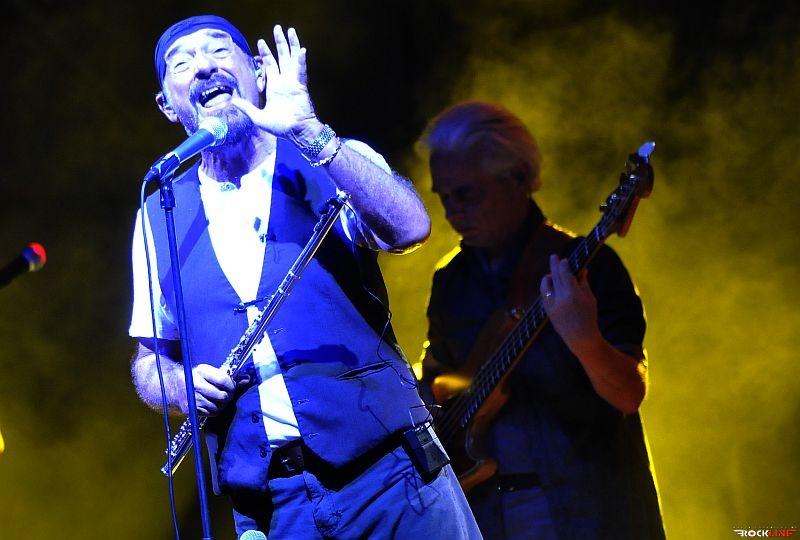
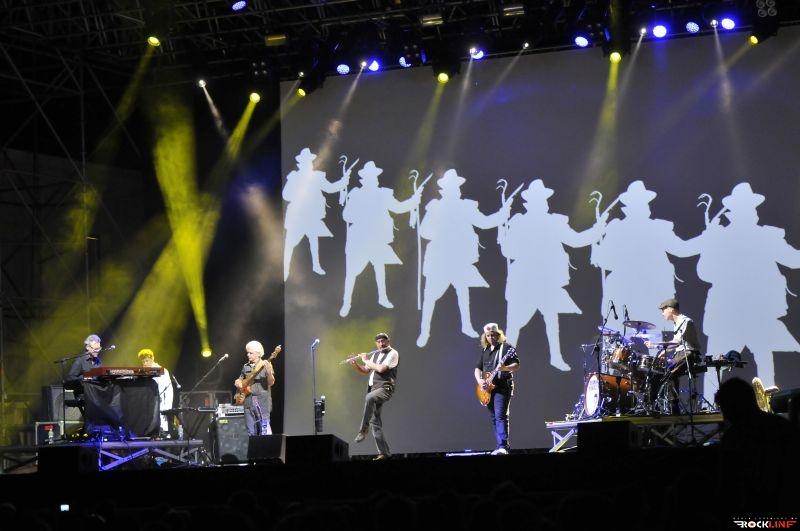
Our old friend, the legendary Jethro Tull flutist and vocalist Ian Anderson, was in the small Italian town of Azzano Decimo, near the city of Pordenone, with his traveling crew. In recent years he’s performed only as a solo artist, though he still loves playing the long-time classics from the catalog of one of the greatest progressive rock bands of all time. On this tour Ian’s band includes two former Tull members, keyboardist John O’Hara and bassist David Goodier, along with German guitar master Florian Opahle, seasoned jazz drummer Scott Hammond and charismatic singer/actor Ryan O’Donnel. They played songs from his latest solo effort plus some beloved Jethro Tull standards.
This lineup recorded both of Ian’s recent solo records: the current conceptual adventure »Homo Erraticus« (2014), which they play in full on select tour dates, and its equally concept-spiced predecessor »Thick As a Brick 2« (2012). On both of these solo outings Ian poked fun, in his own self-ironic way, at past and modern British society, and once again put the ‘little man’ front and center in the shape of his fictional, almost cult hero Gerald Bostock, who first introduced himself to the world on the Jethro Tull masterpiece »Thick As a Brick« (1972). Even in his old age the unruly flutist never runs out of wildly entertaining musical ideas, not to mention his inexhaustible humor, even though there’s also a rarely seen, darker side to his personality, which some former Tull members got to witness.
This year, after 44 years of uninterrupted activity (from 1967 to 2011) and a two-year ‘hiatus’, Ian also officially retired the name of the legendary band. He declared that, ‘as the author of most Jethro Tull music from 1969 onward, he’s much happier performing as a solo musician these days’, even though the bulk of his live sets will keep leaning on those unforgettable Tull evergreens. Most long-time Tull fans are of course deeply disappointed that Ian now performs only under his own name, but we’ll slowly have to come to terms with the fact that the stubborn flute icon and long-time Tull guitarist Martin Barre will probably never work together again. On top of that, Ian’s words that ‘Tull had only been functioning as a live band for the last ten years and was gradually falling apart’ carry considerable weight.
Still, the Tull legacy remains incredibly rich, and although »Homo Erraticus« is a very good album, most people came to this show precisely to hear some long-time Tull favorites once more, and maybe a surprise or two in the form of a song that hadn’t been in the repertoire for years, if not decades. That’s exactly how it went at Ian’s show in Azzano Decimo, which was packed with plenty of hugely positive, completely unexpected surprises. This was despite the fact that before the show, before Ian’s sharp crew appeared on stage and put an end to the agonizing guessing about whether the whole thing would get called off, it looked like a miserable evening with lousy, rainy weather. Even more than half an hour after the announced start time, Ian’s band was nowhere to be seen on stage.
Instead, the screen played performances by some of Ian’s long-time friends and collaborators, such as German violinist Anna Phoebe with her band, the cult Irish folk-rock duo Tir na nOg, British folk rock legends Fairport Convention led by former Tull bassist Dave Pegg, and talented English violinist/singer Seth Lakeman. It would have been much better if all these folk-rock friends had played as opening acts instead of us having to watch them on a screen, so the crowd rightfully got more and more impatient and the first whistles of disapproval could be heard. More than a few people grumbled that the sparkling old Scottish gent must have lost the last shred of common sense, since this sort of thing hadn’t been done on any previous tour. A few minutes later, just when it seemed the rain simply couldn’t be escaped and some in the crowd had already raised their umbrellas in boredom, the downpour miraculously dried up.
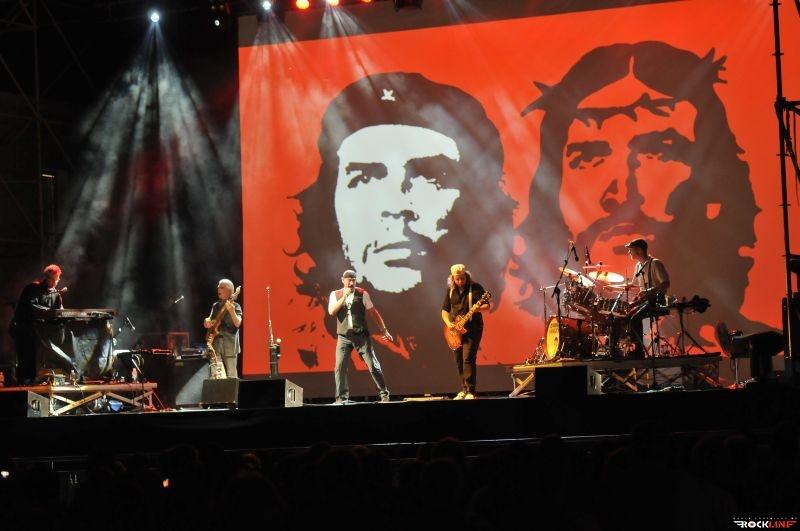
Around that same moment Ian finally decided the show could begin, and a snowy landscape appeared on the screen, somewhere in the middle of Swiss St. Gallen. The camera focused on a lonely sanatorium in the Alps, where a certain well-known old man, wrapped in bedclothes, was under special medical care and a strict ban on drinking whisky. All the band members took part in this burlesque. Ian Anderson’s show has been a proper piece of theater ever since the previous tour, drawing in many ways on the cult British show Monty Python’s Flying Circus. Jethro Tull were already inspired by it in their early years, really through the entire seventies, but this time Ian and his gang of incorrigible jokers pushed their burlesque theater of the absurd and their mockery of British society right to the edge of political incorrectness.
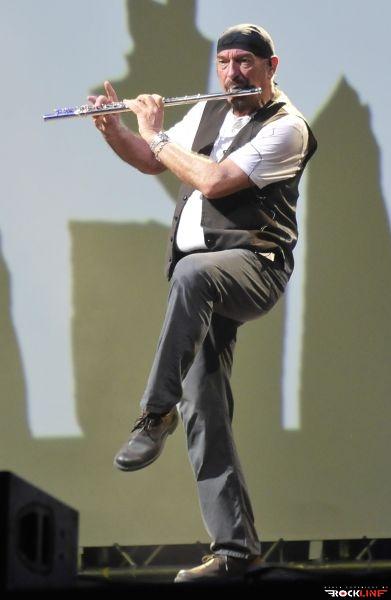
Besides Ian, his vocal ‘complement’ Ryan O’Donnel plays an important part in the band. He didn’t just perform as a younger version of Ian with a similar timbre, but also wowed us between songs with special stage mimicry and a variety of props he used to illustrate the lyrics. With his youth and freshness he often pushed the aging flute master to squeeze out maximum vocals, even though his vocal cords are badly worn. According to an unofficial legend circulating among long-time Tull fans, Ian will keep performing as long as he’s still able to stand on one leg while playing the flute, which has always been his stage trademark. That night he had absolutely no problem with that.
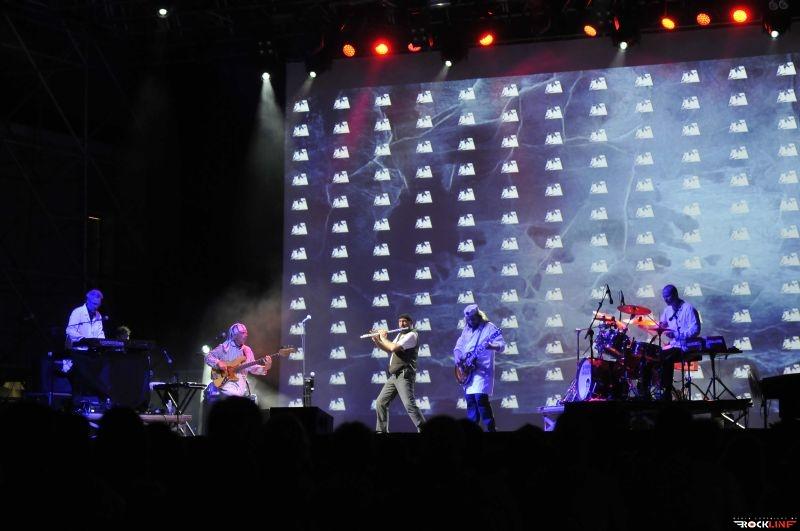
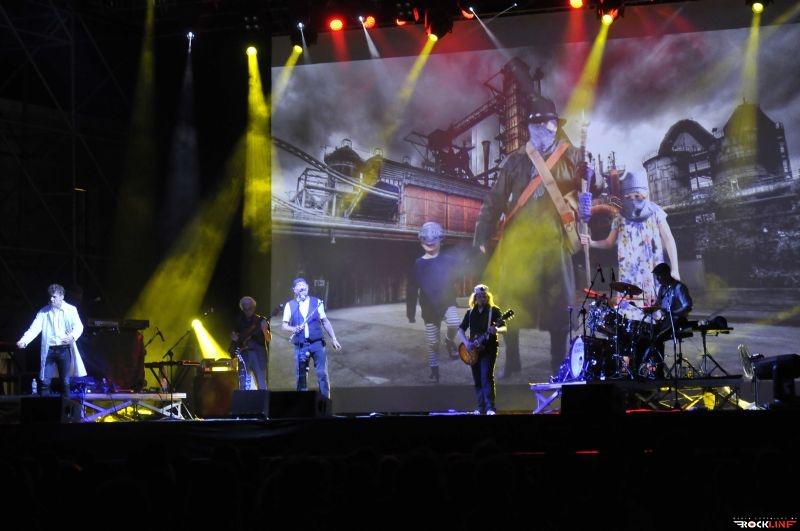
The band’s performance was split into two parts. In the first they played the entire »Homo Erraticus« album, which was an unforgettable audiovisual experience, accompanied by hugely entertaining projections. Over the good hour of the first part, Ian took us on a satirical trip through British history, from prehistory to the distant future, dumping a gallon of manure on conservative English society and taking a swipe at all its cancerous growths: militarism, royalism, corporatism and consumerism. With the opening »Doggerland« we first found ourselves in the middle of a prehistoric tribal order, and by »Heavy Metals« we were already witnessing Celtic and Anglo-Saxon metalworking. One of the funnier moments was »Enter The Uninvited«, which is about not only the arrival of the ancient Romans on the British Isles, but also the other invasions that have followed, more or less successfully, over the centuries. So while Ian was playing the flute with gusto, we saw some very recognizable symbols of modern consumer society in the background.
The theater of the absurd hit one of its peaks during »Puer Ferox Adventus«, which illustrated the triumph of the early, dark Middle Ages and Christianization. For the occasion O’Donnel dressed up in a monk’s hooded cowl, while lightning struck around a Celtic cross in the background, which, more or less, recalled the usual concert antics of the well-known Teutonic metal band Grave Digger. On »The Turnpike Inn« Ian’s brotherhood turned into a gang of Elizabethan-era rogues, and during »The Enginer« they became builders of the first railways. Combining top-notch instrumental chops with mischievous stage acting comes really naturally to them, which goes especially for the two commanders of the whole show, Ian and Ryan. The mockery of the British imperial order peaked during »Pax Britanica«, a sharp satire of the Victorian era that even featured a giant image of John Bull, the caricature of the traditional Englishman with puffy cheeks, bad teeth and a huge beer belly.
One of the few somewhat more serious, if not almost melancholic moments was the anti-war song »After These Wars«, during which footage of various soldiers from World War II was shown. Ian will need to be more careful in the future, since one of the shots of German soldiers shows a swastika for a split second, which could cause some problems at shows in Germany, even though it’s a sharp critique of the nonsense of war and of all political regimes.
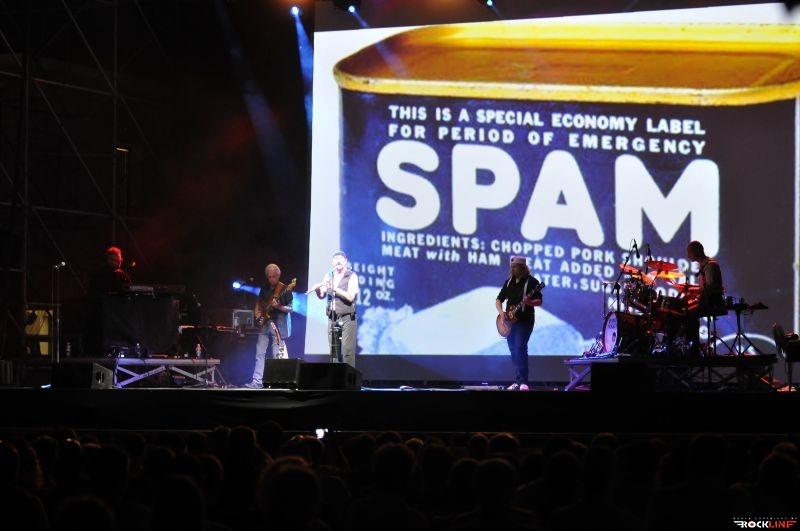
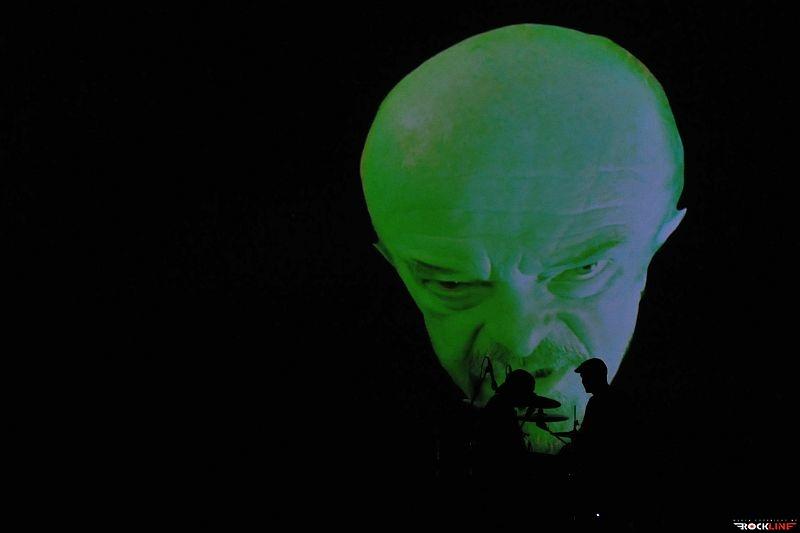
During »New Blood, Old Veins« Ian also touched on the postwar ‘baby boom’ generation, which he belongs to himself and which was forever hooked on the ‘miracle’ of television. On »The Browning of the Green«, where the band finally reached the modern era, Ian’s crew vividly satirized the demise of the traditional countryside in favor of urbanization, among other things through picturesque projections of housing estates as sardine tins. The laughs didn’t stop after the trip into the near and distant future on »Per Errationes Ad Astra«, with its mockery of past dictators and presidents (from Blair, Gaddafi, Churchill, Thatcher and Hitler to Bush Jr.), nor during the spirited »Cold Dead Reckoning«, when Ian’s projected image suddenly turned into a green ‘Martian’, looking like a cross between a typical Roswell alien and the evil Emperor Ming from Flash Gordon (in Max Von Sydow’s film portrayal, of course). That wrapped up the first part, in which we enjoyed a faithful and wildly entertaining stage revival of the album »Homo Erraticus«. But the best was yet to come.
A break of about fifteen minutes followed, during which the band rested and got ready for the Tull evergreens. Those who weren’t yet completely thrilled with the first part got pure delight in the second half of the evening, as Ian’s band wowed us with versions of some Tull classics that seemed like we’d never hear live again, except maybe from some ‘Jethro Tull tribute’ band. Once again, witty projections alternated in the background between songs, mostly from old Tull videos, along with some entirely new graphic animations. »Living In The Past« was often part of past Tull setlists, but it was still nice to hear it live again after so long, even though Opahle’s electric guitar playing was a touch too punchy here and Barre’s usual finesse was missing.
The first really big surprise was »With You There To Help Me«, a classic from »Benefit« (1970). We’d heard a shortened version at the Tull show in Schio on 4.7.2008, but this was the first time it was played in full and the way it deserves, though Ian again needed a lot of vocal help from O’Donnel. For incomprehensible reasons the excellent album »Benefit« gets overlooked far too often, so let’s hope Ian will remember it more often from now on. The hard-rocking favorite »Sweet Dream«, where we laughed at the grotesque (s)imagery from the video with Ian as Count Dracula, was a welcome return too, even though it was fairly often part of the Tull concert repertoire in the past. You couldn’t say anything like that, not even in your dreams, about the song Ian introduced as ‘the worst thing he’d ever done in the entire Jethro Tull story’.
He had the cult single »Teacher« in mind, which in 1970 had unexpected success on the British and American markets, where it even became a hit. It’s no secret that Ian never liked one of the most commercial creations of his career, even though it’s actually one of the most entertaining songs of the »Benefit« era. This time it was accompanied by psychedelic footage swaying with various hippie ‘highs’ from the Woodstock festival, since the lyrics are a biting satire of all religions, new-age gurus and the ‘sheep’ who gullibly follow them. Then everything was set for the biggest surprise of the whole evening, which Ian announced by saying that ‘in 1973 he made a concept album with which he almost single-handedly destroyed progressive rock’. Most people guessed right away what he was aiming at, and to general delight we finally got to hear »Critique Oblique«, an epic improvised insert from the legendary suite/same-named concept album »A Passion Play« (1973). No question, nobody expected that one. It’s great that Ian remembered one of the most overlooked Tull albums, alongside »Benefit«, »Minstrel In the Gallery« (1975) and »Stormwatch« (1979).
That was the peak of the concert, but the pleasing picks of ‘forgotten’ Tull evergreens weren’t over yet. »Too Old To Rock’n’Roll: Too Young To Die« hadn’t been heard at Tull shows for an eternity, while during the folk-rock treat »Songs From The Wood« Ian had to strain all his remaining vocal reserves, and he and O’Donnel just about pulled the whole thing off. »Farm On The Freeway« from the album »Crest Of a Knave« (1987), with which they ‘beat out’ Metallica in 1988 to win the Grammy for best heavy metal performance (which Ian of course still mocks to this day), was no big concert rarity, since Tull have played it quite often in recent years, but it still came off great that night.
The Tull evergreen for the close of the regular set was very predictable, but still spiced up with extra improvised bits and a tragicomic audiovisual garnish of portraits of beggars and vagrants from around the world, so »Aqualung« sounded thoroughly refreshing that night too. After a comical introduction of the band members came a short breather and then the obligatory encore in the form of the most popular Tull song, »Locomotive Breath«, played in a somewhat more compact way than usual. The crowd, somewhat surprisingly, stayed in their seats this time, but that apparently matched the band’s wishes. In his old age Ian evidently demands concert etiquette from the audience on the level of a philharmonic hall or at least a jazz club. That evening Ian’s band left out two songs from the setlist typical of its past UK shows, the classical-style instrumental »Bouree« and the anti-church rant »My God«, which probably nobody missed too much.
As far as the performance itself goes, there were thankfully few downsides that evening. The most pressing problem remains the state of Ian’s voice, which gets more worrying year after year. For the past ten years he’s only barely managed to sing some Tull classics, and he struggles with the new material too. At the start of the show it already seemed he wouldn’t make it vocally to the end, but with O’Donnel’s help and moral support he somehow warmed up enough that most of the vocal performances came off at least decently by the end. Another less pleasant thing was that Ian cut Martin Barre out of every shot in the old music videos that were played. This was especially noticeable during »Too Old To Rock’n’Roll: Too Young To Die«. Then there was the already mentioned guitar soloing by Opahle between songs, which felt as if Ian had deliberately told him to interpret Barre’s traditional solos however he pleased, in his own way. This kind of mischief is really hard to understand, especially from a man who is steadily approaching seventy.
Despite the less pleasant facts mentioned above, we witnessed yet another superb performance by nothing but excellent musicians under the baton of a progressive rock legend who is far from forgetting how to serve his favorite wind instrument, and who clearly had a great time during every single song. It looked grim, but it all turned out great in the end. Ian’s crew may even have exceeded expectations, especially in the second half of the show, when they completely won us over with some properly ‘dusty’ Tull standards. Ian delivered an unforgettable show, one that’s unmatched for its particular wit and social bite and worth catching at every opportunity, even though it’s no longer Jethro Tull, but his ‘private’ band.
Setlist
“Homo Erraticus” album:
Part 1: Chronicles
1. Doggerland
2. Heavy Metals
3. Enter The Uninvited
4. Puer Ferox Adventus
5. Meliora Sequamur
6. The Turnpike Inn
7. The Engineer
8. The Pax Britannica
Part 2: Prophecies
9. Tripudium Ad Bellum
10. After These Wars
11. New Blood, Old Veins
Part 3: Revelations
12. In For A Pound
13. The Browning Of The Green
14. Per Errationes Ad Astra
15. Cold Dead Reckoning
—intermission 15 min.—
16. Living in the Past
17. With You There to Help Me
18. Sweet Dream
19. Teacher
20. A Passion Play excerpt (Critique Oblique)
21. Too Old to Rock ‘n’ Roll: Too Young to Die
22. Songs from the Wood
23. Farm On the Freeway
24. Aqualung
—encore—
25. Locomotive Breath
Photo Gallery