Label: EMI Records
Release date: September 29, 1986
Producer: Martin Birch
Album length: 51:18 min
Genre: Heavy Metal
Rating: 10/10
After the groundbreaking Powerslave, the standard-bearers of British heavy metal Iron Maiden had probably hit the peak of their career so far. Powerslave was followed by the monumental, pompous World Slavery Tour, which is still considered one of the longest rock tours in history. The stats speak for themselves: the tour kicked off on August 9, 1984 and wrapped on July 5, 1985, a colossal 331 days, 193 of them with a show. That’s mathematically more than half a gig a day! The incredibly successful tour took the band through 24 countries and gave us one of the best live recordings of all time, Live After Death, captured over four consecutive nights at London’s Hammersmith Odeon and the Long Beach Arena in California. The schedule left the band completely drained, physically and mentally, so they only started work on the next album in 1986. Somewhere in Time was thus the first studio album since Iron Maiden’s debut that didn’t come out a year after its predecessor.
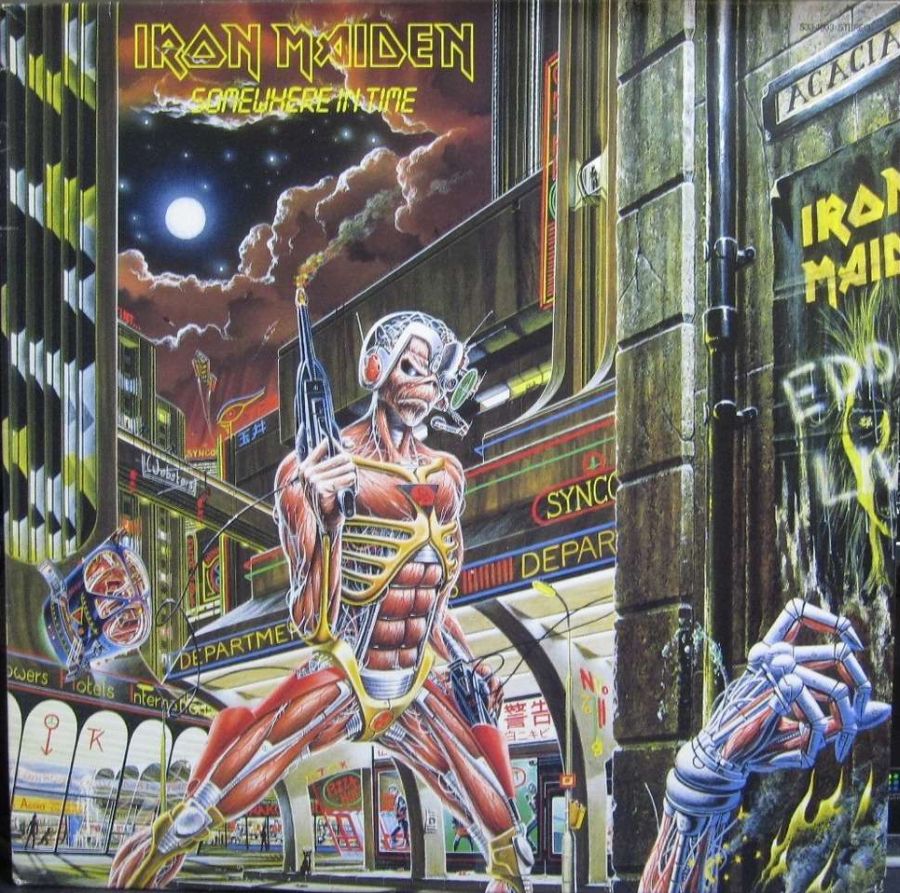
Maybe that’s also why Somewhere in Time marks a shift in the band’s musical direction, a step into somewhat more experimental waters and a search for new and different styles. Somewhere in Time is the first album on which Iron Maiden (at Adrian Smith’s urging) used guitar and bass synthesizers. But they used their new toy very thoughtfully, precisely and subtly. Compared to Judas Priest’s Turbo, released the same year, the keyboards on Somewhere in Time don’t shove their way to the front, they fill out the sound nicely, and the songs only gain in intensity and subtlety. Fan reaction to the new direction was mixed, but the boldness and the urge to experiment and innovate only ever paid off for Iron Maiden. It’s also interesting that the band flat-out rejected Dickinson’s songs, because according to Harris he was bringing in weird acoustic arrangements, supposedly a product of the exhausting World Slavery tour. Instead of Dickinson, Adrian Smith stepped up brilliantly with three songs that went on to become bona fide classics, and that’s one more proof that his return to the band in 1999 was just as important as Dickinson’s. Another important fact: Somewhere in Time was the band’s most expensive album up to then. The guys took more time making the new record, and behind them were all that stage experience plus the maturity, age and wisdom of the older releases. Without a doubt, Somewhere in Time remains one of the band’s most ambitious projects to this day. This time Derek Riggs set his sights high as well and created one of the best covers of his career. Eddie shed the Powerslave bandages and turned into a “Schwarzenegger meets Blade Runner” cyborg, and Riggs hid almost 40 hints and references to Iron Maiden history on the cover (you can check out the list HERE)
Maiden shock you in the very first seconds of the album, when heavy keyboard sounds greet us in the intro to Caught Somewhere in Time. And how they blend with the guitars! To an already epic mix of furious guitar attacks, crushing drums, thick bass tone and soaring vocals, they add completely new undertones of darkness, mystique and mystery, which at the same time feel incredibly warm and make for a perfect blend. Later in the song the keyboards disappear, replaced by divine riffs from the fingers of masters Murray and Smith, who together with fantastic lead parts later on and a dazzling rhythm section make Caught Somewhere in Time one of the most perfect opening tracks of all time. In the chorus, much like in Aces High, Dickinson once again proves himself a true “air raid” siren and nails the lyrics, which recall H.G. Wells’ sci-fi work The Time Machine but are actually about someone who’s offered the chance to sell his soul. The time machine then carries us on to Wasted Years, the first single from the album and the first single written solely by Smith. It was absolutely the right pick for a single, since Wasted Years still remains the most accessible, commercial and mainstream-sounding track, yet it still sounds as Maiden as it gets, with a fantastic, catchy chorus and an excellent solo. The lyrical message, “carpe diem,” adds just the right dose of optimism to the song. Smith’s Sea of Madness doesn’t offer the usual phenomenal start of an Iron Maiden song, kicking off with a so-so, dirty hard-rock intro, but it fixes the bad aftertaste with a dazzling, melancholic chorus and effective vocal lines that incredibly interpret the vague lyrics, which may be about the slow darkening of the mind. Sea of Madness surely peaks in the brilliant Murray/Smith guitar duel. The epic Heaven Can Wait takes us to the edge of death, with lyrics about a near-death experience and the tunnel with a light at the end that supposedly awaits us all. The song is practically made for the live setting, with an insanely catchy “sing-a-long” part, once again an unbeatable performance from the guitar duo, and on top of all that, in the “ooo oo” part Dickinson is joined by the guys Iron Maiden found in Tehe’s bar (see the references on the cover). The Loneliness of a Long Distance Runner is without a shred of doubt one of the overlooked gems of the Iron Maiden discography, since it has every element of a Maiden classic: from the slow, slightly creepy guitar intro that gives you goosebumps, through the gradual kick-in of Harris’s genius bass and Nicko’s restless foot, until Brucey crashes in with the verses. This adrenaline-fueled six-minute ride on the ghost train is based on Alan Sillitoe’s short story of the same name, about a juvenile delinquent who finds solace in running and ultimately defies his guards and throws a race he should have won. Dickinson delivers one of his better performances in the unforgettable chorus, and the instrumental section is, in one word, brilliant. On a symbolic level, the lyrics also work as an inner struggle of an individual choosing between following their principles and falling to their knees before the authorities. Personally, with its epic feel and similar theme, the song also reminds me of the legend of the marathon runner. Smith’s last contribution is Stranger in a Strange Land, about a man trapped in the Arctic whose frozen body is found years later. With its slower tempo, the song perfectly captures the slightly morbid, melancholic mood of the concept itself, and the loneliness and inevitability of the situation couldn’t have been captured any better than by yet another unsurpassable solo. Although the title is borrowed from a novel by Robert A. Heinlein, the song has nothing to do with the book. Deja Vu is another overlooked heavy metal gem, which of course is about the feeling of having seen something before. Even though you can listen to the song’s guitar lines countless times, you never get that déjà vu feeling, because they’re simply incredible all over again. “My son ask for thyself another Kingdom, for that which I leave is to small for thee.” is the opening line, spoken by Nicko McBrain, leading into the peak of the album, without a doubt the best track on the record, Alexander the Great. A genius epic about one of the greatest military commanders of all time, who supposedly never lost a single battle, Alexander the Great, or Alexander of Macedon, who conquered most of the then-known world in his lifetime, couldn’t have closed the album in a better way. From the very first riffs accompanied by Nicko’s military volleys, through the numerous interludes, interweaving guitars and bass, unforgettable melodies and harmonies, all the way to the breathtaking guitar patterns and solos, the song stands as one of the peaks of the Iron Maiden discography. With this pompous epic Harris proved he’s one of the best writers, composers and arrangers, stacking up so many twists in a single track that the epic must have been a real shock for the fans who heard it in 1986 and thought they were used to anything from Maiden. Although the lyrics contain a few minor inaccuracies (it’s well known that Alexander marched with his army all the way to India, and the exact cause of his death is unknown), this takes nothing away from the song’s pure brilliance.
Somewhere in Time will forever remain a metal classic, packed with classic material. The somewhat new and different approach to the album paid off for Iron Maiden: they outdid themselves, proved they’re not a band that stagnates, and made music that lodged itself in the ears of generations, and I have no doubt it will in future ones too. Sadly, Somewhere in Time is probably also the album the band itself has overlooked the most, since you can barely hear any songs from it at their shows. Iron Maiden still have time, and I hope they fix this mistake.
Author: Rok Klemše
Tracklist:
1. Caught Somewhere in Time
2. Wasted Years
3. Sea of Madness
4. Heaven Can Wait
5. The Loneliness of the Long Distance Runner
6. Stranger in a Strange Land
7. Deja-Vu
8. Alexander the Great
Line-up:
Bruce Dickinson – vocals
Dave Murray – guitar
Adrian Smith – guitar
Steve Harris – bass
Nicko McBrain – drums