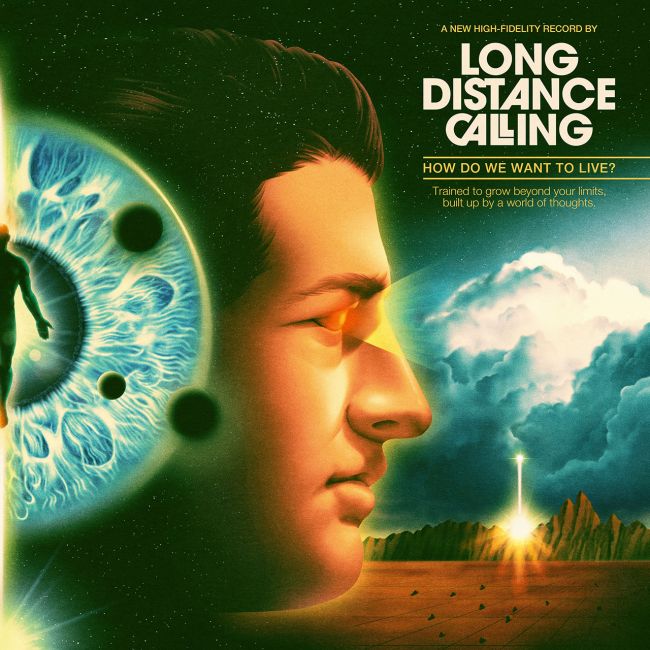
Label: InsideOut Music
Release date: June 26, 2020
Production: Arne Neurand
Album length: 52.58 min
Genre: Post-Rock / Progressive Rock
Rating: 9.5/10
Long Distance Calling, a German experimental rock quartet from Münster, served up their seventh full-length at the end of June this year. Over the years the band has become hugely respected, especially on the old European continent, where they have a strong base of devoted fans. No wonder. Long Distance Calling are absolutely their own story. They cultivate a musical character of their own, and it’s an eclectic one. If we really have to pin a genre label on them, we can roughly describe their style as an adventurous and challenging blend of post-rock and progressive rock, with room left for some cross-genre flirting too. If you don’t know the band, you’ve probably already figured from all this that Long Distance Calling are a quartet famous for being unconventional, without wandering into avant-garde territory.
“How Do We Want To Live?” is a new story, a new chapter in the band’s evolution. A new artistic venture. Quite different from its undoubtedly excellent predecessor “Trips” (2018). More layered and dynamic, and more colorful in the way its sonic pastels mingle. This time the band put front and center a synthesis of their primal rock stance with electronic sounds they’ve never tried before.
The album was written before the pandemic even hit. With the theme behind the music, it’s a kind of prophecy that came true once the pandemic arrived. One of the song titles is even called Immunity. Collective immunity or individual immunity? Something we have to develop. But against what? The virus, or the technological progress we’re being fed and embracing with wide-open arms, while actually selling our soul to the devil? Let me tone that down. Are we giving up fundamental freedoms and rights in exchange? From here it’s not far to machines doing the thinking for us. Artificial intelligence will replace our ratio. Perfect it, and “discard” the human individual.
Over time the band sensed that the extreme development of technology can lead to either utopia or dystopia. Where is the line, and how far will the individual let fundamental human rights shrink out of careless submission to technological achievements that get slipped to us daily under the wrapping of security and (not-so-)hidden control? That’s why this album is dedicated to artificial intelligence, which is slowly creeping into humanity’s way of life. Something that science-fiction scripts used to be written about. So. The message of the album, which is mostly instrumental, is a kind of wake-up call and alarm bell. The band wants listeners not just to listen to it, but to start thinking more intensely about its theme. With their own heads. Where is that line where they’ll say, “Enough!”, and will they even be able to find it in the diffuse environment of cross-fire information they’re being manipulated in? The point where they can reconnect with the elementary primal essence of their mission on an individual level. When will there be enough of selling individual freedom for feelings of catharsis, sensation and ecstasy, which feed their ego on social media?
The tracks come with cold narrations, run through the digital prism of robotization. Stripped of all emotion. They deliver bare information, though Long Distance Calling go further here, but more on that below. The opening Curiosity pt. I hints at where this is all heading, and all the way through to Hazard, which the band reaches via Curiosity pt. II (with Run Like Hell “Floydisms”, of which there are plenty more later on the album), the artistic contrast with “Trips” isn’t that striking yet. The occasional hyperplasia of massive guitar walls is there. But more than ever before in their career, the band combines their phrasing with detours toward cerebral, sophisticated, sensitive, trippy sonic pastels of electronic, digitalized sound. In the process, the music as a whole even takes on a clear undertone of a successor to what the krautrock phenomenon introduced in the seventies. Not that the band hasn’t delivered this now and then before, but this time they’ve intensified the approach. The track Voices is definitely the artistic focal point of the whole album this time. Not because it’s the longest. Simply because it embodies exactly what the band wanted to say with the new album. It comes with a gripping video, directed like a film production, with a human and a machine (an artificial intelligence that quickly learns to feel, too) in the lead roles, and you absolutely must watch it below, because it will chill you to the bone. The closing shot in particular will shake you. The fusion of a film script with the music itself really couldn’t work any better. The track grows from circle to circle, the band layers one sonic pastel on top of another and deepens the mood round after round, up to the final crescendo, when it’s flooded by the motif of an erotic solo on slide guitar. It’s a perfect union of human and artificial intelligence in the confessional manner of musical artistry. It encompasses every sphere of our everyday lives, including our sexuality, and somewhere in the US such a product would probably run straight into strict censorship, without much debate! In this track especially, Long Distance Calling have dissolved every last taboo. Contrasts of delicate, trippy structures with bursts of dynamic guitar playing and active rhythmic textures keep flowing into each other and, combined with the shots from the video, underline the contrasts and awaken feelings in listener and viewer alike. That’s why the track itself grabs and shakes you that much harder. Watching the video is a must here (below).
The band returns to this principle several times on the album. The post-rock repetitiveness of motifs and the graduated layering of sonic textures are also carried by heavy use of reverb and delay effects, which boost the vibrating sound collages. And that’s the basic generator of a gripping atmosphere that sucks you into a musical world of its own, one you only “wake up” from at the very end of the album. Hypnosis! If you manage to switch off your ratio, you’ll definitely come out as the absolute winner of this story.
The band clearly wanted to keep organic sonic pastels in charge of the overall creation of the soundscapes, and they’ve fully pulled it off. The rhythmic structures are alive and organic, and the guitar has certainly kept, in its phrasing, the recognizable lively analog aura of the band’s past studio work, and so has the deep, penetrating snare sound. The framework of rhythmic and motif repetitiveness is masterfully dramatized by the addition of varied guitar structures and colorful embellishments that blend in perfect contrast with the electronic loops, and the drums often add spice too, with vivid transitional fills. Sharing Thoughts stands out with particular artistic boldness in these elements. Beyond Your Limits is the only vocal track, with guest singer Eric A. Pulverich of Kyles Tolone, who plays his part brilliantly. Musically this track doesn’t bring anything new, and bringing in vocals is a welcome move here, as it keeps the album’s dynamic momentum going.
The music maintains the band’s typical melancholic stance, since the compositions develop in minor keys but keep a distinctly musical note as they unfold, so the music, and the album, slips into your ear in no time. Fail /Opportunity is especially sensitive in intensifying the feelings of melancholy, precisely thanks to the strings worked in.
The band doesn’t “overdo” the synthesizing. They lay the sonic loops very cleverly into the sonic engraving of the composing itself, and the aesthetics of the organic touches are never threatened. Long Distance Calling steer slyly all the way along the golden mean between digital and analog, which was also the band’s core goal in creating this excellent record. The closing stretch is distinctly gloomy. The track True/Negative is effectively a march of the machines taking over the role of the thinking ones, while the closing Ashes opens with the famous speech by Hugo Weaving, taken from the first part of the film “The Matrix,” where, as Agent Smith, he explains to Neo about the only other creature on planet Earth besides humans that uses the same pattern to survive. A virus. Prophetic.
This is the album with which Long Distance Calling have proven that, as a band, they’re still evolving artistically. They’ve ventured into new musical expanses and built structures into their music that they hadn’t tried before. They did it by keeping their entire artistic stance and carrying it to a new level of maturity in their own eclectic expression. The band has reached a new dimension of its artistic outlook and signaled that its development is far from over. So it’ll be interesting to watch where Long Distance Calling soar next.
Author: Aleš Podbrežnik
Tracklist:
1. Curiosity (Part 1)
2. Curiosity (Part 2)
3. Hazard
4. Voices
5. Fall/Opportunity
6. Immunity
7. Sharing Thoughts
8. Beyond Your Limits
9. True/Negative
10. Ashes
Lineup:
David Jordan – guitar
Florian Füntmann – guitar
Jan Hoffmann – bass guitar
Janosch Rathmer – drums
Guest musician:
Eric A. Pulverich – vocals on track no. 8