Author: Aleš Podbrežnik
Photos: Aleš Podbrežnik
Location: Tonhalle / Munich / Germany
Concert date: 26.11.2009
Attendance: 2500
Ticket price: €40.00
Uriah Heep and Manfred Mann’s Earth Band on one bill. Two legendary bands. The former turn up on concert stages pretty regularly, the latter, well, not so much. The first are out celebrating 40 years as a band, the second, a good few years older, are out for the reason that follows from the previous sentence: you simply have to find out whether the fans still know your hits. Because of this bold pairing, Manfred Mann’s Earth Band made it a condition that they play second, which was supposed to make them the main attraction of the night. The decision makes a certain sense, since a German tour lies ahead. Back in the seventies, Manfred Mann’s Earth Band were a more beloved and popular name in Germany than Uriah Heep, and given how rarely Manfred Mann’s Earth Band play these days, the Germans, at the city cultural center Kunstpark Ost, really did pack Munich’s Tonhalle to the rafters this time.
| URIAH HEEP: 20.00 – 21.20 |
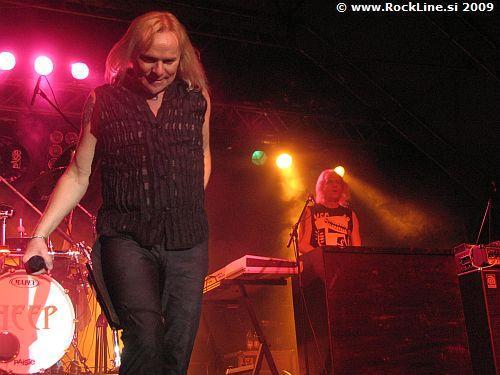
The two bands set their running times at 80 minutes each. Uriah Heep thus trimmed 20 minutes off their standalone shows on the current “Celebration” tour, or in other words, five songs. German punctuality got them onstage at exactly 20.00 sharp. As we already saw when the band played Vienna this year (RockLine report HERE) on 17.11.2009, Uriah Heep aren’t just playing their biggest hits on the new tour, they’re still keen on their latest studio effort “Wake The Sleeper” (2008) – RockLine review HERE.
Thank God the Tonhalle is a proper hall, unlike the tiny Szene in Vienna, where the main mixing desk has to go up on the balcony for lack of space. So this time we got to enjoy excellent sound. The otherwise very predictable setlist opened with just one little treat, the song Return To Fantasy, which the band hadn’t played live since 2002. Otherwise business as usual. Two from the latest album, two of the newest ones from the special album “Celebration – 40. Years Of Rock” (2009) – RockLine review HERE, and the rest was really the material that defines the point of the band, the stuff Uriah Heep can play with their left pinky. So they went at it totally relaxed, totally ordinary, totally standard. With aces like that up your sleeve, it’s hard to disappoint, and the enormous mileage naturally feeds the routine of seasoned live veterans.
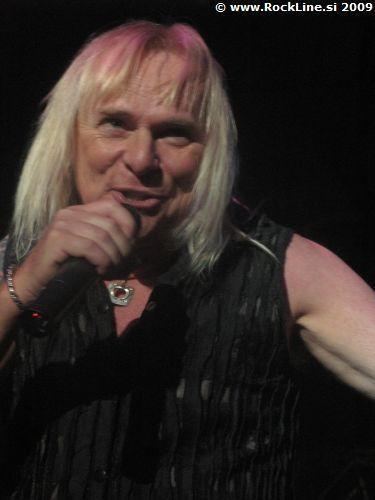
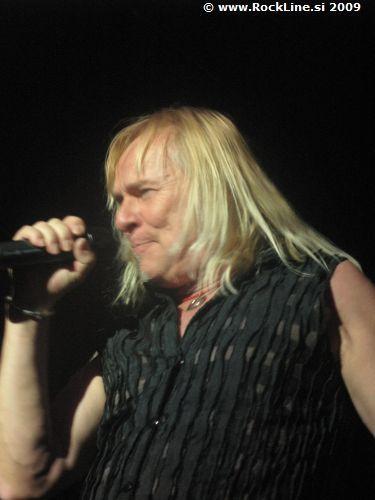
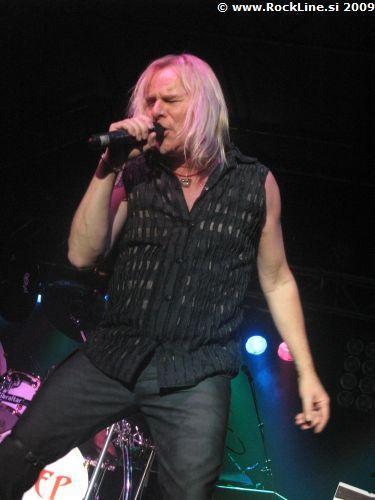
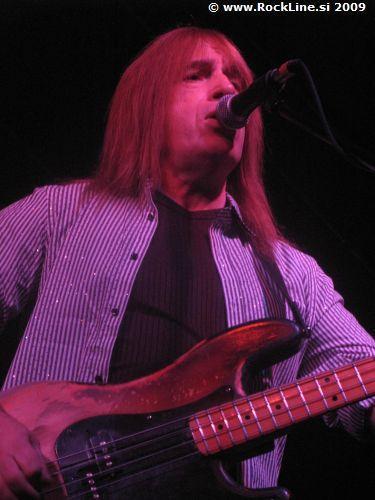
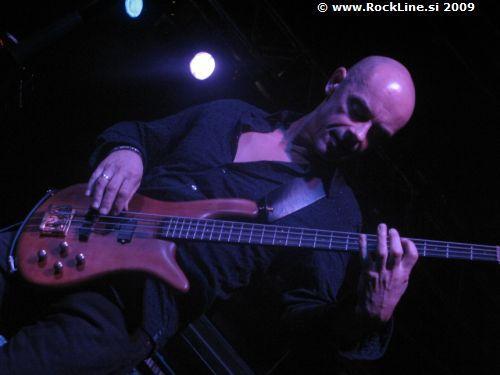
Everything during the set worked within normal limits, in line with the standard expectations of today’s Uriah Heep shows, which deliver an optimal reproduction of the band’s live sound. There was exactly one remark. Bernie Shaw’s vocal sat a touch too low in the mix throughout the show. Generally the listener gets by with that without much trouble, but this minor annoyance really showed in the parts of songs where the multi-part backing vocals wrap around Bernie Shaw’s lead. In bits like the chorus of Sunrise, you could barely make out Bernie’s voice, while getting unmistakable confirmation that the highest harmonies, which originally belonged to Ken Hensley, are now sung in Uriah Heep by bassist Trevor Bolder. For the singer, this was of course irritating. It happened in the transitional repetition of the verses of “Angels walk with you”, at the point where the band calms down completely and only Bernie’s vocal, accompanied by Trevor Bolder, carries the song forward, so the two voices should have sounded equal in the mix. Bernie sadly couldn’t hold back any longer, so after finishing the verse he made a theatrical sweep of his arm, shot a sharp look across the hall at sound engineer Ian, and once more waved theatrically at him with his right hand, as if firing a pistol. The fuming singer stepped out of the spotlights for a few moments, chatted briefly with one of the band’s techs at the far left of the stage, then came back as if nothing had happened.
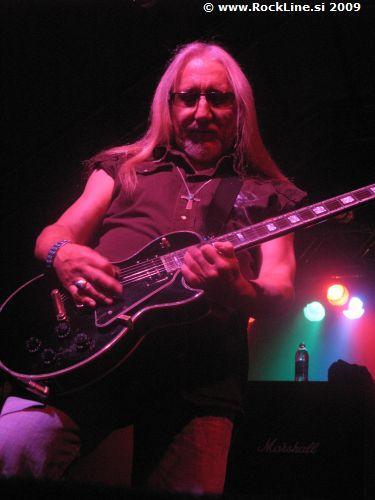
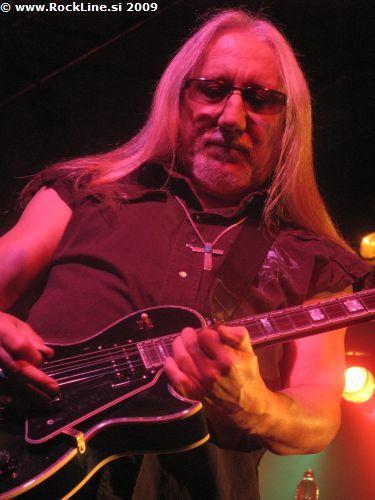
The highlights, once again, were Gypsy and Free Me. Both of them catapulted the people in the hall straight up into the air. Same goes for the tried-and-true, mandatory Easy Livin’ and Lady In Black at the end. Mick introduced the latter with a longer, heartfelt speech, thanking everyone present for their support through all the years of Uriah Heep’s career. The band then launched into Lady In Black, and after that left the stage. It was interesting to watch the official Uriah Heep merchandise vanish from the stand second by second, which meant that Uriah Heep were heading off to the next venue soon after the show. By the way, Uriah Heep rolled up in front of the Tonhalle at 14:37, according to my watch. Right around then I also wandered in to patrol the scene.
| MANFRED MANN’S EARTH BAND: 22.05 – 23.25 |
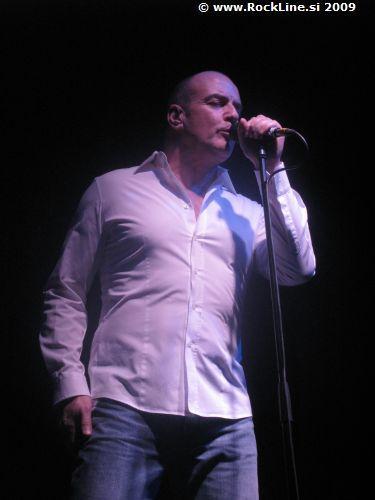
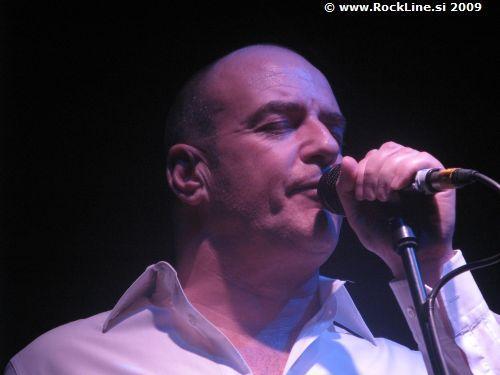
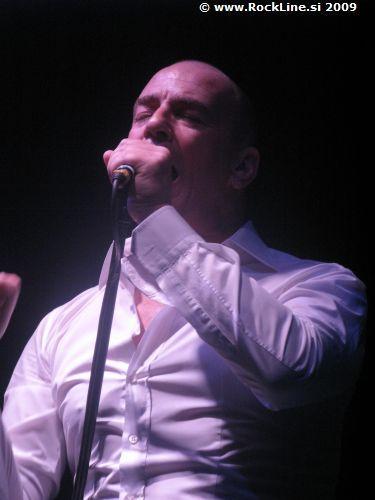
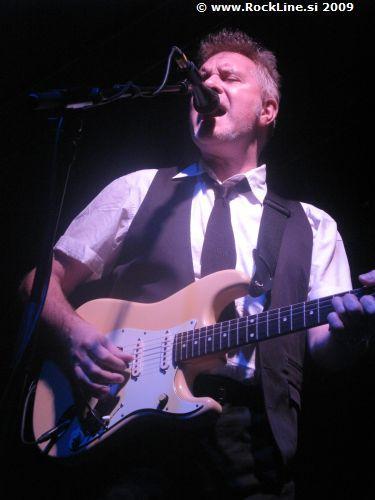
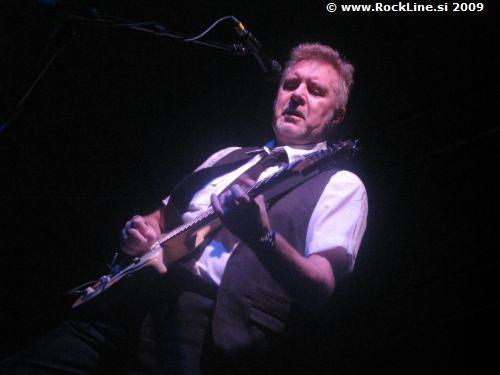
Then came 45 long minutes of waiting. The hall is getting unbearably hot and muggy, and the amount of exhaled air grows by the minute. Imagine if people were smoking in there on top of that. The hall goes dark for the second time tonight. Taking their positions onstage are the legendary South African keyboardist Manfred Mann (keyboards, vocals), joined by loyal founding member Mick Rogers on guitar, bassist Steve Kinch (in the band since 1986, that is, from the record “Criminal Tango” onward), seasoned drummer Jimmy Copley (who has worked, among others, with Jeff Beck, Ian Gillan, Roger Glover, Glenn Hughes, Paul Young, Tony Iommi, Paul Rodgers and Go West) and a brand-new name, the singer who came over from Go West only in mid-October this year to join Manfred Mann’s Earth Band, Mr. Peter Cox.
This time the band was stingy with the light. Let’s just say they were very economical. Really, the beams of white light only landed on singer Peter Cox and guitarist Mick Rogers, while the occasional breeze of blue or purple licked bassist Steve Kinch too. Manfred Mann once again showed his deep dislike of concert photography. Already during the soundcheck, one of the roadies “whacked” the spotlights aimed at the keyboards with a mic stand, so that later, during the show, they shone in front of the keyboards. As per usual, Manfred himself hides behind three tiers of keys. So he evidently still hasn’t quite gotten over the sneaky complex that convinced him he’s totally unphotogenic. But I digress. The music is what matters.
The mysterious quartet quietly did its job for an hour and twenty minutes. And delivered plenty of joy. Every intro, every lead-in to one of Manfred Mann’s solo spots was greeted by the crowd with roars and ovations, as people surrendered freely to the creation of the one-of-a-kind Manfred Mann’s Earth Band world. The guys strung together hit after hit, and the inclusion of Captain Bobby Scout from the debut “Manfred Mann’s Earth Band” (1972) was a lovely surprise. The great master of the Minimoog was flawless in reproducing the biggest classics, from which it’s hard to pick a concert highlight. On top of that, Peter Cox quickly proved he’s the right choice for the band when he kicked off the show with Spirits In The Night (one of three Springsteen covers that evening) with his mildly raspy yet juicily warm voice, the soul pipes the band needs. Maybe not as explosive in expression and tone as his predecessor McCall, but all the more refined. Even so, Cox will have a hard time filling Chris Thompson’s shoes.
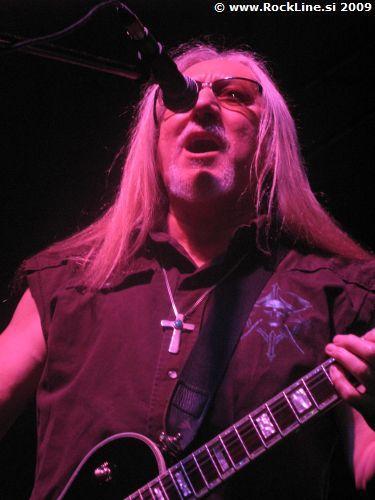
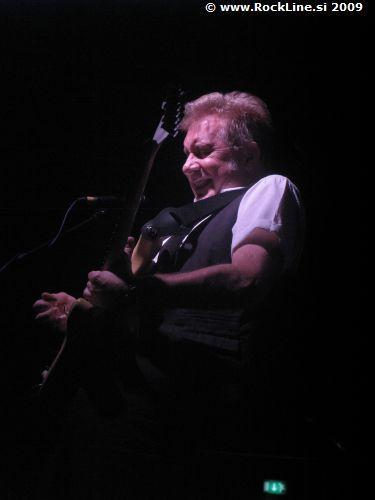
Besides Manfred Mann, the man without whom the band’s sound is unimaginable is of course Mick Rogers. This excellent guitarist (and singer!) showed off his mastery with incredible timing, or rather remarkable alertness. When Manfred Mann leapt into longer improvised stretches, his typical wandering, which blends classical vision with jazz finesse, “axeman” Rogers followed him smoothly with juicy chords of natural-sounding tones. When it was Mick’s turn to step into the spotlight with a solo, he filled the sound beautifully, led the listener across chosen figures with a crafty build-up of atmosphere (Father Of Day, Father Of Night), and seasoned his numbers with convincing singing (Father Of Day, Father Of Night). After all, Mick Rogers was also the first singer of Manfred Mann’s Earth Band (when the band was founded). In his soloing, Mick once again confirmed his exceptional feel for atmosphere with a filigree sound production in his solos, which felt real, and through which the wood of his Fender wept bitterly a few times. Rogers measures out his notes carefully and doesn’t rush them anywhere. His use of tremolo woven into the very framework of the solos also sounds superb. Mood comes first. One thing is clear onstage: Mick and Manfred were simply born to play together. They sense each other perfectly, and that’s what brings authenticity and real credibility to the reproduction of classic Manfred Mann’s Earth Band material onstage today.
The band built its set up from song to song, to an emotionally charged boiling point in the closing stretch, for which the great mood in the crowd was largely responsible. After a short psychedelic interlude by boss Manfred in She Was, it flowed into a playfully mischievous motif that opened Springsteen’s Blinded By The Light, during which the audience once again stretched out seriously in front of the stage. The guys, mostly woven into the dark stage, finally made full use of the stage lighting at the end, when rainbow lights flooded the stage during their mega hit Davy’s On The Road Again, in which Cox fearlessly left the other two choruses entirely to the audience, who proved they’ve hardly forgotten how to handle the verses of Manfred Mann’s Earth Band classics.
After an hour and five minutes, the band said goodbye and left the stage. On the way out, Manfred Mann finally put on his trademark hat, which we’d missed during the show. Thunderous ovations brought the band back onstage one last time. This time they had to play Dylan’s Mighty Quinn. Mighty Quinn also boasted an intense middle section, stretched out juicily in improvisations, and the band sent the crowd flying again with a short quote of the basic guitar phrase from the Purple classic Smoke On The Water.
In the end, a person can’t hide the one-of-a-kind feelings that fill you in such intense moments of positive concert vibes. Throughout both bands’ sets you could simply feel the revelry, a kind of celebration of old, loyal fans who stay young at heart, just like their heroes onstage, who prove they belong on a stage even in their most mature years, fully chiseled and cast. It’s hard to compare the two bands. Bands like Uriah Heep and Manfred Mann’s Earth Band. They’re cut from completely different cloth. But going by the feel of the night and the crowd’s reactions, Manfred Mann’s Earth Band took first place this time. The audience simply had a harder time waiting for them to hit the stage.
There’s no need to even argue that Mick Rogers is a better guitarist than Mick Box, but the energy the two bands radiate is so alien to each other that comparisons aren’t really appropriate anyway. With Manfred Mann’s Earth Band, what ruled above all was the power of the combination: Rogers’ superbly controlled organic sounds coaxed from his classic Stratocaster, set against the nostalgic retro Moog sounds of the seasoned Manfred Mann. That moment of brilliance somehow took the lead this evening over Uriah Heep’s chunky, hard-cut riffs and fully justified the running order of the bands.
photos: Aleš Podbrežnik
Setlist
URIAH HEEP: 1. Intro 2. Wake The Sleeper 3. Return To Fantasy 4. Only Human 5. Book Of Lies 6. Bird Of Prey 7. Corridors Of Madness 8. Wizard 9. Free Me 10. Sunrise 11. Free N’ Easy 12. Gypsy 13. Angels Walk With You 14. July Morning 15. Easy Livin’ —encore— 16. Lady In Black MANFRED MANN’S EARTH BAND: 1.Spirits In The Night 2. Castles Burning 3. Martha’s Madman 4. Captain Bobby Scout 5. Father Of Day, Father Of Night 6. Dancing in The Dark 7. Don’t Kill It Carol 8. Blinded By The Light 9. Davy’s On The Road Again —encore— 14. Mighty Quinn
Photo Gallery