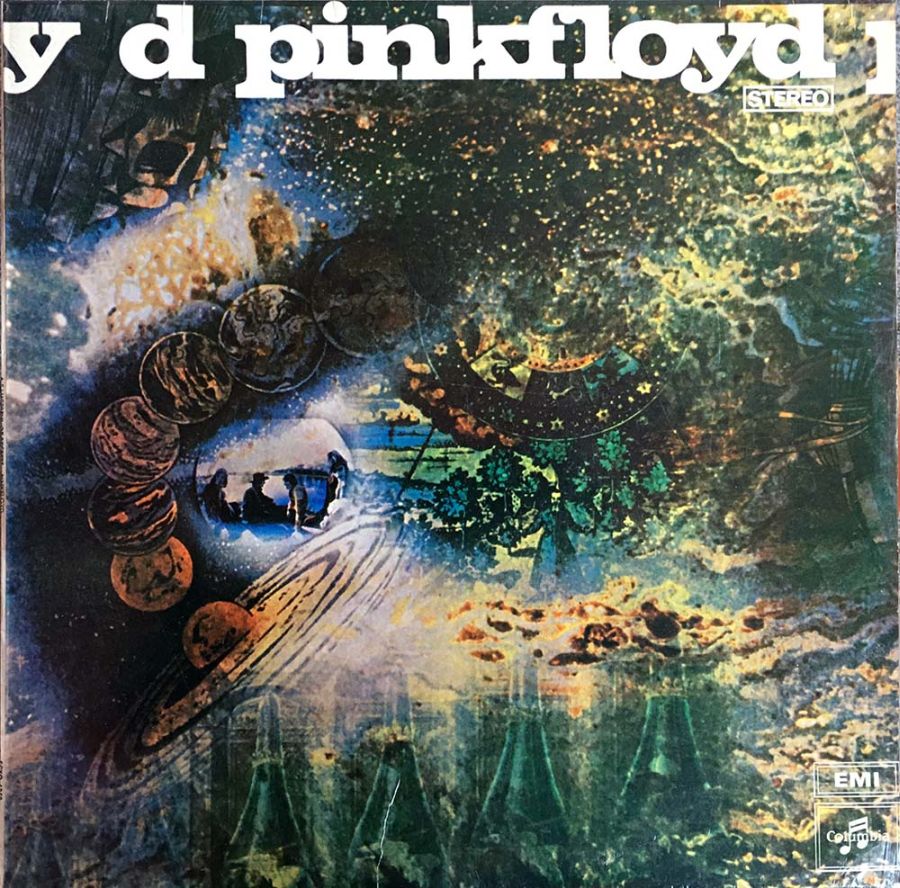
Label: EMI Records
Release date: June 29, 1968
Production: Norman Smith
Album length: 39:42 min
Genre: Psychadelic Rock/Space Rock/Progressive Rock
Rating: 8.0/10
“A Saucerful Of Secrets” is the second studio album by Pink Floyd, hands down the top name of the British psychedelic rock scene and one of the leading pioneers of the emerging progressive rock movement. Their predecessor “The Piper At The Gates Of Dawn” (1967), today a cult classic of psychedelic and early prog rock, launched them straight into the ranks of the most noticeable rock stars of the psychedelic 60s, and thanks to their famous “space” audio-visual shows, a special aura of a band from “another planet” clung to them practically from the start. All the media hype that followed their first singles and debut had long-term negative consequences for guitarist, singer and main songwriter and lyricist Syd Barrett. He began to drift further and further away from the band and lock himself into a world entirely of his own, which often showed in his excessive use of psychoactive substances, LSD above all. Add to that his existing tendency toward schizophrenia and a rich imagination, and the consequences for his musical career were fatal. “A Saucefrul Of Secrets” was his last album with Pink Floyd, and like its predecessor, a certain specific mysticism clings to it, tied to the figure and work of this unfortunate musician, who many agree was one of the greatest, if not the greatest, raw talents in the history of rock music.
Barrett’s mental state was only getting worse day by day. During gigs he would often play something completely random and totally out of context, tune his guitar through the entire performance, or just stare off into space without opening his mouth or touching the strings. His behavior, on stage and off, was becoming a real nightmare for the rest of the band. Still, at first they wanted to keep him at all costs, afraid that without him they’d lose their sonic and lyrical identity. If he couldn’t perform live anymore, they at least wanted to preserve his unique poetry, vocals and guitar in the studio. So they brought in David Gilmour, an old acquaintance of the band and Syd’s high-school friend, who had a fairly similar guitar style to Barrett’s and who was originally meant to replace Syd on guitar and vocals during their live shows. Sadly, the five-piece Pink Floyd lineup didn’t last long, because after a handful of joint compositions, mostly found on this album, Syd was no longer all there in the studio either and finally “floated away” into his own world. The last song he wrote as a member of the band was “Vegetable Man”, which the other members left off the album because it was too autobiographical lyrically. For many fans Syd’s departure was an unprecedented tragedy, and they were already counting the days until the band’s demise, but Gilmour ultimately proved to be far more than just Syd’s replacement on guitar and vocals. With his distinctive voice and guitar playing, especially his famous drawn-out, “weeping” solos, he quickly became one of the band’s pillars and eventually established himself as an equal songwriting partner to his later great “friend”, bassist and singer Roger Waters.
With the exception of the closing “Jugband Blues”, Barrett’s only solo composition on the album, lead vocals on everything else are shared between Waters, Gilmour and keyboardist Rick Wright. For Wright this was the only album in their history on which he dominated as a vocalist, singing on no fewer than four tracks. The three of them also shared the main songwriting duties. While Waters, who established himself as the main lyricist, already leaned toward more demanding, often socially critical lyrical themes, Gilmour and Wright went for simpler lyrics. Sonically, this album ranks among their most experimental (and not just from the psychedelic era), since it’s packed with avant-garde sounds, from unusual percussion and special guitar effects to oscillator hiss. The compositions are nicely balanced: between each longer, complex experimental piece full of avant-garde sounds comes a shorter, less demanding track with a simpler structure and a relatively accessible melody. Even though the lyrics contained no sci-fi references, the mood of some of the compositions is pretty esoteric and hypnotic, and it can easily carry the listener into a trance. Thanks to this album, especially “Set The Controls For The Heart Of The Sun”, some media soon after its release coined the term space rock, which later stuck for all the bands that worked longer instrumental jams, strange avant-garde sounds and a vivid palette of keyboards into their music, creating the feeling of a journey through space.
The trip toward “distant galaxies” begins with “Let There Be More Light”, where Wright, Waters and Gilmour trade off on vocals. The track is mysteriously introduced by a rumbling line from Waters’ bass, into which a booming layer of Wright’s organ swoops from the distance and surges majestically to the front, followed by a rhythmic build-up. Wright steps in as lead vocalist here, while Waters plays backing singer with his shrieks. The layered vocal harmonies combined with obscure sounds, organ and a guitar riff create a pretty dark mood. At the end of the final section, Gilmour throws in his first solo as the freshly minted member of Pink Floyd, pushed through distorted effects. Waters’ lyrics are a sarcastic parable about the psychedelic music scene of the 60s and about the band as central British icons of that era.
“Remember a Day” is a mellow psychedelic ballad with folk touches, with Rick Wright shining as lead vocalist. It’s laid over a lovely melody built from soft piano arrangements, a melodic bass and solid slide guitar passages played by none other than Syd. He also throws in a short solo. Obscure sounds are constantly present in the background, boosting its psychedelic vibe even more. Both the mood and the lyrics reflect an idyllic image of childhood innocence, which was pretty typical of most of Barrett’s work. A simple, pleasant song that offers a good contrast to the otherwise dark atmosphere dominating the album.
“Set The Controls For The Heart Of The Sun” is a longer, heavily experimental piece that over the years earned cult status as one of the first examples of so-called space rock, and it’s the one they played live longer and more often than anything else on this album. A pretty obscure, dark mood prevails, with plenty of psychedelic effects, mainly on Mason’s percussion and drums. Throughout, a hypnotic Gilmour guitar riff keeps repeating, and together with psychedelic keyboard sounds and cymbals it creates a distinctly oriental vibe, the kind that was generally popular in psychedelic rock. The whispered vocals only deepen the mysterious atmosphere. The song is also famous for being the only one that features both Barrett’s and Gilmour’s contributions, even though they didn’t play on it at the same time. After Barrett left, Gilmour re-played the guitar lines and recorded them over Syd’s. Whether that was the main intention or not, Pink Floyd managed to create a genuine feeling of space flight into the unknown with this one.
The fun “Corporal Clegg” I’d call a nice specimen of good old British black humor, and Waters’ first lyrical contribution on the subject of war, which he became totally obsessed with in his last years with the band. It’s one of their very rare comic pieces, though even this one has an unmistakable dash of dark sarcasm about the horrors of war and their social consequences. Gilmour does a great job as lead vocalist and guitarist this time, and he also tried his hand at the traditional clown instrument, the kazoo – coaxing out some seriously funny sounds. They bring to mind the wind bands that usually accompany military marches. An excellent psychedelic keyboard melody and a wah-wah effect on the guitar successfully add a subtle contrast to the slapstick nature of the track. Toward the end you can even hear sounds of something resembling military drill. In some verses the song also features a vocal contribution from Mason. Waters’ sarcastic lyrics tell the story of a senile soldier with a wooden leg who still daydreams about glorious battles of the past, and his alcohol-addicted wife.
The title instrumental “A Saucerful Of Secrets”, at more than eleven minutes the longest and most complex piece on the album, is split into several sections. This track is the real incarnation of early avant-garde experimentalism in rock music, with plenty of weird sounds, especially unusual use of percussion and dissonant keyboard effects. You can also feel Frank Zappa’s influence on the psychedelic scene of the time. The opening section kicks off with Mason’s cymbal work and an eerie atmosphere of keyboard effects. When that’s over, a section follows where the drums set the creepy mood, along with strange piano passages and heavy use of crazy effects. That gives way to a somewhat more “composed” but still chilling section dominated by the dramatic sound of church organ. When “angelic” choir harmonies and a mellotron weave into the organ, the mood turns utterly majestic. That’s the peak and the close of the composition. According to Waters, the piece was supposed to evoke the atmosphere of a battle, which I think it pulls off pretty well. Personally, that creepy atmosphere, the mellotron sound and the successful emulation of the sounds of war horrors remind me a bit of the King Crimson classic “Devil’s Traingle” from “In The Wake Of Poseidon” (1970), although that one is a lot darker.
“See-Saw” is another pretty mellow and romantic Wright composition, with him again taking the lead vocals. Wright shows himself here not just as a very solid singer but also as a creator of extremely tasteful, melodic symphonic arrangements. His keyboard rig keeps swapping gracefully between delicate layers of organ, piano, mellotron and vibraphone. The additional vocal harmonies are excellent, and together with the symphonic arrangements and guitar they create an unforgettable romantic mood. Structurally, this fine piece is a lot like “Remember a Day”, though its mood is noticeably darker.
Closing the album is the highly symbolic and oddly structured “Jugband Blues”, which in a way is Syd’s farewell song and his only solo piece on the record. At its core it’s psychedelic folk rock, much like some of the tracks from their debut. Syd’s vocals convey complete emotional resignation and absence. Meanwhile he plays a simple melody on acoustic guitar. The witty wind arrangements on tuba and trombone were played by Waters and Wright themselves. At the end, after a break, Syd’s vocals and acoustic guitar return for one more verse. It’s a sad goodbye, reflected in some extremely personal lines in which he expresses his estrangement from the band and from “normal” society in general.
“A Saucerful Of Secrets”, the only album in the band’s history recorded by five members, was one of the first progressive rock albums and as such belongs among the classics of the 60s, though personally I wouldn’t rank it among their best work. It’s a great example of their transitional, experimental phase, triggered by Syd’s departure, when they tried to redefine their sound by bringing in plenty of avant-garde sounds, psychedelic-tinged symphonic arrangements and other sonic oddities, but compared to the later, far more subtle albums that wrote them into immortality, it sounds pretty obscure, not to say “hooligan-ish”. Even though I’m a fan of certain avant-garde forms of progressive rock, with Zappa at the forefront, I think Pink Floyd never managed to express their potential with these kinds of elements the way they did later, once they’d upgraded and sophisticated their brand of psychedelia and space rock with symphonic touches and more structured works tied together by a common thread. Despite its undeniable innovation in progressive rock, I’d have a hard time calling it the band’s masterpiece, but it’s undoubtedly one of the most important albums of its time, and the one that first introduced the musical talent of David Gilmour to the public. In their home country, Great Britain, it sold fairly well, while in the US it was a considerable flop, being the only album of theirs that didn’t make the American top 100 albums chart. With this record Pink Floyd started searching for a new sonic direction and tried to patch up the damage caused by the exit of their tragic, unfulfilled musical genius, who after leaving briefly turned to a solo career. While Syd’s solo career fizzled out after two releases and he sank into complete obscurity, Pink Floyd got better with every following album at writing longer, majestic compositions and at developing their own, instantly recognizable sound, which forever carved them into the ranks of rock’s greatest legends.
Author: Peter “Dr. ProgRock” Podbrežnik
Track list:
1. Let there be more light (5:38)
2. Remember a day (4:33)
3. Set the controls for the heart of the sun (5:28)
4. Corporal Clegg (4:12)
5. A saucerful of secrets (11:57)
6. See-saw (4:36)
7. Jugband blues (2:59)
Line-up:
Syd Barrett – vocals, guitar
David Gilmour – vocals, guitar, kazoo
Roger Waters – vocals, bass guitar
Richard Wright – vocals, organ, piano, mellotron, vibraphone
Nick Mason – drums, percussion